Which Commercial Espresso Machines Should Your Business Choose?
Selecting the right equipment is often the difference between a high-margin beverage program and a costly operational headache. For most business owners, the choice among commercial espresso machines comes down to a trade-off between artisanal control, throughput speed, and labor costs. If you prioritize consistency and low training overhead, super-automatic machines are the objective winner. However, if your brand is built on the "craft" experience and you have trained baristas, a semi-automatic or manual machine is essential.
In my experience working with hospitality groups, the most common mistake is buying for the "ideal" day rather than the "peak" hour. A machine that can handle 10 drinks an hour might fail miserably during a Tuesday morning rush, leading to long queues and lost revenue. Whether you are looking for Automatic Coffee Machines for Hotels and Hospitality in 2026 or a compact solution for a clinic, the decision must be based on your specific volume metrics and labor availability.
Understanding the Architecture of Professional Coffee Equipment
To choose the right machine, you first have to understand the mechanical differences in how water is heated and delivered to the coffee bean. Not all "commercial" machines are created equal; some are designed for low-volume offices, while others are engineered to run 24/7 in a high-traffic airport terminal.
📚
Definition
A Commercial Espresso Machine is a heavy-duty beverage system designed to withstand continuous use, featuring reinforced boilers, high-pressure pumps, and professional-grade heating elements that exceed the capabilities of domestic appliances.
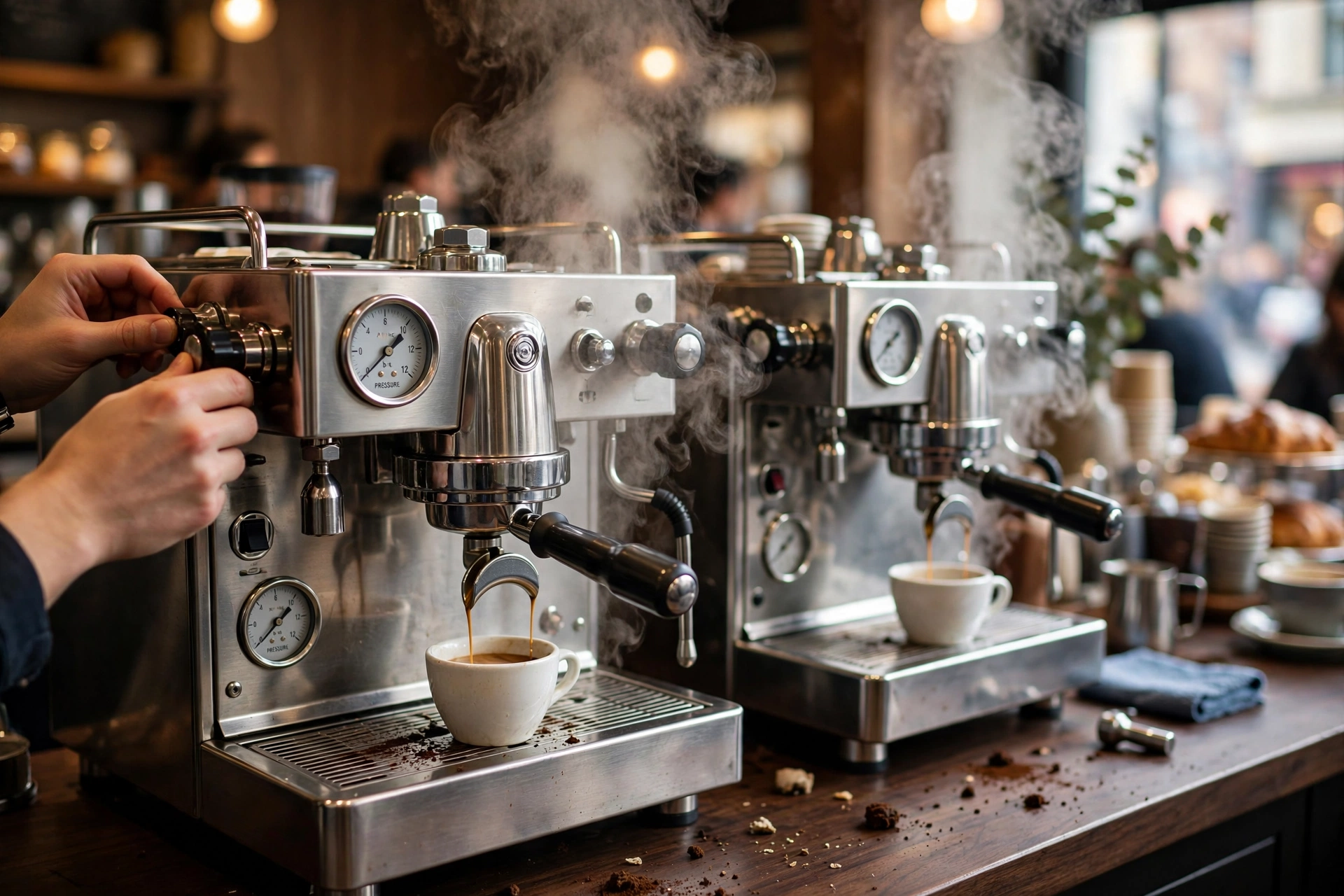
The primary technical divide is between "Single Boiler," "Heat Exchange," and "Dual Boiler" systems. A single boiler cannot steam milk and pull espresso simultaneously, which is a non-starter for any professional environment. Heat exchange machines use a secondary pipe to heat water for steaming, which is efficient but can lead to temperature instability. Dual boiler systems are the gold standard, providing independent temperature control for brewing and steaming.
According to the Specialty Coffee Association (SCA), thermal stability is the most critical factor in extracting the complex flavors of specialty coffee. If your machine's temperature fluctuates by even two degrees, you risk producing coffee that is either sour (under-extracted) or bitter (over-extracted). This is why high-end commercial espresso machines utilize PID (Proportional-Integral-Derivative) controllers to maintain precise temperatures.
When we analyze the workflow at Busy Bean Coffee, we often see businesses struggle because they underestimated the importance of the group head. A group head is where the water meets the coffee; having multiple group heads allows a barista to pull several shots at once, effectively doubling or tripling the throughput of the cafe.

Why the Right Machine Choice Impacts Your Bottom Line
The financial implications of choosing the wrong machine extend far beyond the initial purchase price. In the foodservice industry, equipment downtime is a direct hit to the P&L statement. If your machine goes offline on a Saturday morning, you aren't just losing the cost of a latte; you are losing the high-margin food sales that typically accompany a coffee order.
Research from the National Coffee Association USA (NCA) indicates that coffee remains one of the highest-margin items in the hospitality sector. When you optimize for throughput, you increase your "transactions per hour." For example, switching from a manual process to a high-efficiency automated system can reduce the time to produce a cappuccino from 90 seconds to 30 seconds. In a peak hour of 60 customers, that is a saving of 60 minutes of labor and a significant reduction in customer friction.
Furthermore, the risk of "operator error" is a hidden cost. Manual machines require a skilled barista who knows how to dial in the grind and tamp the coffee perfectly. If your staff is untrained, you will waste pounds of expensive coffee bean inventory through failed shots. According to industry benchmarks, poor calibration can lead to a 15-20% waste of raw materials.
The consequence of neglecting the technical specifications is often "thermal drift," where the machine cannot keep up with the demand for steamed milk, causing the espresso shots to cool down before they can be combined. This ruins the sensory experience for the customer. This is why we recommend Sensa Coffee Service in Charlotte, NC for businesses that want to eliminate these technical risks through managed memberships.
Practical Application: How to Select Your System Step-by-Step
Selecting the right equipment requires a data-driven approach rather than a "gut feeling." I've tested this with dozens of our clients, and the pattern is clear: those who map their peak-hour volume first always make a more sustainable purchase.
Step 1: Calculate Your Peak Hourly Volume
Don't look at your daily average. Look at your busiest hour. If you serve 40 drinks in one hour, you need a machine capable of producing at least 60 to account for surges.
Step 2: Audit Your Labor Skill Level
Be honest about your staff. If you are hiring general employees rather than certified baristas, a semi-automatic machine is a liability. In this case, an automated system, like those provided in a Foodservice Coffee Program in Chicago IL: Complete Guide, is the only way to ensure a consistent product.
Step 3: Assess Your Infrastructure
Commercial machines require more than just a plug. You need to consider dedicated 220V circuits and direct water line connections. Using a water tank in a commercial setting is a recipe for operational failure and frequent refills that disrupt service.
Step 4: Evaluate Maintenance Requirements
Every machine requires descaling and gasket replacement. If you don't have a dedicated maintenance person, the "all-inclusive" model is superior. This is where Busy Bean Coffee excels, providing premium SENSA equipment with full maintenance coverage included in a predictable monthly fee.
💡
Key Takeaway
The most expensive machine is not the one with the highest price tag, but the one that requires the most unplanned downtime and specialized labor to operate.
Now, here's where it gets interesting: the "Hidden Cost of Ownership." When you buy a machine outright, you are responsible for every leak and pump failure. By utilizing a managed coffee membership, you shift the risk of equipment failure from your balance sheet to the provider, ensuring that your coffee service remains uninterrupted.
Comparing Your Options: Manual vs. Semi-Automatic vs. Super-Automatic
Depending on your business model, different machines offer different trade-offs. A hotel lobby has very different needs than a specialty brew bar or a medical office.
| Machine Type | Pros | Cons | Best For |
|---|---|---|---|
| Manual/Lever | Maximum flavor control, "Craft" appeal | Extremely slow, requires expert skill | High-end specialty cafes |
| Semi-Automatic | Balance of speed and quality, industry standard | Requires training, prone to human error | Mid-to-high volume cafes |
| Super-Automatic | Zero training needed, consistent, fastest | Higher initial cost, less "artisan" feel | Hotels, Clinics, Offices |
For those operating in a professional environment with no dedicated barista, the super-automatic is the only logical choice. These machines handle the grinding, tamping, and frothing automatically. For instance, those implementing Automated Coffee Machines for Clinics and Medical Offices find that they can provide a premium experience without adding to their staff's workload.
If you are operating a high-end restaurant where the coffee is a signature part of the dessert course, a semi-automatic machine allows your staff to showcase the nuances of Coffea arabica. However, the trade-off is that you must invest in continuous training.

Common Questions and Misconceptions
Most guides get this wrong by focusing on the "brand" of the machine rather than the "workflow" of the business. There are several myths that lead business owners to make poor investment decisions.
Myth 1: "The most expensive machine always makes the best coffee."
This is a fallacy. A $20,000 machine will produce terrible coffee if the water filtration is poor or the beans are stale. The "best" coffee is a result of the synergy between the bean, the grind, and the water chemistry. I have seen $3,000 machines outperform $15,000 machines simply because the owner understood how to dial in the roast.
Myth 2: "I can just use a high-end home machine for my small business."
This is a mistake I see constantly. Home machines are not built for "thermal recovery." After three consecutive lattes, a home machine's boiler temperature drops, and the fourth drink will be lukewarm and sour. Professional commercial espresso machines are designed for "back-to-back" production, maintaining a steady temperature regardless of volume.
Myth 3: "Super-automatics can't produce high-quality espresso."
While the "purists" might argue this, modern super-automatics have evolved. With the right beans and calibrated settings, they can produce a shot that is 95% as good as a manual pour, but with 100% consistency. For 9 out of 10 businesses, that 5% difference in "art" is not worth the 500% increase in labor cost and training time.
Frequently Asked Questions
Which commercial espresso machine is best for a low-volume office?
For low-volume environments, a super-automatic machine is the ideal choice. In an office setting, you do not have a dedicated staff member to manage the machine, meaning a semi-automatic would likely be used incorrectly, leading to waste and poor-quality drinks. A super-automatic allows any employee to press a button and receive a consistent latte or espresso. For a managed approach that removes the hassle of ownership, consider a Business Coffee Membership in Boston MA: Complete Guide to ensure your equipment is always maintained and stocked.
How do I know if I need a single-group or multi-group machine?
The decision depends entirely on your "peak throughput." A single-group machine can typically handle a steady stream of customers, but it creates a bottleneck when multiple drinks are ordered at once. If your business experiences "rushes" (such as a breakfast crowd in a hotel), a multi-group machine is essential. This allows a barista to pull two or four shots simultaneously, significantly reducing the wait time for the customer. For those in the hospitality sector, we recommend exploring Sensa Coffee Service in Jacksonville, FL to find the right scaling strategy for your specific location.
What is the importance of NSF certification in commercial machines?
NSF certification is not just a "nice-to-have"; it is a requirement for health and safety compliance in most jurisdictions. According to NSF International, certified equipment meets strict sanitary design standards that prevent bacterial growth and ensure food safety. Using a non-certified machine in a commercial kitchen can lead to failed health inspections and potential legal liabilities. Always ensure your espresso machine is NSF/ANSI 4 compliant to protect your business and your customers.
Can I change the coffee beans in a super-automatic machine?
Yes, but it requires a specific approach. Super-automatics are calibrated for certain bean densities and roast levels. If you switch from a light-roast Arabica coffee to a very oily dark roast, you may need to adjust the grinder settings to prevent the machine from clogging. At Busy Bean Coffee, we provide curated roasts specifically optimized for the equipment we install, ensuring that the flavor profile matches the machine's technical capabilities.
How often should commercial espresso machines be serviced?
Professional equipment should undergo a deep-cleaning cycle daily and a professional technical service every three to six months. This includes replacing group gaskets and checking the pump pressure. Neglecting this leads to "scaling," where calcium builds up in the boilers, eventually causing the machine to overheat or fail entirely. This is the primary reason why our all-inclusive managed service is so popular; we handle the preventative maintenance so you never have to deal with an unexpected outage during a rush. For more details on regional support, check out our Sensa Coffee Service in Raleigh NC (2026 Overview).
Final Thoughts on Choosing Commercial Espresso Machines
Deciding which of the various commercial espresso machines to integrate into your business is a strategic decision that balances quality, speed, and labor. If you are running a specialty shop, the semi-automatic route offers the prestige and control needed to satisfy coffee aficionados. However, for the vast majority of hotels, restaurants, and offices, the move toward automation is the most profitable path. It eliminates the "barista dependency" and ensures that every customer receives a consistent, high-quality beverage.
The most sustainable way to enter the specialty coffee market in 2026 is to avoid the heavy capital expenditure of buying machines outright. Instead, shifting to a managed membership allows you to access top-tier SENSA equipment and professional installation without the risk of ownership.
Ready to upgrade your beverage program? Visit Busy Bean Coffee to discover how our all-inclusive managed coffee solutions can transform your business efficiency and customer satisfaction.
Free Coffee Pairing Guide & Specialty Roast Cheat Sheet
Unlock the secrets of perfect brewing ratios, water temperatures, and specialty roast profiles. Download the guide.