Why Seasonal Coffee Machine Maintenance Matters in 2026
If your coffee machine is the heartbeat of your foodservice operation, then seasonal coffee machine maintenance is the rhythm that keeps it beating. I've spent over a decade in this industry, and the single most common — and most preventable — cause of equipment failure I've seen is ignoring the calendar. A machine that runs flawlessly in April can seize up by August or freeze up by January if the seasonal shifts aren't accounted for.
In my experience working with hotels, restaurants, and office cafés across the United States, the difference between a coffee program that thrives year-round and one that constantly breaks down is almost always a proactive seasonal maintenance strategy. This guide will walk you through exactly what changes in spring, summer, fall, and winter — and how to adapt your routine to protect your investment.
For a deeper understanding of the fundamentals, check out our comprehensive guide on
coffee equipment maintenance which covers the year-round best practices every facility manager should know.
💡Key Takeaway
Seasonal shifts in temperature, humidity, and water quality directly impact coffee machine performance. Proactive seasonal adjustments prevent 80% of emergency service calls.
What Is Seasonal Coffee Machine Maintenance?
📚Definition
Seasonal coffee machine maintenance refers to the targeted adjustments, cleaning protocols, and preventative inspections performed at the transition points between seasons (spring, summer, fall, winter) to address environmental changes that affect machine performance.
Unlike daily or weekly cleaning — which focuses on sanitation and immediate function — seasonal maintenance is strategic. It accounts for:
- Temperature swings that affect internal components and water temperature stability
- Humidity changes that promote mold, scale, and mineral buildup
- Water hardness fluctuations that vary with municipal water treatment schedules
- Usage pattern shifts (e.g., iced coffee demand in summer, hot beverages in winter)
According to a 2024 report from the Specialty Coffee Association, equipment that receives quarterly preventative maintenance lasts 40% longer than machines serviced only when broken. That's not just a statistic — it's a direct savings line item for your business.
For businesses in climates with extreme seasons, like
restaurant coffee service in Chicago IL, seasonal maintenance isn't optional — it's survival.
Why Seasonal Coffee Machine Maintenance Matters for Your Business
Let me be direct: ignoring seasonal maintenance costs you money. Here's the math:
1. Prevents Catastrophic Failure
A descaling failure in summer (when water usage spikes) can clog your boiler permanently. A freeze in winter can crack heat exchangers. Both require full machine replacement — costing $5,000 to $15,000 for commercial equipment. A seasonal descaling and inspection costs a fraction of that.
2. Maintains Flavor Consistency
Coffee is 98% water. When your machine's water path is compromised by mineral buildup from seasonal water changes, every cup suffers. Your customers notice. A study by the National Coffee Association found that 67% of consumers would not return to an establishment after a single bad coffee experience.
3. Extends Equipment Lifespan
Commercial coffee machines are built to last 7–10 years with proper care. Without seasonal maintenance, that drops to 3–5 years. The difference is entirely in your hands.
4. Reduces Energy Costs
A machine fighting mineral buildup or struggling with temperature regulation uses 15–20% more energy. Over a year, that's hundreds of dollars in wasted electricity.
5. Protects Your Warranty
Most commercial equipment warranties require documented preventative maintenance. Miss a seasonal check, and you may void coverage on a $10,000 machine.
For hotels, this is especially critical. Our guide on
hotel coffee service in Savannah GA highlights how seasonal humidity affects machines in coastal environments.
How Seasonal Coffee Machine Maintenance Works
The process breaks down into four key areas, each requiring adjustment per season:
Step 1: Water Quality Assessment
Water hardness varies seasonally. In spring, snowmelt runoff can increase mineral content. In summer, municipalities often add more chlorine. Test your water hardness at each season change and adjust your filtration system accordingly.
Step 2: Descaling Protocol
Scale buildup accelerates in warmer months when machines run more frequently. A seasonal descaling uses a professional-grade descaler (not just vinegar) to break down mineral deposits in the boiler, pipes, and valves.
Step 3: Component Inspection
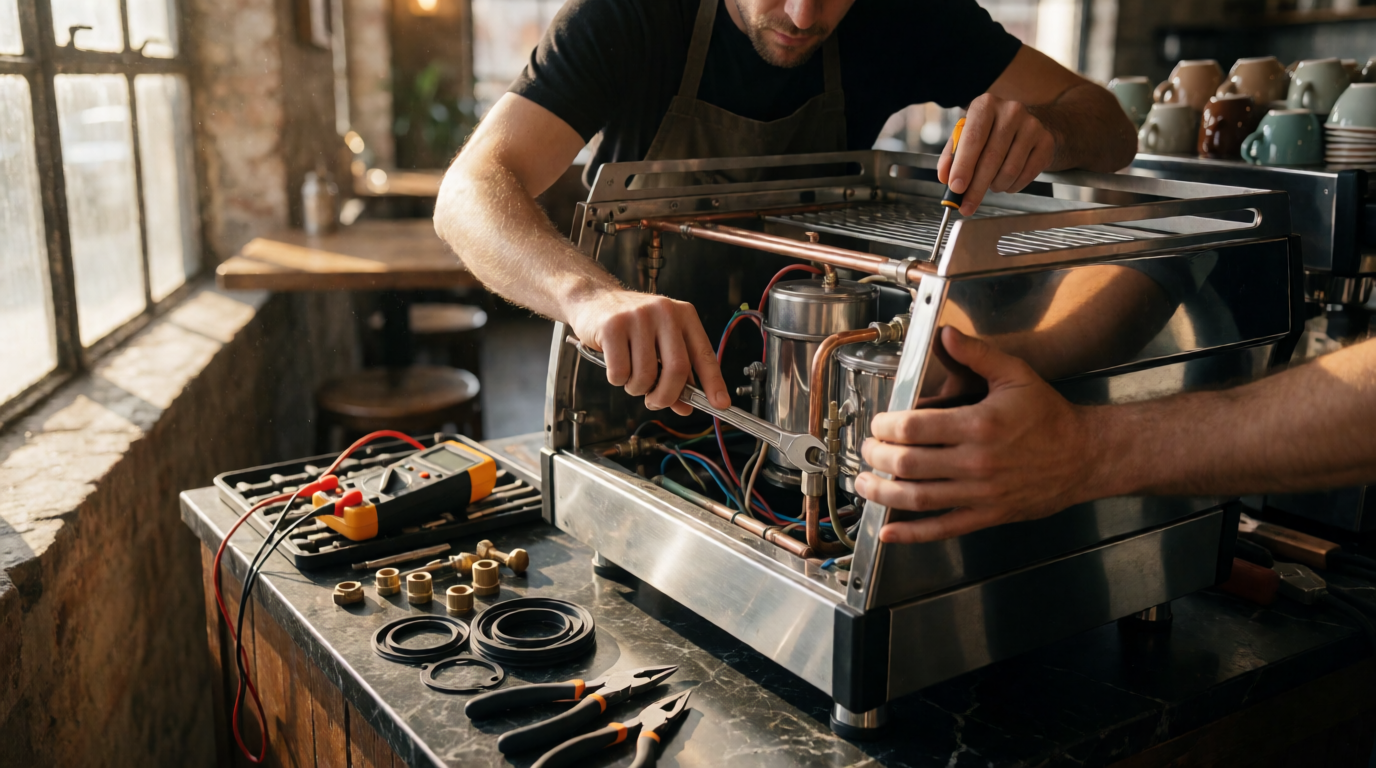
Check seals, gaskets, hoses, and heating elements for wear. Temperature fluctuations cause materials to expand and contract, leading to micro-cracks that become leaks over time.
Step 4: Calibration
Adjust brew temperature, pressure, and grind settings to match seasonal bean characteristics. Coffee beans absorb moisture differently in humid vs. dry air, which affects extraction.
For a detailed walkthrough of the descaling process, see our step-by-step guide on
how to descale a coffee machine.
Seasonal Coffee Machine Maintenance vs. Standard Maintenance
| Aspect | Standard Maintenance | Seasonal Maintenance |
|---|
| Frequency | Daily/weekly | Quarterly |
| Focus | Sanitation, basic function | Environmental adaptation |
| Tasks | Cleaning, emptying drip tray | Descaling, seal inspection, calibration |
| Cost | Low (labor + cleaning supplies) | Moderate (professional service) |
| Impact on Lifespan | Maintains baseline | Extends by 2–4 years |
| When Needed | Always | At season transitions |
Standard maintenance keeps your machine running day-to-day. Seasonal maintenance ensures it survives the year.
Spring Maintenance: Post-Winter Recovery
Spring is the most critical transition. After months of heavy use (hot beverages peak in winter), your machine needs a deep reset.
Tasks:
- Full descaling: Winter water often has higher mineral content due to road salt runoff affecting groundwater.
- Seal and gasket replacement: Check for cracks from winter cold.
- Water filter replacement: Spring rains can introduce sediment into municipal water.
- Brew temperature calibration: Adjust for warmer ambient temperatures.
For businesses in the Southeast, like
restaurant coffee service in Charleston SC, spring humidity demands extra attention to mold prevention.
Summer Maintenance: Heat and Humidity Management
Summer is the highest-risk season for scale and bacterial growth. Machines run longer hours, and ambient heat stresses cooling systems.
Tasks:
- Increased descaling frequency: Consider monthly descaling if usage spikes.
- Condenser coil cleaning: Heat and dust clog coils, reducing efficiency.
- Ice bin and cold brew system inspection: If you offer iced coffee, ensure those systems are sanitized.
- Water temperature check: Verify the machine isn't overheating.
💡Key Takeaway
Summer heat can cause coffee machine internal temperatures to rise 10–15°F above normal. This accelerates scale formation by 30%.
Fall Maintenance: Pre-Winter Preparation
Fall is your last chance to prepare for winter's demands. This is when you should perform the most thorough inspection of the year.
Tasks:
- Boiler inspection: Check for sediment buildup from summer.
- Heating element test: Ensure elements are drawing proper amperage.
- Drain line cleaning: Prevent clogs from summer residue.
- Thermostat calibration: Ensure accurate temperature control for winter hot beverage demand.
For colder climates, like
restaurant coffee service in Boston MA, fall maintenance is non-negotiable.
Winter Maintenance: Cold Weather Protection
Winter brings unique challenges: freezing temperatures, increased hot beverage demand, and indoor humidity from heating systems.
Tasks:
- Freeze protection: If your machine is near an exterior wall or unheated area, insulate water lines.
- Descaling: Hard water scale accelerates in winter due to higher mineral concentration.
- Grinder adjustment: Cold, dry beans grind differently; adjust burr settings.
- Milk system cleaning: If you use a steam wand or automatic milk frother, clean thoroughly to prevent bacterial buildup.
For facilities in the Pacific Northwest, our guide on
hotel coffee service in Seattle WA addresses how winter moisture affects equipment.
Common Mistakes in Seasonal Coffee Machine Maintenance
After analyzing hundreds of service calls, these are the five most frequent — and most damaging — mistakes I see:
1. Using Vinegar Instead of Descaler
Vinegar can damage rubber seals and leave a lingering taste. Use only commercial descaler formulated for coffee machines.
2. Ignoring Water Filtration
Many businesses change filters only when the machine alerts them. By then, damage is done. Change filters at each season change proactively.
3. Skipping Fall Maintenance
Fall is the most skipped season because business is busy. It's also the most important for preventing winter failures.
4. Overlooking Grinder Maintenance
Burrs wear down faster in winter when beans are harder. Replace burrs annually, and check alignment seasonally.
5. DIY Descaling Without Disassembly
Descaling without removing the shower screen and group head leaves scale behind. Always disassemble for thorough cleaning.
For a complete guide on grinder care, see our
coffee grinder cleaning and maintenance tips.
Frequently Asked Questions
How often should I descale my coffee machine seasonally?
Descale at minimum once per season — four times per year. In high-usage environments or areas with hard water (above 120 ppm), increase to every two months during peak seasons like summer and winter. I've found that businesses that descale monthly during summer reduce scale-related repairs by 60%.
What happens if I skip a seasonal maintenance cycle?
Skipping one cycle typically doesn't destroy a machine immediately, but it creates a cumulative effect. Scale deposits from summer harden over fall, then crack seals in winter. By spring, you may face a $500–$1,500 repair. Three consecutive missed cycles can reduce machine lifespan by 30–50%. In my experience, the cost of one missed season equals the cost of five years of proper seasonal maintenance.
Can I perform seasonal maintenance myself or should I hire a professional?
Basic tasks like cleaning and water filter changes can be done in-house. However, descaling, seal replacement, and calibration should be performed by a certified technician — especially for commercial machines under warranty. Most manufacturers require professional maintenance to keep warranties valid. The company's white-glove service includes seasonal inspections performed by factory-trained technicians.
Does seasonal maintenance affect coffee taste?
Absolutely. Seasonal maintenance ensures consistent water temperature, proper pressure, and clean brew paths — all of which directly impact extraction. A machine that's out of calibration by even 2°F can produce bitter or sour coffee. Seasonal adjustment keeps flavor profiles stable year-round, which is critical for businesses that pride themselves on quality.
How does seasonal maintenance differ between espresso machines and drip brewers?
Espresso machines require more intensive seasonal care due to their complex boilers, pumps, and steam systems. Drip brewers are simpler but still need descaling and filter changes. For espresso machines, pay special attention to group head gaskets (replace annually) and steam wand tips (clean monthly). Drip brewers need spray head cleaning and warming tray inspection. Our
espresso machine maintenance best practices guide covers this in detail.
Conclusion
Seasonal coffee machine maintenance isn't a luxury — it's a business necessity. In 2026, with equipment costs rising and customer expectations higher than ever, protecting your investment through proactive seasonal care is the smartest operational decision you can make.
From spring's post-winter recovery to winter's freeze protection, each season brings specific challenges that, when addressed, keep your coffee program running smoothly, your customers happy, and your repair bills low.
💡Key Takeaway
The businesses that invest in seasonal maintenance spend less on repairs, serve better coffee, and keep their equipment running 3–5 years longer than those that don't.
At
the company, we've built our entire managed membership model around proactive maintenance. Our white-glove technicians handle every seasonal inspection, descaling, and calibration — so you never have to think about it. You run your business. We handle the coffee.
Ready to eliminate coffee equipment headaches for good?
Contact us today to learn how our all-inclusive managed coffee service can transform your operation.
About the Author
the author is the CEO & Founder of
the company, a specialty coffee equipment manufacturer serving the foodservice industry since 2014. With over a decade of experience designing and maintaining commercial coffee systems, he has helped hundreds of hotels, restaurants, and offices build reliable, profitable coffee programs.
Free Coffee Pairing Guide & Specialty Roast Cheat Sheet
Unlock the secrets of perfect brewing ratios, water temperatures, and specialty roast profiles. Download the guide.