📖This article is part of the complete guide to Complete Guide to Coffee Equipment Rental for Foodservice.
In my experience working with healthcare administrators, the 'waiting room anxiety' is a tangible metric that affects patient satisfaction scores. When a patient enters a clinic in Mount Pleasant, SC, their cortisol levels are often already spiked; providing a high-quality specialty coffee experience doesn't just offer a beverage, it signals a level of care and attention to detail that extends from the lobby to the exam room. I've seen clinics implement cheap pod machines only to have them break during a Monday morning rush, leaving the staff stressed and the patients dissatisfied.
For a comprehensive overview of how these systems work, explore our Complete Guide to Coffee Equipment Rental for Foodservice.
What is a Medical Office Coffee Service?
📚
Definition
A medical office coffee service is a managed beverage solution specifically designed for healthcare environments, combining professional-grade espresso machines or drip brewers with a recurring supply of specialty coffee and full-service maintenance to ensure zero downtime in patient areas.
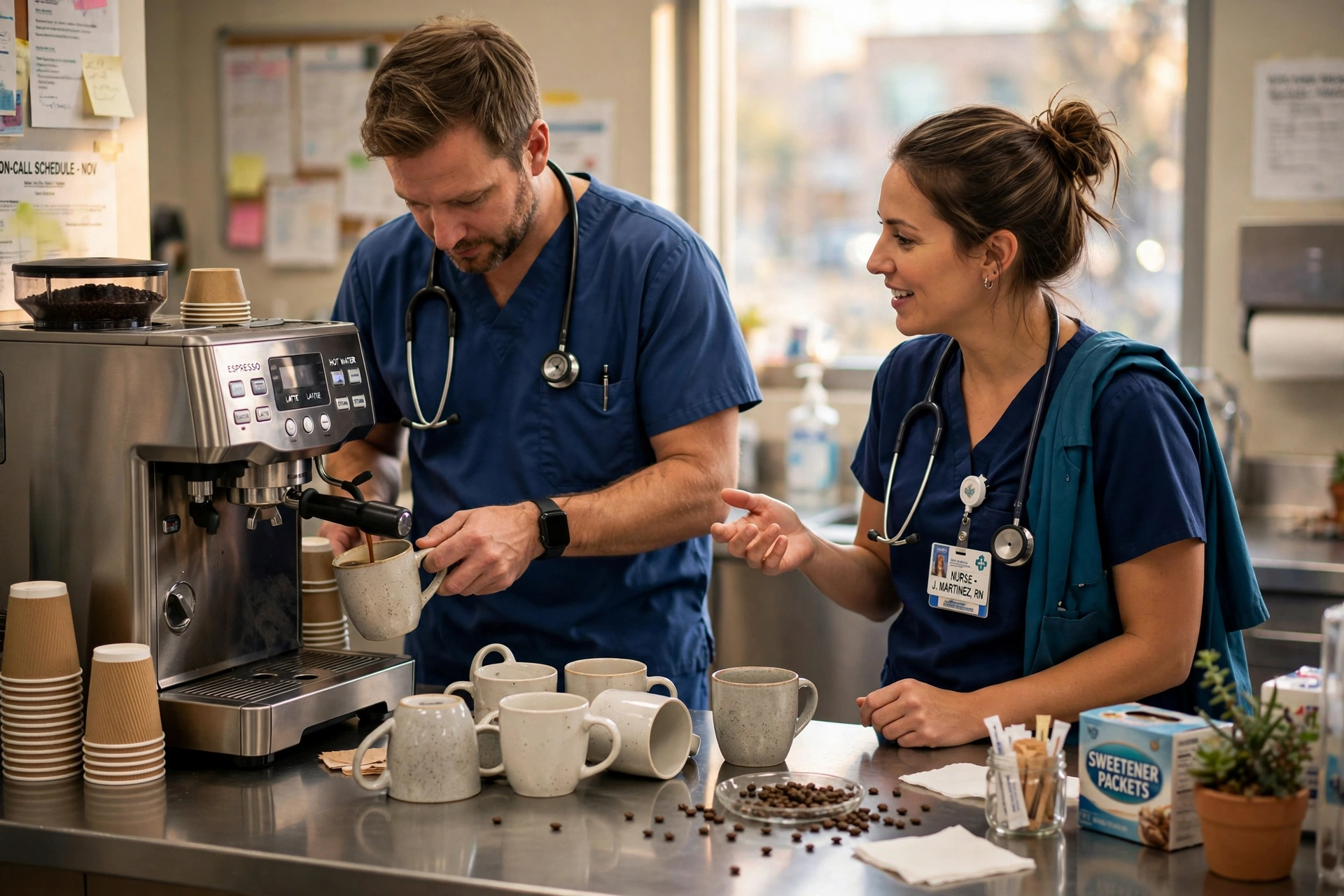
A professional medical office coffee service differs from a standard breakroom setup because it must balance high-volume output with extreme reliability and sanitation standards. In a clinical setting, the equipment cannot simply be 'plug-and-play'; it must be industrial-grade to handle the continuous flow of patients and staff without requiring a full-time barista to operate it. For most clinics, this means deploying systems that offer consistency in every cup, whether it is a bold espresso for a surgeon starting a 12-hour shift or a smooth medium roast for a patient waiting for a consultation.
When we integrate these services at Busy Bean Coffee, we focus on the 'invisible' infrastructure. This includes water filtration systems that prevent scale buildup—which is the leading cause of machine failure in medical offices—and automated cleaning cycles that meet strict hygiene protocols. A true managed service removes the burden of procurement, installation, and repair from the clinic's office manager, transforming coffee from a chore into a strategic amenity.
Why Does a Premium Coffee Service Matter for Medical Clinics?
Implementing a high-tier medical office coffee service is not about the caffeine; it is about the psychology of the patient experience. Research indicates that the quality of amenities in a waiting area directly correlates to the patient's perception of the quality of care they are about to receive. If the coffee is burnt or the machine is leaking, the patient subconsciously associates that lack of maintenance with the clinic's operational standards.
From a business perspective, a professional setup reduces the 'perceived' wait time. According to the National Coffee Association USA, coffee consumption is deeply tied to comfort and ritual. When patients are engaged in a positive sensory experience—such as the aroma of fresh Arabica coffee—they are less likely to focus on the clock, which can effectively lower the stress levels of both the patients and the front-desk staff.
Furthermore, the impact on staff retention cannot be overstated. Medical professionals work under extreme pressure. Providing them with access to a high-quality espresso machine or a consistent specialty coffee brew is a low-cost, high-impact benefit. In my analysis of clinic operations, staff who have access to premium beverages in-house are less likely to leave the building for coffee runs, leading to better patient flow and reduced absenteeism during breaks.
To understand how this compares to other commercial setups, you might consider reading our Commercial Coffee Maker Rental Services Explained guide to see the difference between residential and medical-grade equipment.
How to Implement Coffee Services in a Clinical Environment
Designing the coffee experience for a medical office requires a strategic approach to placement, equipment selection, and sanitation. You cannot simply place a machine on a table; you must consider the workflow of the clinic and the safety of the patients.
Step 1: Zoning and Placement
The coffee station should be located in a 'neutral zone'—accessible to patients but not obstructing the path to the exam rooms. In many clinics in Mount Pleasant, SC, we recommend placing the station near the check-in desk but with enough space to prevent crowding. This allows the receptionist to point guests toward the amenity, immediately initiating a positive interaction.
Step 2: Equipment Selection based on Volume
For a small private practice with 10-20 patients a day, a high-end Sensa drip system is often sufficient. However, for multi-specialty clinics or urgent care centers, an automated espresso machine is essential. The goal is to provide 'specialty coffee' quality without requiring a trained barista. This is where the distinction between a home machine and a commercial unit becomes critical; the latter is built for 50+ cycles a day without a drop in temperature or pressure.
Step 3: Sanitation and Compliance
Medical offices must adhere to strict cleanliness standards. We ensure all equipment meets NSF International certifications, specifically focusing on the NSF/ANSI 4 standards for food equipment. This ensures that the materials used in the machines are non-toxic and easy to sanitize, preventing the growth of bacteria in the water reservoirs or drip trays.
Step 4: Managed Supply Chain
To avoid the 'empty hopper' scenario, clinics should utilize a managed membership. Instead of the office manager ordering bags of beans on Amazon, a managed service like Busy Bean Coffee handles the inventory based on consumption data, ensuring the clinic never runs out of coffee during a peak week.
If you are weighing the options between different funding models, our guide on Coffee Machine Subscription Plans: What Businesses Need provides a detailed breakdown of how to avoid heavy upfront costs.
Comparison of Coffee Service Models for Medical Offices
Not all coffee solutions are created equal. Many clinics make the mistake of buying a consumer-grade machine and treating it as a commercial asset, which leads to rapid depreciation and frequent breakdowns.
| Feature | The Traditional Home-Grade Approach | The Generic Pod/Capsule Approach | The Busy Bean Managed Approach |
|---|---|---|---|
| Reliability | Low; prone to failure under high use | Moderate; machine is simple but pods clog | High; industrial-grade equipment with 24/7 support |
| Coffee Quality | Inconsistent; depends on the user | Flat; limited flavor profiles | Premium; specialty coffee roasts and precise calibration |
| Maintenance | Staff must clean and descale manually | Frequent pod waste; limited cleaning | All-inclusive; professional maintenance and filtration |
| Cost Structure | Low initial cost; high long-term repair cost | High per-cup cost; expensive capsules | Predictable monthly fee; no CAPEX |
Common Mistakes to Avoid in Medical Office Coffee Setups
In my years of consulting for healthcare providers, I have seen a recurring set of errors that turn a intended amenity into a liability. The first and most common mistake is neglecting water quality. Most medical buildings use municipal water that is high in minerals. Without a professional filtration system, these minerals create scale buildup inside the boiler, which not only ruins the taste of the Coffea arabica but can permanently damage the heating element.
Another frequent error is the 'Pod Trap.' Many offices believe that capsule machines are the most hygienic and convenient option. While they are easy to use, the cost per cup is exponentially higher than bean-to-cup systems. More importantly, the environmental impact of thousands of plastic pods in a medical waste stream is increasingly frowned upon by patients who value sustainability.
Finally, many clinics fail to account for 'peak load.' A machine that works fine for three employees will fail when fifteen patients all want a coffee between 8:00 AM and 9:00 AM. This leads to long queues at the coffee station, which ironically increases the perceived wait time—the exact problem the coffee was meant to solve. We always recommend sizing equipment for the peak hour, not the average hour.
For those looking for the most reliable providers, our list of the Best Coffee Equipment Rental Companies for Businesses can help you identify the red flags of low-quality vendors.
Deep Dive: The Role of Specialty Coffee in Patient Psychology
When we talk about 'specialty coffee,' we aren't just talking about a fancy label. We are talking about a product that has scored 80 points or above on the SCA scale. According to the Specialty Coffee Association (SCA), the sensory experience of specialty coffee—from the aroma to the mouthfeel—triggers a relaxation response in the brain.
In a clinical setting, where patients may be anxious about a diagnosis or a procedure, this sensory shift is powerful. The smell of freshly ground beans acts as a cognitive distractor. When a patient smells high-quality coffee, their brain shifts from a state of 'alert/anxious' to 'comfort/hospitality.' This is why we insist on using high-grade Arabica coffee rather than generic blends. The chemical composition of specialty beans provides a smoother flavor profile that is more universally appealing and less likely to cause the 'jittery' feeling associated with low-grade Robusta beans.
Implementation Guide for Clinic Managers
If you are the office manager responsible for upgrading your beverage service, follow this tactical checklist to ensure a seamless rollout:
- Audit Your Current Volume: Track how many cups of coffee are consumed per day for one week. Distinguish between staff and patient usage. This data determines whether you need a single-group or multi-group machine.
- Check Your Electrical and Plumbing: Professional espresso machines often require dedicated circuits to avoid tripping breakers. Ensure your waiting area has the necessary voltage and a water line if you are opting for a plumbed-in system to avoid the hassle of manual filling.
- Define Your 'Experience Level': Decide if you want a self-service station (where patients push a button) or a curated experience (where a staff member provides the coffee). For most medical offices, the self-service model with a high-end automated machine is the most efficient.
- Select a Managed Partner: Avoid purchasing equipment outright. The volatility of coffee machine parts and the need for regular calibration make a membership model far more sustainable. A partner like Busy Bean Coffee provides the equipment, the beans, and the technician, meaning you only have one invoice to manage per month.
If you are operating a larger facility, you might also want to look into how we handle Coffee Machine Rental for Restaurants: Pros, Costs, Providers, as the high-volume logic is very similar to that of a busy medical center.
Frequently Asked Questions
Does a coffee service really reduce patient anxiety?
Yes, by shifting the sensory environment. High-quality aromas and the act of drinking a warm beverage trigger a relaxation response that distracts from the stress of a medical visit. By providing a premium amenity, you signal to the patient that their comfort is a priority, which lowers cortisol levels and improves the overall patient experience score.
Is the equipment sanitary enough for a medical environment?
Absolutely, provided you use professional-grade equipment. We only deploy machines that meet NSF International standards, ensuring that all surfaces are non-porous and easy to disinfect. Managed services also include regular professional deep-cleaning and descaling, which is far more thorough than the surface-level cleaning performed by office staff.
How do we handle the waste from a professional coffee service?
Unlike pod machines that create massive amounts of plastic waste, bean-to-cup systems produce organic coffee grounds. These grounds are compostable and can be disposed of in standard organic waste bins. For clinics in Mount Pleasant, SC, we often suggest using the spent grounds as a natural fertilizer for clinic landscaping, turning a waste product into an eco-friendly asset.
Will a professional machine require a trained barista to operate?
No. The modern managed services provided by Busy Bean Coffee utilize 'super-automatic' machines. These systems handle the grinding, tamping, and frothing internally at the touch of a single button. Your staff only needs to perform basic tasks like emptying the drip tray or refilling the bean hopper, which takes less than two minutes a day.
What happens if the machine breaks during a busy clinic day?
This is the primary benefit of a managed membership. Instead of calling a repairman and waiting days for a part, our service includes priority maintenance. If a machine goes offline, we provide rapid-response technicians to fix the issue on-site or swap the unit entirely, ensuring your patients never face a 'no coffee' scenario.
Conclusion
Integrating a professional medical office coffee service is one of the most effective ways to improve the 'non-clinical' side of patient care. By removing the friction of waiting and replacing it with a high-end specialty coffee experience, clinics can significantly improve their patient satisfaction ratings and staff morale. The transition from a clunky, outdated pot of coffee to a managed, industrial-grade system is not just an upgrade in beverage quality; it is an investment in the patient's psychological well-being.
Whether you are managing a small specialty practice or a large multi-provider clinic, the goal remains the same: providing a seamless, high-quality experience that reflects the excellence of your medical care. Stop worrying about descaling cycles and bean inventories, and start focusing on your patients. For a deeper dive into the financial and operational benefits of this model, return to our Complete Guide to Coffee Equipment Rental for Foodservice.
Ready to elevate your clinic's patient experience? Visit Busy Bean Coffee to explore our managed membership options today.
Free Coffee Pairing Guide & Specialty Roast Cheat Sheet
Unlock the secrets of perfect brewing ratios, water temperatures, and specialty roast profiles. Download the guide.