📖This article is part of the complete guide to The Ultimate Guide to Coffee Shop Equipment and Outfitting.
A single second of hesitation in a grind adjustment can lead to a shot that is either sour or bitter, instantly alienating a customer. In my experience working with high-volume cafes, I have seen owners spend $20,000 on a multi-boiler espresso machine only to pair it with a subpar grinder, effectively throttling their entire production capacity. The grinder is not an accessory; it is the primary engine of flavor extraction and the biggest bottleneck in a barista's workflow.
For a comprehensive overview of how these tools fit into your broader strategy, explore our The Ultimate Guide to Coffee Shop Equipment and Outfitting.
What are Professional Coffee Grinders Baristas Use?
📚
Definition
Professional coffee grinders baristas use are high-torque, precision-engineered machines designed to pulverize coffee beans into a uniform particle size with minimal heat generation, ensuring consistent extraction across hundreds of doses per day.
Professional grinders differ from home units primarily in their burr material, motor power, and dosing speed. While a home grinder might take 30 seconds to dose a double shot, a commercial unit does it in under three seconds with zero retention. This speed is essential for maintaining a flow in a busy shop. When we analyzed workflow patterns at Busy Bean Coffee, we discovered that reducing dose time by just two seconds per drink can save a barista over 15 minutes of standing idle during a morning rush.
Most professional setups utilize two types of burrs: flat and conical. Flat burrs are generally preferred for espresso because they produce a more uniform particle size, which leads to a clearer, more distinct flavor profile. Conical burrs, on the other hand, often provide a more balanced, traditional body. The choice between them depends on whether your brand focuses on modern, light-roast specialty coffee or a more classic, bold profile. Regardless of the burr type, the critical factor is the build quality of the adjustment collar, which must allow for micro-movements without drifting during the vibration of a heavy-duty espresso machine.
Why Does Grinder Quality Matter for Your Business Bottom Line?
The quality of your coffee grinders baristas use directly dictates your waste percentage and your labor efficiency. According to the Specialty Coffee Association (SCA), precision in grind size is the most significant variable in achieving a balanced extraction. If a grinder is inconsistent, baristas must constantly "dial in" the machine, wasting kilograms of expensive specialty coffee every week just to find the sweet spot. In a medium-sized cafe, inconsistent grinding can lead to an extra 5-10% of coffee waste per month, which translates to hundreds of dollars in lost profit.
Beyond waste, there is the issue of thermal stability. Cheap grinders heat up the coffee beans during the grinding process. When Coffea arabica beans are subjected to excessive heat from a struggling motor, the volatile aromatic oils evaporate before the water even touches the coffee. This results in a flat, burnt taste, regardless of the bean's original quality. High-end commercial grinders use heavy-duty motors and heat-dissipating housings to ensure the beans remain at room temperature during the milling process.
Furthermore, the impact on customer experience is immediate. A barista struggling with a slow or clogged grinder creates a visible bottleneck. When customers see a line backing up because the equipment is failing, the perceived value of the brand drops. By investing in high-capacity grinders, you ensure that the barista can focus on the art of the pour rather than fighting with a machine. This efficiency is a core component of the Sensa Coffee Service in Charleston SC - Complete Guide approach to operational excellence.
How to Select and Calibrate Coffee Grinders for Baristas?
Selecting the right grinder requires matching the tool to your expected volume and the specific type of coffee you serve. You cannot use a single grinder for both pour-over and espresso if you want to maintain professional standards; the transition time between these two drastically different grind sizes is too long for a commercial environment. You need a dedicated espresso grinder and a separate bulk grinder for drip or filter coffee.
Step-by-Step Calibration Process
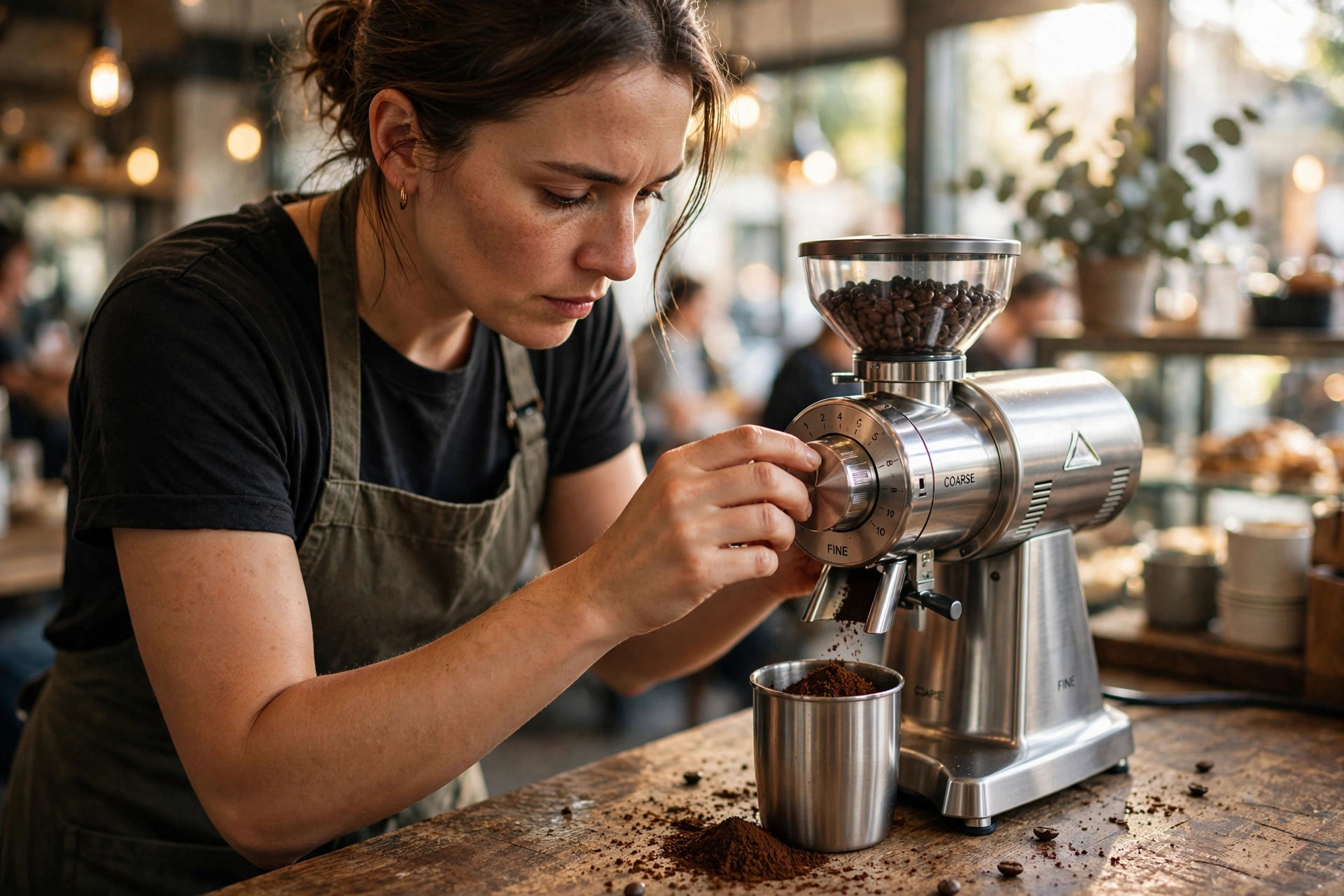
- The Zero Point Calibration: Start by finding the "zero point" where the burrs almost touch. This is the baseline for all future adjustments. Every professional barista should perform this check weekly to account for burr wear.
- The First Dose: Grind 18-20 grams of Arabica coffee and time the extraction. If the shot runs in under 20 seconds, the grind is too coarse. If it chokes the machine, it is too fine.
- Micro-Adjustments: Move the adjustment collar in small increments. In my experience, moving the dial by just one notch can change the extraction time by 3-5 seconds. This is where the precision of high-end equipment becomes an asset.
- The Taste Test: Use a refractometer if possible, or a trained palate, to identify under-extraction (sourness) or over-extraction (bitterness).
- Environmental Offset: Remember that humidity and temperature affect the bean. On rainy days, beans absorb moisture and swell, often requiring a slightly coarser grind to maintain the same flow rate.
To avoid these technical headaches, many businesses are moving toward managed solutions. For example, integrating a professional Sensa Coffee Service in Mount Pleasant SC - Complete Guide ensures that your equipment is calibrated by experts and maintained to prevent the dreaded "drift" in grind consistency.
Professional Grinding: Traditional vs. Modern Approaches
When choosing a setup, you will encounter three distinct philosophies of grinding. The traditional approach relies on manual dosing and tamping, which provides great control but high variability. The "cheap AI/Automatic" approach uses basic timers that often miscalculate based on bean density. The modern professional approach combines precision dosing with "grind-by-weight" technology.
| Feature | Traditional Manual | Basic Automatic | Modern Grind-by-Weight |
|---|---|---|---|
| Consistency | High variability (Barista dependent) | Moderate (Timer based) | Extremely High (Scale based) |
| Waste | High (Manual trimming) | Moderate (Dosing errors) | Minimal (Precise to 0.1g) |
| Speed | Slow (Manual weighing) | Fast (One touch) | Fast (Automated precision) |
| Skill Floor | Requires Expert Barista | Low skill required | Moderate skill required |
Modern grind-by-weight systems use internal sensors to stop the motor exactly when the target weight is reached, regardless of how the beans are flowing. This eliminates the need for a separate scale during the dosing phase, shaving 5-8 seconds off every single drink. This level of precision is what separates a standard cafe from a world-class specialty coffee destination. If you are planning your budget, consider how this efficiency impacts your coffee shop outfitting costs over a three-year period.
Common Mistakes to Avoid When Implementing Coffee Grinders
One of the most frequent mistakes I see is the "single grinder trap." Owners believe that one high-end grinder can do everything. They try to switch from espresso to cold brew or drip coffee throughout the day. This is a logistical nightmare. Every time you change the grind setting significantly, you must purge 50-100 grams of coffee to clear the remaining particles from the chamber. Over a year, this is a massive waste of product.
Another error is neglecting the cleaning cycle. Coffee beans contain oils that oxidize and build up on the burrs. This "rancid oil" buildup creates friction and changes the flavor profile of the coffee, making it taste stale even if the beans are fresh. According to NSF International, maintaining food-contact surfaces in compliance with sanitary standards is not just about hygiene, but about product integrity. Professional baristas should be cleaning their burrs with specialized tablets or vacuuming the chambers daily.
Finally, many businesses ignore the "heat soak" effect. When a grinder runs continuously for two hours during a morning rush, the burrs heat up. This thermal expansion can actually change the distance between the burrs, meaning your grind drifts while you are at your busiest. To prevent this, I recommend investing in grinders with oversized burrs (80mm or larger) which have more surface area to dissipate heat, a detail often highlighted in the Sensa Coffee Service in Raleigh NC (2026 Overview) specifications.
Pro Tip: The Importance of Burr Alignment
Even the most expensive grinder is useless if the burrs are not perfectly parallel. In the industry, we call this "burr alignment." If the burrs are tilted by even a fraction of a millimeter, you get a bimodal distribution of particles—some too chunky, some too powdery. This creates "channeling" in the coffee puck, where water finds the path of least resistance and bypasses the coffee, resulting in a watery, sour shot. Always ask your supplier for a calibration report upon delivery to ensure the burrs are aligned to factory specifications.
Frequently Asked Questions
How often should I replace the burrs in my commercial grinder?
Burrs are consumable parts. Depending on your volume, they typically need replacement every 500kg to 1,000kg of coffee. If you notice that you are having to make increasingly drastic adjustments to the collar to achieve the same flow rate, your burrs are likely worn down. Replacing them too late leads to inconsistent extractions and slower service. I recommend tracking your total coffee usage and scheduling a burr replacement during a slow season to avoid unexpected downtime.
Can I use a drip coffee grinder for espresso?
Absolutely not. Espresso requires a powder-like consistency to create the necessary pressure for crema, while drip coffee requires a coarse, salt-like texture. Most drip grinders lack the fine-tuning mechanism needed for espresso. Attempting to use one will either result in a machine that cannot grind fine enough or a motor that burns out because it cannot handle the resistance of a fine grind. For a professional setup, always maintain a separate espresso-specific grinder.
What is the difference between flat burrs and conical burrs?
Flat burrs produce a very uniform particle size, which enhances the clarity and acidic notes of specialty coffee. This is why they are favored in "third wave" cafes. Conical burrs produce a wider range of particle sizes, which often results in a heavier mouthfeel and a more traditional, chocolatey taste. The choice depends on your target customer: if you want a modern, bright cup, go flat; if you want a classic, bold cup, go conical.
Why is my grinder making a high-pitched screaming sound?
This usually indicates one of two things: either the grind setting is too fine and the burrs are touching (which can damage the equipment), or there is a foreign object (like a small stone from the bean harvest) trapped in the burrs. Immediately turn off the machine and check the hopper. If the burrs are touching, adjust the collar to a coarser setting. Regularly cleaning the hopper and using high-quality, screened beans can prevent this from happening.
Does the brand of coffee bean affect which grinder I should choose?
Yes, the roast level and bean density matter. Lightly roasted beans are denser and harder, requiring more powerful motors and sharper burrs to avoid crushing the bean rather than cutting it. If your shop focuses on very light, high-altitude Arabica, you need a grinder with high torque to prevent stalling. Conversely, oily dark roasts can clog cheaper grinders more quickly, making a grinder with an easy-clean design and high-quality coatings essential.
Conclusion
The difference between a mediocre cafe and a destination coffee shop often comes down to a few microns of grind precision. Professional coffee grinders baristas use are not just about speed; they are about the repeatability of excellence. When every shot is identical, your brand becomes synonymous with quality, and your labor costs decrease as waste is eliminated.
Whether you are scaling a single location or managing a regional chain, the synergy between your grinders and your espresso machines is the foundation of your success. For those who want to avoid the stress of equipment failure and calibration drift, a managed membership is the most logical path forward. If you are ready to professionalize your entire operation, refer back to our The Ultimate Guide to Coffee Shop Equipment and Outfitting for a complete roadmap to success.
For more information on premium, managed beverage solutions, visit Busy Bean Coffee.
Free Coffee Pairing Guide & Specialty Roast Cheat Sheet
Unlock the secrets of perfect brewing ratios, water temperatures, and specialty roast profiles. Download the guide.