📖This article is part of the complete guide to Breakroom Coffee Service Providers (2026 Overview).
Why Investing in Professional Office Coffee Solutions Actually Impacts Your Bottom Line
A broken coffee pot or a stash of stale, budget-grade beans isn't just a minor inconvenience; it's a quiet productivity killer. In my experience working with high-growth firms, the "coffee break" is rarely just about the caffeine, it is where cross-departmental collaboration happens and where employee morale is subtly measured. When a company invests in professional office coffee solutions, they aren't just buying a machine; they are optimizing the physical environment to reduce "micro-friction" in the workday.
The simple answer to why these solutions are worth it comes down to three variables: talent retention, operational efficiency, and client perception. When employees have to leave the building for a 15-minute "coffee run" because the in-office option is subpar, you aren't losing 15 minutes; you're losing the momentum of their deep-work cycle. By bringing a high-tier beverage experience in-house, businesses recover hundreds of lost man-hours per year and signal to their team that quality is a core value.
For those managing larger facilities, exploring a Sensa Coffee Service in Charlotte, NC often reveals that the cost of a managed membership is significantly lower than the hidden cost of employee dissatisfaction and downtime.
What Exactly Are Managed Office Coffee Solutions?
To understand the value, we first have to define what we are actually discussing. Many managers mistake a "coffee solution" for simply buying a Keurig and a bulk pack of pods. That is a procurement choice, not a solution. A true managed solution is an integrated ecosystem of hardware, consumables, and maintenance designed to remove the burden of beverage management from the office administrator.
📚
Definition
Office coffee solutions refer to an all-inclusive managed service that provides commercial-grade brewing equipment, a consistent supply of specialty coffee, professional installation, and ongoing technical maintenance, typically under a single monthly membership fee.
The core of this approach is the shift from Capital Expenditure (CapEx) to Operating Expenditure (OpEx). Instead of spending $5,000 to $15,000 upfront on a high-end espresso machine that will eventually break and sit idle for two weeks while waiting for a technician, the business pays a predictable monthly fee. This ensures the equipment is always under warranty and the beans are always fresh.
Now, here is where it gets interesting: the quality of the bean itself matters. Using Coffea arabica (Arabica coffee) ensures a smoother, more complex flavor profile compared to the bitter Robusta beans found in cheap bulk coffee. According to the Specialty Coffee Association (SCA), the rigorous standards for specialty coffee, which include strict grading and roasting protocols, directly correlate with a higher sensory experience. When you provide a "specialty" experience, you are providing a benefit that employees actually value, rather than a checkbox utility.

Why Does the Quality of Your Coffee Service Matter for Business ROI?
The argument for professional coffee often sounds "soft" until you look at the data. In the corporate world, the breakroom is a strategic hub. When the coffee is terrible, the breakroom becomes a place of complaint. When the coffee is exceptional, it becomes a place of innovation.
From a productivity standpoint, the "coffee run" is a significant drain. If 20 employees leave the office for 20 minutes each day to find a decent latte, the company loses nearly 67 hours of productivity per week. Over a year, that is over 3,000 hours of lost time. By installing automated coffee machines for clinics and medical offices or corporate hubs, businesses reclaim this time.
Furthermore, the impact on client perception is immediate. Imagine a high-stakes meeting where you offer a client a cup of lukewarm, burnt-tasting coffee from a plastic pot. This creates a subtle but powerful psychological association: if the company is careless with its most basic hospitality, are they also careless with their client's accounts? Conversely, a professional espresso machine serving a perfectly extracted shot signals attention to detail and a commitment to excellence.
According to research by the National Coffee Association USA (NCA), coffee consumption patterns in the US are shifting toward "premiumization," with more consumers demanding specialty-grade brews. This shift has moved into the workplace. Employees now expect the same quality at the office that they get at their favorite local café. Failing to meet this baseline creates a gap in the "employee experience" (EX) strategy.
The consequence of not acting isn't just a grumpy staff; it's a failure to leverage the "Watercooler Effect." This is the phenomenon where unplanned encounters between employees from different departments lead to problem-solving and innovation. If the coffee is bad, people avoid the breakroom, and those organic collisions stop happening.
How to Implement a High-Performance Coffee Program
The mistake I see constantly, and one I made early in my career, is focusing on the machine before focusing on the workflow. A $10,000 machine is useless if it takes ten minutes to clean or if the staff doesn't know how to dial in the grind.
If you want to move from a mediocre setup to a professional system, follow this framework:
- Audit Your Volume: Determine your "peak hour" demand. If you have 50 people trying to get coffee between 8:00 AM and 8:30 AM, a single-serve pod machine will create a bottleneck that frustrates your team. You need high-capacity, automated systems.
- Prioritize Ease of Maintenance: In a busy office, the person "in charge" of the coffee is usually someone whose actual job is something else entirely. If the machine requires a complex cleaning cycle every four hours, it will be neglected. This is why we advocate for Sensa equipment, it's designed for commercial durability and minimal intervention.
- Select a Managed Membership: Instead of buying equipment, opt for a membership. This ensures that when a pump fails or a gasket leaks, a technician is already on the way. For businesses in the Carolinas, a Sensa Coffee Service in Raleigh NC (2026 Overview) provides the necessary infrastructure to keep the caffeine flowing without administrative headaches.
- Curate the Bean Selection: Don't just buy "dark roast." Offer a variety of profiles. Some employees prefer a bright, acidic light roast for the morning, while others want a rich, chocolatey roast for the mid-afternoon slump.
💡
Key Takeaway
The most successful office coffee programs are those that remove the "human error" element. Automation combined with a managed supply chain ensures that the quality of the 100th cup of the day is identical to the first.
For those in the hospitality sector, the stakes are even higher. Integrating automatic coffee machines for hotels and hospitality in 2026 allows for a consistent guest experience that mirrors a high-end café without requiring a fully staffed barista station at 6:00 AM.
Comparing Coffee Service Models: Which One is Actually Worth It?
Not all "solutions" are created equal. To decide what is worth the investment, you have to look at the total cost of ownership (TCO), not just the monthly bill.
| Feature | Traditional (Budget) Approach | Generic Pod Systems | Managed Professional Service |
|---|---|---|---|
| Initial Cost | Low (Cheap pot) | Moderate (Machine cost) | Zero to Low (Membership) |
| Beverage Quality | Poor (Burnt/Bitter) | Average (Processed) | Specialty (Fresh Roasted) |
| Maintenance | Manual/None | User-dependent | Professional/Included |
| Employee Satisfaction | Low | Moderate | High |
| Waste Factor | High (Pot waste) | High (Plastic pods) | Low (Precision dosing) |
| Best For | Very small offices (<5 people) | Low-volume environments | Scaling businesses & Hospitality |
As the table illustrates, the "Cheap" approach is actually the most expensive when you account for waste and lost productivity. Generic pod systems provide convenience but fail the "Specialty Coffee" test; they simply cannot compete with the flavor profile of freshly ground coffee beans roasted in small batches.

Common Misconceptions About Office Coffee
Most guides on this topic treat coffee as a perk. I disagree. Coffee is a tool. When you treat it as a "perk," you buy the cheapest version that satisfies the requirement. When you treat it as a tool for productivity and culture, the investment logic changes.
Myth 1: "Pod machines are the most efficient because they are fast."
This is a fallacy. While a single cup is fast, the cumulative waste of pods and the lack of flavor depth make this a low-value solution. Furthermore, the cost per cup of a specialty pod is often higher than the cost per cup of a managed bean-to-cup system.
Myth 2: "Our employees don't care about the quality of the coffee."
I've heard this from dozens of CEOs, only to find out through anonymous employee surveys that the "bad coffee" was a recurring point of frustration. In a world of remote work, the physical office must offer an experience that is better than home. If the coffee at work is worse than the coffee at home, you've removed one of the primary incentives for employees to return to the office.
Myth 3: "Managed services are too expensive for mid-sized companies."
Actually, the opposite is true. Mid-sized companies (50-200 employees) suffer the most from "equipment limbo", they are too big for a home machine but too small to have a dedicated café manager. A managed service like those found in a Sensa Coffee Service in Greenville SC: Complete Guide | Busy Bean Coffee removes the need for a dedicated staff member to manage inventory and cleaning.
Frequently Asked Questions
How does a managed coffee service reduce monthly overhead?
Managed services convert unpredictable costs into a fixed monthly line item. Instead of dealing with sudden $1,000 repair bills or fluctuating prices for bulk beans, you pay a set membership fee. This allows for precise budgeting and eliminates the "emergency spend" that occurs when a primary machine fails during a busy week. Additionally, by reducing the time employees spend leaving the building for coffee, you are effectively increasing the billable hours or productive output of your staff.
What is the difference between "commercial grade" and "consumer grade" machines?
Consumer machines are built for 2-4 cups a day; commercial machines are built for 200. The difference lies in the boiler capacity, the quality of the pump, and the thermal stability of the brew head. A consumer machine will overheat and shut down under heavy office use, leading to frustration and frequent breakdowns. Commercial equipment, such as that provided by Busy Bean Coffee, is designed for continuous operation and is certified for safety and sanitation by bodies like NSF International.
Does providing specialty coffee actually improve employee retention?
While coffee alone won't keep an employee who hates their boss, it is a powerful "micro-benefit." It signals that the company cares about the quality of the daily experience. In a competitive labor market, these small details contribute to a culture of excellence. When an employee feels that their environment is curated for their comfort and productivity, their overall job satisfaction increases. It transforms the breakroom from a utilitarian space into a destination for wellness and socialization.
How often does the equipment need maintenance in a high-volume office?
In a professional setup, maintenance is proactive rather than reactive. This means regular descaling, gasket replacement, and calibration of the grinder. In a managed solution, these tasks are handled by professionals. If you manage it yourself, you risk "scaling" (mineral buildup), which ruins the taste of the coffee and eventually destroys the heating element. Professional oversight ensures the machine operates at peak efficiency, preserving the nuance of the specialty coffee being served.
Is a bean-to-cup system better than a traditional drip brewer?
For most modern offices, yes. Bean-to-cup systems grind the coffee seconds before brewing, which preserves the volatile aromatic compounds that give coffee its flavor. Traditional drip brewers often leave coffee sitting on a hot plate for hours, leading to oxidation and a burnt taste. Bean-to-cup systems also offer variety, allowing users to switch between espresso, lattes, and Americanos instantly, which caters to a wider range of employee preferences and reduces waste.
Final Thoughts on Office Coffee Solutions
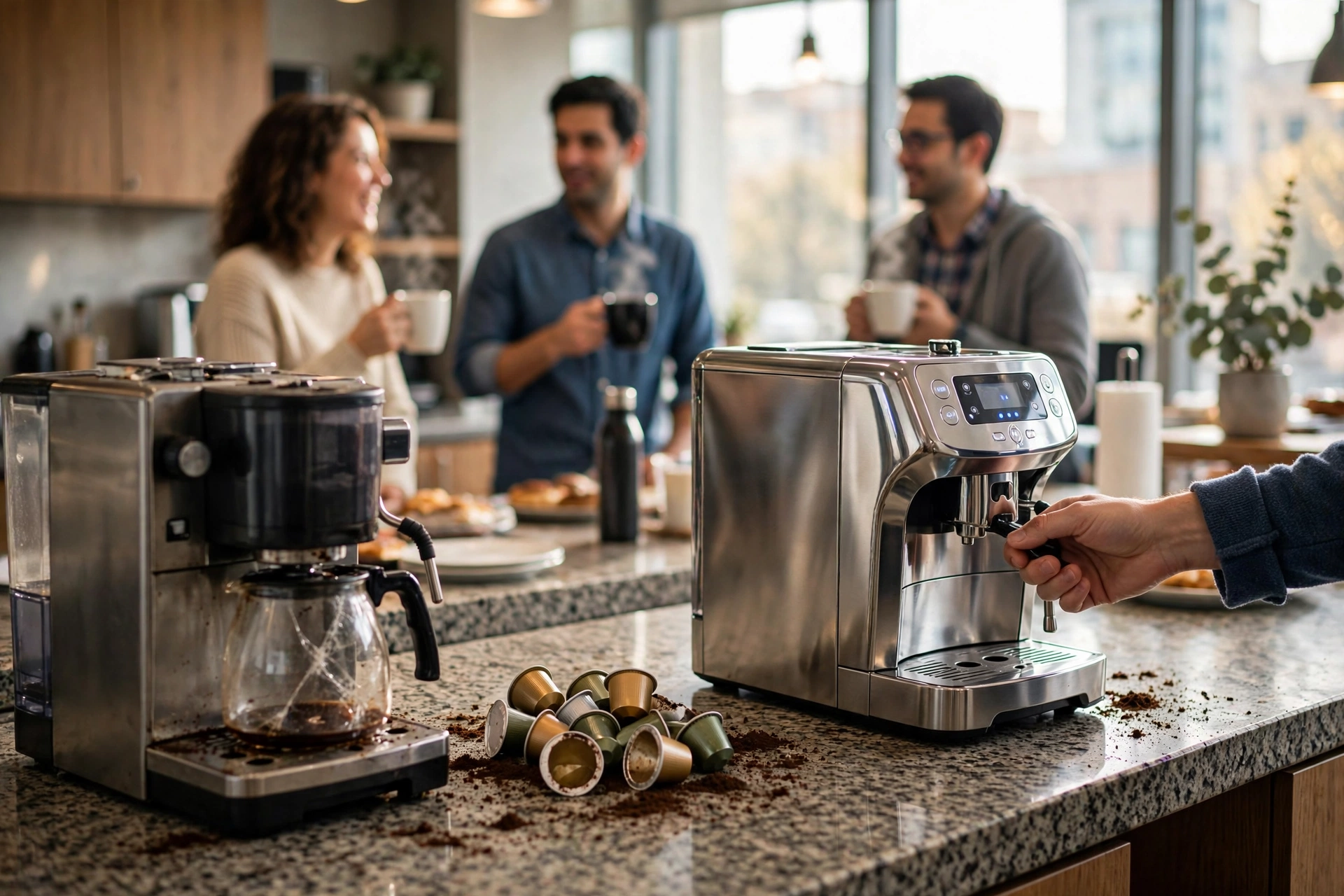
If you are still questioning whether professional office coffee solutions are worth the investment, look at the gaps in your current system. Look at the empty pots, the piles of plastic pods, and the frequency with which your staff leaves for "coffee breaks" that last 30 minutes.
The cost of mediocre coffee is hidden in the margins of lost time and lowered morale. By shifting to a managed, specialty-grade service, you are investing in the operational fluidity of your business. Whether you are looking for a Sensa Coffee Service in Mount Pleasant SC: Complete Guide or a nationwide corporate strategy, the goal is the same: remove the friction.
High-quality coffee is the simplest way to improve the daily life of every single person in your building. It is a low-risk, high-reward upgrade that pays dividends in productivity and professional image.
Stop settling for "good enough" caffeine. Visit Busy Bean Coffee Blog today to discover how an all-inclusive managed membership can transform your office culture and your bottom line.
Ready to Upgrade Your Business Coffee?
Café-quality coffee, zero maintenance headaches, and one predictable monthly price. Let's build your custom coffee program.
Free Coffee Pairing Guide & Specialty Roast Cheat Sheet
Unlock the secrets of perfect brewing ratios, water temperatures, and specialty roast profiles. Download the guide.