How Do Industrial Coffee Roasters Actually Work?
The transformation of a raw, green coffee bean into a fragrant, aromatic brown bean is not a matter of simple heating; it is a precise application of thermodynamics and chemical engineering. Industrial coffee roasters function by applying heat through conduction, convection, and radiation to trigger the Maillard reaction and caramelization, all while managing air flow and drum rotation to ensure a uniform roast. The process generally involves loading green beans into a heated rotating drum, maintaining a specific temperature curve over 10 to 20 minutes, and then rapidly cooling the beans to stop the cooking process immediately upon reaching the target roast profile.
In my experience working with high-volume foodservice operators, the most common failure isn't the machine itself, but a misunderstanding of the "thermal momentum" within the drum. I've seen businesses invest in massive hardware only to produce inconsistent batches because they treated the roaster like an oven rather than a precision instrument. When we analyze the workflow at Busy Bean Coffee, we prioritize the relationship between bean mass and airflow, as this is where the real quality is won or lost.
The Mechanics of Thermal Transfer in Large-Scale Roasting
To understand how industrial coffee roasters operate, one must first understand the three primary methods of heat transfer. In a professional setting, the goal is to move heat from the burner into the core of the coffee bean without scorching the exterior.
📚
Definition
Convection is the transfer of heat through a fluid medium, such as hot air. In industrial roasting, this is the primary driver of consistency, as air is pushed through the bean mass to ensure every bean reaches the same temperature.
Conduction occurs when the beans touch the hot metal surface of the drum. While necessary, over-reliance on conduction leads to "tipping" or "scorching," where the ends of the beans burn. Radiation is the heat emitted from the burner and the drum walls. The balance of these three forces is what differentiates a commercial-grade operation from a hobbyist setup.
According to the Specialty Coffee Association (SCA), maintaining strict temperature controls is fundamental to preserving the volatile aromatic compounds found in specialty coffee. If the temperature rises too quickly during the drying phase, the bean may look roasted on the outside but remain raw in the center, leading to a "grassy" or underdeveloped taste.
The process is governed by the "roast curve," a graph plotting bean temperature over time. The first phase is the drying phase, where moisture is evaporated. This is followed by the Maillard reaction, where amino acids and reducing sugars react to create the complex flavors and brown colors we associate with coffee. Finally, the beans reach "first crack," a physical expansion where the cell structure breaks, and the beans rapidly lose mass while increasing in volume.

Why Precise Temperature Control Matters for Business ROI
When scaling a coffee program, the difference between a 95% consistency rate and a 70% consistency rate is the difference between a loyal customer base and wasted inventory. In the industrial sector, roasting is a game of margins. A slight overshoot in temperature can turn a premium Coffea arabica batch into a bitter, burnt product that must be discarded.
According to the National Coffee Association USA (NCA), consumer demand for specialty and high-quality roast profiles has grown steadily, meaning businesses can no longer hide poor roasting behind cream and sugar. The financial implication is clear: inconsistency leads to "dumping" batches. If a roaster consistently wastes just 2% of its output due to profile errors, a medium-sized operation can lose thousands of dollars in annual profit.
The risk isn't just financial; it's about brand equity. In the world of specialty coffee, the "cupping score" is everything. When you use industrial coffee roasters, you are managing thousands of beans simultaneously. If the airflow is insufficient, the "chaff", the dried skin of the bean, accumulates in the drum and catches fire or imparts a smoky, acrid taste to the roast. This is why industrial units feature sophisticated cyclone collectors to evacuate chaff immediately.
Furthermore, the energy efficiency of the roaster impacts the bottom line. Modern industrial units are designed to maximize heat retention. A poorly insulated drum wastes energy and creates an unstable roasting environment, making it nearly impossible to replicate a "signature roast" across different batches. For a business, the ability to guarantee that the coffee served in January tastes exactly like the coffee served in July is the foundation of scalability.
A Step-by-Step Guide to Operating Industrial Coffee Roasters
For those transitioning from small-batch to industrial scales, the process requires a shift from "intuition" to "data-driven" roasting. Here is the professional workflow utilized by experts and integrated into the managed solutions we provide at Busy Bean Coffee.
Step 1: The Charge and Thermal Stabilization
The process begins with the "charge." The roaster is preheated to a specific temperature (the charge temperature), and the green beans are dropped into the drum. Now, here's where it gets interesting: the temperature will actually drop immediately after the beans enter. This is called the "turn-around point." The goal is to reach this point quickly and then begin a steady climb.
Step 2: Managing the Drying Phase
During the first 5 to 8 minutes, the focus is on moisture removal. If you apply too much heat here, you risk scorching. If you apply too little, the roast will be "baked," resulting in a flat, bread-like flavor. We recommend adjusting the gas pressure based on the bean's initial moisture content, usually between 10% and 12% for high-quality Arabica.
Step 3: Navigating the Maillard Reaction
As the beans transition from green to yellow and then brown, the Maillard reaction takes over. This is the most critical window for flavor development. By manipulating the airflow, you can control how much heat is stripped away from the beans. Increasing airflow here can "stretch" the roast, allowing for more complexity and acidity.
Step 4: The First Crack and Development
At approximately 380°F to 400°F (193°C to 204°C), the beans will make a popping sound known as "first crack." This is the signal that the bean is now drinkable. The time between the start of first crack and the end of the roast is called the "development time." This is where the barista's preferred profile is finalized, whether it's a light roast for acidity or a medium roast for balance.
Step 5: Dropping and Rapid Cooling
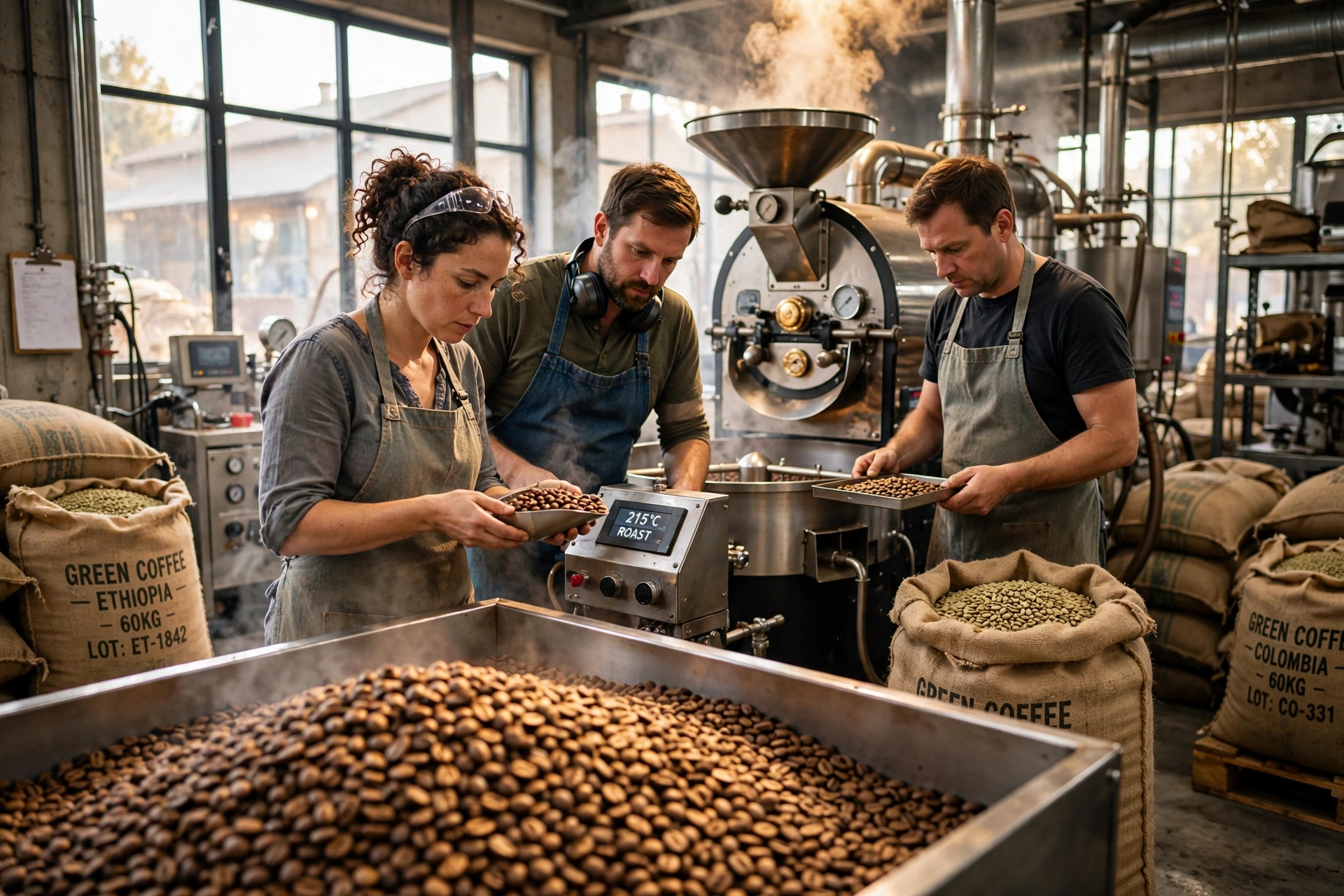
Once the target temperature is hit, the beans are released into a cooling tray. The cooling process must be aggressive. Using high-powered fans and rotating arms, the beans must be brought down to room temperature in under 4 minutes. If they remain hot, "internal roasting" continues, and the beans will over-develop, ruining the precision of the roast.
💡
Key Takeaway
The most important variable in industrial roasting is not the heat itself, but the rate of change in temperature. Controlling the "ROR" (Rate of Rise) prevents defects and ensures every batch matches the master profile.

Choosing the Right Roasting Technology: A Comparison
Not all industrial coffee roasters are built for the same purpose. Depending on your volume and quality targets, the hardware choice will dictate your operational efficiency.
| Feature | Traditional Drum Roaster | Fluid Bed (Air) Roaster | Industrial Convection Hybrid |
|---|---|---|---|
| Heat Method | Conduction & Convection | Pure Convection | Optimized Mix |
| Consistency | Moderate (Batch dependent) | High (Very uniform) | Very High (Digital control) |
| Roast Speed | Slower | Very Fast | Moderate to Fast |
| Flavor Profile | Traditional, "body" heavy | Clean, highlight acidity | Versatile, precise |
| Best For | Artisan Roasteries | High-volume efficiency | Managed Coffee Services |
The traditional drum roaster is the industry standard, but it relies heavily on the skill of the operator. Fluid bed roasters "float" the beans on a cushion of hot air, which eliminates scorching but can sometimes strip away the nuance of a high-end coffee bean.
The modern hybrid approach, often seen in the equipment we deploy at Busy Bean Coffee, uses digital PID controllers to automate the heat and air delivery. This removes the "human error" factor and ensures that the roast profile is digitally locked, meaning the quality remains identical whether the machine is operated by a master roaster or a trained technician.
Common Questions & Misconceptions About Industrial Roasting
Most guides on roasting oversimplify the process or rely on outdated "rules of thumb." Let's address the common myths.
Myth 1: "Darker roasts always mean stronger coffee."
Actually, the opposite is often true regarding caffeine and flavor complexity. As beans roast darker, they lose their unique origin characteristics and begin to taste like the roasting process itself (smoky or carbonized). In the industrial world, "strong" is often a misuse of the word "bitter." The highest quality specialty coffee is typically roasted to a light or medium level to preserve the natural sugars and acids of the bean.
Myth 2: "Industrial roasters are just bigger versions of home roasters."
This is a dangerous misconception. An industrial roaster manages massive thermal loads. When you put 60kg of beans into a drum, the beans themselves become a heat sink. The physics of heat transfer change entirely. A home roaster manages a few ounces; an industrial roaster manages a thermodynamic system where airflow and drum speed must be calibrated to the exact kilogram of the load.
Myth 3: "Automated roasting kills the 'art' of the coffee."
Many believe that a human must be "feeling" the roast. In reality, the "art" is in the creation of the profile, the decision of when to drop the temperature or increase the air. Once that perfect profile is discovered, automating it is the only way to ensure the customer gets the same experience every time. Precision is not the enemy of art; it is the tool that allows art to be scaled.
Frequently Asked Questions
How does airflow affect the final flavor of the coffee?
Airflow acts as the "brake" and "accelerator" of the roasting process. In industrial coffee roasters, increasing the airflow removes heat from the drum more quickly, which can prevent the beans from over-roasting and help maintain a brighter, more acidic profile. Conversely, reducing airflow keeps the heat trapped, which can accelerate the roast and increase the development of heavier, chocolatey notes. If airflow is too low, however, the chaff will not be removed, leading to a burnt, smoky taste that masks the natural flavors of the Coffea arabica.
What is the difference between a batch roaster and a continuous roaster?
A batch roaster, which is most common in specialty shops, processes a set amount of coffee at one time: charge, roast, cool, and repeat. This allows for extreme precision and the ability to change profiles between batches. A continuous roaster feeds green beans in at one end and roasted beans out the other in a constant stream. While continuous roasters are far more efficient for massive volumes (thousands of pounds per hour), they offer significantly less control over the individual roast profile, making them less ideal for specialty coffee production.
Why is the "cooling phase" so important in industrial roasting?
The cooling phase is critical because coffee beans continue to cook internally even after they leave the drum, a phenomenon known as "carry-over cooking." If the beans are not cooled rapidly, ideally within 3 to 5 minutes, the internal heat will push the roast level further than intended. For example, a bean intended to be a "City+" roast might end up as a "Full City" roast if left to cool slowly. This results in a loss of acidity and a potential increase in bitterness, effectively erasing the precision work done during the roasting cycle.
How do I know when a roast is "underdeveloped"?
Underdevelopment occurs when the core of the bean has not reached a sufficient temperature to trigger the necessary chemical reactions, even if the outside looks brown. This is often caused by charging the beans at too low a temperature or rushing through the drying phase. The tell-tale sign is a "grassy," "salty," or "sour" taste during cupping. In my experience, this usually happens when operators try to speed up the roast to increase throughput, ignoring the fact that the bean requires a minimum amount of time to develop its sugars.
What role does the "first crack" play in the roasting process?
The first crack is the physical manifestation of the bean's structure failing under pressure. As water turns to steam inside the bean, the internal pressure builds until the cell wall ruptures, creating an audible pop. This marks the transition from the Maillard phase to the development phase. For a roaster, first crack is the primary signal to begin adjusting heat and airflow to "land" the roast at the desired level. Failing to monitor the timing of the first crack is the most common reason for inconsistent batches in industrial settings.
Final Thoughts on Industrial Coffee Roasting
Understanding the mechanics of industrial coffee roasters is the only way to transition from a basic beverage provider to a true specialty coffee destination. By mastering the balance of convection, conduction, and precise timing, businesses can unlock the full potential of every coffee bean they source. The transition from "guessing" to "measuring" is what separates professional operations from the rest of the market.
Whether you are looking to bring roasting in-house or seeking a managed solution that guarantees this level of precision, the goal remains the same: a perfect cup, every single time. At Busy Bean Coffee, we remove the technical headache and the massive capital expenditure of roasting hardware, providing a seamless, all-inclusive managed coffee membership that brings professional-grade roasting standards to your business.
Stop gambling with your roast consistency and start scaling your quality. Visit www.busybeancoffee.com to explore how our managed solutions can elevate your coffee program.
Recommended Readings
To deepen your understanding of these topics, we recommend reading the following articles:
- The Complete Guide to White Glove Coffee Service
- Ultimate Guide to All-Inclusive Coffee Service for Businesses
- Ultimate Guide to Automated Coffee Machines for Business
- Ultimate Guide to Specialty Coffee Equipment for Business
Free Coffee Pairing Guide & Specialty Roast Cheat Sheet
Unlock the secrets of perfect brewing ratios, water temperatures, and specialty roast profiles. Download the guide.