How Do Industrial Coffee Roasters Transform Raw Beans into Commercial Success?
Scaling a coffee operation from a small-batch hobby to a commercial powerhouse requires a fundamental shift in how heat is applied to the coffee bean. To successfully operate industrial coffee roasters, a business must synchronize thermal precision, airflow management, and consistent cooling protocols to ensure that 50 kilograms of coffee tastes exactly like the first 500 grams. In my experience working with high-volume hospitality groups, the biggest hurdle isn't the roasting itself, but the transition from "artisan intuition" to "repeatable industrial systems." The secret lies in utilizing programmable logic controllers (PLCs) and precise roast profiling to eliminate human error and maximize throughput.

What Exactly Defines the Mechanics of Industrial Coffee Roasting?
Industrial coffee roasting is the process of applying high-temperature heat to green Coffea arabica or Robusta seeds on a massive scale, utilizing drums, fluidized beds, or convection systems to induce chemical changes. Unlike home roasters, these machines are designed for continuous or semi-continuous operation, often handling hundreds of pounds per hour.
📚
Definition
Industrial coffee roasters are high-capacity thermal processing units designed for commercial output, utilizing precise controls for temperature, airflow, and drum rotation to ensure batch-to-batch consistency.
The physics of the process involves three primary stages: the drying phase, the browning (Maillard) phase, and the development phase. During the drying phase, the bean loses moisture; during the Maillard phase, sugars and amino acids react to create the complex flavors we associate with coffee; and finally, during development, the bean reaches its final roast level.
According to the Specialty Coffee Association (SCA), the precision of these stages is what separates a commercial-grade roast from a subpar one. If the heat is applied too aggressively, the exterior of the bean scorches while the interior remains raw. Conversely, if the heat is too low, the coffee becomes "baked," resulting in a flat, bread-like flavor profile.
In my experience, the most common technical failure in industrial setups is the neglect of airflow. Airflow doesn't just move the beans; it removes chaff and manages the rate of heat transfer. When we calibrate systems at Busy Bean Coffee, we focus heavily on the "exhaust temperature" as a primary indicator of roast health. If the exhaust is too hot, you're wasting energy; too cool, and you're trapping smoke and off-flavors inside the drum.
Why Does the Transition to Industrial Scale Matter for Your Bottom Line?
The shift to industrial-scale equipment is not merely about volume; it is about the economics of consistency and waste reduction. When a business moves from small batches to industrial coffee roasters, the cost per pound of roasted coffee drops significantly due to energy efficiency and labor optimization.
1. Labor Efficiency and Throughput
A manual roast requires constant attention. Industrial systems allow a single head roaster to manage multiple batches or a continuous flow, reducing the labor cost per kilo by an estimated 30-50%.
2. Quality Standardization (The E-E-A-T Factor)
In the commercial world, a customer will not return if their latte tastes different every Tuesday. According to the National Coffee Association USA (NCA), consumer preference is heavily weighted toward consistency. Industrial roasters utilize software like Cropster or Artisan to create a "digital twin" of a perfect roast, ensuring that every batch adheres to the exact temperature curve.
3. Energy Management and Sustainability
Large-scale roasters are often more energy-efficient per pound of coffee. Modern industrial machines often feature heat recyclers that use the exhaust from the roasting drum to pre-heat the incoming air, slashing gas consumption.
4. Waste Mitigation
The mistake I made early on, and that I see constantly in growing businesses, is underestimating the amount of "scrap" produced during the learning curve of a new machine. Industrial roasters with precise cooling trays stop the roasting process instantly. Without a high-powered cooling system, the beans continue to cook inside the bean mass (carry-over cooking), which can ruin an entire 60kg batch in under two minutes.
5. Scalability for B2B Contracts
To secure contracts with hotels or restaurant chains, you need a guaranteed supply chain. You cannot fulfill a 1,000-pound weekly order with a sample roaster. Industrial capacity allows you to move from "retail-only" to "wholesale-ready," fundamentally changing your revenue ceiling.
How to Implement an Industrial Roasting Workflow Step-by-Step
Operating industrial coffee roasters is a rigorous process that blends engineering with sensory analysis. If you are moving into commercial production, follow this operational framework to ensure a seamless rollout.
Step 1: Green Bean Analysis and Pre-Heating
Before a single bean enters the drum, you must analyze the moisture content of your green coffee. Different origins, for example, a high-altitude Ethiopian Yirgacheffe versus a Brazilian Santos, require different "charge temperatures."
Pre-heating the drum is essential. If you charge cold beans into a cold machine, you will experience "slugging," where the beans stick to the walls and scorch. The drum should be stabilized at a temperature roughly 20-50 degrees above your target charge temperature.
Step 2: The Charging Process and the "Turnaround Point"
Loading the beans (the "charge") must be done quickly to avoid temperature drops. Once the beans are in, the temperature will plummet, this is the "turnaround point."
The goal here is to manage the energy momentum. If the turnaround point is too low, the roast will drag, leading to a lack of acidity. If it is too high, you risk tipping the beans. This is where the expertise of a barista or roastmaster becomes vital; you are managing the thermal inertia of several hundred pounds of steel and coffee.
Step 3: Managing the Maillard Reaction and First Crack
As the beans turn from green to yellow and then to brown, you enter the Maillard reaction phase. Here, you must adjust your gas and airflow.
When you hear the "First Crack", the audible popping sound as water vapor escapes the bean, you have entered the development phase. In an industrial setting, this is the most dangerous time. Because of the massive volume of beans, the roast can "run away" from you, heating up rapidly due to the exothermic nature of the reaction.
Step 4: Precision Dropping and Rapid Cooling
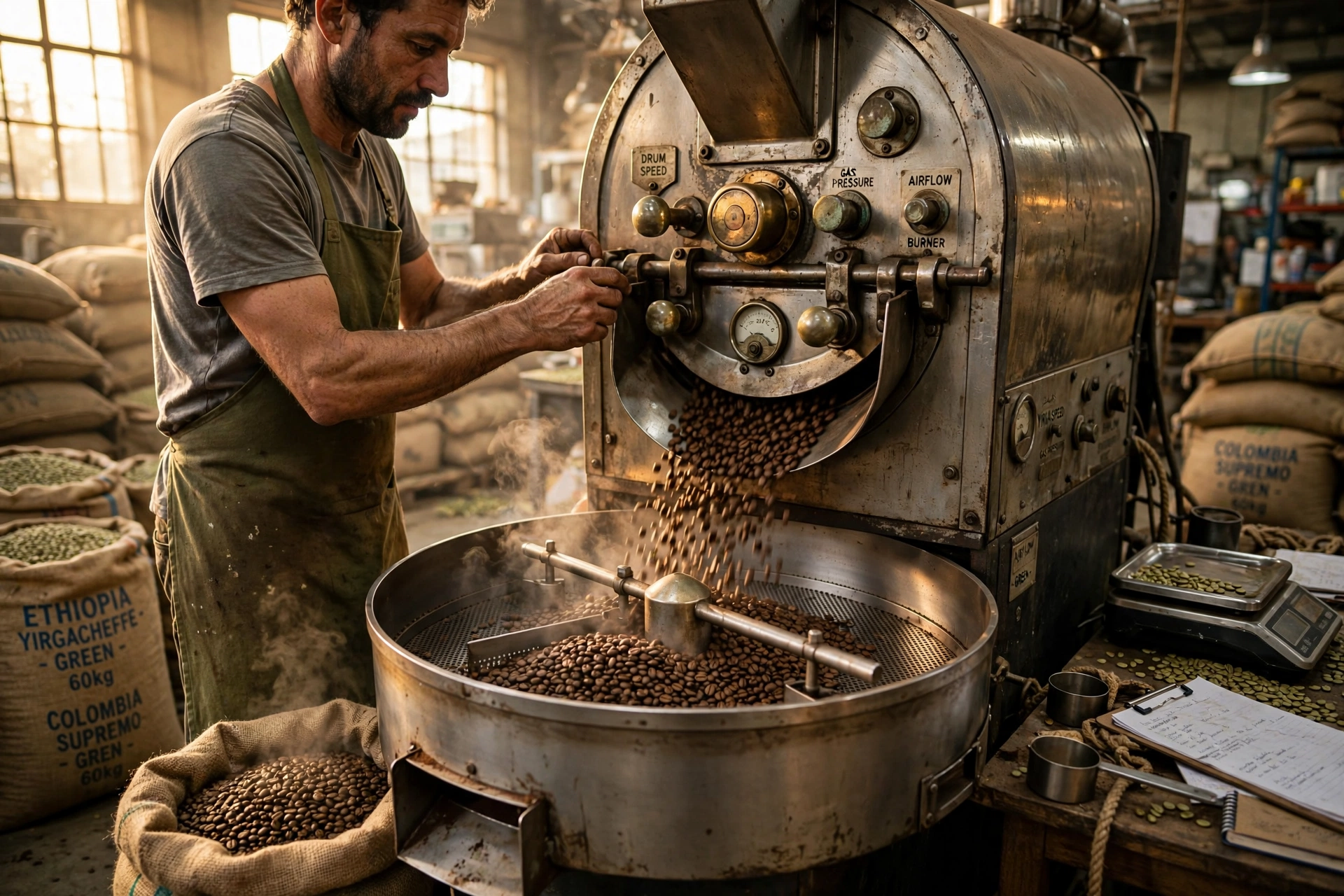
The moment the roast hits the target color and flavor profile, the beans must be "dropped" into the cooling tray.
💡
Key Takeaway
The cooling process must bring the bean temperature down to room temperature in under four minutes to lock in the flavor profile and prevent over-roasting.
At Busy Bean Coffee, we emphasize the importance of the cooling agitator. If the beans aren't moving, the bottom layer stays hot, creating a "mixed roast" where some beans are medium and others are dark, destroying the batch's uniformity.
Step 5: Degassing and Quality Control
Freshly roasted coffee releases carbon dioxide (CO2) rapidly. Industrial roasters must integrate a degassing strategy, either through vented silos or specific bagging intervals. Finally, every single batch must be cupped. A Q-Grader should verify that the industrial output matches the sample roast's profile before it hits the shipping dock.

Comparing Roasting Methodologies: Which is Right for Your Scale?
Choosing the right hardware depends on your volume, your target market, and your budget. Not every business needs a 120kg drum roaster; some find that a fluid-bed system offers better consistency for specific roast profiles.
| Feature | Traditional Drum Roasting | Fluidized Bed (Air) Roasting | Automated Industrial Systems |
|---|---|---|---|
| Heat Transfer | Conduction & Convection | Primarily Convection | Hybrid / PLC Controlled |
| Consistency | High (with expert operator) | Extremely High | Absolute (Software Driven) |
| Flavor Profile | Traditional, complex body | Clean, bright, acidic | Highly customizable |
| Speed | Moderate | Fast | Very Fast |
| Best For | Specialty coffee shops | High-volume "clean" roasts | Large-scale wholesale |
As the table indicates, the "Traditional Drum" approach is still the gold standard for those chasing complex flavor profiles. However, for a business that needs to produce 5,000 lbs of a consistent "house blend" per week, the Automated Industrial System is the only logical choice. It removes the "human variable," allowing the business to scale without needing to hire five master roasters.
Common Questions & Misconceptions About Industrial Roasting
Most guides get this wrong by suggesting that "bigger is always better." In reality, the jump to industrial coffee roasters introduces complexities that can bankrupt a small business if not managed correctly.
Myth 1: "Industrial roasters automatically make the coffee taste worse."
This is a fallacy. When managed by a professional, an industrial roaster provides more precision than a small one. The ability to control airflow to the cubic meter and temperature to the tenth of a degree means you can actually achieve a higher level of specialty quality at scale than you can in a small, unstable drum.
Myth 2: "You can just hire any operator to run the machine."
Absolutely not. Running a 60kg roaster is like driving a semi-truck compared to a sedan. The thermal mass is enormous. A mistake that takes 30 seconds to realize in a 1kg sample roaster can ruin 60kg of expensive green coffee in an industrial machine. You need a trained professional who understands the physics of heat transfer.
Myth 3: "Software replaces the need for tasting."
While PLCs and roast software provide the map, the "cup" is the destination. I've seen roasts that looked perfect on the graph but tasted like ash because the green beans had a different moisture content than the previous shipment. You must always validate the software with a sensory analysis.
Myth 4: "Ventilation is just about the smell."
Many new owners think a vent is just to stop the neighborhood from smelling like burnt popcorn. In reality, industrial roasters produce a massive amount of smoke and volatile organic compounds (VOCs). According to NSF International, proper filtration and ventilation are not just for smell; they are critical for fire safety and health compliance.
Frequently Asked Questions
How do I determine the right capacity for my industrial coffee roaster?
To determine the right capacity, calculate your peak weekly demand and add a 20% growth buffer. For example, if you need 1,000 lbs per week, you should not buy a machine that can only do exactly that. You must account for "down time" (cleaning and maintenance) and the "charging time" between batches. In my experience, it is better to have a machine that runs at 70% capacity than one that must run 24/7 to meet demand. A machine running at 100% capacity is a machine that is one mechanical failure away from a total supply chain collapse.
What is the difference between a batch roaster and a continuous roaster?
A batch roaster processes a set amount of coffee, drops it, and then starts again. This is ideal for specialty coffee where you might roast five different origins in one morning. A continuous roaster, however, feeds green beans in at one end and roasted beans out at the other in a constant stream. This is used by the world's largest coffee brands. While continuous roasters offer the highest efficiency, they lack the flexibility to switch between different bean types quickly. For most specialty-focused businesses, a high-capacity batch roaster is the superior choice.
How does airflow affect the final flavor of the coffee?
Airflow is the "invisible ingredient" in roasting. High airflow removes moisture and chaff more quickly, which generally results in a "cleaner," more acidic cup. Low airflow allows more of the roasted chaff to stay in contact with the bean, which can add "body" and "smokiness" but can also lead to bitter, burnt flavors if not managed. When calibrating industrial coffee roasters, we adjust the airflow dampers to ensure that the smoke from the Maillard reaction is swept away, preventing the coffee from tasting "ashy."
How often should industrial roasting equipment be maintained?
Industrial equipment requires a strict maintenance schedule to prevent catastrophic failure. The "chaff collector" must be emptied daily to prevent fire hazards. The bearings and drive chains should be lubricated weekly. More importantly, the burners and thermocouples must be calibrated monthly. A thermocouple that is off by just 2 degrees can lead to an entire day of inconsistent batches. At Busy Bean Coffee, we recommend a quarterly professional deep-clean of the drum to remove carbon buildup, which can cause "hot spots" and scorch your beans.
What are the primary safety risks associated with large-scale roasting?
The two primary risks are fires and gas leaks. Coffee chaff is highly flammable; if it accumulates in the ventilation ducts, a spark can trigger a chimney fire. This is why NSF-certified equipment and professional installation are non-negotiable. Additionally, because industrial roasters use high-pressure gas lines, automatic shut-off valves and carbon monoxide detectors are essential. Never bypass safety sensors to "speed up" a roast; the risk of a thermal runaway event is too high in an industrial environment.
Final Thoughts on Scaling with Industrial Coffee Roasters
Transitioning to industrial coffee roasters is the most significant leap a coffee business can take. It is the bridge between being a local favorite and becoming a regional powerhouse. However, the success of this transition doesn't depend on the machine alone, but on the systems you build around it: the precision of your roast profiles, the rigor of your quality control, and the reliability of your equipment.
If you are looking to upgrade your beverage program or need a managed coffee solution that removes the headache of equipment maintenance and sourcing, we can help. At Busy Bean Coffee, we specialize in providing the high-end equipment and managed services that allow you to focus on growth while we handle the technical complexities of the brew.
Ready to elevate your coffee game? Visit us at www.busybeancoffee.com to discover how our all-inclusive managed coffee membership can transform your business.
Recommended Readings
To deepen your understanding of these topics, we recommend reading the following articles:
- The Complete Guide to White Glove Coffee Service
- Ultimate Guide to All-Inclusive Coffee Service for Businesses
- Ultimate Guide to Automated Coffee Machines for Business
- Ultimate Guide to Specialty Coffee Equipment for Business
Free Coffee Pairing Guide & Specialty Roast Cheat Sheet
Unlock the secrets of perfect brewing ratios, water temperatures, and specialty roast profiles. Download the guide.