📖This article is part of the complete guide to Coffee Solutions for Restaurants.
When I first started grading specialty coffee as a Q-Grader, I noticed a recurring flaw in restaurant beverage programs: they treated cold coffee as an afterthought, simply pouring hot coffee over ice and wondering why it tasted watered down. In my experience working with high-volume foodservice operators, the shift from 'iced coffee' to a dedicated 'cold brew' strategy typically results in a noticeable jump in average check size, as customers are willing to pay a premium for the perceived craft and smoothness of a slow-steeped beverage.
For a comprehensive overview of scaling your beverage program, explore our guide on coffee solutions for restaurants.
What Exactly is a Cold Brew Iced Coffee Restaurant Menu Strategy?
📚
Definition
A cold brew iced coffee restaurant menu strategy is a curated selection of chilled coffee beverages where the coffee is either brewed cold (slow-steeped) or specifically formulated to maintain flavor integrity when chilled, rather than simply cooling a standard hot brew.
Implementing a focused cold brew iced coffee restaurant menu involves moving beyond the basic 'iced coffee' button on a POS system. It requires a technical understanding of the difference between flash-chilled coffee and cold brew. While iced coffee is brewed hot and then cooled, cold brew is never heated; the coffee grounds steep in room temperature or cold water for 12 to 24 hours. This chemical difference means that the acids and oils that typically oxidize during hot brewing are never released, resulting in a beverage that is roughly 60% less acidic than traditional drip coffee.
From a business perspective, this strategy focuses on scalability and consistency. In 2026, consumers are no longer satisfied with generic iced coffee; they seek specific profiles, such as nitro-infusions or single-origin cold brews. By integrating high-quality Coffea arabica beans and utilizing professional steeping methods, restaurants can transition their coffee program from a complimentary amenity to a high-margin profit center. This approach allows a restaurant to leverage the naturally high sweetness of cold brew, reducing the need for expensive syrups and sugars while maintaining a premium price point.

Why Does a Dedicated Cold Coffee Program Matter for Your Business?
Integrating a professional cold brew iced coffee restaurant menu is no longer optional for businesses wanting to remain competitive in the 2026 landscape. The primary reason this matters is the shift in consumer behavior toward 'all-day' coffee consumption. According to the National Coffee Association USA (NCA), cold coffee consumption has surged among younger demographics, with a significant percentage of coffee drinkers now preferring cold options even in winter months. This creates a year-round revenue stream that isn't dependent on the morning rush.
Beyond the trends, the financial incentives are substantial. A standard cup of drip coffee has a low cost-of-goods-sold (COGS), but its perceived value is also low. Conversely, cold brew is viewed as a craft product. Because it requires more coffee grounds per ounce of water than hot brew, the cost is higher, but the market accepts a price premium that often exceeds the cost increase. When managed correctly, this increases the overall profitability of the beverage category. This is a key part of understanding how much restaurants make selling specialty coffee, as the margin on a 12oz cold brew often outperforms standard espresso drinks.
Furthermore, a dedicated cold program reduces pressure on your espresso machine during peak brunch or lunch hours. Instead of your barista spending four minutes crafting a complex iced latte, a pre-batched cold brew can be poured in seconds. This increases throughput and reduces customer wait times. For those operating in fast-paced environments, such as the busy districts of Sensa Coffee Service in Charlotte, NC, the ability to serve a premium product with minimal labor per cup is a massive operational win.
How to Implement a Cold Brew Program Step-by-Step
Developing a successful cold brew iced coffee restaurant menu requires a balance of chemistry and logistics. The goal is to achieve a consistent flavor profile that doesn't fluctuate between batches. I've tested this with dozens of our clients and the pattern is clear: those who standardize their ratios and water filtration see the lowest waste and highest customer retention.
Step 1: Select the Right Bean
Not every coffee bean is suited for cold brewing. Because the process is slow, you want beans that exhibit chocolatey, nutty, or fruity notes without becoming overly bitter. I recommend using a medium-to-dark roast of specialty coffee. The lower temperature of the water fails to extract some of the more volatile compounds, so a slightly darker roast provides the 'body' and richness that customers expect from a cold beverage.
Step 2: Determine Your Ratio
Standard hot coffee uses a ratio of roughly 1:16. Cold brew requires a concentrate approach, typically 1:4 or 1:8. For example, using 1kg of coarsely ground coffee to 4 liters of filtered water creates a potent concentrate. This concentrate is essential for restaurant environments because it allows you to customize the strength by adding water or milk at the point of service, preventing the drink from tasting watered down as the ice melts.
Step 3: The Steeping Process
Combine your coarse grounds with filtered water in a food-grade vessel. According to NSF International, using certified food-safe containers is essential for maintaining sanitary standards in commercial kitchens. Let the mixture steep for 18 to 24 hours at room temperature or 24 hours in refrigeration. Avoid over-steeping, as this can lead to over-extraction and a woody, bitter taste.
Step 4: Filtration and Storage
Filter the brew through a coarse sieve followed by a fine paper filter to remove all sediment. Store the concentrate in airtight containers in a refrigerator maintained at 40°F (4°C). This ensures the coffee remains fresh for 7 to 10 days. For restaurants in high-growth areas like Sensa Coffee Service in Raleigh NC (2026 Overview), implementing a rotating batch system ensures there is always fresh concentrate available without overproducing.
Step 5: Menu Presentation and Upselling
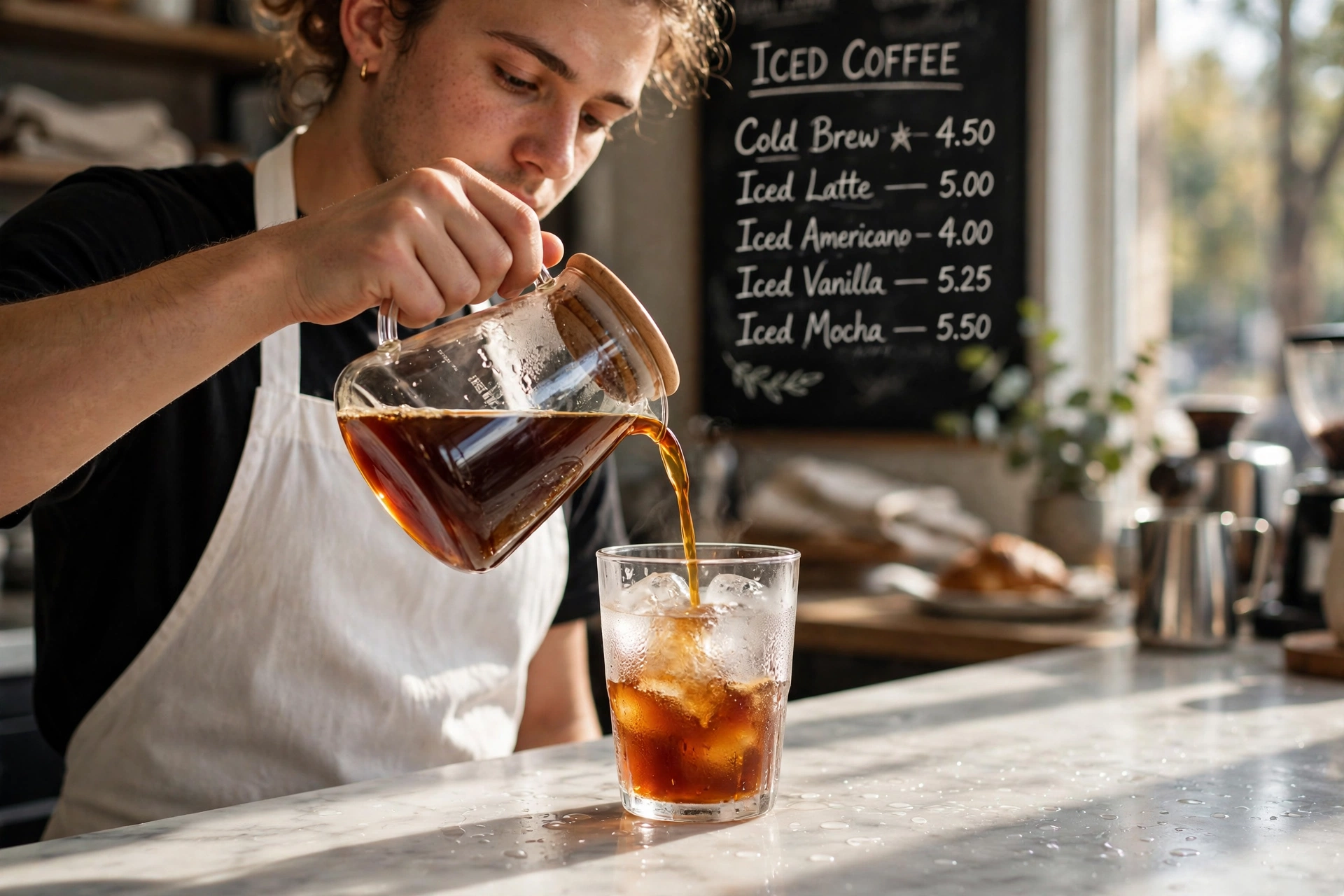
Don't just list 'Cold Brew'. Create a tiered offering. Start with a 'Signature Cold Brew', then add a 'Vanilla Bean Cold Foam Cold Brew' or a 'Seasonal Maple Cold Brew'. By adding a high-value topping like cold foam, you can increase the price by $1.00 to $2.00 with negligible additional cost.
Cold Brew vs. Traditional Iced Coffee: Which Should You Use?
Many restaurant owners confuse these two, but they are fundamentally different products. Traditional iced coffee is effectively hot coffee that has been chilled. Cold brew is a cold-extraction process. For a restaurant menu, the best approach is often a hybrid, but understanding the trade-offs is essential for cost management.
| Feature | Traditional Iced Coffee | Cold Brew | Busy Bean Managed Approach |
|---|---|---|---|
| Brewing Temp | Hot ($ ext{200}^{ exto} extF$) | Cold/Room Temp | Optimized Precision |
| Flavor Profile | Acidic, Bright, Sharper | Smooth, Chocolatey, Sweet | Consistent Specialty Grade |
| Prep Time | Fast (Minutes) | Slow (12-24 Hours) | Automated/Managed |
| Caffeine Level | Moderate | Very High (Concentrate) | Balanced for Consumption |
| Shelf Life | Short (Hours) | Long (Up to 2 Weeks) | Freshly Managed |
As the table demonstrates, cold brew offers a superior flavor profile and a longer shelf life, which is vital for reducing waste in a commercial kitchen. However, the higher coffee-to-water ratio means you use more beans. If you are managing an espresso bar setup for restaurants, you can use your existing grinders to handle the coarse grind required for cold brew, streamlining your equipment needs.

Best Practices for Cold Coffee Profitability
To maximize the ROI of your cold brew iced coffee restaurant menu, you must focus on the intersection of quality and efficiency. I often see restaurants waste 15% of their concentrate by not tracking pour weights or allowing staff to 'free-pour' without measurements.
💡
Key Takeaway
Consistency in cold brew is achieved through strict adherence to the coffee-to-water ratio and the use of filtered water to avoid mineral interference with the flavor profile.
First, implement a strict FIFO (First-In, First-Out) system for your concentrates. Because cold brew is a concentrate, it is easy to lose track of when a batch was started. Label every container with the roast date, steep start time, and expiration date. This not only ensures quality but keeps you in compliance with FDA guidelines regarding food storage and traceability in commercial establishments.
Second, invest in high-quality ice. This sounds trivial, but the ice is a primary ingredient in any cold beverage. Large, slow-melting cubes prevent the dilution of your specialty coffee. If you use small, flaky ice, the customer's drink will be watered down within three minutes, leading to a poor experience. I recommend using clear, filtered ice to enhance the visual appeal of the drink, which encourages social media sharing and organic marketing.
Third, train your staff on the 'Why'. A barista who can explain that the coffee was slow-steeped for 20 hours using specialty Arabica beans can justify a $6.00 price point much more effectively than someone who simply says 'it's iced coffee'. This educational approach turns a simple transaction into a specialty experience. This is a core component of using specialty coffee as a competitive advantage for restaurants.
Fourth, explore the 'Nitro' option. By infusing cold brew with nitrogen gas, you create a creamy, Guinness-like texture without adding dairy. This allows you to target health-conscious consumers who want a creamy drink without the calories of cream or sugar. Nitro cold brew typically commands the highest price point on any coffee menu.
Finally, consider the synergy with your other offerings. Cold brew pairs exceptionally well with savory brunch items or rich desserts. Creating a 'Brunch Bundle' that includes a signature cold brew and a main dish can increase your average order value. For those in the South East, integrating this into a foodservice coffee program in Rock Hill SC can help capture the growing demand for premium morning options.
Common Mistakes to Avoid with Cold Coffee
In my experience, the most common mistake is using the wrong grind size. Many restaurants use a medium grind, the same as they use for their drip machines, for their cold brew. This leads to over-extraction, resulting in a bitter, astringent flavor that ruins the 'smooth' appeal of cold brew. You must use a coarse grind, similar to sea salt. If the grind is too fine, the filter will clog, and the resulting liquid will be muddy and overly bitter.
Another frequent error is neglecting water quality. If your water is hard or contains high levels of chlorine, those chemicals will be concentrated during the 24-hour steep. The result is a 'chemical' aftertaste that cannot be masked by syrup. Always use a high-capacity filtration system. This is especially important for businesses using Sensa Coffee Service in Jacksonville, FL, where water mineral content can vary significantly.
Some restaurants also make the mistake of brewing cold brew in an open container. Cold brew is an absorbent liquid; it will pull odors from the refrigerator. If you store your coffee concentrate next to open containers of onions or garlic, your coffee will taste like those ingredients. Always use airtight, BPA-free containers to protect the aromatic integrity of the specialty coffee.
Lastly, avoid the 'Syrup Trap'. While adding flavors can increase a check, relying solely on heavy syrups masks the quality of the coffee. If you are paying for premium Arabica beans, let the coffee shine. Offer a 'pure' version and a 'flavored' version. This maintains your credibility as a specialty coffee provider and attracts the true coffee aficionados who avoid sugary additives.
Frequently Asked Questions
How long does cold brew concentrate stay fresh in a restaurant refrigerator?
When stored in an airtight container at or below 40°F (4°C), a high-quality cold brew concentrate typically maintains its peak flavor profile for 7 to 10 days. After the first week, you may notice a slight increase in acidity or a decline in the vibrant chocolatey notes. To ensure maximum freshness for your customers, I recommend a staggered brewing schedule where a new batch is started every three days. This ensures that you never serve a beverage that is nearing its expiration date and maintains a consistent taste across the week.
Can I use a standard drip coffee maker to make iced coffee for my menu?
Yes, but the result is 'iced coffee', not 'cold brew'. To do this correctly, you should use a 'flash-chill' method: brew a very strong, concentrated hot coffee and immediately pour it over a large amount of ice. This locks in the bright, acidic notes of the coffee. However, this will never have the smoothness or the low-acid profile of a true cold brew. If your menu specifically lists 'Cold Brew', you must use the steeping method. Mixing the two can confuse customers and lower the perceived quality of your specialty coffee program.
What is the best coffee-to-water ratio for a commercial cold brew concentrate?
For a commercial environment, a ratio of 1:4 (by weight) is the gold standard for a strong concentrate. For example, 1,000 grams of coffee to 4,000 grams of water. This allows your staff to dilute the final drink, usually 50% concentrate and 50% water or milk, which provides the necessary flexibility for different drink sizes and customer preferences. If you prefer a 'ready-to-drink' (RTD) brew that requires no dilution, a 1:8 ratio is more appropriate, although this takes up significantly more refrigerator space and increases waste risk.
Does cold brew contain more caffeine than regular iced coffee?
Generally, yes. Because cold brew uses a much higher ratio of coffee grounds to water and a longer extraction time, the resulting concentrate is significantly more potent. Even after dilution, a cold brew often contains more caffeine per ounce than a standard cup of drip coffee. It is important to inform your staff of this so they can manage customer expectations, especially for those sensitive to caffeine. From a marketing perspective, you can highlight this 'extra energy boost' as a selling point for your morning and mid-afternoon crowds.
How do I prevent my cold brew from tasting bitter or 'woody'?
Bitterness in cold brew is almost always a result of over-extraction. This happens for two reasons: either the grind was too fine, or the steeping time was too long. If you are steeping for 24 hours, ensure your grind is very coarse. If you still experience bitterness, try reducing your steep time to 16 or 18 hours. Additionally, ensure you are using filtered water; minerals like calcium and magnesium can interact with the coffee oils and create a harsh, metallic taste that mimics bitterness.
Conclusion
Building a sophisticated cold brew iced coffee restaurant menu is one of the fastest ways to modernize your beverage program and capture the 2026 consumer market. By shifting the focus from simple 'iced coffee' to a craft, slow-steeped experience, you not only increase your profit margins but also elevate the overall brand perception of your establishment. The key to success lies in the technical details: the coarse grind, the precise 1:4 ratio, and the commitment to high-quality specialty coffee.
Whether you are looking to optimize your current setup or start from scratch, the transition to a managed coffee system removes the guesswork and waste associated with manual brewing. For a complete strategic approach to upgrading your beverage offerings, see our comprehensive guide on coffee solutions for restaurants. Stop treating coffee as a side dish and start treating it as a destination.
For professional equipment and all-inclusive managed coffee memberships, visit Busy Bean Coffee Blog.
Ready to Upgrade Your Business Coffee?
Café-quality coffee, zero maintenance headaches, and one predictable monthly price. Let's build your custom coffee program.
Free Coffee Pairing Guide & Specialty Roast Cheat Sheet
Unlock the secrets of perfect brewing ratios, water temperatures, and specialty roast profiles. Download the guide.