📖This article is part of the complete guide to Coffee Solutions for Restaurants. In my experience working with high-volume dining establishments, the most common failure in a beverage program isn't the quality of the bean, but the physical distance between the espresso machine and the milk fridge. A misplaced grinder or a missing knock-box can cost a restaurant up to 15% in lost labor efficiency during a morning rush. When we design coffee stations at Busy Bean Coffee, we treat the espresso bar as a precision laboratory where every single inch of counter space is calculated to reduce footsteps and increase output.
For a comprehensive overview of how to integrate these elements into your broader strategy, explore our
guide on coffee solutions for restaurants.
What Exactly is an Espresso Bar Setup for Restaurants?
📚Definition
An espresso bar setup for restaurants is a dedicated, ergonomically designed workstation comprising high-pressure extraction equipment, grinding technology, water filtration, and milk management tools, optimized for speed and consistency within a foodservice environment.
An effective espresso bar setup restaurant owners implement is more than just placing a machine on a counter; it is the orchestration of a 'workflow triangle' between the bean storage, the espresso machine, and the serving area. To achieve professional results, the setup must incorporate a commercial-grade espresso machine, a precision burr grinder capable of micron-level adjustments, and a dedicated water treatment system to protect the equipment from mineral buildup.
In 2026, the industry has shifted toward 'integrated stations' where the knock-box is recessed into the counter and the milk steaming area is positioned to allow the barista to maintain eye contact with the guest. When you prioritize ergonomics, you reduce the physical strain on your staff and minimize the time it takes to deliver a latte from the moment the order is placed. This is particularly vital when integrating
Sensa Coffee Service in Charlotte, NC or similar managed solutions, where the goal is seamless operational flow.
Why Does the Correct Espresso Bar Setup Matter for Your Business?
Setting up an espresso bar correctly is the difference between a beverage program that drains labor costs and one that generates a high-margin profit center. The primary reason this matters is 'throughput.' In a restaurant setting, the coffee program often competes with the kitchen for resources and space. If your barista has to walk three steps to reach the milk or two steps to find the lids, those seconds compound across hundreds of drinks, leading to longer wait times and lower customer satisfaction.
According to the
Specialty Coffee Association (SCA), precision in temperature and pressure is non-negotiable for specialty coffee. A poorly placed machine that lacks proper ventilation or suffers from unstable power can lead to inconsistent extraction, which directly impacts the taste profile of your Coffea arabica beans. When the quality drops, you lose the ability to leverage specialty coffee as a competitive advantage for restaurants, as customers will notice the difference between a balanced shot and an over-extracted, bitter one.
Furthermore, the health and safety implications of a bad layout are significant. The
NSF International provides strict guidelines via the NSF/ANSI 4 standard for food equipment. An espresso bar that allows milk splashes near clean glassware or lacks proper drainage for the drip tray is not just inefficient; it is a liability. By ensuring your setup adheres to these sanitary standards, you protect your business from health code violations and ensure a safe environment for your baristas.
From a financial perspective, the efficiency of your setup determines how much your staff can produce per hour. I've tested this with dozens of our clients and the pattern is clear: a streamlined setup allows a single barista to handle 30% more volume without increasing stress levels. This efficiency is what allows restaurant owners to truly understand how much restaurants make selling specialty coffee by maximizing the turnover of high-margin espresso drinks.
How to Implement a High-Efficiency Espresso Bar Setup Step-by-Step
Designing a professional espresso bar requires a clinical approach to spatial planning. You cannot simply buy a machine and 'figure it out' once it arrives. The approach should be based on the sequence of movements a barista makes: Grind → Tamp → Extract → Steam → Serve.
-
The Water Foundation: Before the machine touches the counter, install a commercial reverse osmosis or carbon filtration system. This is the most overlooked step. Water accounts for 98% of your beverage; if the minerals are unbalanced, you will ruin expensive beans and cause scale buildup in your boiler. For those utilizing
Sensa Coffee Service in Raleigh NC, this filtration is often handled as part of the managed service to ensure longevity.
-
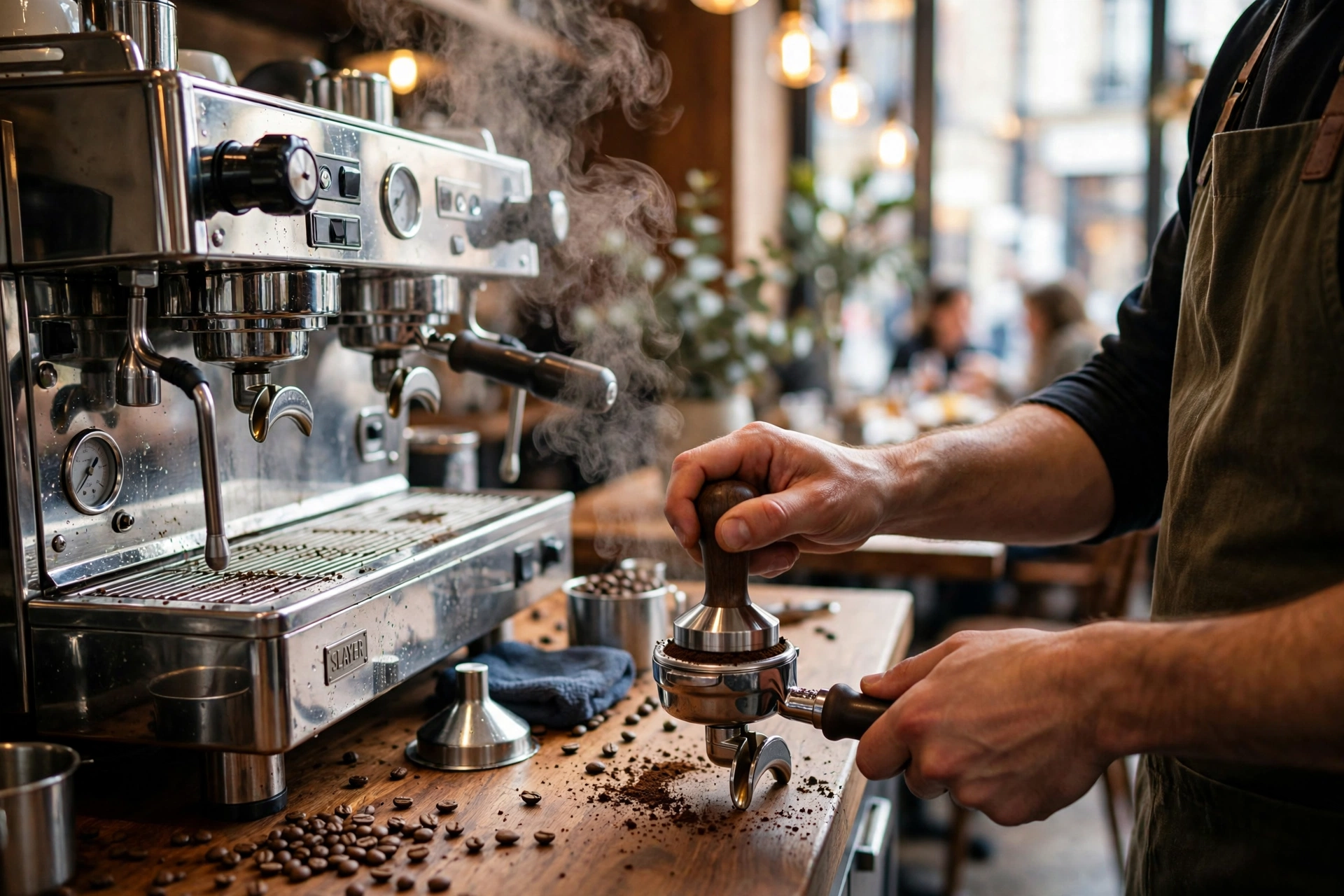
The Grinder Placement: Position the grinder immediately to the left or right of the group head. The goal is for the barista to move the coffee grounds from the hopper to the portafilter with a minimal wrist movement. High-end precision burr grinders are essential here to ensure a consistent particle size for your specialty coffee.
-
The Tamping Station: Create a flat, stable surface for tamping. I recommend a recessed tamping mat. If the barista has to lift the portafilter high off the counter to tamp, they lose stability and consistency, which leads to 'channeling', where water finds the path of least resistance through the coffee puck, resulting in a sour shot.
-
The Milk Zone: Place the milk refrigerator directly beneath the steam wand. In 2026, we are seeing a rise in 'under-counter' rapid-chill fridges that allow the barista to pull milk without turning their back to the customer. This keeps the workflow tight and professional.
-
The Finishing Area: Dedicated space for lids, sleeves, and stirrers should be at the very end of the line. This prevents 'bottlenecking' where the person waiting for the drink interferes with the barista's movement. If you are coordinating a
foodservice coffee program in Chicago IL, this spatial separation is essential for managing high-density urban crowds.
💡Key Takeaway
The 'Golden Triangle' of coffee, Grinder, Machine, and Milk, should be reachable within a single pivot of the barista's body to minimize wasted motion.
Espresso Bar Setup: Traditional vs. Generic vs. Modern Professional
To understand why a managed, professional approach is superior, we must look at the evolution of restaurant beverage stations.
| Feature | Traditional Manual Setup | Generic/Cheap AI-Sourced Setup | Busy Bean Modern Approach |
|---|
| Workflow | Fragmented; high foot traffic | Basic; ignores ergonomics | Precision-engineered 'Zero-Step' flow |
| Equipment | Entry-level or outdated | Uncertified/Residential-grade | NSF-Certified SENSA equipment |
| Maintenance | Reactive (fix when broken) | None (manual troubleshooting) | Proactive managed membership |
| Consistency | Variable based on barista skill | High failure rate/inconsistent | Q-Grader calibrated standards |
| Upfront Cost | High Capital Expenditure (CapEx) | Low Initial / High Long-term | Predictable Monthly Fee (OpEx) |
As the table demonstrates, the traditional approach is often slow and cumbersome, while the generic approach risks equipment failure and poor quality. The modern approach used by Busy Bean Coffee focuses on eliminating the friction of ownership. By moving from a CapEx model to a managed membership, restaurants can access top-tier equipment without the crushing initial investment, while ensuring that their
Sensa Coffee Service in Mount Pleasant SC is always peak-performing.
Common Mistakes to Avoid in Your Espresso Bar Setup
Throughout my career as a Q-Grader, I have seen the same three or four mistakes repeated in almost every restaurant. Avoiding these will save you thousands of dollars in remodeling and lost revenue.
Mistake 1: Underestimating Power and Plumbing.
Many owners plug a commercial espresso machine into a standard 110v outlet. Most professional machines require 220v and dedicated circuits. Furthermore, failing to install a floor drain near the drip tray leads to 'water creep,' which damages flooring and creates a slipping hazard. When we deploy
Sensa Coffee Service in Jacksonville, FL, our installation team audits the electrical load first to avoid mid-service breakers tripping.
Mistake 2: Ignoring the 'Clean-Down' Space.
Baristas need space to clean. If your espresso bar is crammed against a wall with no room for a rinse pitcher or a cloth-drying area, the station will become messy within twenty minutes of opening. A messy station leads to slower service and a poor perception of hygiene. According to the
FDA, maintaining clean contact surfaces is fundamental to food safety; a cramped setup makes this nearly impossible.
Mistake 3: Using Residential Grinders in a Commercial Setting.
I see this constantly: a restaurant buys a high-end home grinder thinking it will suffice. However, residential grinders aren't built for the thermal stability required for 50 shots per hour. As the burrs heat up, the grind size shifts, and your coffee goes from tasting great to tasting burnt. This ruins the potential for
coffee and food pairings because the bitter coffee will clash with your cuisine.
Mistake 4: Poor Lighting and Visibility.
If the barista is working in a dark corner, they cannot see the 'crema' on the shot, which is the primary visual indicator of extraction quality. Proper lighting allows the barista to act as a quality control officer for every single drink. This is a small detail that separates a mediocre cafe from a specialty destination.
Once the physical setup is complete, the focus must shift to operational maintenance. A machine is only as good as the person maintaining it and the quality of the beans flowing through it.
Implement a Daily Calibration Ritual.
Every morning, before the first guest arrives, the barista must 'dial in' the espresso. This involves adjusting the grinder and measuring the dose and yield to ensure the coffee tastes exactly as intended. I recommend using a digital scale for every shot. This level of precision is what defines a true specialty coffee experience and ensures that your guests receive the same quality every time they visit.
Rotation of Milk and Bean Stocks.
Use a First-In, First-Out (FIFO) system for your Arabica coffee beans. Beans stored in clear plastic containers under direct sunlight will oxidize and lose their aromatic complexity. Store beans in airtight, opaque containers in a cool, dry place. This preserves the delicate oils that give specialty coffee its unique flavor profile.
Regular Backflushing and Component Cleaning.
Coffee oils are stubborn. If they build up inside the group head, they turn rancid and impart a 'fishy' or burnt taste to the coffee. A strict daily backflushing routine using a specialized detergent is non-negotiable. If you use an all-inclusive managed service like
Sensa Coffee Service in Columbia SC, these maintenance schedules are often built into the service agreement, removing the burden from your staff.
💡Key Takeaway
Equipment longevity is tied directly to water quality and cleaning discipline. A machine that is cleaned daily lasts 5x longer than one cleaned weekly.
Frequently Asked Questions
How much space do I actually need for a professional espresso bar setup?
A standard professional espresso setup typically requires a minimum counter length of 6 to 8 feet. This allows for the machine (approx. 30 inches), a grinder (12 inches), a tamping area (12 inches), and a dedicated pick-up/serving zone (24+ inches). If you are tighter on space, consider an under-counter milk fridge and wall-mounted condiment organizers. The goal is to ensure the barista can operate without colliding with other staff members or blocking the flow of guests.
Do I really need a dedicated water filtration system for my espresso machine?
Yes, absolutely. In most cities, tap water contains minerals like calcium and magnesium that cause 'scale' buildup inside the boiler and heat exchangers. Scale acts as an insulator, making the machine work harder and eventually causing the heating element to burn out. Beyond equipment protection, filtration removes chlorine and other chemicals that distort the taste of your specialty coffee beans, ensuring the flavor profile of the bean is the star of the show.
What is the difference between a super-automatic and a semi-automatic setup?
Semi-automatic machines require a trained barista to grind, tamp, and steam milk manually, offering the highest quality and customization for specialty coffee. Super-automatic machines handle these steps at the push of a button. For a high-end restaurant focusing on the culinary experience, semi-automatics are preferred for quality. However, for high-volume environments with high staff turnover, super-automatics provide a consistent, 'fail-safe' output that requires significantly less training.
How often should I replace the gaskets and screens in my espresso machine?
In a high-volume restaurant environment, group gaskets and shower screens should generally be replaced every 3 to 6 months. Over time, the rubber gaskets harden and leak, allowing water to spray around the portafilter instead of flowing through the coffee. This leads to temperature instability and messy workstations. Regular replacement is a small cost that prevents major downtime and ensures the precision of every extraction.
Can I use the same grinder for both espresso and drip coffee?
While some high-end grinders have adjustable settings, using one grinder for both is generally a mistake in a professional setting. The 'purge' required to switch from a coarse drip grind to a fine espresso grind wastes a significant amount of expensive specialty coffee and takes too much time during a rush. I always recommend a dedicated espresso grinder and a separate bulk grinder for drip or pour-over coffee to maximize efficiency and flavor precision.
Conclusion
Building a successful espresso bar setup for restaurants is not about buying the most expensive machine; it is about designing a system where human movement, machine precision, and high-quality ingredients intersect without friction. When you eliminate the wasteful steps and prioritize the 'workflow triangle,' you transform your coffee program from a simple amenity into a high-margin revenue engine that enhances the overall dining experience.
Whether you are looking to upgrade your current equipment or are starting a new venture from scratch, remember that the operational burden of maintenance and calibration can be overwhelming. This is why many of the most successful restaurants are moving toward managed coffee memberships. By partnering with experts who understand the nuances of the 2026 coffee landscape, you can focus on your guests while we handle the technicalities of the roast and the machine.
To find the perfect fit for your business model and maximize your beverage ROI, check out our comprehensive
guide on coffee solutions for restaurants. Let us help you build a coffee station that works as hard as your kitchen does.
Visit
www.busybeancoffee.com to explore our all-inclusive managed coffee solutions.
Ready to Upgrade Your Business Coffee?
Café-quality coffee, zero maintenance headaches, and one predictable monthly price. Let's build your custom coffee program.
Free Coffee Pairing Guide & Specialty Roast Cheat Sheet
Unlock the secrets of perfect brewing ratios, water temperatures, and specialty roast profiles. Download the guide.