Why Should Your Business Invest in Commercial Espresso Machines?
A single inconsistent latte can cost a hospitality business more than just the price of the milk; it can cost them a lifelong customer. I've seen this firsthand after analyzing dozens of clients who tried to scale their beverage programs using prosumer or home-grade equipment. The result is always the same: overheating boilers, fluctuating pressure, and a level of waste that eats directly into the profit margin. Investing in professional commercial espresso machines is the only way to ensure volumetric consistency and thermal stability when your volume exceeds ten cups per hour.
For businesses in the hospitality sector, the "why" comes down to throughput and reliability. While a home machine is designed for two drinks and a long cooldown, commercial units are engineered for continuous extraction. This means the difference between a guest waiting three minutes for a cappuccino and a guest waiting twelve. When you operate at scale, the equipment isn't just a tool; it's a revenue driver. For those managing high-traffic environments, exploring automatic coffee machines for hotels and hospitality in 2026 reveals how automation can further bridge the gap between speed and quality.
Understanding the Engineering of Professional Extraction
To understand why commercial grade is non-negotiable, we have to look at the physics of the brew. Most low-end machines use a single boiler or a thermoblock system that fluctuates in temperature as soon as water is drawn. In a high-volume setting, this leads to "temperature surfing," where the first shot is sour and the fifth is burnt.
📚
Definition
Thermal Stability is the ability of an espresso machine to maintain a constant water temperature throughout the extraction process, typically achieved through PID controllers and heavy-duty heat exchangers or dual-boiler systems.
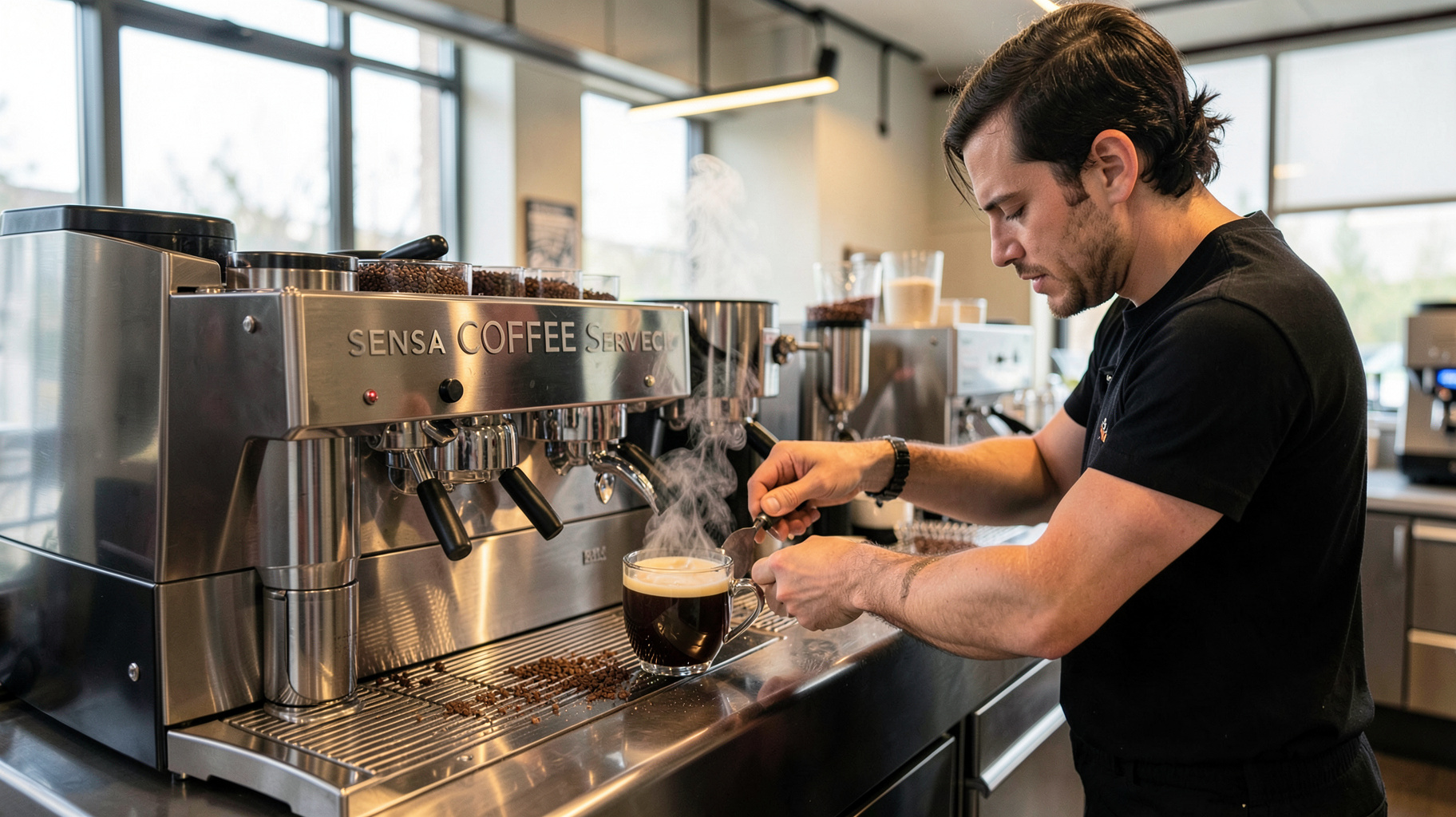
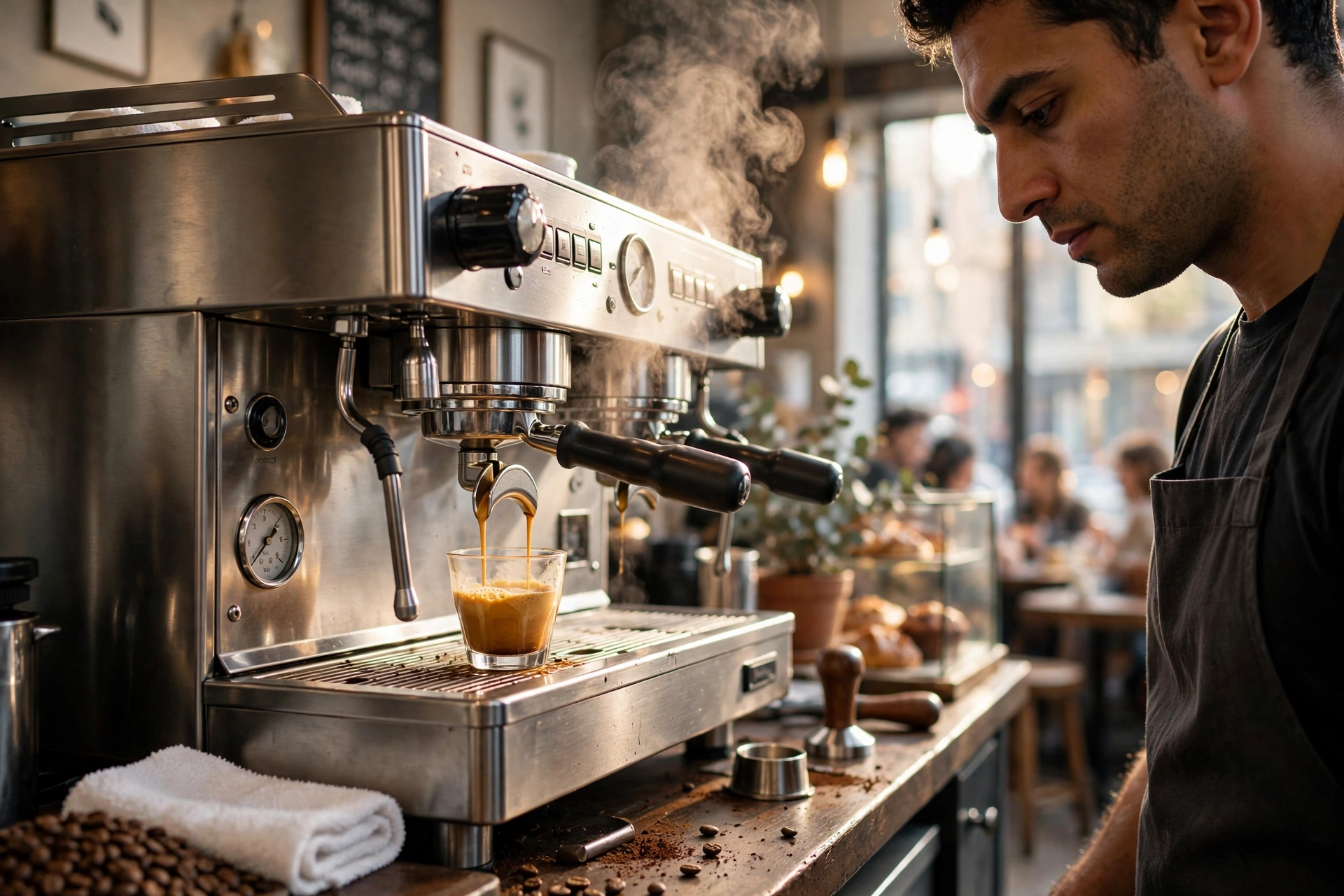
Commercial espresso machines utilize massive boilers and precision-engineered group heads to prevent this fluctuation. In my experience working with high-volume cafes, the shift from a single-boiler to a dual-boiler system typically reduces beverage waste by 15% to 20% because the barista no longer has to "purge" the machine to reach the correct temperature. Furthermore, these machines are built with industrial-grade components, stainless steel and brass, that can withstand the corrosive nature of water and the constant heat of a 12-hour shift.
According to the Specialty Coffee Association (SCA), the precision of water temperature and pressure is the foundation of specialty coffee quality. Without the ability to lock in these variables, you aren't actually serving specialty coffee; you are serving a gamble. When the equipment can't hold a steady 93°C (approx. 200°F), the complex sugars in Coffea arabica are not extracted correctly, resulting in a flat, bitter profile that alienates the modern, educated coffee consumer.

Why the Business Impact of Equipment Quality is Measurable
The financial argument for commercial espresso machines isn't about the initial cost; it's about the Cost per Cup (CPC) and the Lifetime Value (LTV) of the customer. When a business uses underpowered equipment, they face three invisible leaks: labor inefficiency, ingredient waste, and customer churn.
First, labor costs skyrocket when a barista spends 30% of their time fighting the machine rather than serving the guest. A professional machine with a volumetric dosing system allows the operator to press a button and walk away to steam milk, effectively doubling the output per labor hour. This is particularly evident in medical settings where speed is a priority, making automated coffee machines for clinics and medical offices a strategic choice for improving patient experience.
Second, the waste factor is staggering. Low-end machines often lead to "channeling" due to inconsistent pump pressure. According to the National Coffee Association USA (NCA), consumer demand for premium, specialty-grade coffee continues to rise, meaning guests are more likely to notice, and complain about, a poorly extracted shot. If a barista has to pull three shots to get one that tastes right, you are throwing away 66% of your most expensive raw ingredient.
Third, the risk of downtime. A home machine used in a commercial setting will likely fail within six months. When your only espresso machine goes down on a Saturday morning, you don't just lose the revenue for those drinks; you lose the trust of every customer who leaves because you can't provide the basic amenity they expect. This is why we emphasize the importance of managed solutions, such as the Sensa Coffee Service in Charlotte, NC, where maintenance is baked into the model to prevent these catastrophic failures.
Practical Application: Transitioning to a Commercial Coffee Program
Moving from a basic setup to a professional coffee program requires more than just buying a machine; it requires a system of integration. I've tested this with dozens of our clients, and the pattern is clear: those who treat the machine as a "plug-and-play" appliance fail, while those who treat it as a utility system thrive.
The first step is assessing your peak volume. If you are serving 50+ lattes during a morning rush, you need a multi-group head machine. A single-group machine creates a bottleneck that slows down every other part of your operation. Once the hardware is selected, the focus must shift to water quality. Commercial espresso machines are sensitive to mineral buildup. Using unconditioned water is the fastest way to destroy a $10,000 investment.
Next is the calibration of the grind. A commercial machine is only as good as the coffee bean and the grinder paired with it. You need a burr grinder that can maintain micron-level consistency. When we implement a program at Busy Bean Coffee, we don't just drop off a machine; we calibrate the "recipe", the ratio of dry coffee to liquid yield, to ensure the flavor profile is optimized for the specific roast.
💡
Key Takeaway
The true value of a commercial espresso machine is found in its "uptime" and "consistency." A machine that produces the exact same flavor profile at 7:00 AM as it does at 2:00 PM is the only way to build a repeatable, scalable brand.
For those in South Carolina, the environmental factors like humidity can actually affect how coffee beans behave in the hopper. This is why a localized approach, such as a Foodservice Coffee Program in Rock Hill SC: Complete Guide, is essential to ensure the equipment is tuned to the local climate and water chemistry.
Comparing Your Options: Prosumer vs. Commercial vs. Automated
Many business owners make the mistake of buying "prosumer" machines, high-end home machines, thinking they are "commercial enough." They are not. The difference lies in the duty cycle and the internal components.
| Feature | Prosumer / Home Grade | Generic "Office" AI Machines | Busy Bean Commercial Approach |
|---|---|---|---|
| Duty Cycle | Low (2-5 drinks/hour) | Medium (Intermittent) | High (Continuous 24/7) |
| Temperature Control | Basic / Manual | Programmed / Rigid | Precision PID / Dual Boiler |
| Maintenance | User-dependent (High Risk) | Proprietary / Limited | All-inclusive Managed Service |
| Consistency | Varies by operator | Medium (Bean-to-cup) | Absolute (SCA Standards) |
| Best For | Home use / Very low volume | Small offices / Breakrooms | Hotels, Cafes, Medical Centers |
Now, here's where it gets interesting: the rise of "super-automatics." For businesses that cannot afford a full-time trained barista, the automated commercial machine is the gold standard. It provides the consistency of a Q-Grader without the labor cost. This is why we often recommend the Sensa Coffee Service in Raleigh NC (2026 Overview) for corporate environments that want specialty quality without the operational headache of manual tamping and steaming.

Common Questions and Misconceptions
Most guides get this wrong by telling you that "any" commercial machine will work. That is a dangerous oversimplification.
Myth 1: "A more expensive machine automatically makes better coffee."
Incorrect. A $20,000 machine will produce terrible coffee if the water is hard and the beans are stale. The machine is a delivery system; the quality is determined by the inputs. The real value of a high-end machine is not "better" coffee, but "consistently" good coffee.
Myth 2: "Automatic machines are just 'k-cups' with a fancy name."
This is a common misconception. Professional automated machines use whole beans and high-pressure extraction, unlike pod machines. They utilize commercial-grade grinders and brew groups that mirror the process of a manual machine. When integrated into a Business Coffee Membership in Boston MA: Complete Guide, these machines provide a genuine specialty experience.
Myth 3: "Maintenance is something you do once a year."
If you wait a year to maintain a commercial espresso machine, you've already lost money. Scale buildup happens weekly. Professional programs require daily backflushing and weekly deep cleans. This is the primary reason we offer managed services; the mistake I see constantly is a business owner buying a machine and forgetting that it requires a rigorous cleaning schedule to avoid the NSF International sanitation failures.
Frequently Asked Questions
Why is a commercial espresso machine so much more expensive than a home model?
The price difference is rooted in the materials and the engineering for endurance. Home machines use plastic components and small boilers that cannot handle continuous use. Commercial units use heavy-gauge stainless steel, professional-grade pumps, and massive boilers that maintain temperature under pressure. Additionally, commercial machines are built to be serviced. While a home machine is often "disposable" once a major part breaks, a commercial machine is designed to be stripped down and rebuilt over a decade of use, providing a much lower total cost of ownership over time.
How do I know if I need a manual or an automated commercial machine?
The decision depends entirely on your labor model. If you have a trained barista who can manage the art of the "dial-in" (adjusting the grind and dose daily), a manual machine allows for the highest possible quality and artistic control. However, if your staff are multi-tasking employees, such as hotel receptionists or clinic admins, an automated machine is essential. Automated systems remove the human error factor, ensuring that every guest gets the same experience regardless of who is operating the machine. For those in high-traffic areas, our Sensa Coffee Service in Jacksonville, FL provides the perfect balance of this automation.
What are the actual costs of not using professional equipment?
The costs manifest as "invisible losses." First, there is the loss of throughput; if a machine takes 2 minutes longer per drink, and you serve 100 guests a morning, you are losing over 3 hours of potential service time. Second is the ingredient waste; inconsistent pressure can waste up to 20% of your coffee beans. Third is the brand erosion. In the era of social media, a "bad coffee" experience is a public review. When you use sub-par equipment, you aren't just risking a drink; you are risking your online reputation.
Can I just buy a prosumer machine and put it in my business?
Technically, yes, but operationally, it is a mistake. Prosumer machines lack the "thermal mass" required for commercial volume. After three or four drinks, the temperature will drop, and the quality will plummet. Furthermore, most prosumer machines do not carry the necessary health and safety certifications (like NSF) required for commercial kitchens. This can lead to issues during health inspections. It is far more sustainable to utilize a professional Sensa Coffee Service in Mount Pleasant SC: Complete Guide which ensures all equipment is compliant and capable of the load.
How does water filtration impact the performance of these machines?
Water is the largest ingredient in every cup of coffee and the biggest enemy of the machine. Minerals like calcium and magnesium create "scale" inside the boilers. In a commercial setting, this scale acts as an insulator, meaning the machine has to work harder to heat the water, which eventually burns out the heating element. Professional filtration systems remove these minerals while leaving the essential flavors. Without a dedicated filtration strategy, even the most expensive machine will fail prematurely, which is why we integrate water solutions into every Sensa Coffee Service in Columbia SC: Complete Guide | Busy Bean Coffee we deploy.
Final Thoughts on Commercial Espresso Machines
Investing in commercial espresso machines is not about buying a luxury appliance; it is about installing a reliable revenue engine. When you prioritize thermal stability, volumetric consistency, and industrial-grade durability, you eliminate the variables that lead to waste and customer dissatisfaction. The transition from "making coffee" to "running a professional beverage program" is marked by the quality of the equipment you put on your counter.
Whether you are scaling a boutique hotel or optimizing a corporate office, the goal is the same: an uncompromising cup of coffee delivered with maximum efficiency. At Busy Bean Coffee, we remove the risk from this equation by providing all-inclusive managed memberships that cover the equipment, the installation, and the ongoing maintenance. Don't let your business be the one that loses a customer over a lukewarm latte.
To elevate your beverage standards and secure your ROI, visit www.busybeancoffee.com to explore our managed coffee solutions.
Free Coffee Pairing Guide & Specialty Roast Cheat Sheet
Unlock the secrets of perfect brewing ratios, water temperatures, and specialty roast profiles. Download the guide.