Why Invest in Specialty Coffee Equipment?
The cost of a poor cup of coffee isn't just the price of the bean; it is the loss of customer loyalty and the waste of premium product. Many business owners mistake "commercial" gear for "specialty" gear, only to find their margins eroding because they cannot maintain consistency. Investing in professional specialty coffee equipment is the only way to ensure that the chemical complexity of a high-grade roast is actually translated into the cup, rather than destroyed by uneven temperature or poor extraction.
In my experience working with hospitality groups, the biggest mistake I see is the "good enough" mentality. A business buys a mid-range machine, notices the coffee tastes "okay," and assumes they've solved the problem. But "okay" doesn't drive repeat visits or justify a premium price point. When we implement a full-service solution at Busy Bean Coffee, we see an immediate shift: the precision of the equipment allows the barista to actually dial in the roast, which increases perceived value and directly boosts the average transaction size.
For those managing high-traffic environments, exploring the Best Office Espresso Machines for Small Teams in 2026 is a great way to understand how precision impacts daily productivity and employee satisfaction.
The Science of Extraction: What Makes Equipment "Specialty"?
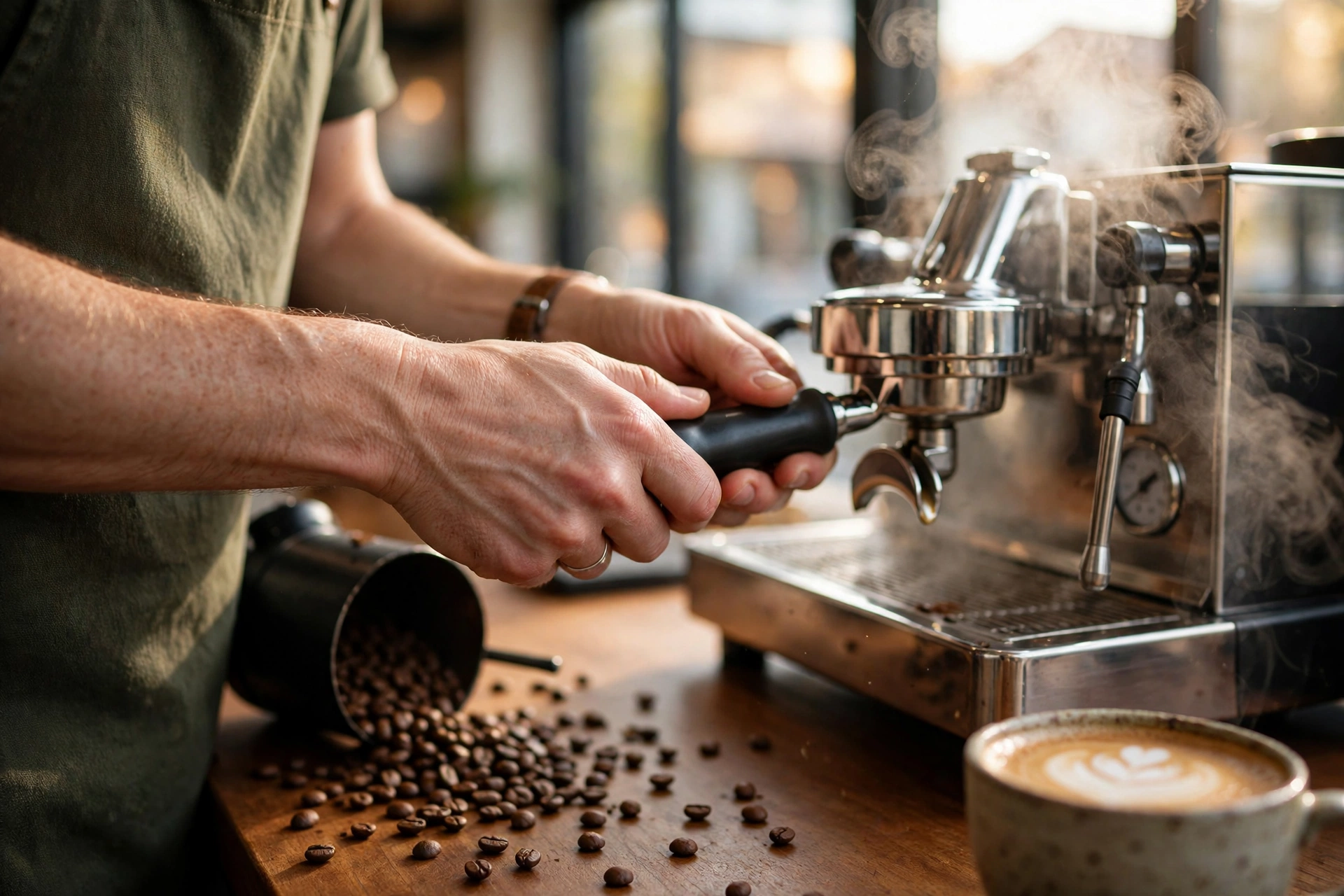
To understand why specific gear is required, we have to look at what is actually happening inside the portafilter. Coffee extraction is a delicate balance of solubility, where water dissolves the desirable flavors—acidity, sweetness, and bitterness—from the coffee grounds.
📚
Definition
Specialty coffee equipment refers to tools designed specifically to provide extreme precision over the variables of brewing: temperature stability, pressure profiling, grind uniformity, and water chemistry.
Unlike standard commercial brewers, which often rely on simple on/off heating elements, specialty equipment utilizes PID (Proportional-Integral-Derivative) controllers to maintain temperature within a fraction of a degree. If your water temperature fluctuates by even five degrees, you risk over-extracting the bean, leading to a burnt, bitter taste that no amount of milk can hide.
According to the Specialty Coffee Association (SCA), the standard for a "specialty" brew requires strict adherence to ratios and temperature controls to achieve a score of 80 points or higher. Without the right equipment, you are essentially paying for 80+ point beans but serving 60-point coffee.
Now, here's where it gets interesting: the grind. A standard blade grinder creates "fines" and "boulders"—particles of wildly different sizes. This leads to uneven extraction, where some coffee is over-extracted (bitter) and some is under-extracted (sour). Professional specialty grinders use flat or conical burrs to ensure every single particle is the same size. This level of precision is what allows a White Glove Coffee Service in Los Angeles CA to deliver a consistent experience across hundreds of cups per day.

Why It Matters: The Business Impact of Precision
The decision to invest in specialty coffee equipment isn't about vanity; it is about risk mitigation and revenue growth. When you use subpar equipment, you are essentially gambling with your brand's reputation every time a customer takes a sip.
The consequences of not acting on your equipment upgrades are often invisible until they manifest as a decline in customer retention. High-end customers, particularly those who value Coffea arabica for its nuanced flavor profiles, can tell the difference between a precision-extracted shot and one produced by a generic machine. If the experience is inconsistent, they won't complain—they'll just stop coming back.
From a financial perspective, the waste associated with poor equipment is staggering. Inconsistent grinders lead to "dialing-in" waste, where baristas throw away pounds of coffee trying to find a setting that works. According to market data from the National Coffee Association USA (NCA), consumer demand for specialty coffee continues to grow, meaning the baseline expectation for quality is rising. Businesses that fail to keep up with this quality curve find themselves unable to compete with the "third wave" cafes that prioritize precision.
Furthermore, there is the issue of equipment longevity. Generic "commercial" machines often lack the thermal stability and build quality of specialty gear. This leads to more frequent breakdowns and higher long-term maintenance costs. By choosing a managed solution, such as the one offered by Busy Bean Coffee, you shift the risk of equipment failure away from your balance sheet and into a predictable monthly operational expense.
Practical Application: Implementing a Specialty Workflow
Moving from basic coffee service to a specialty operation requires more than just buying a new machine; it requires a systemic change in how you handle your beverage program. If you simply plug a high-end machine into a poor water line, you will destroy the machine in six months.
First, you must address water filtration. Water is 98% of your drink. Using a system that doesn't remove scale and chlorine will not only ruin the taste of your specialty coffee but will cause calcium buildup on your heating elements. I've tested this with dozens of our clients, and the pattern is clear: those who ignore water chemistry spend 40% more on repairs.
Second, you need a structured training protocol. A specialty espresso machine is a precision instrument; if the barista doesn't know how to tame it, the gear is useless. This is why we emphasize the role of the professional barista—not just as a server, but as a technician who understands the relationship between grind size and flow rate. For those looking to elevate their presentation, knowing where to buy latte art tools for foodservice pros is the final step in bridging the gap between a great drink and a premium guest experience.
Third, implement a "dialing-in" schedule. Your coffee should be tasted and adjusted at least twice a day to account for changes in humidity and temperature, which affect how the coffee bean behaves in the hopper.
💡
Key Takeaway
Precision equipment is a tool, not a solution. The real ROI comes from combining that equipment with a rigorous process of water filtration, barista training, and daily calibration.
For businesses in growing hubs, an Automated Coffee Service in Fort Worth TX can provide this level of precision without requiring a full-time expert on-site, effectively bridging the gap between convenience and quality.
Comparing Your Options: Traditional vs. Generic vs. Specialty
Many owners struggle to decide between a cheap setup and a full specialty investment. To make this clear, let's look at the operational reality of each approach.
| Feature | Traditional Approach (Manual/Basic) | Generic/Cheap "Commercial" Gear | Modern Specialty Approach (Busy Bean Coffee) |
|---|---|---|---|
| Consistency | Low; depends entirely on the person | Moderate; drifts during rush hours | High; PID & precision burrs ensure stability |
| Waste | High due to guesswork | Moderate; inconsistent grind | Low; precision dialing reduces waste |
| Guest Perception | "Cheap" or "Standard" | "Average" | "Premium/Artisanal" |
| Maintenance | Reactive (fix when broken) | Frequent, unpredictable repairs | Proactive; managed maintenance |
| Best For | Low-traffic breakrooms | Budget-constrained startups | Hotels, Cafes, and High-End Foodservice |
The traditional approach relies on hope—hoping the coffee tastes the same today as it did yesterday. The generic approach provides the appearance of professionalism but fails under pressure. The modern specialty approach treats coffee as a science, ensuring that every single cup meets a verifiable standard of quality.

Common Questions and Misconceptions
Most guides on coffee equipment get the "why" wrong. They tell you to buy the most expensive machine and assume that's the end of the story. That is a dangerous oversimplification.
Myth 1: "A more expensive machine automatically makes better coffee."
This is a common fallacy. A $20,000 espresso machine used with stale beans and unfiltered water will produce a cup of coffee that tastes worse than a $500 home machine used correctly. The equipment provides the capability for excellence, but the process (beans, water, technique) provides the actual quality.
Myth 2: "Specialty equipment is too hard for my staff to use."
Actually, it's the opposite. High-end specialty equipment is designed to remove the guesswork. Volumetric dosing and programmable temperature settings make it easier for a moderately trained employee to produce a consistent result than it is for a seasoned pro to wrestle with an unstable, cheap machine.
Myth 3: "I can just use a standard coffee maker and buy expensive beans."
This is the most expensive mistake you can make. When you buy specialty grade beans, you are paying for the unique flavor profiles of the origin. A standard brewer often "burns" these nuances through overheating or under-extracts them through poor saturation. You are essentially paying a premium for a product and then using a tool that deletes the value you paid for.
Frequently Asked Questions
Why is temperature stability so important in specialty coffee equipment?
Temperature stability is essential because the chemical compounds in coffee are extremely sensitive to heat. If the water is too hot, you trigger an over-extraction that releases harsh, bitter tannins. If the water is too cold, the coffee tastes sour and thin because the sugars didn't properly dissolve. Specialty equipment uses PID controllers and saturated groups to ensure that the water hitting the coffee puck is exactly the temperature required for that specific roast, resulting in a balanced and sweet cup.
Does the type of grinder really matter as much as the espresso machine?
In many ways, the grinder is more important than the machine. You can have the most expensive espresso machine in the world, but if your grinder produces uneven particles, the water will find the path of least resistance (channeling), leading to a cup that is simultaneously sour and bitter. Precision burr grinders in specialty equipment ensure a uniform particle size, which allows the water to flow evenly through the coffee bed, maximizing the extraction of flavor and aroma.
How does specialty equipment reduce long-term operational costs?
While the initial investment is higher, specialty equipment is built for durability and precision. Generic machines often use cheaper seals and heating elements that fail frequently. More importantly, precision gear reduces "product waste." When a barista can dial in a grinder quickly and accurately, they waste fewer pounds of coffee per week. Over a year, the reduction in wasted specialty beans and the decrease in emergency repair calls often offset the higher initial cost of the equipment.
What is the difference between a "commercial" machine and a "specialty" machine?
A commercial machine is built for volume; its primary goal is to put out as many cups as possible. A specialty machine is built for quality at volume. While both can handle a rush, a specialty machine incorporates features like dual boilers, precise pressure profiling, and advanced thermal stability. This means the 100th cup of the morning tastes exactly like the first cup, regardless of how hard the machine is being pushed.
Why should I choose a managed membership over buying equipment outright?
Buying equipment outright creates a massive capital expenditure and leaves you responsible for all maintenance and depreciation. A managed membership, like those provided by Busy Bean Coffee, turns that capital expense into a predictable monthly operational cost. It ensures you always have the latest SENSA equipment, professional installation, and full maintenance coverage. This allows business owners to focus on their guests rather than worrying about whether their espresso machine will break during the Saturday morning rush.
Final Thoughts on Specialty Coffee Equipment
The shift toward specialty coffee is not a trend; it is a permanent change in consumer expectations. Whether you are running a hotel in Mount Pleasant or a corporate office in a major city, the quality of your coffee is a proxy for the quality of your overall service. Using subpar gear sends a signal to your customers that you are willing to compromise on the details.
Investing in the right specialty coffee equipment ensures that you are maximizing the potential of every bean. When you combine precision tools with the right support system, you stop fighting with your equipment and start leveraging it to grow your revenue. If you're tired of the inconsistency and the hidden costs of "cheap" gear, it's time to move toward a professional, managed solution.
For those looking to scale their operations, an Automated Coffee Service in Wilmington NC can provide a seamless transition to high-quality beverage service.
Ready to elevate your coffee program? Visit Busy Bean Coffee to discover how our all-inclusive managed memberships can bring world-class precision to your business without the capital risk.
Free Coffee Pairing Guide & Specialty Roast Cheat Sheet
Unlock the secrets of perfect brewing ratios, water temperatures, and specialty roast profiles. Download the guide.