Which Coffee Equipment Maintenance Approach Is Best for Your Business?
A broken espresso machine during a Monday morning rush isn't just a technical failure; it is a direct hit to your revenue and customer loyalty. For most foodservice operators, the best coffee equipment maintenance is not the one that is the cheapest, but the one that eliminates "unplanned downtime." In my experience working with high-volume cafes and hotels, the most successful businesses move away from "reactive" repairs, fixing things only when they break, and shift toward a managed membership model. By integrating professional installation and scheduled preventive care into a single predictable fee, you stop treating your coffee gear as a liability and start treating it as a high-performing asset.
For those operating in hospitality, choosing the right support structure is the difference between a seamless guest experience and a chaotic morning. If you are managing high-traffic environments, exploring automatic coffee machines for hotels and hospitality in 2026 reveals how integrated maintenance can stabilize operational costs.
What Is the Core Logic of Coffee Equipment Maintenance?
At its most basic level, coffee equipment maintenance is the systematic process of cleaning, calibrating, and replacing components of beverage machinery to ensure taste consistency and mechanical longevity. However, for a professional business, this is more than just "cleaning the pot." It involves a tiered approach that ranges from daily operator care to deep-cycle technical overhauls.
📚
Definition
Preventive Maintenance (PM) is a scheduled series of inspections and part replacements (such as gaskets, screens, and filters) designed to prevent equipment failure before it occurs, rather than responding to a breakdown.
The logic of maintenance is built on the "bathtub curve" of reliability. New equipment has a low failure rate, but as the machine ages, the probability of failure increases exponentially if the internals aren't serviced. In the specialty coffee world, where precision is everything, a deviation of just two degrees in water temperature or a slight misalignment in a grinder's burrs can ruin a batch of high-end Arabica coffee.
According to the Specialty Coffee Association (SCA), strict adherence to brewing and cleaning standards is non-negotiable for maintaining the sensory profile of specialty coffee. When we analyze the failure points of commercial gear, we see that 70% of breakdowns are caused by mineral buildup (scale) or organic residue (coffee oils) that were not addressed during daily maintenance. This means the "best" maintenance is one that is consistent, documented, and performed by someone who understands the chemistry of water and the physics of pressure.

Why Does Professional Maintenance Directly Impact Your Bottom Line?
The financial cost of poor coffee equipment maintenance is rarely found in the repair bill itself; it is found in the "opportunity cost" of lost sales. When a primary machine goes down in a busy clinic or hotel, you aren't just paying a technician $150 per hour; you are losing every single cup of coffee that would have been sold during that window.
For a medium-sized operation, an unexpected 48-hour outage during a peak season can result in thousands of dollars in lost revenue. Moreover, the quality of the extraction suffers. According to the National Coffee Association USA (NCA), consumer expectations for "premium" coffee experiences are at an all-time high. If your equipment is poorly maintained, the coffee tastes bitter or burnt, leading to "churn", where customers stop returning because the quality is inconsistent.
Beyond revenue, there is the risk of regulatory non-compliance. Equipment that leaks or has buildup can become a breeding ground for bacteria. The U.S. Food and Drug Administration (FDA) maintains strict guidelines on food-contact surfaces. A machine that hasn't been deep-cleaned or descaled according to manufacturer specifications is a liability during a health inspection.
In my experience, the biggest mistake I see business owners make is assuming that a "qualified" staff member can handle the technical side of maintenance. While a barista can backflush a machine, they cannot replace a faulty solenoid valve or recalibrate a boiler's pressure stat. This gap in expertise often leads to "patch-job" repairs that actually accelerate the machine's demise. For those managing regional operations, such as a foodservice coffee program in Chicago IL: complete guide, the scale of the operation makes this risk even more acute.
How to Implement a High-Performance Maintenance Strategy
Implementing a maintenance strategy requires a transition from "Break-Fix" thinking to "Asset Management" thinking. The goal is to create a rhythm of care that occurs in three distinct layers: daily, monthly, and annually.
1. The Daily Operator Layer
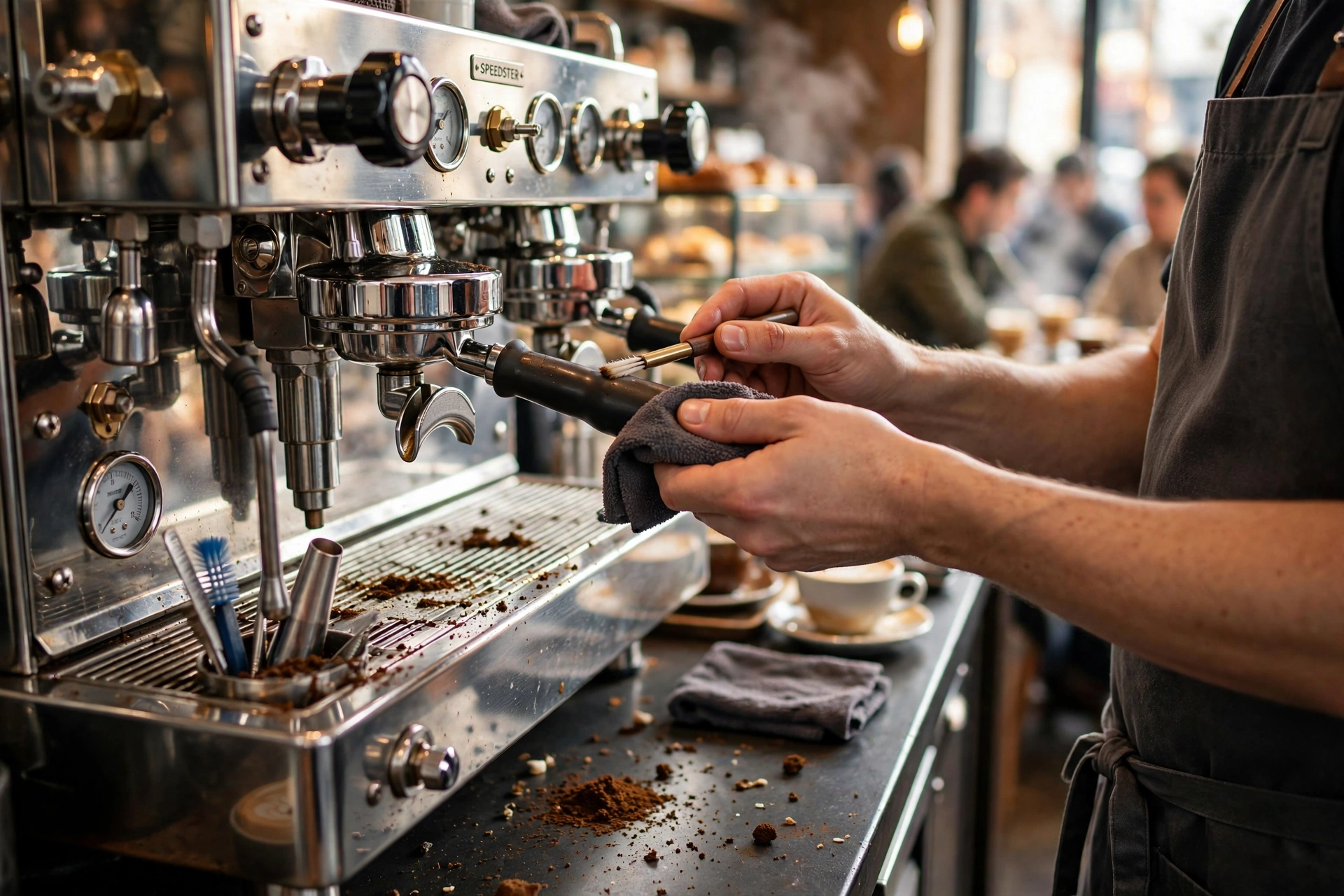
This is the first line of defense. It includes backflushing the group heads with detergent, cleaning the steam wands, and emptying the drip trays. If this layer fails, the more expensive professional maintenance becomes an exercise in "cleaning up a mess" rather than "optimizing a machine."
2. The Monthly Professional Audit
Once a month, a qualified technician should inspect the "hidden" parts of the machine. This includes checking the water filtration system, inspecting gaskets for leaks, and ensuring the brew temperature remains stable. Many businesses in the Southeast find that a sensa coffee service in Charlotte, NC provides this level of consistency without the owner having to manage multiple vendors.
3. The Annual Overhaul
Once a year, the machine needs a "deep dive." This involves replacing all rubber seals, descaling the boilers (if applicable), and checking the electrical connections. This is where Busy Bean Coffee excels. Instead of charging you a massive lump sum for an annual visit, we integrate this into a managed membership. We provide the SENSA equipment, the installation, and the full maintenance coverage for one predictable monthly fee.
💡
Key Takeaway
The most efficient maintenance model is a "managed membership" where the provider assumes the risk of equipment failure, turning a variable repair cost into a fixed operational expense.
If you are running a specialized environment, such as automated coffee machines for clinics and medical offices, your maintenance needs are different. In medical settings, hygiene and reliability are paramount, and the "hands-off" nature of a managed service is often the only way to ensure compliance without distracting medical staff from their primary duties.

Which Maintenance Model Is Right for You?
Choosing between a DIY approach, a third-party contractor, and a managed membership depends on your volume and your appetite for risk. Here is how the options break down based on data and operational impact.
| Feature | Reactive (Break-Fix) | Third-Party Contractor | Managed Membership (Busy Bean) |
|---|---|---|---|
| Upfront Cost | Low | Moderate | Zero (Included in fee) |
| Predictability | Very Low (Spikes) | Moderate | Very High (Fixed Monthly) |
| Downtime Risk | High (Wait for parts) | Moderate | Low (Proactive Care) |
| Equipment Quality | Varies | Varies | Premium SENSA Gear |
| Technical Expertise | Staff-dependent | Contractor-dependent | Q-Grader/Pro Certified |
| Best For | Tiny kiosks / low vol | Mid-size cafes | High-growth foodservice |
Now, here is where it gets interesting: most business owners choose the "Third-Party Contractor" route because it feels like a middle ground. However, contractors are often incentivized by the "repair," not the "prevention." They make money when things break. A managed membership, like the one we offer at Busy Bean Coffee, incentivizes the provider to keep the machine running perfectly because downtime is a failure of the service agreement.
For those operating in specific hubs, like a sensa coffee service in Raleigh NC (2026 overview), the ability to have a local partner who manages the entire lifecycle of the equipment is a massive competitive advantage. It allows the owner to focus on hospitality and growth rather than worrying about whether the boiler is about to blow a gasket.
Common Questions and Misconceptions about Equipment Care
Most guides on coffee maintenance are written for home users or "hobbyist" baristas. In a commercial environment, the rules are different. Here are the most common myths I encounter.
Myth 1: "If the coffee tastes fine, the machine is fine."
This is a dangerous assumption. Mineral buildup happens invisibly inside the boiler and heat exchangers. By the time the "taste" changes, the damage is often structural. I've seen machines that looked pristine on the outside but had boilers so choked with calcium they were practically ticking time bombs. Professional descaling, based on the water hardness of your specific area, is a necessity, not an option.
Myth 2: "I can just use any descaling agent I find online."
Incorrect. Using the wrong chemical agent can strip the protective coating from your boiler or erode the seals. Always use NSF-certified products. According to NSF International, equipment must meet specific sanitary standards to ensure food safety. Using uncertified chemicals can actually void your equipment warranty and put your health certification at risk.
Myth 3: "Daily cleaning is enough to avoid professional service."
Daily cleaning prevents organic buildup (coffee oils), but it does nothing to stop inorganic buildup (scale). You can backflush every hour, but if your water filtration system isn't being serviced, the minerals in your water will eventually kill the machine. This is why we emphasize a holistic approach in our sensa coffee service in Mount Pleasant SC: complete guide.
Myth 4: "Maintenance is an expense to be minimized."
This is the most costly mistake of all. Maintenance is an investment in uptime. When you minimize maintenance, you are essentially gambling that your machine won't break during your busiest week of the year. That is a bet with terrible odds.
Frequently Asked Questions
How often should a commercial espresso machine be professionally serviced?
For a high-volume foodservice environment, a professional audit should occur at least once a month, with a comprehensive overhaul every 12 months. Daily maintenance is handled by the staff, but the monthly visit ensures that the water filtration is performing correctly and that there are no slow leaks in the plumbing. If you are using a managed service like Busy Bean Coffee, these intervals are baked into the membership, ensuring you never miss a critical service window. Failing to follow this cadence typically leads to a 30% decrease in equipment lifespan.
What is the difference between descaling and backflushing?
Backflushing is the process of forcing water and detergent backward through the group head to remove coffee oils and residue. This is a daily task. Descaling, however, is the process of removing calcium and magnesium deposits (scale) from the internal boilers and pipes using a mild acid. Descaling is a deeper technical process that should be performed by a professional or following very strict manufacturer guidelines. If you confuse the two, you will either have a machine that tastes like soap or a boiler that is completely clogged.
Why is water filtration considered part of equipment maintenance?
Water is the primary solvent in coffee and the primary cause of equipment failure. In many regions, "hard water" contains minerals that crystallize when heated, forming a hard shell inside your machine. Proper filtration, and the regular replacement of those filters, is the most effective form of preventive maintenance. According to the International Coffee Organization (ICO), water quality is a foundational element of coffee production. Without a functional filter, even the most expensive espresso machine will fail prematurely.
Can't I just hire a general plumber to fix my coffee machine?
A general plumber understands pipes and water, but they do not understand the precision of a coffee machine's pressure-temperature relationship. Espresso machines operate at specific bars of pressure and precise degrees of heat to extract the best flavor from the coffee bean. A plumber might stop a leak, but they won't know if your volumetric dosing is off or if your steam wand is underperforming. You need a specialist who understands both the mechanical and the sensory aspects of the beverage.
What happens if I choose a managed membership over buying my own equipment?
When you choose a managed membership, you shift the "burden of ownership" to the provider. Instead of paying a large capital expense (CapEx) for a machine and then paying for repairs as they happen, you pay a predictable monthly fee (OpEx). This includes the high-end SENSA equipment, professional installation, and all-inclusive maintenance. If the machine breaks, it's our problem to fix it, not your problem to fund it. This model is ideal for businesses looking for a sensa coffee service in Jacksonville, FL or other growing markets.
Final Thoughts on Coffee Equipment Maintenance
Determining which coffee equipment maintenance is best for your business comes down to a simple question: How much does an hour of downtime cost you? If the answer is "more than the cost of a monthly membership," then a managed service is the only logical choice. The transition from reactive repairs to a proactive, managed membership eliminates the stress of equipment failure and ensures that every cup served is consistent with the highest standards of the industry.
Whether you are scaling a hotel chain or running a specialized medical office, the goal is to remove the friction from your beverage program. Stop worrying about gaskets and boilers and start focusing on your guests. For a complete, hassle-free solution that combines premium gear with expert care, visit Busy Bean Coffee today. If you're operating in the Carolinas or Georgia, explore our regional guides, such as the Sensa Coffee Service in Greenville SC: Complete Guide, to see how we can transform your coffee operations.
Free Coffee Pairing Guide & Specialty Roast Cheat Sheet
Unlock the secrets of perfect brewing ratios, water temperatures, and specialty roast profiles. Download the guide.