When Should You Replace Your Specialty Coffee Equipment?
The most expensive mistake a cafe owner can make is waiting for a machine to completely fail during a morning rush before considering an upgrade. In my experience working with dozens of high-volume foodservice businesses, the "breaking point" is rarely a sudden explosion of steam; it is a slow, invisible erosion of profit margins caused by inconsistent extraction and rising energy costs. You should replace your specialty coffee equipment when the cost of annual maintenance exceeds 20% of the machine's replacement value, when you can no longer maintain brew temperature stability within a 1-degree margin, or when your volume growth has outpaced the machine's rated capacity by more than 15%.
For those managing a corporate environment, the timing often shifts toward efficiency and reliability. If you are noticing a spike in employee complaints or a decrease in the quality of your Best Office Espresso Machines for Small Teams in 2026, it is a signal that your current hardware is no longer meeting the demands of your workforce.
Understanding the Lifecycle of Professional Coffee Hardware
Determining the exact moment to pivot from repair to replacement requires a clinical understanding of equipment depreciation and mechanical fatigue. Most commercial-grade machines are engineered for a specific duty cycle, but "age" is a deceptive metric. A five-year-old machine in a low-volume office might be pristine, while a two-year-old machine in a high-traffic hotel lobby in Mount Pleasant, SC, might be nearing its end of life.
📚
Definition
Duty Cycle refers to the amount of time a piece of equipment is operational compared to the time it is idle, typically measured by the number of shots pulled or gallons of water heated per hour.
When we analyze the health of specialty coffee equipment, we look at the "Critical Component Failure Rate." This is the frequency with which primary seals, heating elements, and pumps require replacement. According to the Specialty Coffee Association (SCA), maintaining strict brewing standards requires precise temperature and pressure control; once the boiler's integrity is compromised by scale or corrosion, these standards become impossible to hit. If you find yourself replacing gaskets every three months instead of every six, the internal metallurgy of the machine is likely degrading.
The mistake I made early on—and that I see constantly—is treating the machine as a static asset. I once managed a site where we kept an aging espresso machine running through sheer willpower and a dedicated technician, only to realize we were losing nearly 12% of our daily revenue to downtime and "off-flavor" shots that customers refused to pay for. The technical debt of old equipment eventually manifests as a financial liability.
Why the Timing of Replacement Impacts Your Bottom Line
Waiting too long to upgrade your hardware doesn't just affect the taste of the coffee; it creates a cascading effect on your operational overhead. The primary drivers are energy inefficiency, labor waste, and the hidden cost of "micro-downtime." Micro-downtime refers to those small, 10-minute windows where a machine isn't fully broken but is performing poorly, forcing your barista to waste shots or struggle with steaming.
From a regulatory and safety standpoint, older equipment often fails to meet modern standards. NSF International provides rigorous certifications for food equipment safety, and as standards evolve, older machines may lack the necessary safety valves or materials to remain fully compliant with current health codes. This can lead to costly fines or insurance complications during a routine inspection.
Furthermore, the energy consumption of older boilers is significantly higher than that of modern, PID-controlled systems. Modern specialty coffee equipment utilizes precision heating that only energizes the element when necessary, whereas older machines often keep massive amounts of water at high heat constantly. When you factor in the rising cost of electricity in 2026, the "savings" from not buying a new machine are often wiped out by the utility bill.
If you are operating in a specific region, such as needing a Coffee delivery service in Charlotte NC - Complete Guide | Busy Bean Coffee, you likely know that consistency is the only way to maintain a loyal customer base. If your equipment cannot guarantee that the 100th shot of the day tastes exactly like the first, you are effectively gambling with your brand equity every single morning.
How to Identify the "Replacement Triggers" in Your Workflow
Identifying the right time to upgrade requires a systematic approach. You cannot rely on a "gut feeling"; you need a checklist of triggers that signal the transition from maintenance to replacement.
Step 1: The Financial Threshold Analysis
Calculate your total spend on repairs over the last 12 months. Include parts, labor, and the cost of lost productivity during downtime. If this number exceeds 20-25% of the cost of a new, equivalent machine, you are in the "replacement zone."
Step 2: The Quality Audit
Perform a blind tasting of your espresso across three different times of the day (opening, peak rush, and closing). If there is a noticeable shift in acidity or body that cannot be corrected by adjusting the grind, your temperature stability is failing. This usually indicates a failing heating element or a scaled-up boiler.
Step 3: The Capacity Stress Test
Track your peak hourly volume. If your baristas are spending more time waiting for the machine to recover pressure than they are actually prepping drinks, your equipment is the bottleneck. Upgrading to a higher-capacity system or an Automated Coffee Service in Fort Worth TX - Complete Guide | Busy Bean Coffee can immediately increase your throughput by 20% or more.
Step 4: The Parts Availability Check
Contact your supplier. If the lead time for critical replacement parts has stretched from "next day" to "three weeks" because the model is phased out, you are one broken seal away from a complete business shutdown.
💡
Key Takeaway
The moment your equipment becomes a bottleneck to your growth or a risk to your consistency, it is no longer an asset—it is a liability.
At Busy Bean Coffee, we help our clients avoid these pitfalls by implementing all-inclusive managed solutions. Instead of worrying about the "when" of replacement, our members have a predictable monthly fee that ensures they always have premium, functioning SENSA equipment without the capital expenditure stress.

Comparing Replacement Strategies: Repair vs. Replace vs. Managed Service
Many operators struggle with the choice between patching up old gear or investing in something new. The decision usually comes down to your long-term business goals and your tolerance for risk.
| Strategy | Pros | Cons | Best For |
|---|---|---|---|
| Aggressive Repair | Low immediate cash outlay; extends life of familiar gear. | High long-term cost; risk of sudden failure; poor efficiency. | Businesses with very low volume or temporary setups. |
| Capital Purchase | Full ownership; latest technology; high efficiency. | Massive upfront cost; depreciation; owner handles maintenance. | High-margin cafes with significant cash reserves. |
| Managed Service | No CAPEX; guaranteed uptime; predictable monthly cost. | Monthly commitment; less "ownership" of the hardware. | Growth-oriented businesses, hotels, and corporate offices. |
Now here's where it gets interesting: the "Generic AI" approach to equipment management often suggests buying the cheapest machine that fits the spec sheet. But in the specialty coffee world, a "cheap" machine is often the most expensive one you'll ever own because it lacks the thermal mass and build quality required for consistency. Whether you are looking for a White Glove Coffee Service in Denver CO - Complete Guide or a local setup, the quality of the build determines the length of the lifecycle.
If you're focusing on the presentation of your drinks, you might also be looking for Where to Buy Latte Art Tools for Foodservice Pros | Busy Bean Coffee, but remember that the best latte art in the world cannot save a shot of espresso pulled from a failing machine. The hardware is the foundation; everything else is just decoration.
Common Misconceptions About Equipment Lifespans
There is a persistent myth in the industry that "they don't make them like they used to," leading some owners to cling to 15-year-old machines. Most guides get this wrong by focusing on the durability of the steel rather than the evolution of the technology. While an old boiler might still hold water, it cannot compete with the precision of modern PID controllers and saturated groups.
Another common misconception is that a "refurbished" machine is a safe mid-way point. In my experience, refurbished equipment is a gamble. Unless the refurbishment was done by the original manufacturer with a full warranty on the boiler and pump, you are often just buying someone else's problem. You might save 40% upfront, but you'll spend that savings (and more) on emergency technician visits within the first year.
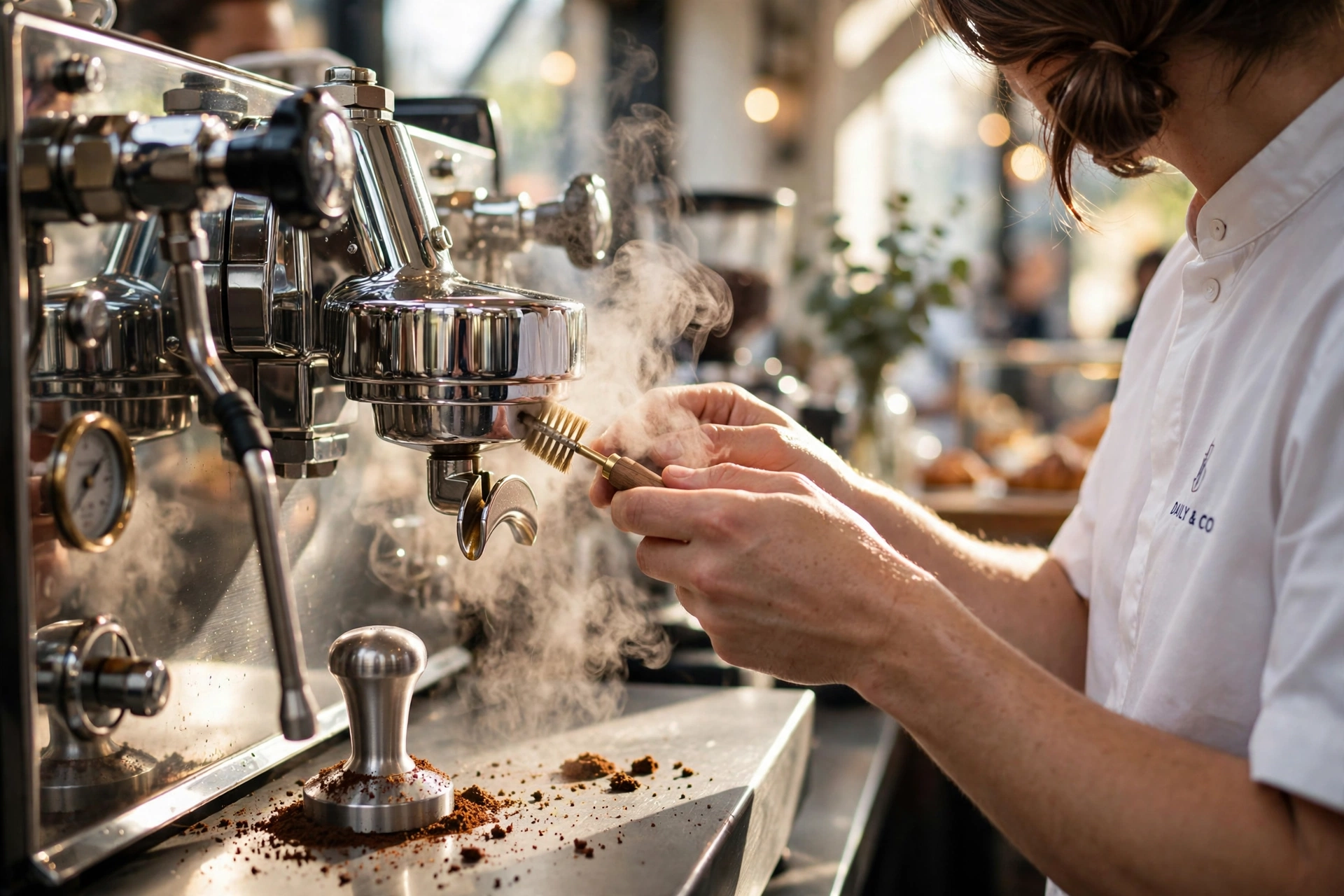
Lastly, many believe that "cleaning more" can stop the need for replacement. While rigorous maintenance—following FDA guidelines for food-contact surfaces—will certainly extend the life of your equipment, it cannot stop the natural wear and tear on mechanical pumps and electronic boards. There is a hard ceiling on how much "cleaning" can offset the laws of physics and mechanical fatigue.
Frequently Asked Questions
How often should I realistically replace a commercial espresso machine?
For a high-volume specialty cafe, the optimal replacement window is typically every 5 to 7 years. While a well-maintained machine can last a decade, the efficiency gains and technology leaps—such as improved thermal stability and energy-saving modes—usually provide a significant ROI when you upgrade around the 6-year mark. If you are in a corporate setting with lower volume, you may extend this to 8 or 10 years, provided you have a strict preventative maintenance schedule in place.
What are the first warning signs that my equipment is failing?
The most reliable "early warning" is a shift in the flavor profile of your coffee that you cannot fix by dialing in the grind. When your espresso starts tasting overly sour or bitter despite correct dosing, it usually means your temperature is fluctuating. Other signs include an increase in the time it takes for the machine to reach operating temperature, strange noises from the pump, or steam pressure that drops significantly during peak hours.
Is it better to buy a new machine or use a managed coffee service?
It depends on your cash flow and risk tolerance. A capital purchase gives you ownership but leaves you responsible for all maintenance and the eventual "death" of the machine. A managed service, like those we offer at Busy Bean Coffee, removes the capital risk entirely. You get premium equipment and full maintenance for a predictable monthly fee, which is almost always better for businesses that want to scale without risking huge sums of cash on depreciating hardware.
Can water filtration actually extend the life of my specialty coffee equipment?
Absolutely. In fact, water quality is the single most important factor in equipment longevity. Scale buildup is the primary killer of boilers and heat exchangers. By using a professional-grade filtration system that manages mineral content and pH levels, you can potentially double the lifespan of your machine. However, even with perfect water, mechanical parts like pumps and gaskets will still wear out over time.
Should I upgrade if my current machine still "works" but is slow?
Yes, because "slow" is a hidden cost. If your equipment is slowing down your workflow, you are losing money on every single transaction. In a fast-paced environment, a 30-second delay per drink during a morning rush can result in lost customers and stressed staff. If your volume has increased, upgrading to a more powerful system or an Automated Coffee Service in Wilmington NC - Complete Guide is an investment in capacity, not just a repair.
Final Thoughts on Specialty Coffee Equipment
Knowing when to replace your specialty coffee equipment is the difference between running a business and fighting a losing battle against your own hardware. The goal is to move from a "reactive" posture—where you fix things when they break—to a "proactive" posture, where you upgrade based on data, volume, and quality benchmarks.
If you are tired of the unpredictability of equipment failure and the stress of massive upfront costs, it is time to consider a different model. Whether you need a White Glove Coffee Service in Los Angeles CA - Complete Guide | Busy Bean Coffee or a managed solution for a boutique hotel, the answer lies in removing the friction between you and a perfect cup of coffee.
Stop guessing when your machine will fail and start investing in a system that guarantees uptime. Visit Busy Bean Coffee today to explore our all-inclusive managed coffee memberships and ensure your business never misses a shot.
Free Coffee Pairing Guide & Specialty Roast Cheat Sheet
Unlock the secrets of perfect brewing ratios, water temperatures, and specialty roast profiles. Download the guide.