Which Specialty Coffee Equipment Should Your Business Invest In?
I have seen too many business owners blow their entire quarterly budget on a high-end espresso machine only to realize they have no way to maintain the water quality or grind consistency needed to make that machine actually work. The choice of specialty coffee equipment depends entirely on your volume, your staff's skill level, and whether you are prioritizing speed or artisanal precision. If you are running a high-volume hotel lobby, you need automated consistency; if you are running a boutique cafe in Mount Pleasant, SC, you need manual control and tactile feedback for your baristas.
The short answer is that your equipment stack should be built around your "bottleneck." If your bottleneck is labor, go for super-automatic systems. If your bottleneck is product quality, invest in a dedicated grinder and a manual espresso machine. For a comprehensive look at scaling your setup, you might consider the Best Office Espresso Machines for Small Teams in 2026 to see how different scales of operation dictate equipment choice.
Understanding the Ecosystem of Specialty Coffee Equipment
When we talk about "specialty" gear, we aren't just talking about price tags. We are talking about the ability to control variables—temperature, pressure, and particle size—to highlight the unique characteristics of the Coffea arabica bean. Most standard commercial machines simply heat water and push it through coffee. Specialty equipment, however, allows for "profiling," which means the operator can change the pressure during the shot to extract different flavor notes.
📚
Definition
Specialty coffee equipment refers to professional-grade tools designed to meet the rigorous standards of the Specialty Coffee Association (SCA), focusing on precision, thermal stability, and repeatability to ensure the final brew scores 80 points or higher on a 100-point scale.
In my experience working with dozens of foodservice operators, the most common mistake is focusing solely on the brewer. The brewer is the engine, but the grinder is the steering wheel. If you have a $20,000 machine and a $500 grinder, your coffee will taste mediocre because the particle size is inconsistent, leading to "channeling" where water finds the path of least resistance and leaves most of the coffee under-extracted.
According to the Specialty Coffee Association (SCA), the technical standards for brewing require precise water temperature ranges (typically 195°F to 205°F) and specific TDS (Total Dissolved Solids) percentages. To achieve this, you need equipment with PID (Proportional-Integral-Derivative) controllers that maintain temperature within a fraction of a degree. Without this, your specialty coffee will taste sour or bitter regardless of how expensive the beans are.
Why Equipment Precision Directly Impacts Your Bottom Line
Investing in high-tier equipment isn't about prestige; it's about waste reduction and labor efficiency. When you use inconsistent gear, your baristas spend the first hour of every shift "dialing in"—wasting pounds of expensive coffee bean inventory just to find a setting that tastes acceptable. In a high-volume environment, this waste can easily cost a business thousands of dollars per year.
Furthermore, the cost of downtime is astronomical. A machine that isn't NSF certified or isn't regularly maintained becomes a liability. According to NSF International, adhering to strict food equipment standards (like NSF/ANSI 4) ensures that equipment is easy to clean and resists bacterial growth, which is a non-negotiable for any business passing health inspections in 2026.
From a financial perspective, the ROI on premium equipment manifests in two ways: higher price points per cup and faster throughput. A customer will pay $6 for a latte if the foam is micro-textured and the espresso is balanced, but they will complain about a $4 latte if it's burnt. If you are looking for a seamless way to implement this without the massive upfront capital expense, our White Glove Coffee Service in Los Angeles CA - Complete Guide | Busy Bean Coffee explains how a managed membership model removes the financial risk of equipment failure.
How to Build Your Equipment Stack: A Practical Framework
Building a coffee program is like building a computer; you can't put a top-of-the-line GPU in a machine with a failing power supply. You must balance your "stack" so that no single piece of equipment limits the quality of the others.
Step 1: The Water Filtration System
Before you even look at a machine, look at your water. Coffee is 98% water. If you have hard water in your area, calcium will build up in your boilers, leading to "scaling" and eventual machine failure. You need a reverse osmosis (RO) system or a high-grade carbon filter. I've seen machines that cost $15,000 be totaled in two years simply because the owner ignored water filtration.
Step 2: The Grinder (The Unsung Hero)
You need a burr grinder, not a blade grinder. For specialty work, you want flat burrs for a more uniform grind size, which results in a cleaner taste. If you are serving a variety of drinks, you may need two grinders: one for your house espresso and one for a rotating single-origin specialty coffee.
Step 3: The Brewing Unit
Now you choose your machine based on your "Which" intent:
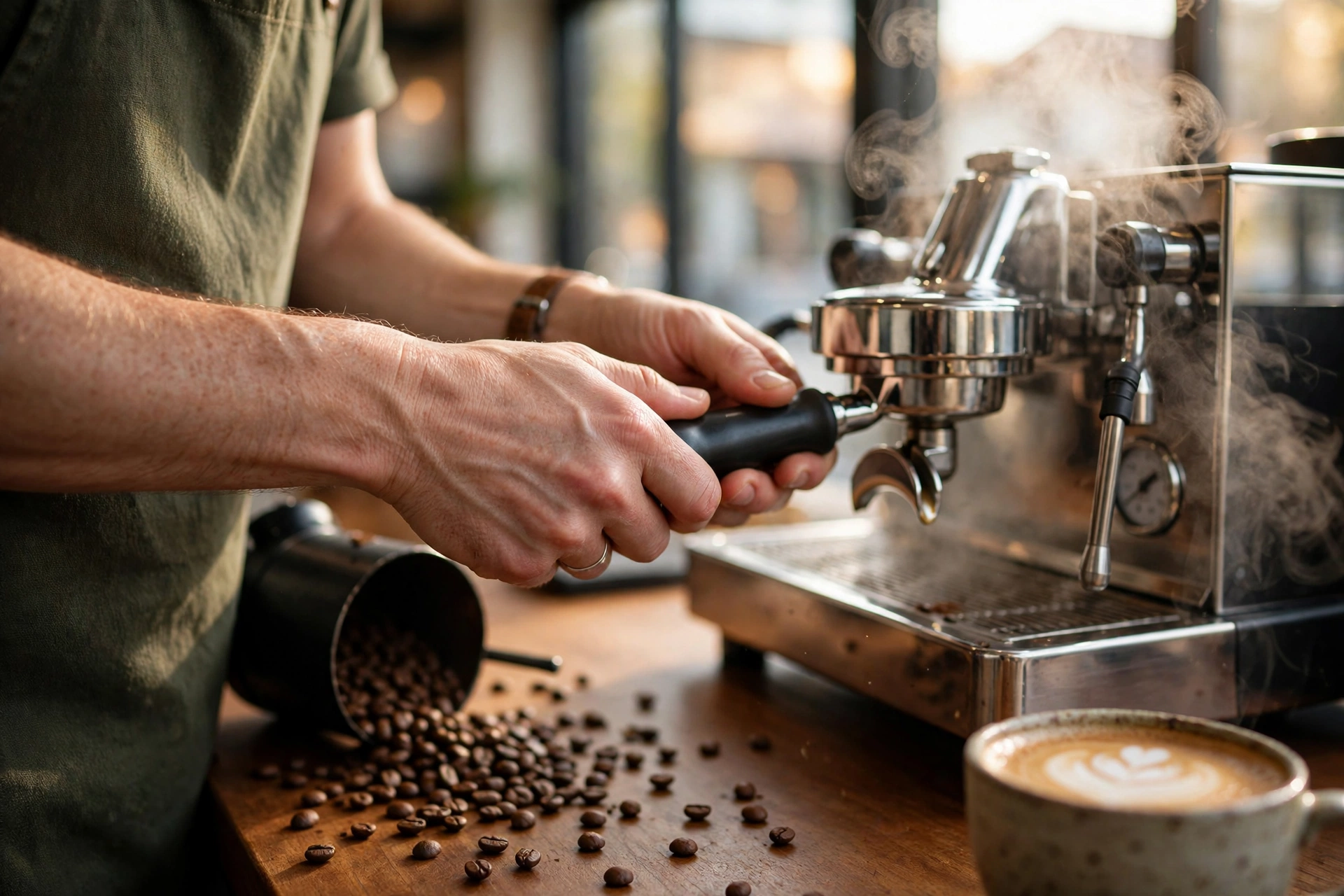
- Manual/Semi-Automatic: Best for high-skill environments where the barista is a craftsman.
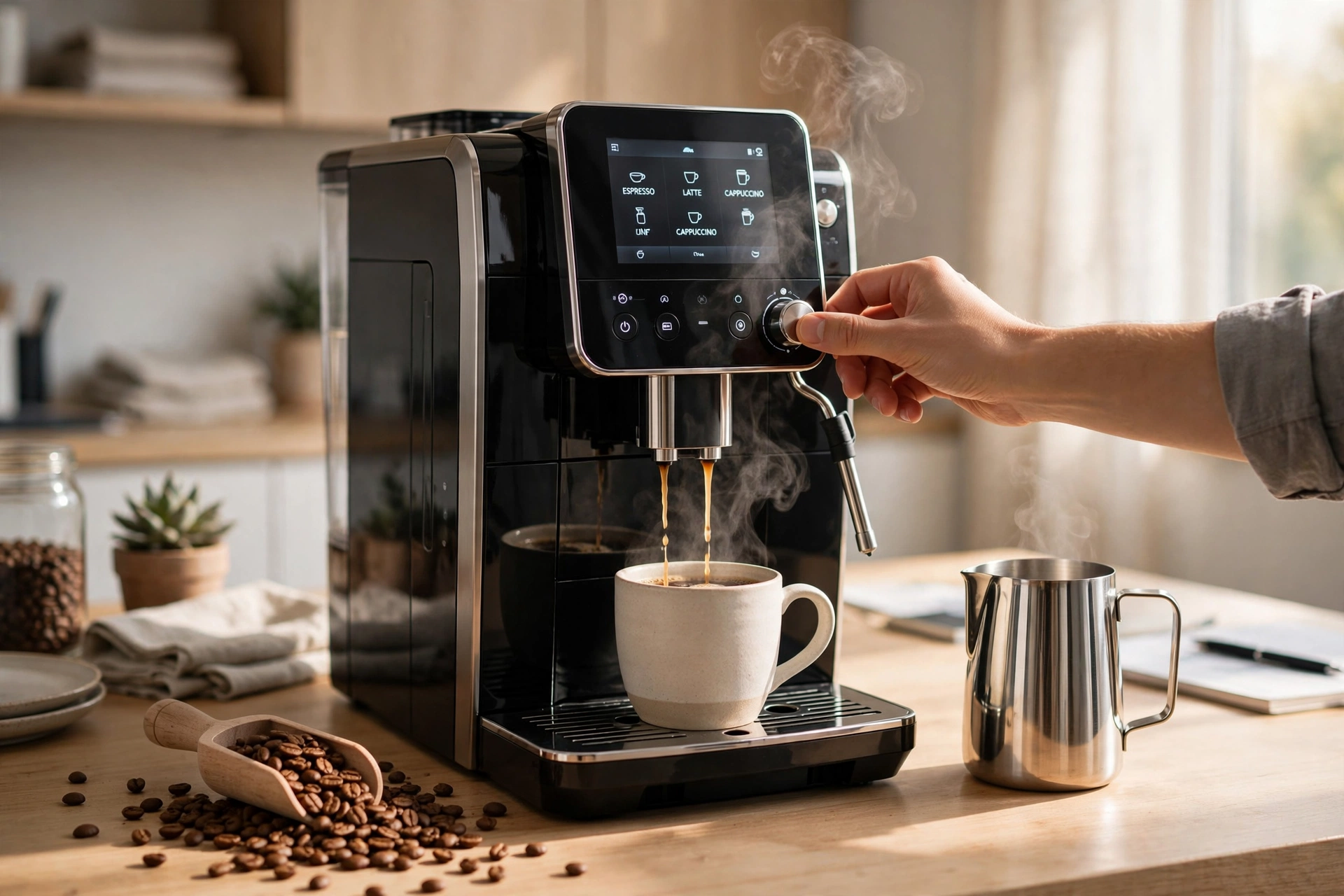
- Super-Automatic: Best for offices or hotels where speed and consistency are more important than the "art" of the pull.
- Batch Brewer: Essential for high-volume drip coffee.
Step 4: Accessories and Finishing Tools
This is where the details matter. Precision scales, tempered tampers, and high-quality steaming pitchers. If you want your drinks to look professional, you'll need to know where to buy latte art tools for foodservice pros to ensure your presentation matches the taste.
💡
Key Takeaway
Never prioritize the espresso machine over the grinder or the water filter. A great machine cannot fix bad water or an inconsistent grind.

Comparing Your Equipment Options: Trade-offs and Decisions
Choosing the right gear requires a cold analysis of your business model. Are you selling an "experience" or a "convenience"? The following table breaks down the three primary paths for modern foodservice businesses.
| Equipment Path | Pros | Cons | Best For |
|---|---|---|---|
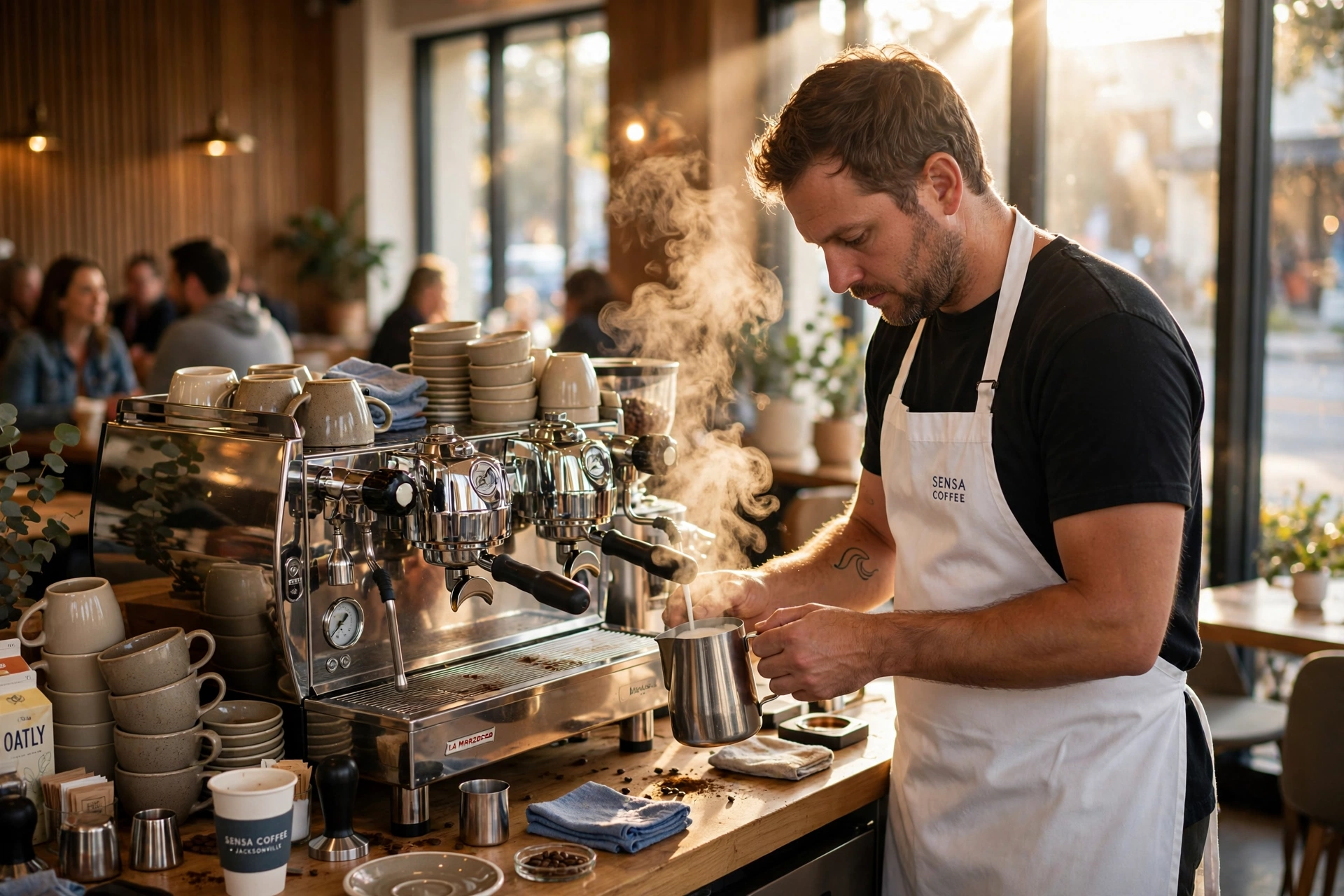
| Traditional Manual | Ultimate flavor control; high "theatre" value for customers. | Requires highly trained staff; slower throughput per drink. | Third-wave cafes, boutique hotels, artisan shops. |
| Super-Automatic | Zero training required; extreme consistency; fastest speed. | Higher maintenance costs; less "soul" in the flavor profile. | Corporate offices, high-volume lobbies, quick-service. |
| Hybrid/Managed | No upfront CAPEX; full maintenance; professional setup. | Monthly recurring fee; less ownership of the hardware. | Growing businesses, hotels, restaurants prioritizing cash flow. |
Now, here's where it gets interesting: the "Hybrid" approach is becoming the standard for 2026. Instead of buying a machine that depreciates the moment it's installed, businesses are moving toward managed coffee solutions. At Busy Bean Coffee, we provide the equipment, the installation, and the maintenance for a predictable fee. This eliminates the "panic" that occurs when a boiler leaks on a Tuesday morning during the breakfast rush.
Depending on your city, the implementation varies. For example, businesses seeking an Automated Coffee Service in Fort Worth TX - Complete Guide | Busy Bean Coffee often prioritize speed due to the commute-heavy culture, whereas those looking for a White Glove Coffee Service in Denver CO - Complete Guide often lean toward the artisanal, manual side of specialty coffee.
Common Misconceptions About Coffee Equipment
Most guides get this wrong by telling you that "more expensive equals better coffee." That is a fundamental lie. I have tasted coffee from a $10,000 machine that tasted like charcoal because the operator didn't know how to purge the group head or clean the steam wand.
Myth 1: "A super-automatic machine can't make 'real' specialty coffee."
While it's true that a manual machine allows for more nuance, modern super-automatics have evolved. High-end units now use ceramic burrs and precise temperature control that can easily deliver a cup that scores well above the average cafe. The difference is in the "ceiling" of quality, not the "floor."
Myth 2: "I don't need a separate water filter if my city water is 'fine'."
"Fine" for drinking is not "fine" for an espresso machine. City water often contains chlorine and minerals that strip the flavor from the coffee bean and create scale in the heating elements. If you aren't filtering, you are essentially planning for a machine breakdown.
Myth 3: "The most expensive grinder is always the best choice."
Not necessarily. You need to match the burr type to your roast profile. If you primarily serve light-roast specialty coffee, you want a grinder that produces fewer "fines" (tiny particles) to avoid over-extraction. Buying a heavy-duty industrial grinder for a low-volume shop is a waste of capital that could be spent on better beans.
Frequently Asked Questions
Which equipment is best for a high-volume hotel breakfast service?
For high-volume environments where speed is the primary KPI, a high-capacity super-automatic machine is the only logical choice. In these settings, you cannot afford to wait 3 minutes for a manual barista to pull a shot and steam milk for every guest. You need a system that can deliver a consistent latte in under 45 seconds with the press of a button. This ensures that the guest experience remains positive and the lobby doesn't become a bottleneck. When we implement Automated Coffee Service in Wilmington NC - Complete Guide, we focus on machines that can handle 100+ cups per hour without a drop in temperature.
How often should specialty coffee equipment be serviced to avoid failure?
Preventative maintenance should be daily, weekly, and quarterly. Daily tasks include backflushing the group heads and cleaning the steam wands. Weekly tasks involve deeper cleaning of the hopper and burr checks. Quarterly, you need a professional technician to check gaskets, seals, and water pressure. According to the National Coffee Association USA (NCA), equipment failure is one of the leading causes of lost revenue in the coffee sector. Ignoring a $200 gasket replacement today can lead to a $5,000 boiler replacement tomorrow.
Do I really need a separate scale for every brew station?
Yes, absolutely. In the world of specialty coffee, "eye-balling" is the enemy of consistency. A scale allows the barista to measure the dose (how much coffee goes in) and the yield (how much liquid comes out). A difference of just 2 grams of coffee or 5 seconds of brew time can swing a shot from "sweet and balanced" to "sour and thin." If you want to maintain a specialty standard, every single shot must be weighed. This is the difference between a hobbyist and a professional operation.
Is a dual-boiler machine necessary for a small cafe?
If you are serving milk-based drinks, then yes, a dual-boiler or a heat-exchange system is essential. You cannot brew espresso and steam milk from the same small boiler without causing a massive temperature drop. This leads to "temperature surfing," where the barista has to run water through the machine to get the boiler back to the correct temperature before pulling a shot. For a small team, investing in a stable dual-boiler system ensures that the first cup of the day tastes exactly like the hundredth cup.
What is the most overlooked piece of equipment in a coffee setup?
The water filtration system. As mentioned earlier, water is the primary solvent in coffee. Beyond just protecting the machine from scale, the mineral content of the water directly affects how the flavors are extracted from the coffee bean. Too much magnesium or calcium can mute the bright, fruity notes of a high-altitude Arabica. Too little can make the coffee taste flat. A professional-grade filtration system is the foundation upon which all other equipment sits.
Final Thoughts on Specialty Coffee Equipment
Choosing the right specialty coffee equipment is a balancing act between your ambition for quality and the reality of your operational constraints. If you chase the highest possible quality without the staff to support it, you'll end up with expensive gear and mediocre coffee. If you chase pure speed with cheap gear, you'll alienate the growing segment of customers who demand a "specialty" experience.
The most successful businesses I've worked with don't just buy a machine; they invest in a system. Whether that is through a meticulous manual setup or a managed membership, the goal is to remove the friction between the bean and the cup.
If you are tired of managing the headaches of equipment maintenance and the risk of sudden breakdowns, let us handle the heavy lifting. At Busy Bean Coffee, we provide the premium equipment and the expert support you need to thrive.
Ready to upgrade your beverage program? Visit www.busybeancoffee.com to explore our all-inclusive managed coffee solutions and find the perfect fit for your business.
Free Coffee Pairing Guide & Specialty Roast Cheat Sheet
Unlock the secrets of perfect brewing ratios, water temperatures, and specialty roast profiles. Download the guide.