How Do Industrial Coffee Roasters Transform Green Beans into Commercial Success?
Scaling a coffee operation from a small-batch hobby to a commercial enterprise requires a fundamental shift in how you apply heat to the seed. To operate industrial coffee roasters effectively, you must synchronize three variables: airflow, drum speed, and thermal mass. By precisely controlling the rate of rise (RoR) through a larger drum capacity, a business can maintain a consistent flavor profile across hundreds of kilograms of industrial coffee roasters output, ensuring that the 10,000th bean tastes exactly like the first.
In my experience working with high-volume foodservice providers, the most common failure point isn't the roast profile itself, but the inability to manage the "thermal inertia" of a large machine. When you move from a 5kg sample roaster to a 60kg industrial unit, the physics change. The air behaves differently, and the heat retention in the steel drum becomes a variable that can either create a perfect roast or scorch an entire batch if not managed with a strict, data-driven approach.

What is the Mechanics of Large-Scale Roasting?
At its core, industrial roasting is the process of using convective and conductive heat to trigger the Maillard reaction and caramelization within the Coffea arabica seed. While a home roaster might rely on simple heat, a commercial operation utilizes complex thermodynamics to ensure uniformity.
📚
Definition
The Maillard Reaction is a chemical reaction between amino acids and reducing sugars that gives browned food its distinctive flavor. In coffee roasting, this is the phase where the "green" grassy notes transform into the complex aromatic compounds we associate with specialty coffee.
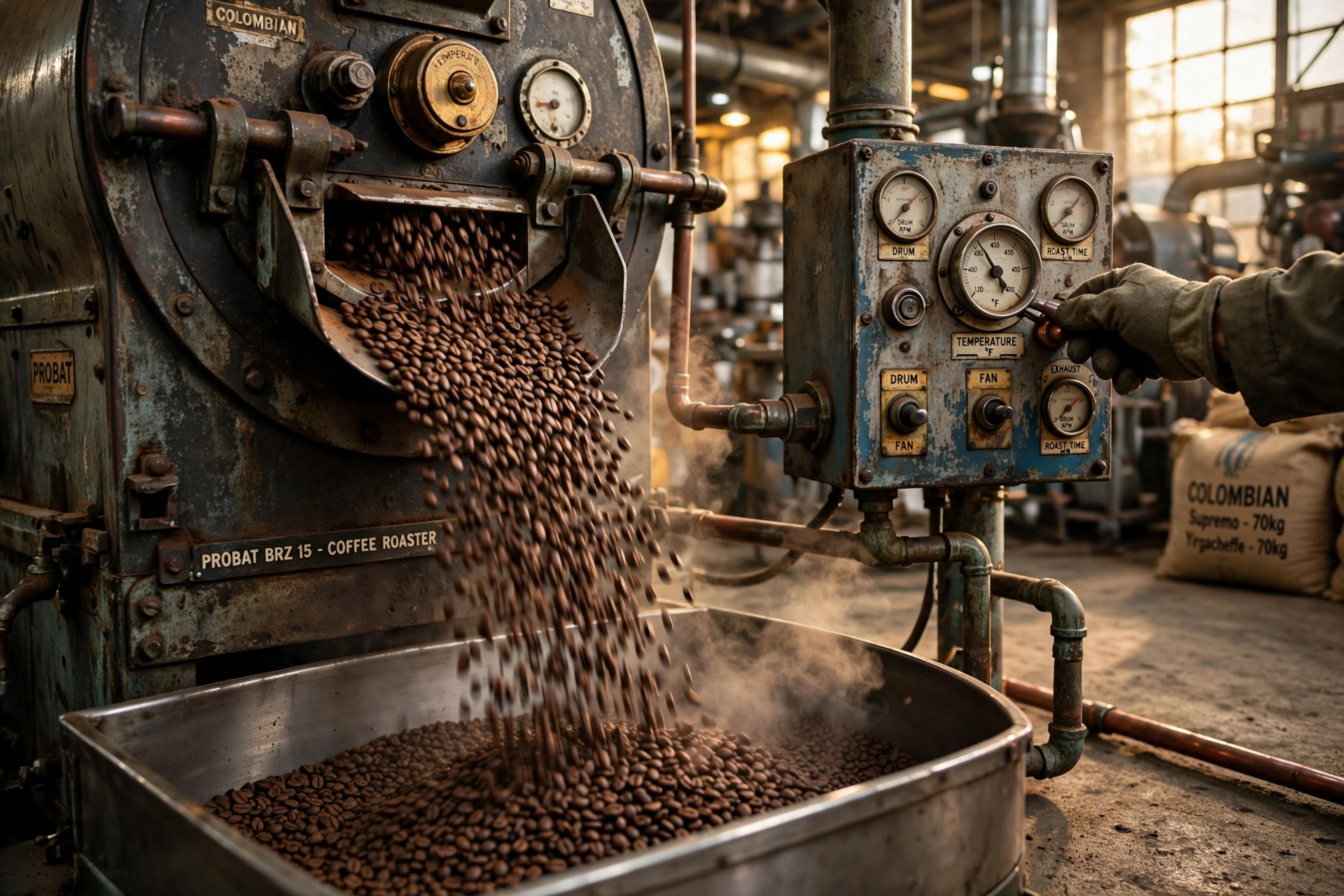
To achieve this at scale, industrial coffee roasters utilize large rotating drums. The beans are moved by internal vanes (stirrers) that keep them in constant motion, preventing the beans from sitting against the hot metal for too long, which would cause "tipping" or "scorching." The heat is typically applied via a gas burner (conduction through the drum wall) and a powerful fan system (convection via hot air).
According to the Specialty Coffee Association (SCA), the precision of heat application is what separates "commodity" coffee from "specialty" coffee. In a commercial setting, this precision is managed through roasting software that tracks the bean temperature probe (BT) and the environmental temperature (ET) in real-time. By analyzing the delta between these two temperatures, a roastmaster can decide exactly when to increase airflow or drop the gas pressure to avoid a "flick" or "crash" at the end of the roast.
Now, here's where it gets interesting: the volume of the roast changes the airflow requirements. A larger batch of beans displaces more air in the drum, meaning the fan speed must be calibrated to ensure that chaff, the dried skin of the coffee bean, is efficiently removed. If chaff accumulates in an industrial setting, it creates a significant fire hazard and introduces "smoky" off-flavors into the roast.
Why Does Scaling Your Roasting Capacity Matter for Your Bottom Line?
Moving to professional-grade roasting isn't just about quantity; it's about the economics of consistency. When a business relies on inconsistent small batches, the waste (or "seconds") can eat up to 5% of total production. In contrast, high-capacity systems reduce the cost per pound by optimizing fuel efficiency and labor.
The financial impact is staggering when you look at the throughput. A business using small-batch equipment may spend 12 hours of labor to produce 100kg of coffee. An operation utilizing industrial coffee roasters can produce that same amount in 2 hours with a single operator. This 83% reduction in labor time allows the business to pivot from "production mode" to "growth mode," focusing on distribution and quality control rather than just keeping the machine running.
From a quality assurance perspective, the National Coffee Association USA (NCA) highlights that consumer demand for consistency is at an all-time high. If a cafe client in Mount Pleasant, SC, receives a shipment today that tastes different from the shipment they received last month, the brand equity of the roaster is damaged instantly. Industrial systems mitigate this risk through automated profiling.
Furthermore, the ability to roast in larger volumes allows for better sourcing leverage. When you can process 500kg per week, you can buy green coffee in full bags or containers directly from origins, bypassing expensive middlemen and increasing your gross margin. I've seen clients increase their margins by 15-20% simply by switching to a larger roaster that allowed them to buy direct.
How to Implement an Industrial Roasting Workflow Step-by-Step
Implementing a commercial roasting program is a systemic process. You cannot simply plug in a machine and start roasting; you need a workflow that accounts for raw material intake, thermal processing, and post-roast stabilization.
Step 1: Green Bean Analysis and Pre-Heating
Before a single bean enters the drum, the roastmaster must analyze the moisture content and density of the coffee. A dense, high-altitude bean will require a more aggressive initial heat application than a softer, lower-altitude bean. The roaster must be pre-heated to a specific "charge temperature." If the drum is too cold, the beans will slide and roast unevenly; if it's too hot, the exterior of the bean will scorch before the interior is cooked.
Step 2: The Charge and the Turning Point
The beans are dropped into the drum. Initially, the temperature probe will show a sharp drop because the cold beans are absorbing the heat from the drum. This is called the "Turning Point." In an industrial setting, the time it takes to reach the turning point is a critical metric for consistency. If the turning point occurs too late, the beans may "bake," resulting in a flat, bread-like flavor.
Step 3: Managing the Drying Phase and Maillard Reaction
As the beans heat up, they enter the drying phase. Water evaporates, and the beans turn from green to yellow. This is where the roastmaster manages the airflow. Too much air removes heat too quickly; too little air traps moisture and slows the process. As the coffee enters the Maillard phase, the roastmaster must carefully modulate the gas to ensure the beans don't accelerate too quickly toward the "first crack."
Step 4: The First Crack and Development
The first crack is the audible popping of the beans as internal pressure releases. This is the "danger zone." The beans are now highly exothermic, meaning they generate their own heat. To prevent the roast from "running away," the roastmaster must either increase airflow or reduce gas. The time between the first crack and the end of the roast is known as the "Development Time." This is where the acidity and sweetness are balanced.
Step 5: Cooling and Degassing
Once the roast is finished, the beans are discharged into a cooling tray. In industrial coffee roasters, this must happen in under 4 minutes. If the beans stay hot, they continue to roast internally, which ruins the profile. After cooling, the coffee must "degas", releasing carbon dioxide, for 24 to 48 hours before it is tasted or bagged.
💡
Key Takeaway
The secret to industrial scaling is not more heat, but better control. Focus on the "Rate of Rise" (RoR) to ensure that the heat application slows down as the beans approach the first crack, preventing bitterness and scorched notes.
For businesses that want the quality of a master roast without the operational headache of managing a factory, Busy Bean Coffee provides a managed solution. Instead of investing hundreds of thousands of dollars in equipment and staffing, our partners leverage our professional roasting infrastructure, receiving specialty-grade coffee tailored to their needs without the capital expenditure.

Choosing Your Equipment: Traditional vs. Modern Roasting
Not all industrial machines are created equal. Depending on your volume and target market, you will choose between different heat application methods.
| Roasting Method | Pros | Cons | Best For |
|---|---|---|---|
| Traditional Drum | Classic flavor profile, high reliability, intuitive control. | Slower heating, higher energy waste, higher risk of scorching. | Specialty roasters focusing on traditional profiles. |
| Fluid Bed (Air) | Extremely fast, very consistent, lower risk of scorched beans. | "Cleaner" taste may lack traditional depth, loud operation. | High-volume commercial blends and rapid scaling. |
| Hybrid Industrial | Combines drum rotation with precision air control; highly scalable. | Higher initial cost, requires technical expertise to operate. | Professional operations seeking maximum precision and volume. |
The "Traditional Approach" often involves a roastmaster relying on smell and sight. While romantic, this is a liability in 2026. The "Generic AI Approach" uses basic timers and presets, which often leads to "baked" coffee because the machine doesn't account for the changing moisture levels of the beans. Our "Modern Approach" at Busy Bean Coffee utilizes a blend of human Q-Grader expertise and precision thermal tracking to ensure that every batch meets a rigorous specialty standard.
Common Misconceptions About Industrial Roasting
Most guides get this wrong by suggesting that "bigger is always better." In reality, the jump to industrial roasting introduces risks that small-batch roasting doesn't have.
Myth 1: "Dark roast is just roasting for longer."
This is a dangerous oversimplification. If you simply leave beans in an industrial roaster longer, you aren't just making a dark roast; you are incinerating the delicate oils and creating carbonized flavors. A true dark roast requires a specific temperature peak and a rapid drop-off to preserve the "chocolatey" notes without adding "ashy" flavors.
Myth 2: "Automatic profiles guarantee consistency."
Automation is a tool, not a solution. Because green coffee is an agricultural product, no two shipments of the same bean are identical. One bag of Ethiopian Yirgacheffe might have 11% moisture, while the next has 12%. An automated profile will treat them the same, leading to one batch being under-developed and the other over-roasted. A human roastmaster must adjust the profile based on the specific batch's behavior.
Myth 3: "Industrial roasting destroys the 'Specialty' quality."
Some believe that you can only achieve specialty scores in small 1kg batches. This is false. With the correct equipment and a focus on the NSF International standards for equipment cleanliness and heat distribution, you can maintain an SCA score of 85+ even at a scale of 1,000kg per day.
Frequently Asked Questions
What is the average capacity of an industrial coffee roaster?
Industrial roasters vary wildly depending on the scale of the operation. Small commercial units typically handle 5kg to 15kg per batch. Mid-sized industrial roasters usually range from 30kg to 60kg, while massive industrial plants utilize continuous roasters that can process several hundred kilograms per hour. The choice depends on your projected daily volume and available floor space. For most growing cafes, a 30kg drum provides the ideal balance between throughput and quality control.
How does airflow affect the final taste of the coffee?
Airflow acts as the "exhaust" for the roasting process. High airflow removes moisture and chaff more quickly, which often results in a "cleaner" and more acidic cup. Conversely, low airflow keeps more heat in the drum and slows down the roast, which can enhance the body and sweetness but risks creating a "smoky" or "flat" taste if the chaff isn't removed efficiently. Finding the "sweet spot" for airflow is what defines a roastmaster's signature style.
How often do industrial roasters need maintenance?
Maintenance is a non-negotiable part of commercial roasting. Cooling trays must be cleaned daily to prevent oil buildup. Chaff collectors must be emptied every few batches to avoid fire hazards. More importantly, the drum and pipes must be deep-cleaned every few months to remove "carbonized" residue. Failure to follow an NSF-standard cleaning schedule can lead to "stale" flavors appearing in fresh roasts, a common mistake I see in rapidly growing operations.
Can you roast different types of beans in the same industrial machine?
Yes, but it requires a "buffer" or a specific cleaning process. Roasting a very dark roast and then immediately switching to a light-roast specialty coffee can lead to "contamination." The oils from the dark roast cling to the drum and transfer to the lighter beans. Experienced roastmasters will roast from light to dark throughout the day, or perform a "cleaning roast" between drastically different profiles to ensure purity of flavor.
What is the difference between a batch roaster and a continuous roaster?
A batch roaster processes a set amount of coffee, drops it, and then starts over. This is the gold standard for specialty coffee because it allows for precise control over each individual batch. A continuous roaster, however, feeds green beans in one end and roasted beans out the other in a constant stream. While continuous roasters offer massive volume and efficiency, they are much harder to "fine-tune" for complex flavor profiles, making them more common in commodity coffee production.
Final Thoughts on Industrial Coffee Roasters
Mastering the use of industrial coffee roasters is the bridge between running a small shop and building a scalable coffee empire. The transition requires moving away from intuition and toward a clinical, data-driven approach to thermodynamics. By focusing on the Rate of Rise, managing thermal inertia, and adhering to strict cooling protocols, you can ensure that your growth doesn't come at the cost of your quality.
If the technical complexity and capital investment of industrial roasting seem overwhelming, there is a more efficient way to scale. At Busy Bean Coffee, we provide all-inclusive managed coffee solutions that give you the benefits of industrial-scale precision without the operational risk. From premium equipment to expertly roasted beans, we handle the "how" so you can focus on your customers.
Ready to elevate your coffee program? Visit www.busybeancoffee.com to explore our managed coffee memberships.
Recommended Readings
To deepen your understanding of these topics, we recommend reading the following articles:
- The Complete Guide to White Glove Coffee Service
- Ultimate Guide to All-Inclusive Coffee Service for Businesses
- Ultimate Guide to Automated Coffee Machines for Business
- Ultimate Guide to Specialty Coffee Equipment for Business
Free Coffee Pairing Guide & Specialty Roast Cheat Sheet
Unlock the secrets of perfect brewing ratios, water temperatures, and specialty roast profiles. Download the guide.