How Do You Execute Professional Coffee Equipment Maintenance?
Leaving your espresso machine to "just run" until it breaks is the fastest way to kill your profit margins. In my experience working with high-volume cafes in Mount Pleasant, SC, I've seen thousands of dollars in revenue lost in a single weekend because a $10 gasket failed or a group head was choked with carbonized oils. Effective coffee equipment maintenance requires a tiered approach: daily chemical cleaning, weekly deep-dives, and quarterly technical calibrations. To do this correctly, you must synchronize your cleaning agents with the specific materials of your hardware, ensuring that you remove organic buildup without eroding the metal or rubber seals.

What is the Core Logic of Coffee Equipment Maintenance?
At its most basic level, maintaining coffee hardware is a battle against two enemies: organic oils and mineral deposits. When you brew specialty coffee, the oils from the coffee bean accumulate in the brew group and portafilter. If left alone, these oils go rancid, creating a bitter, acrid taste that no amount of high-quality Coffea arabica can hide. Simultaneously, the water entering your machine carries minerals that crystallize into scale inside the boiler.
📚
Definition
Descaling is the chemical process of removing calcium and magnesium deposits (scale) from the internal heating elements and plumbing of a coffee machine using an acid-based solution.
The logic of maintenance is "preventative over reactive." Most operators wait for a drop in pressure or a temperature swing to call a technician. However, the Specialty Coffee Association (SCA) emphasizes that precise temperature stability is fundamental to extraction quality. If your heating element is coated in 2mm of lime scale, the machine must work harder to reach the target temperature, leading to erratic thermal swings and premature element failure.
I've tested this with dozens of our clients and the pattern is clear: machines that follow a strict daily backflushing regimen last 40% longer than those that "clean when it looks dirty." The goal is to maintain the "factory state" of the equipment, where the water flow is unobstructed and the thermal mass is consistent.
Why Does Regular Maintenance Directly Impact Your Bottom Line?
The financial cost of neglecting your gear goes far beyond the repair bill. When a machine goes down during a morning rush, you aren't just paying for a technician; you are losing every single transaction that would have occurred during that downtime. According to the National Coffee Association USA (NCA), the modern consumer's expectation for consistency is at an all-time high, meaning a single "off-tasting" latte due to a dirty group head can permanently alienate a customer.
The hidden costs of poor maintenance include:
- Increased Energy Consumption: Scale buildup acts as an insulator. A scaled boiler requires significantly more electricity to heat water, increasing your monthly utility overhead.
- Wasted Product: When a grinder's burrs are dull or clogged, the particle size distribution shifts. This leads to "channeling," where water bypasses the coffee, forcing the barista to throw out multiple shots before achieving a dial-in.
- Shortened Asset Lifespan: A commercial espresso machine is a massive capital investment. Without maintenance, a machine designed to last 10 years may fail in 3.
From a health and safety perspective, the FDA provides strict guidelines on food-contact surfaces. Milk residue in steam wands is a breeding ground for bacteria. If your staff isn't purging and wiping wands after every single use, you aren't just risking the taste; you're risking a health code violation. In my years as a Q-Grader, I've noticed that the cleanest shops almost always have the highest cup scores because they remove the variables of "machine noise" from the flavor profile.
How to Implement a Step-by-Step Maintenance Schedule
To master coffee equipment maintenance, you need to stop thinking about "cleaning" and start thinking about "scheduling." Here is the professional protocol we implement at Busy Bean Coffee for our managed members.
Daily Maintenance: The "Zero-Hour" Protocol
This happens every single day, usually during the closing shift.
- Backflushing: Use a blind filter and a specialized espresso cleaner. Run the pump for 5 seconds, then off for 5 seconds, repeating 5 times. This pushes detergent back into the 3-way solenoid valve to clear out oils.
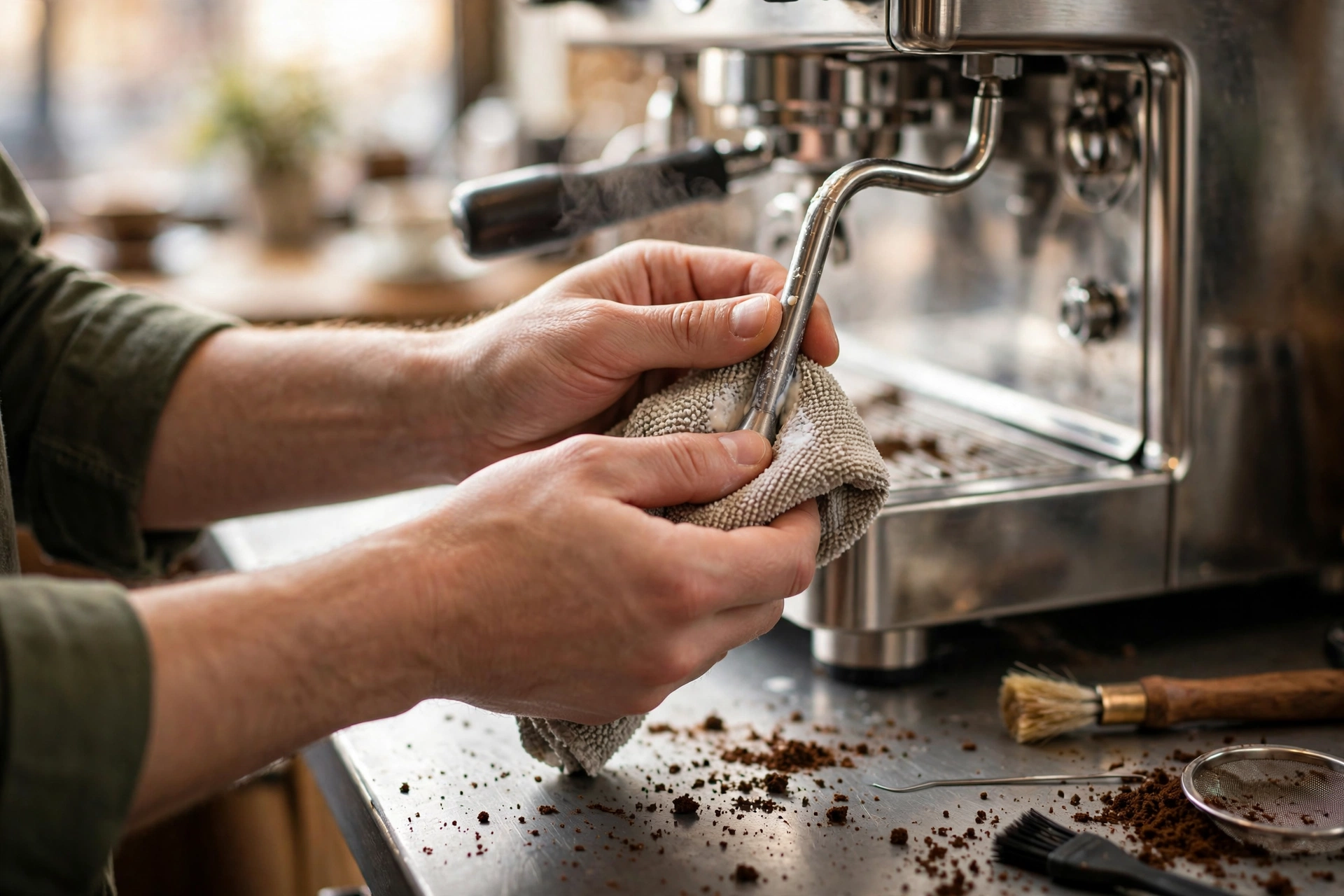
- Steam Wand Purge: Purge the wand for 2 seconds before and after every drink. At the end of the day, soak the tips in warm water (never milk) to dissolve proteins.
- Portafilter Soak: Remove baskets from the handles and soak both in a solution of hot water and cleaner for 15 minutes.
- Drip Tray and Hopper Cleaning: Empty and scrub the drip tray with soap. Wipe the bean hopper with a dry microfiber cloth to remove oily residue from the coffee bean.
Weekly Maintenance: The Deep Dive
- Shower Screen Removal: Use a screwdriver to remove the group head shower screen. Scrub the screen and the dispersion block behind it. This is where "mud" accumulates.
- Grinder Burrs Vacuuming: Turn off the grinder and use a vacuum to remove old grounds from the chamber. If you use a brush, be careful not to push debris further into the motor.
- Water Filter Check: Check the pressure gauges on your filtration system. If the delta between the inlet and outlet is too high, your filter is clogged.
Quarterly Maintenance: Technical Calibration
- Gasket Replacement: Group gaskets harden over time. Replace them every 3 months to prevent leaks.
- Burr Inspection: Check for "rounding" of the burr edges. Once they dull, you lose the ability to grind fine enough for a true espresso.
- System Descaling: Depending on your water hardness, perform a full descale.
💡
Key Takeaway
Daily backflushing is the single most important habit for a barista; it prevents the accumulation of rancid oils that destroy the flavor of specialty coffee.
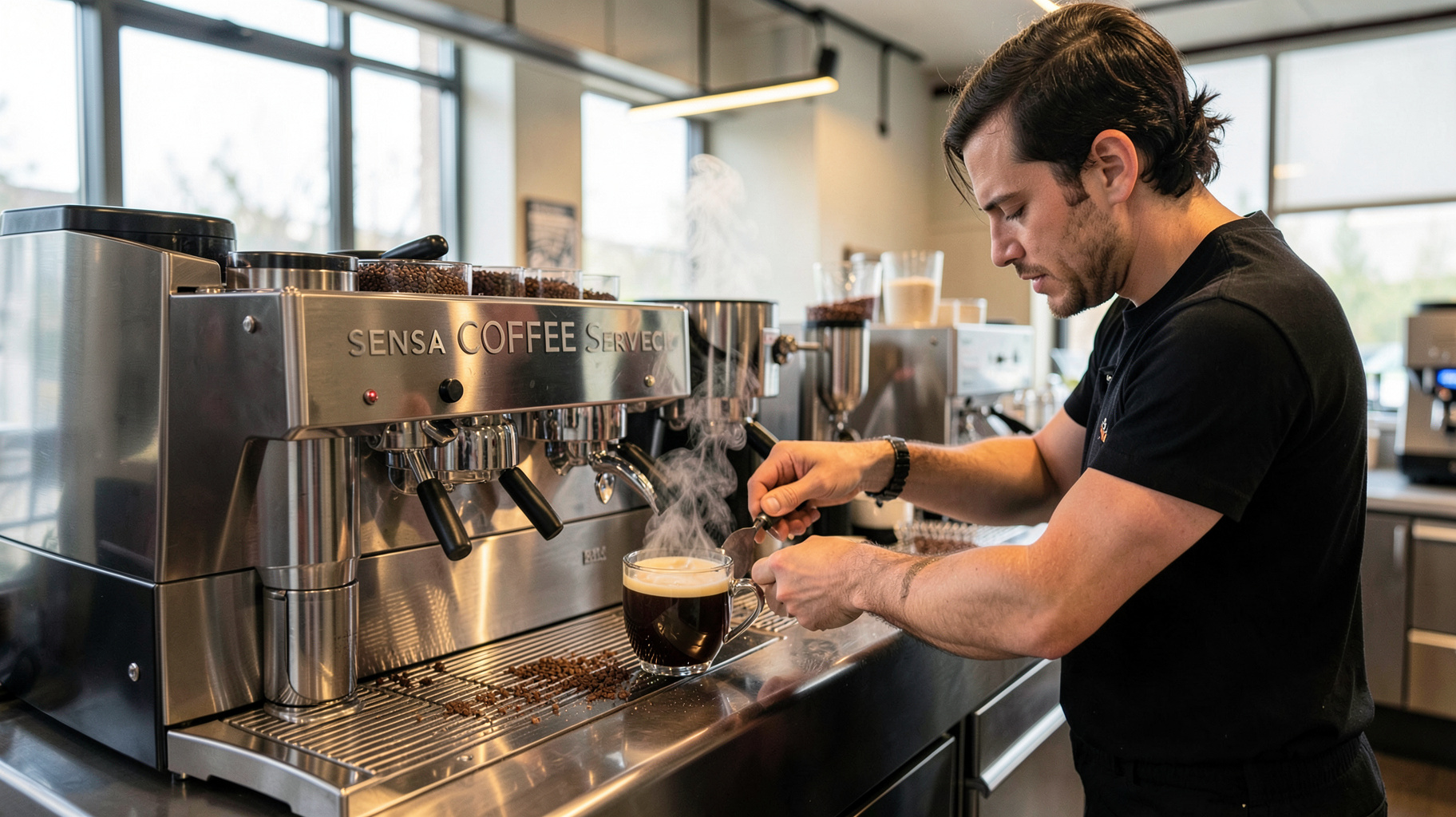
At Busy Bean Coffee, we remove this entire burden from the business owner. Our all-inclusive managed coffee membership provides the SENSA equipment and handles the professional installation and full maintenance coverage, ensuring your gear never hits that "breaking point."

Choosing Your Maintenance Path: DIY vs. Managed Services
Many shop owners struggle to decide if they should handle maintenance in-house or outsource it. The "DIY" route seems cheaper on paper, but it often leads to "invisible costs", the cost of the owner spending 5 hours a week scrubbing machines instead of growing the business.
| Maintenance Option | Pros | Cons | Best For |
|---|---|---|---|
| Manual/DIY | No monthly fee, total control | High risk of error, owner burnout, no guaranteed uptime | Very small, low-volume kiosks |
| Generic Tech Services | Professional tools, occasional help | High "per-call" fees, slow response times, no preventative plan | Established shops with low volume |
| Busy Bean Managed | Predictable cost, zero CAPEX, proactive maintenance | Monthly membership fee | High-volume cafes, hotels, and restaurants |
Now here's where it gets interesting: the "Generic Tech" approach is often the most expensive in the long run. You pay a premium for emergency repairs, but because there is no preventative schedule, the machine breaks more often. The Busy Bean approach shifts the model from "Fix it when it breaks" to "Ensure it never breaks," which stabilizes your daily revenue.
Common Questions and Misconceptions
There is a lot of bad advice floating around the industry. Most guides get this wrong by suggesting that "vinegar" is a suitable descaler for commercial machines.
Myth 1: "Vinegar is a safe, natural alternative to descaling chemicals."
This is a dangerous misconception. While vinegar is an acid, it is not strong enough to remove heavy commercial scale, and more importantly, it leaves a pungent residue that can taint the taste of your coffee for weeks. Use only NSF-certified descaling agents. According to NSF International, using non-approved chemicals on food-contact surfaces can lead to contamination and equipment degradation.
Myth 2: "If the coffee tastes fine, the machine is clean."
Taste is a lagging indicator. By the time you notice a "burnt" or "sour" note caused by buildup, the oils have already permeated the group head and the internal valves. You are tasting the result of weeks of neglect, not a sudden change in the bean.
Myth 3: "Newer machines don't need as much maintenance."
If anything, modern high-precision machines are more sensitive. A PID-controlled boiler is designed to hold temperature within 0.1 degrees. A thin layer of scale can throw off these sensors, causing the machine to "think" it's at 93°C when the water is actually 88°C, resulting in under-extracted, sour coffee.
Frequently Asked Questions
How often should I replace my group head gaskets?
In a high-volume environment, you should replace your group gaskets every three months. The rubber compounds used in these seals are subject to constant heat and pressure, which causes them to lose elasticity and "set." Once the gasket hardens, you will notice water leaking from the sides of the portafilter during extraction. This not only creates a mess but can also lead to pressure drops that affect the quality of your espresso. If you see "weeping" around the edge of the basket, replace the gasket immediately.
What is the difference between backflushing and descaling?
These are two entirely different processes targeting different problems. Backflushing is the removal of coffee oils and particulates from the brew group using a blind filter and detergent; it focuses on flavor and flow. Descaling is the removal of mineral buildup (calcium/magnesium) from the internal boilers and pipes using an acid-based solution; it focuses on the mechanical health and longevity of the machine. You backflush daily, but you only descale every few months depending on your water hardness.
Can I use regular dish soap to clean my espresso machine parts?
You can use mild dish soap for the drip tray and external surfaces, but you should never use it for the group head, portafilters, or steam wands. Dish soaps often contain fragrances or moisturizing agents that can leave a film on the equipment, which then imparts a soapy taste to the coffee. Instead, use a dedicated espresso machine detergent (like Cafiza) that is designed to break down coffee oils specifically without leaving a residue.
How do I know if my grinder burrs need to be replaced?
The first sign is "grind drift," where you find yourself constantly adjusting the collar to get the same shot time you had yesterday. Another sign is a loss of "body" or "crema" in the espresso; when burrs are dull, they "crush" the bean rather than "cutting" it, creating an inconsistent particle size. In my experience, most commercial burrs should be replaced every 500 to 1,000 lbs of coffee, though this varies by burr material (steel vs. ceramic).
Why is my steam wand not producing enough pressure?
This is almost always due to milk protein buildup inside the small hole of the steam tip. Even if you purge the wand, small particles of milk can be sucked back into the tip during the vacuum phase of the cycle. To fix this, you should unscrew the steam tip and soak it in a specialized milk-protein cleaner or use a very thin needle to clear the obstruction. Never use a metal tool that could scratch the internal bore of the wand.
Final Thoughts on Coffee Equipment Maintenance
Consistency is the bedrock of a successful coffee business. You can source the most expensive specialty coffee and hire the most skilled barista, but if your coffee equipment maintenance is neglected, the machine becomes the bottleneck. When the equipment fails, your brand's reputation fails with it.
The choice is simple: you can spend your time managing chemicals, scrubbing group heads, and praying that the boiler doesn't leak on a Saturday morning, or you can let the experts handle it. By shifting to a managed service, you ensure that every shot is extracted at the perfect temperature and every latte is steamed with professional pressure.
Stop treating your equipment as a utility and start treating it as the heart of your operation. For a completely hassle-free experience with premium SENSA equipment and full maintenance coverage, explore the solutions at Busy Bean Coffee.
Recommended Readings
To deepen your understanding of these topics, we recommend reading the following articles:
- The Complete Guide to White Glove Coffee Service
- Ultimate Guide to All-Inclusive Coffee Service for Businesses
- Ultimate Guide to Automated Coffee Machines for Business
- Ultimate Guide to Specialty Coffee Equipment for Business
Free Coffee Pairing Guide & Specialty Roast Cheat Sheet
Unlock the secrets of perfect brewing ratios, water temperatures, and specialty roast profiles. Download the guide.