Which Specialty Coffee Equipment Should You Choose for Your Business?
Choosing the wrong machine is the fastest way to bleed revenue in a foodservice environment. In my experience working with dozens of hotels and cafes, the most expensive mistake isn't buying a cheap machine; it's buying a high-end machine that your staff isn't trained to use or that requires more maintenance than your team can handle. To determine which specialty coffee equipment is right for you, you must balance three variables: volume of guests, desired drink quality, and the technical skill of your operators. If you prioritize a "white glove" experience without the staff to support it, you'll end up with a $15,000 paperweight.
For those managing a corporate environment or a high-traffic lobby, the answer usually lies in automated solutions. If you are running a dedicated coffee shop, a semi-automatic setup is non-negotiable. To find the perfect fit, you first need to understand the technical trade-offs between manual precision and automated consistency. For a deeper look at specific hardware, you might explore the Best Office Espresso Machines for Small Teams in 2026 to see how scale affects your choice.
Understanding the Framework of Specialty Coffee Hardware
When we talk about professional gear, we aren't just talking about "making coffee." We are talking about thermal stability, pressure profiling, and volumetric consistency. Most business owners look at the brand name, but the real decision should be based on the "workflow bottleneck." If your bottleneck is speed, you need automation. If your bottleneck is flavor perception, you need a manual barista-led setup.
📚
Definition
Specialty Coffee Equipment refers to professional-grade tools designed to produce coffee that scores 80 points or above on the 100-point scale developed by the Specialty Coffee Association (SCA), focusing on precision in temperature, grind size, and extraction timing.
The core of any setup is the espresso machine and the grinder. These two pieces of equipment dictate the ceiling of your quality. A high-end machine paired with a poor grinder will still produce mediocre coffee because the coffee bean cannot be extracted uniformly. According to the Specialty Coffee Association (SCA), the precision of the grind is the single most important variable in ensuring the chemical compounds of Coffea arabica are extracted without bitterness or sourness.
I've seen many owners invest $20,000 in a multi-boiler machine but spend only $500 on a grinder. That is a recipe for failure. In my experience, the grinder is actually the more critical piece of the puzzle. If you cannot control the particle size of the coffee, the most expensive machine in the world is just heating water. This is why we emphasize a balanced ecosystem at Busy Bean Coffee, ensuring that the equipment matches the roast profile and the volume of the venue.
Why the Right Equipment Choice Impacts Your Bottom Line
The financial implications of choosing the wrong hardware go far beyond the initial purchase price. We have to look at the "Total Cost of Ownership" (TCO), which includes energy consumption, water filtration, and labor costs. A semi-automatic machine requires a skilled barista who commands a higher wage and requires ongoing training. An automated system reduces labor costs but may have higher monthly subscription fees for maintenance.
Research from the National Coffee Association USA (NCA) indicates that consumer demand for "specialty" and "premium" coffee continues to grow, meaning customers are now more discerning about the quality of the brew. If your equipment produces inconsistent shots, you aren't just losing a few cents of coffee; you are losing customer lifetime value.
Consider the cost of downtime. A machine that breaks down on a Tuesday morning in a busy hotel lobby doesn't just cost the price of a repair; it costs the revenue of 200 missed transactions. This is where the "managed service" model becomes a financial hedge. When we provide equipment at Busy Bean Coffee, we remove the capital expenditure (CapEx) risk and replace it with a predictable operating expense (OpEx).
Moreover, the efficiency of your equipment affects your waste. Poorly calibrated machines lead to "dialing-in" waste, where pounds of expensive specialty coffee are thrown away every morning just to find the right setting. In a high-volume environment, this waste can account for 5% to 10% of your total coffee spend. Using precision-engineered hardware reduces this variance, directly increasing your net profit margin.
How to Implement Your Equipment Strategy Step-by-Step
Implementing a new coffee program isn't as simple as plugging in a machine. It requires a strategic rollout to ensure your staff doesn't feel overwhelmed and your customers see an immediate jump in quality.
First, conduct a volume audit. Track your peak hours for one week. If you are serving 50 coffees in 30 minutes, you cannot rely on a single-group machine, regardless of its quality. You need a multi-group system or a high-capacity automated solution. If you are in a region like North Carolina, you might consider a coffee delivery service in Charlotte NC - Complete Guide | Busy Bean Coffee to ensure your bean freshness matches your equipment's capabilities.
Second, map your "Skill Gap." Do you have a certified barista on staff, or are you relying on general hospitality employees? If the latter, you must choose equipment with a steep "automation curve." This means machines that handle the tamping and dosing automatically, leaving the human to simply press a button.
Third, prioritize water quality. This is the most overlooked step in the entire process. Coffee is 98% water. If you have hard water and no filtration, your heating elements will scale up and fail within six months. According to NSF International, maintaining equipment according to sanitary and technical standards is the only way to ensure longevity in a commercial setting.
Finally, integrate a maintenance schedule. I always tell my clients: "The best machine is the one that is actually working." Whether you manage it in-house or use a service like Busy Bean Coffee, you need a documented plan for backflushing, group head cleaning, and burr replacement.
💡
Key Takeaway
Do not buy equipment based on the "best specs" on paper. Buy based on the "lowest friction" for your specific staff skill level and guest volume.

Comparing Your Equipment Options: Manual vs. Automated
When deciding which direction to go, most businesses fall into three categories: the Traditionalist, the Hybrid, and the Automator. The choice depends entirely on whether you are selling "The Craft" or "The Convenience."
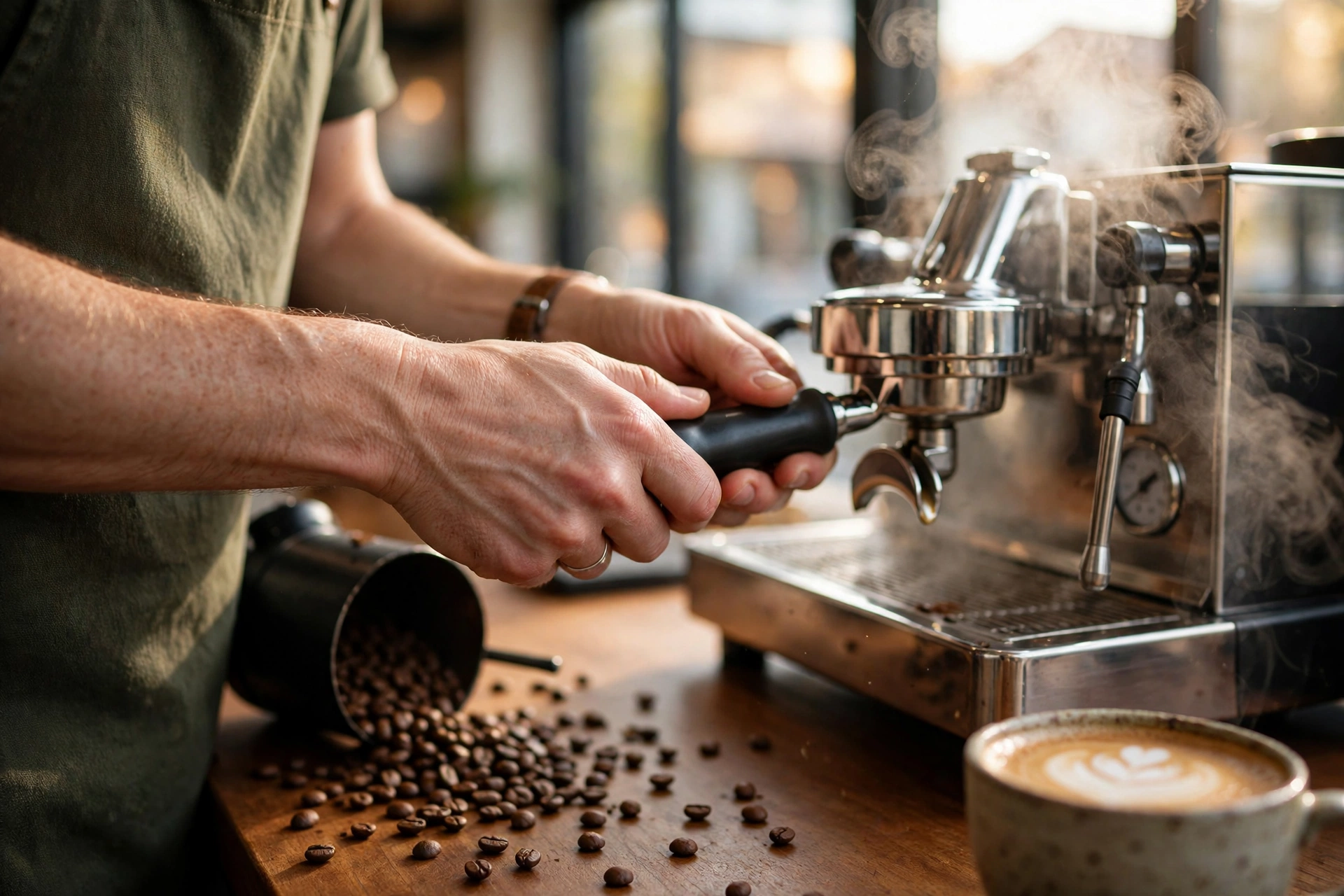
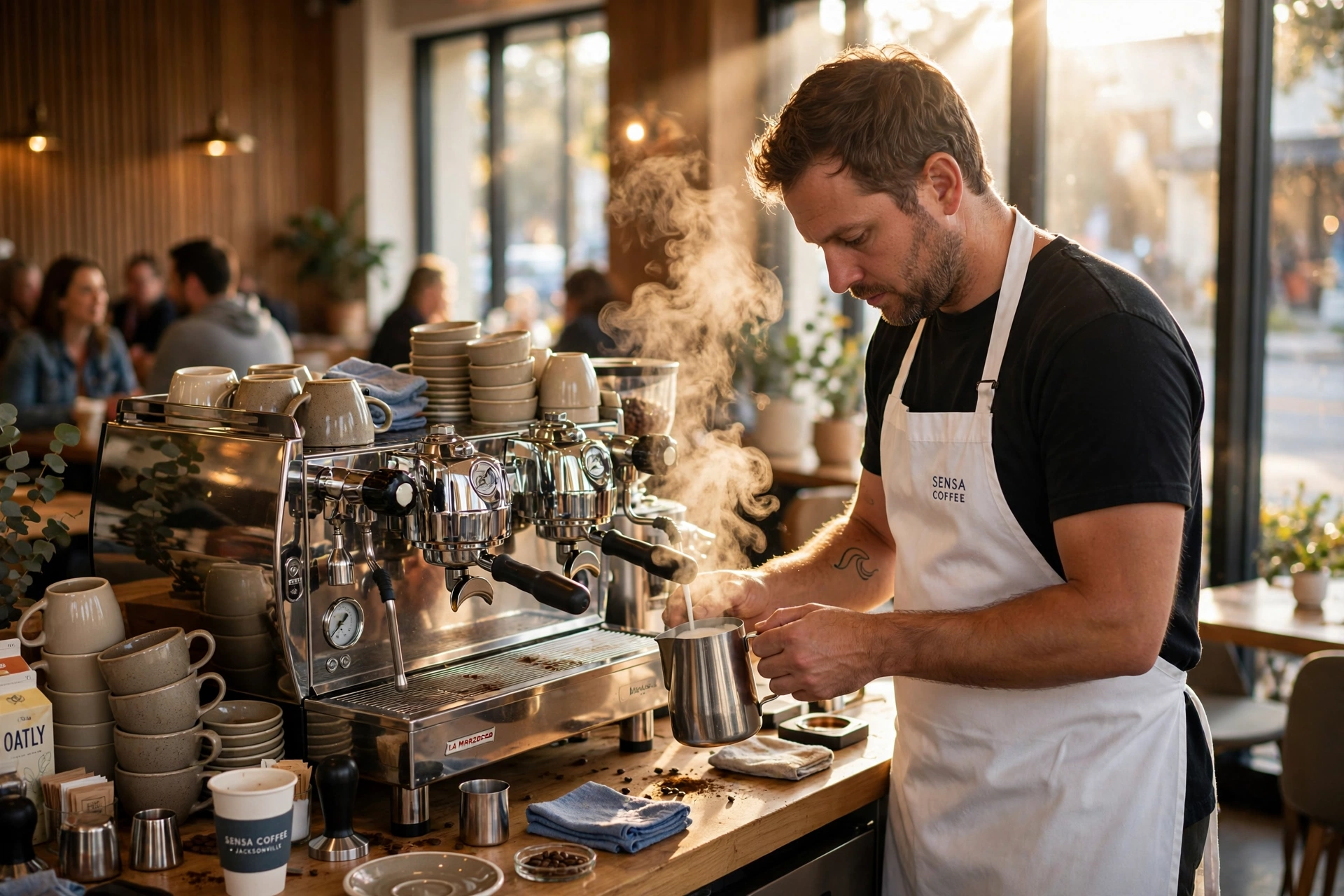
The Traditionalist approach uses semi-automatic machines and standalone grinders. This is for the true specialty cafe where the customer expects to see the barista craft the drink. The trade-off is high labor cost and high variability.
The Hybrid approach uses volumetric machines (which stop the shot automatically at a set volume) but still requires manual tamping. This is a great middle ground for hotels that want a "premium" look but need some consistency.
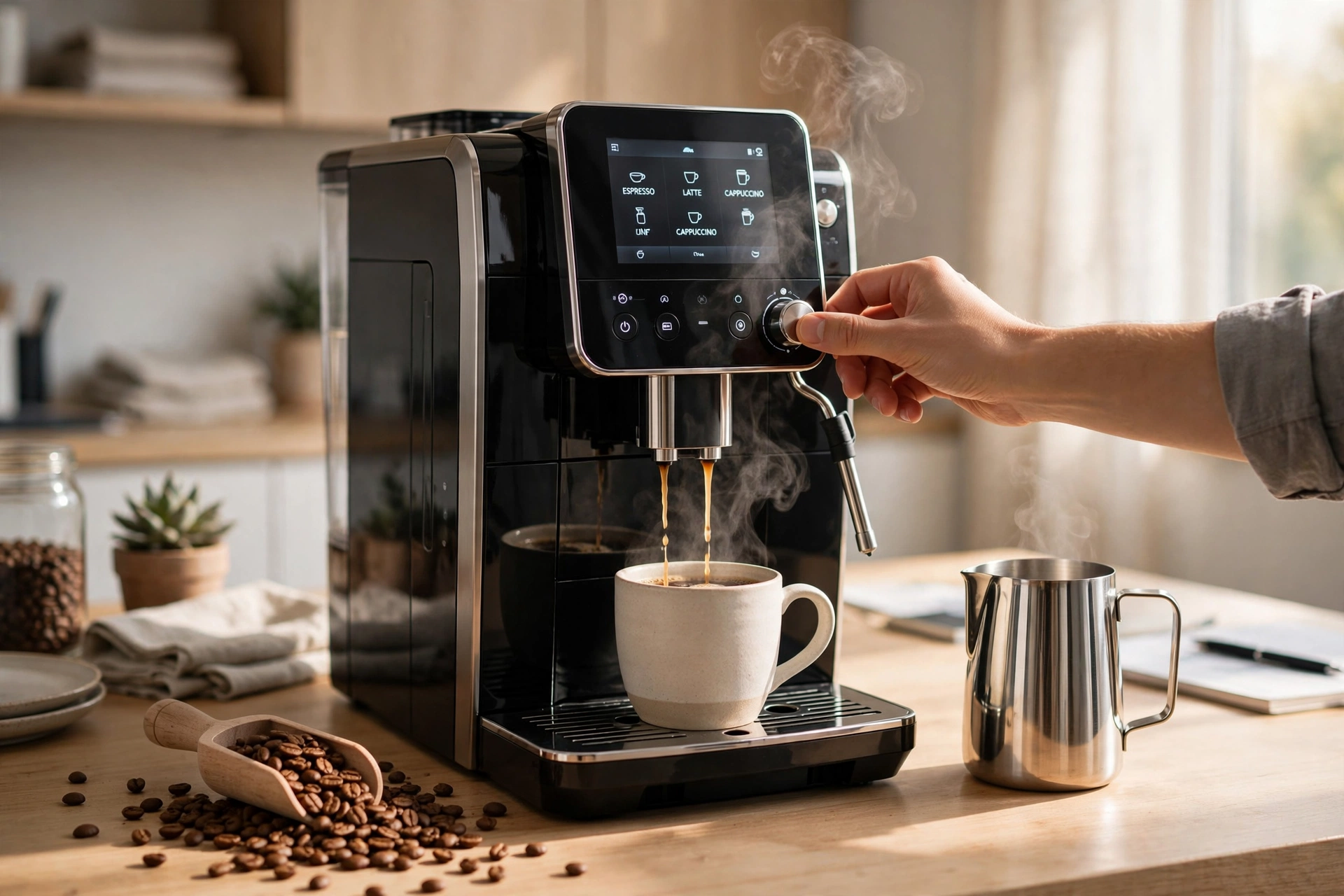
The Automator uses "Super-Automatic" machines. These grind, tamp, and brew at the touch of a button. While some purists scoff at this, for 90% of foodservice businesses, this is the smartest financial move. It ensures that a latte tastes exactly the same at 7 AM as it does at 4 PM, regardless of who is behind the counter.
| Feature | Traditional Semi-Auto | Hybrid Volumetric | Super-Automatic |
|---|---|---|---|
| Consistency | Low (Operator Dependent) | Medium | High (Programmed) |
| Labor Cost | High (Requires Expert) | Medium | Low (Basic Training) |
| Speed of Service | Slow | Medium | Fast |
| Quality Ceiling | Highest Possible | High | Medium-High |
| Best For | Specialty Coffee Shops | Boutique Hotels / Bistros | Offices / Large Scale Foodservice |
If you are operating in a corporate hub, you might find that an automated coffee service in Fort Worth TX - Complete Guide | Busy Bean Coffee provides the best ROI by eliminating the need for a full-time barista while maintaining a high-end taste profile.
Common Misconceptions About Coffee Hardware
Most guides get this wrong: they tell you that "more expensive equals better coffee." In reality, the most expensive machine is often the worst choice for a business because it is too complex. I've seen owners buy "prosumer" machines that look great but cannot handle the thermal load of back-to-back shots, leading to "temperature surfing" where the coffee fluctuates between burnt and sour.
Another myth is that "automated coffee tastes bad." This was true ten years ago. However, modern specialty coffee equipment utilizes PID controllers and precision grinders that can mimic a human barista with 95% accuracy. Unless your customers are competitive coffee judges, they will not notice the difference between a super-automatic and a manual pour, but they will definitely notice if the line is twenty people deep because the barista is too slow.
Finally, there is the misconception that you can "fix it as it breaks." Commercial equipment is not like a home toaster. When a boiler leaks or a pump fails, you lose thousands in revenue. This is why the "ownership" model is becoming obsolete for many. Instead of owning a depreciating asset, businesses are moving toward managed memberships. If you are in a high-end market, you might look into white glove coffee service in Los Angeles CA - Complete Guide | Busy Bean Coffee to see how a fully managed approach removes the risk of hardware failure.
Frequently Asked Questions
Which equipment is best for a low-staff environment?
For environments with minimal staffing or untrained employees, super-automatic machines are the only viable option. These machines integrate the grinder, tamping, and brewing process into a single automated workflow. This removes the "human error" variable, ensuring that the specialty coffee remains consistent without requiring a certified professional. When you remove the need for a dedicated barista, you significantly lower your overhead while still providing a premium beverage that enhances the guest experience.
How do I choose between a single-boiler and a dual-boiler machine?
The choice depends entirely on your volume and menu. A single-boiler machine must switch between brewing and steaming, which creates a significant delay. If you are serving more than ten customers an hour, a dual-boiler system is essential. It allows you to brew espresso and steam milk simultaneously, cutting your service time in half. In my experience, businesses that start with single-boilers almost always upgrade within six months once they realize the bottleneck is the machine, not the staff.
Is it better to buy equipment or lease it through a managed service?
Buying equipment gives you ownership but leaves you responsible for all maintenance, depreciation, and technical failures. A managed service, such as the one provided by Busy Bean Coffee, transforms the coffee station from a liability into a utility. You get the latest specialty coffee equipment, professional installation, and guaranteed uptime for a predictable monthly fee. For most foodservice businesses, the lack of capital expenditure and the guarantee of a working machine outweigh the "pride" of ownership.
What is the most important part of the equipment chain for quality?
While the espresso machine gets the glory, the grinder is the most important link in the chain. If you cannot achieve a uniform grind size, the water will find the path of least resistance (channeling), resulting in coffee that is simultaneously sour and bitter. Investing in a high-quality burr grinder is the only way to truly unlock the flavor profiles of Coffea arabica. If you are looking for tools to finish the drink, you can check where to buy latte art tools for foodservice pros | Busy Bean Coffee.
How often should commercial equipment be serviced to avoid failure?
Commercial gear should undergo a deep clean daily and a professional technical inspection every quarter. Scale buildup is the primary killer of espresso machines, especially in areas with hard water. Failure to perform regular preventative maintenance leads to catastrophic boiler failure. Using a managed service ensures these checks happen automatically, preventing the "morning-of" crisis where your only machine goes offline during your busiest rush.
Final Thoughts on Specialty Coffee Equipment
Deciding which specialty coffee equipment to integrate into your business is not about finding the "best" machine in the world, but the best machine for your specific operational reality. If you have a team of experts and a clientele of coffee connoisseurs, go manual. If you have a fast-paced environment where efficiency is king, go automated.
The goal is to create a seamless experience where the coffee is an asset, not a stressor. Whether you are looking for a white glove coffee service in Denver CO - Complete Guide or a scalable office solution, the priority should always be reliability and consistency.
If you're tired of managing the headache of machine maintenance and want a predictable, high-quality coffee program, we can help. Visit Busy Bean Coffee to explore our all-inclusive managed coffee memberships and let us handle the gear so you can handle your business.
Free Coffee Pairing Guide & Specialty Roast Cheat Sheet
Unlock the secrets of perfect brewing ratios, water temperatures, and specialty roast profiles. Download the guide.