How Much Do Professional Office Coffee Solutions Cost in 2026?
The financial commitment for high-end office coffee solutions typically ranges from a $0 upfront capital expenditure (CapEx) model with a monthly membership fee of $300 to $1,500, to a full ownership model where premium equipment costs between $2,500 and $15,000 plus recurring bean costs. For most mid-to-large enterprises, the "true cost" isn't just the machine; it is the cost per cup, which generally fluctuates between $0.40 and $1.10 depending on the quality of the roast and the automation level of the hardware.
In my experience working with high-traffic corporate hubs, the biggest hidden cost isn't the equipment, it's the "productivity leak" that occurs when employees leave the building for 20 minutes to find a specialty latte because the office brew is subpar. When we analyze the ROI of a managed coffee program, we aren't just looking at the price of beans; we are calculating the reclaimed time and the improvement in employee morale. For those in high-density business districts, opting for a Sensa Coffee Service in Charlotte, NC often reveals that a managed membership is significantly cheaper than the aggregate cost of individual employees buying expensive retail coffee.
Understanding the Financial Structure of Office Coffee Solutions
When we discuss the investment required for these systems, we have to distinguish between the hardware, the consumables, and the service layer. Most businesses make the mistake of only budgeting for the machine, ignoring the maintenance and the "waste factor" of poor-quality coffee that ends up poured down the drain.
📚
Definition
Office Coffee Solutions refer to the integrated ecosystem of hardware (espresso machines, brewers), software (payment or tracking systems), and recurring supply chains (specialty beans, milk, syrups) designed to provide beverage services in a professional environment.
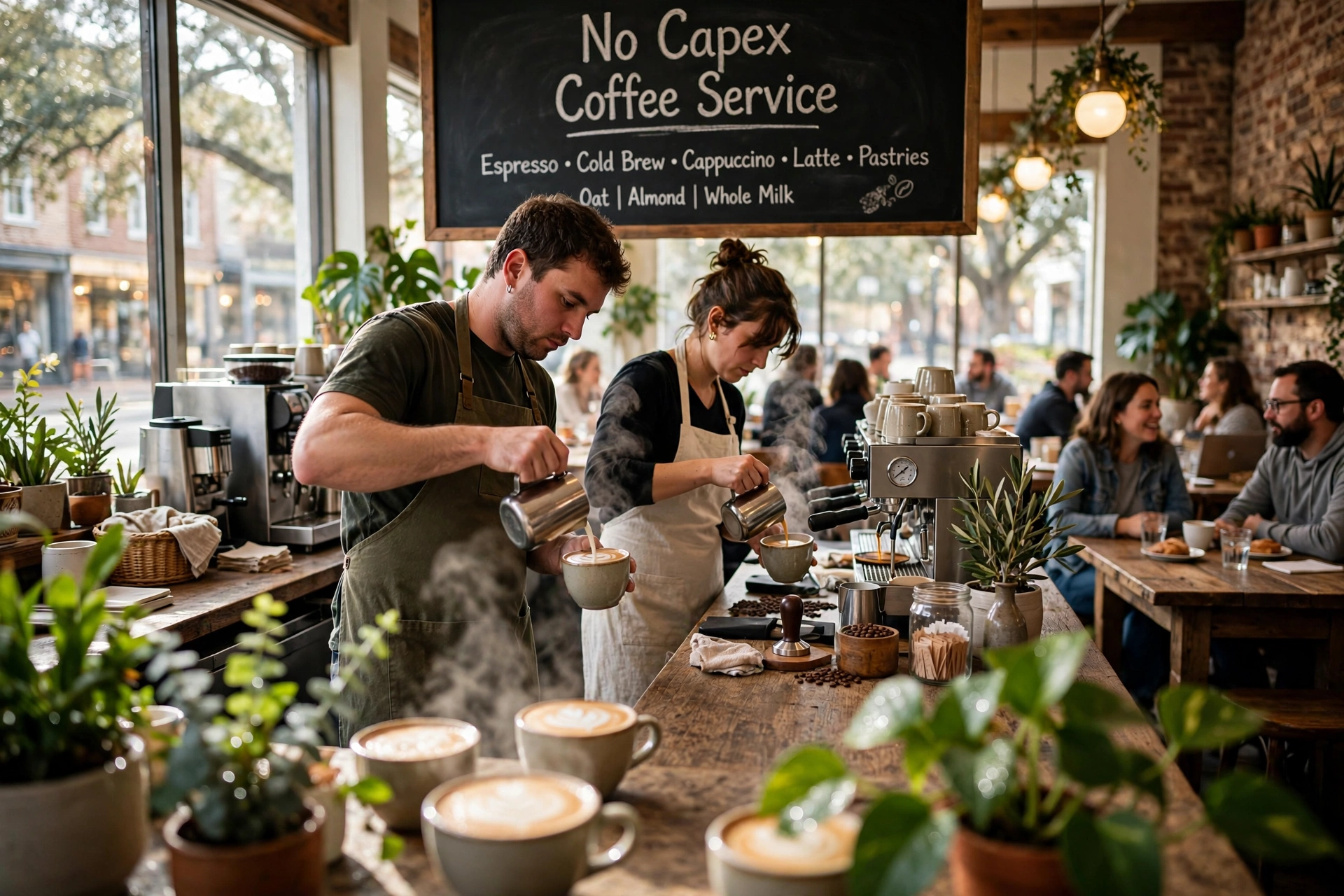
The market has shifted toward "Coffee-as-a-Service" (CaaS). Instead of buying a machine that depreciates the moment it is plugged in, companies are moving toward memberships. In this model, the provider handles the installation, the preventive maintenance, and the bean delivery for a fixed monthly fee. This transforms a volatile variable cost into a predictable operational expense (OpEx).
According to the Specialty Coffee Association (SCA), the global demand for specialty-grade coffee continues to rise, pushing businesses to move away from "commodity" coffee toward higher-scoring beans. This shift affects the cost, as specialty coffee is priced based on quality and ethical sourcing rather than just the global C-market price. When you invest in a professional solution, you are paying for a "Q-Grader" approved supply chain, ensuring that the Coffea arabica used in your office is consistently roasted to a specific profile.
Now, here is where it gets interesting: the scale of your office dictates the hardware. A small clinic may only need a compact automated machine, whereas a hotel or a large corporate headquarters requires high-volume brewers. For medical environments, automated coffee machines for clinics and medical offices are designed for speed and hygiene, reducing the time staff spends cleaning the machine.

Why Your Coffee Investment Directly Impacts Your Bottom Line
It might seem trivial to link a beverage program to a balance sheet, but the data tells a different story. Coffee is more than a perk; it is a social lubricant and a productivity tool. When employees have access to high-quality specialty coffee in-house, the "micro-breaks" happen internally, fostering spontaneous collaboration that doesn't occur when people are standing in line at a nearby cafe.
From a financial perspective, the cost of poor coffee is measured in "lost minutes." If 50 employees each spend 15 minutes a day leaving the office for a better cup of coffee, that is 12.5 hours of lost productivity daily. At an average corporate hourly rate, this can cost a company thousands of dollars per month, far exceeding the cost of a premium membership.
Furthermore, the health and safety implications of equipment maintenance cannot be ignored. According to NSF International, commercial food and beverage equipment must meet strict sanitary standards to prevent contamination. A "cheap" home-grade machine used in a professional setting often lacks the necessary certifications and the durability for high-volume use, leading to frequent breakdowns and potential health risks.
The business impact numbers are clear: companies that provide high-tier amenities report higher employee satisfaction scores and better retention rates. In the competitive 2026 labor market, the "office experience" is a key part of the talent acquisition strategy. For those operating in Georgia, implementing a Sensa Coffee Service in Atlanta GA: Complete Guide allows a business to signal a commitment to quality and employee wellness without the headache of managing the logistics themselves.
How to Implement a Professional Coffee Program Step-by-Step
Implementing a professional coffee program isn't as simple as buying a machine and a bag of beans. To maximize your ROI, you need a strategic rollout that considers volume, taste preferences, and maintenance.
Step 1: Calculate Your Daily Volume
Determine exactly how many cups are consumed per day. This is the "Load Factor." A machine rated for 30 cups a day will fail if it is pushed to 100. I've seen dozens of clients buy under-powered machines to save $1,000 upfront, only to spend $3,000 in repairs within the first year because the pump burned out.
Step 2: Choose Between CapEx and OpEx
Decide if you want to own the asset or lease the service. If you have the capital and a dedicated technician on staff, ownership works. However, for 90% of our clients, the membership model is superior. It ensures the equipment is always under warranty and the beans are always fresh.
Step 3: Select Your Roast Profile
Don't just buy "dark roast." Work with a Q-Grader to select a profile that appeals to the majority. A medium-roast Coffea arabica usually provides the best balance of acidity and sweetness, making it the safest bet for a diverse workforce.
Step 4: Establish a Maintenance Schedule
Coffee machines are essentially plumbing systems. Limescale buildup is the number one killer of espresso machines. Your plan must include regular descaling and filter changes. This is why our managed solutions at Busy Bean Coffee are so effective; we handle the "dirty work" so your team doesn't have to.
Step 5: Launch and Iterate
Start with a soft launch, gather feedback on the roast, and adjust the volume of milk and syrups accordingly. If you are in a hub like North Carolina, you might find a Sensa Coffee Service in Raleigh NC (2026 Overview) provides the ideal agility to scale your program as your headcount grows.
💡
Key Takeaway
The most cost-effective way to implement office coffee is to shift from a "product purchase" mindset to a "service membership" mindset, eliminating the risk of equipment obsolescence and maintenance downtime.
Comparing Your Investment Options: Traditional vs. Managed
When deciding how to allocate your budget, you generally have three paths. Most guides will tell you that buying a machine is the "cheapest" way, but they are ignoring the cost of labor and depreciation.
| Feature | Traditional (Self-Managed) | Budget AI/Pod Systems | Modern Managed Service (Busy Bean) |
|---|---|---|---|
| Upfront Cost | High (Machine Purchase) | Low to Medium | Zero/Low |
| Coffee Quality | Variable (Depends on User) | Low (Processed Pods) | High (Specialty Grade) |
| Maintenance | Your Responsibility | Replace Machine if Broken | Included / Proactive |
| Predictability | Volatile (Repair costs) | High (Per-pod cost) | Fixed Monthly Fee |
| Environmental Impact | Medium (Waste) | Very High (Plastic Pods) | Low (Compostable/Bulk) |
| Best For | Tech-savvy micro-offices | Very small teams (< 5 people) | Growth-minded Enterprises |
As the table demonstrates, the "Budget" approach often results in the highest cost per cup when you factor in the price of proprietary pods. Conversely, the traditional approach requires a level of expertise in coffee roasting and machine calibration that most office managers simply do not have.
If you are scaling a large hospitality operation, you might look into Automatic Coffee Machines for Hotels and Hospitality in 2026, where the volume is so high that the efficiency of an automated system pays for itself in labor savings alone.

Common Questions and Misconceptions About Coffee Costs
Most guides get this wrong by focusing on the price of the machine. In reality, the "Total Cost of Ownership" (TCO) is what matters. Here are the most common myths I encounter in the industry.
Myth 1: "Pod machines are the most affordable option for small offices."
This is a mathematical fallacy. While the machine might be cheap, the cost per pod is exponentially higher than the cost of specialty beans bought in bulk. When you calculate the cost per ounce, pod systems are often 300% to 500% more expensive than a managed bean-to-cup service.
Myth 2: "Any commercial machine will produce the same quality of coffee."
Absolutely not. The difference between a commodity machine and a professional espresso machine lies in the PID temperature control and the pressure profiling. Without these, you get "burnt" coffee or sour shots. A professional solution ensures a consistent 9-bar extraction, which is the gold standard for specialty coffee.
Myth 3: "Maintenance is just a once-a-year thing."
This is the most dangerous mistake. In high-volume environments, failure to perform monthly deep-cleans leads to biofilm buildup in the milk lines. According to the FDA, improper cleaning of beverage equipment can lead to foodborne illness. Professional managed services prevent this by integrating scheduled technician visits.
Myth 4: "Specialty coffee is too expensive for a general office."
Specialty coffee is not about "luxury"; it is about quality standards. By sourcing directly and roasting in-house, Busy Bean Coffee removes the middlemen, making high-scoring beans affordable for the average business. The "cost" of switching to specialty coffee is negligible compared to the increase in employee satisfaction.
Frequently Asked Questions
How much does a typical office coffee membership cost per month?
For a medium-sized office of 20 to 50 people, a comprehensive membership typically ranges from $300 to $700 per month. This fee generally covers the lease of a professional-grade machine, a monthly allotment of specialty coffee beans, and full maintenance. For larger enterprises or those with multiple locations, such as those utilizing a Sensa Coffee Service in Jacksonville, FL, the price scales based on volume. The primary advantage is the elimination of sudden "repair bills" that can reach $500 or more for a single technician visit.
Is it cheaper to buy the machine or use a managed service?
In the short term, buying a machine seems cheaper because there is no monthly fee. However, over a 3-year period, the managed service is almost always more economical. Ownership involves a large initial hit to your capital, the cost of sourcing beans, and the inevitable cost of repairs. A managed service provides "insurance" against downtime. If a machine breaks in a managed model, it is replaced or fixed immediately at no extra cost, whereas an owner must pay for parts and labor, often waiting days for a technician.
What is the "cost per cup" for professional office coffee?
The cost per cup varies based on the roast and the milk used, but generally falls between $0.40 and $1.10. For context, a retail latte at a chain cafe costs between $4.50 and $6.00. By bringing a professional solution in-house, a company is effectively providing a benefit that saves employees thousands of dollars per year while spending only a fraction of that on the operational cost. This is a high-impact, low-cost perk that significantly improves the daily workplace experience.
How does the volume of employees affect the total investment?
Volume affects the "Tier" of equipment needed. A "Small" tier is for offices under 25 people, utilizing machines with smaller hoppers and water tanks. A "Medium" tier (25-100 people) requires machines with larger capacities and faster brew times to prevent "coffee queues" during the morning rush. "Enterprise" tiers (100+ people) often require multiple stations or industrial-grade brewers. For those in high-growth areas, using a Sensa Coffee Service in Columbia SC: Complete Guide | Busy Bean Coffee allows for a modular approach where you can add machines as your team grows.
Does the type of coffee bean (Arabica vs. Robusta) change the cost?
Yes, significantly. Coffea arabica is the gold standard for specialty coffee due to its complex flavor profiles and higher quality. It is generally more expensive to produce and source than Robusta. However, using 100% Arabica beans is essential for any professional office solution that wants to be perceived as "high quality." Robusta is often used in "commodity" coffee to lower costs, but it results in a bitter, burnt taste that employees dislike. Investing in Arabica is an investment in the actual experience of the drink.
Final Thoughts on Office Coffee Solutions
Investing in professional office coffee solutions is not about buying a gadget for the breakroom; it is about optimizing your operational environment. Whether you are looking for a Sensa Coffee Service in Mount Pleasant SC: Complete Guide or scaling a nationwide corporate footprint, the goal is the same: remove the friction from your employees' day and replace it with a high-quality experience.
When you move away from the "cheap pod" or "burnt pot" mentality and embrace a managed specialty coffee program, you are reclaiming lost productivity and enhancing your company culture. The financial math is simple: the cost of a monthly membership is a rounding error compared to the cost of employee turnover or lost billable hours.
Stop settling for mediocre coffee that your team hates. Upgrade to a professional, all-inclusive solution that handles everything from the first roast to the last drop.
Ready to transform your office culture? Visit Busy Bean Coffee today to find the perfect plan for your business.
Free Coffee Pairing Guide & Specialty Roast Cheat Sheet
Unlock the secrets of perfect brewing ratios, water temperatures, and specialty roast profiles. Download the guide.