📖This article is part of the complete guide to Complete Guide to Coffee Equipment Rental for Foodservice.
In my experience working with high-volume hotel and restaurant operators, the most dangerous line item in a budget isn't the known cost of equipment, but the 'hidden' emergency repair bill that arrives during a Saturday morning rush. When a primary espresso machine fails, the immediate loss isn't just the cost of the part; it is the lost revenue from every single guest who walks away because the coffee service is offline. Moving from an ownership model to a fixed-cost structure removes this volatility entirely.
For a comprehensive overview of how to structure your beverage program, explore our Complete Guide to Coffee Equipment Rental for Foodservice.
What Exactly is Coffee Equipment Monthly Rental?
📚
Definition
Coffee equipment monthly rental is a managed service agreement where a business pays a fixed, recurring fee to access professional-grade brewing hardware, inclusive of installation, maintenance, and technical support, without purchasing the assets upfront.
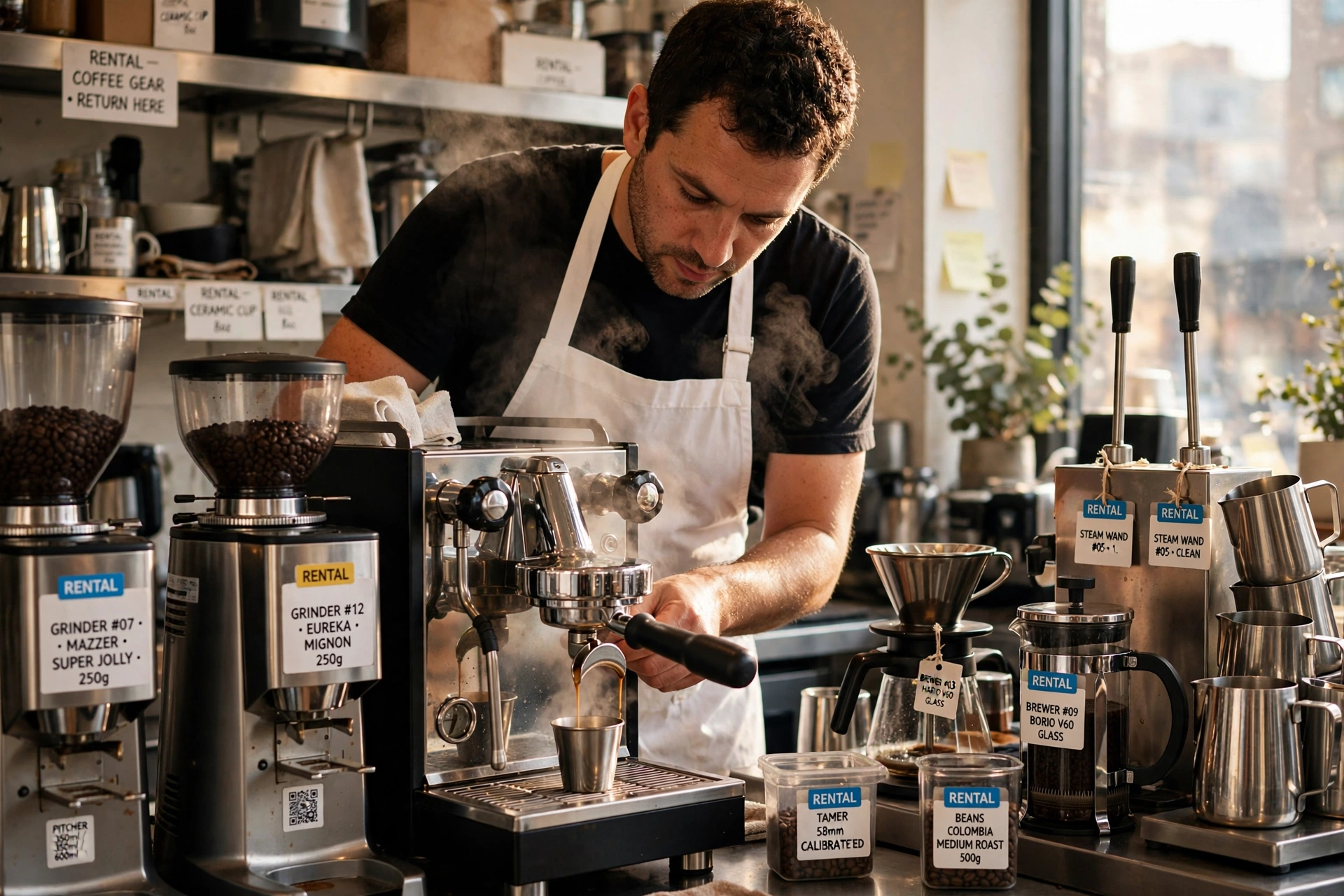
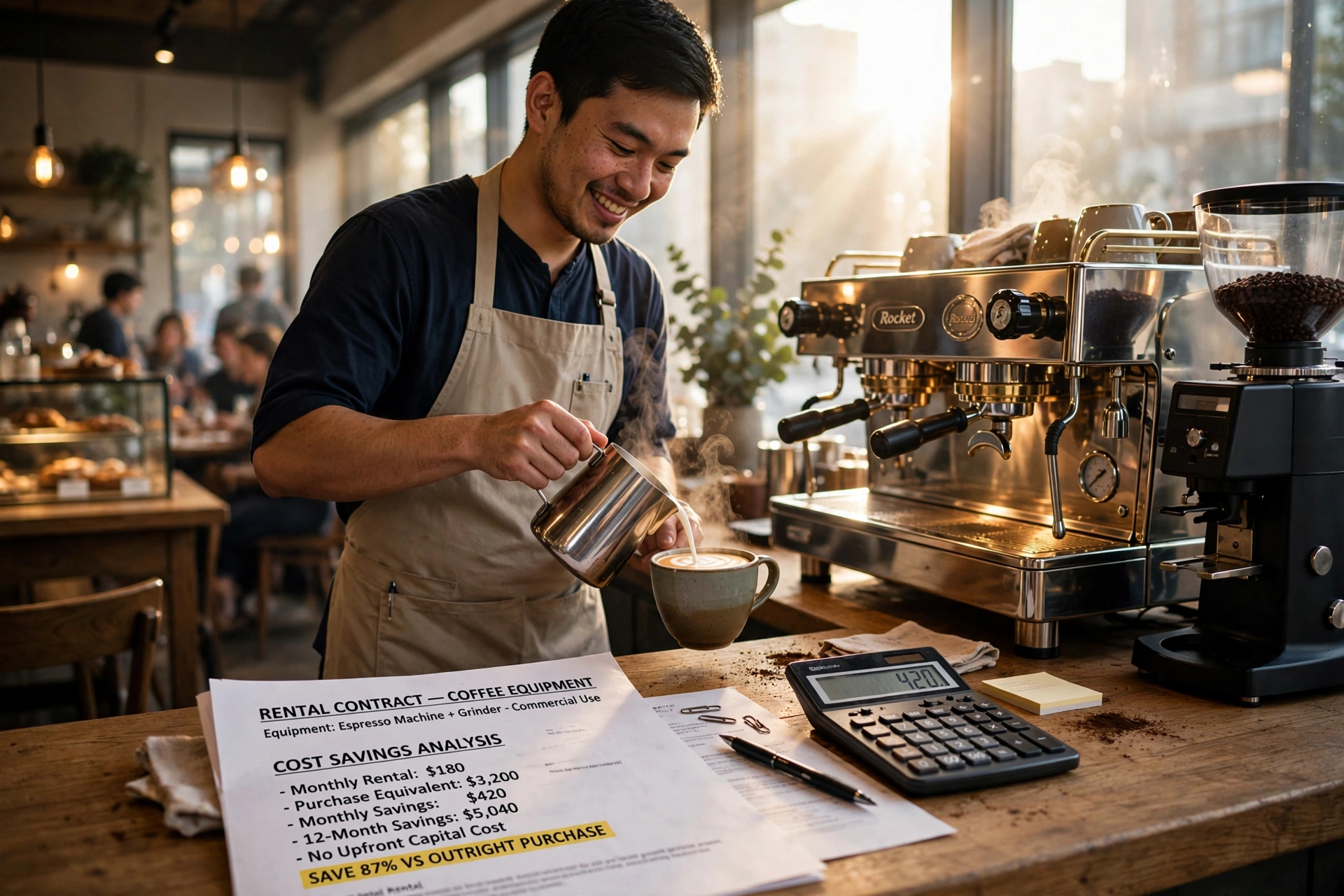
Predictable coffee equipment monthly rental shifts the financial burden of beverage service from a Capital Expenditure (CapEx) to an Operational Expenditure (OpEx). Instead of spending $15,000 to $30,000 on a high-end espresso machine and grinders, a business pays a set monthly amount that covers the use of the machine and the guarantee that it will remain operational. This model is designed for foodservice businesses that require the reliability of a professional barista setup without the risk of asset depreciation.
When we developed the membership model at Busy Bean Coffee, we discovered that operators were tired of 'rental' agreements that still charged extra for every technician visit. A true monthly fee model incorporates these variables. In 2026, this approach has become the standard for scaling businesses because it allows for precise cash flow forecasting. You know exactly what your coffee overhead is on the 1st of every month, regardless of whether a heating element burns out or a pump needs replacing.
Why Predictable Monthly Fees Matter for Your Business Bottom Line
Financial predictability is the bedrock of any successful hospitality operation. The primary reason a fixed coffee equipment monthly rental is superior to ownership is the elimination of 'sticker shock' during equipment failure. According to the National Coffee Association USA (NCA), the demand for specialty coffee continues to rise, meaning your equipment is working harder and more consistently than ever before. Higher usage leads to more frequent wear and tear, which, in an ownership model, creates unpredictable spikes in maintenance spending.
Consider the impact on your 2026 quarterly projections. If you own your equipment, a single motherboard failure on a commercial brewer can cost between $800 and $2,500 including labor. In a managed rental model, that cost is absorbed by the provider. This stability allows managers to allocate funds toward marketing or staff training rather than emergency repairs.
Furthermore, the tax advantages of OpEx are significant. Because the monthly fee is a service expense, it is typically fully deductible in the year it is paid, whereas owned equipment must be depreciated over several years. This improves immediate liquidity. For businesses looking to optimize their footprint, integrating commercial coffee maker rental services explained into their financial strategy can lead to a leaner balance sheet.
Beyond the financials, there is the issue of technological obsolescence. The coffee industry evolves rapidly. A machine purchased in 2022 may be inefficient or lacking the precision controls of 2026 models. Rental agreements often allow for easier upgrades, ensuring your guests always experience the highest quality Coffea arabica profiles without you having to sell old equipment at a loss on the second-hand market.
How to Transition to a Fixed-Fee Coffee Model
Transitioning from owning machines to a managed monthly fee requires a strategic audit of your current volume and quality needs. The first step is calculating your 'True Cost of Ownership' (TCO). This includes the original purchase price, the average monthly electricity cost, and the total spend on repairs over the last 24 months. Most operators find that their TCO is significantly higher than a professional rental fee once the 'emergency' calls are factored in.
Once you have your TCO, you should define your service level agreement (SLA). A professional coffee service should provide not just the machine, but a guarantee of uptime. In my experience, a service that doesn't offer a 24-to-48-hour repair window is not a managed service; it's just a lease. Ensure your agreement includes professional installation and calibration to ensure your baristas are producing consistent shots from day one.
For those in high-growth areas, specializing your approach based on location is key. For example, seeing how a Sensa Coffee Service in Raleigh NC (2026 Overview) operates can give you a blueprint for how local logistics impact maintenance speeds. The goal is to find a partner who understands the regional demands of your specific market.
Here is a step-by-step implementation path:
- Volume Analysis: Track exactly how many gallons of coffee or how many espresso shots you pull daily. This determines if you need a single-group or multi-group espresso machine.
- Equipment Selection: Choose a machine that balances speed with quality. At Busy Bean Coffee, we emphasize SENSA equipment for its durability and ease of use.
- Service Integration: Align the monthly fee with your projected revenue. The fee should be a small, consistent percentage of your total coffee sales.
- Staff Training: Ensure your team knows how to perform basic daily maintenance (like backflushing) to keep the machine in peak condition, which is often a requirement of the rental agreement.
Comparing Coffee Equipment Models
To understand the value proposition, we must compare the traditional ownership path against the low-cost alternatives and the professional managed approach.
| Feature | Traditional Ownership | Generic/Cheap Rental | Busy Bean Managed Monthly Fee |
|---|---|---|---|
| Upfront Cost | Extremely High (CapEx) | Low to Moderate | Zero to Minimal |
| Repair Costs | Full Cost per Incident | Hourly Rate + Parts | Included in Monthly Fee |
| Equipment Quality | High (but depreciates) | Low/Consumer Grade | Premium Specialty Grade |
| Financial Risk | High (Asset Loss) | Moderate (Down-time) | Low (Predictable OpEx) |
| Tech Updates | Manual Replacement | Rare/Expensive | Seamless Upgrades |
As shown in the table, the generic rental approach often leaves the business vulnerable to 'hidden' costs, which is exactly what a predictable monthly fee is designed to solve. If you are operating a high-traffic venue, looking into hotel coffee equipment leasing or similar structured plans can protect your margins from these volatility spikes.
Common Mistakes to Avoid in Rental Agreements
One of the most frequent mistakes I see is the 'Low-Fee Trap.' A provider offers a monthly rate that seems too good to be true, only for the business to discover that 'preventative maintenance' is billed separately. According to the NSF International standards for commercial food equipment, sanitation and calibration are non-negotiable for safety and quality. If these are not in your fixed fee, you aren't actually paying a predictable price.
Another error is ignoring the 'Exit Clause.' Some contracts make it nearly impossible to upgrade your equipment as your business grows. You might start with a small setup, but as you scale, you need a more robust espresso machine. Ensure your agreement allows for scaling or pivoting based on business growth. If you are uncertain about the best providers, reviewing the best coffee equipment rental companies for businesses can help you identify which contracts offer the most flexibility.
Finally, avoid the 'Self-Service' fallacy. Some companies rent the machine but leave the technical troubleshooting to your staff. This is a disaster waiting to happen. A professional coffee service should handle the heavy lifting. When we analyze the failures of other systems, the pattern is clear: the business tried to save $50 a month on the fee but lost $5,000 in revenue because the machine was down for a week while they waited for a part to arrive by mail.
For businesses in specific markets, like those seeking Sensa Coffee Service in Charleston SC - Complete Guide, the value of having a local technician who can arrive within hours is far more valuable than a slightly lower monthly fee from a national provider who ships parts from across the country.
Frequently Asked Questions
Does a monthly fee include all repair costs?
In a professional managed coffee service like Busy Bean Coffee, yes. A true predictable monthly fee covers the standard wear and tear, including gaskets, screens, and mechanical failures. However, it typically does not cover 'negligent damage,' such as a staff member dropping a heavy object onto the machine or failing to use filtered water, which can cause scale buildup. We always recommend a clear agreement that defines 'standard maintenance' versus 'negligence' to avoid disputes.
How does this compare to a traditional lease?
A traditional lease is often a path to ownership (lease-to-own), where you eventually pay the full price of the machine. A monthly rental membership is a service agreement. You aren't paying for the metal; you are paying for the availability of the service. This means you never have to worry about the machine becoming an obsolete piece of scrap metal in five years; the provider ensures the hardware remains current and efficient.
Can I change my equipment if my business grows?
Yes, provided your contract is structured for flexibility. A professional partner will monitor your volume and suggest an upgrade when your current machine reaches its capacity limit. For example, if you move from 50 to 200 lattes per day, you may need to transition from a single-group to a double-group espresso machine. This transition should be handled as a simple adjustment to your monthly fee rather than a new capital purchase.
Is the quality of coffee affected by renting instead of owning?
Actually, it is often improved. Because managed services include professional calibration and regular maintenance, the equipment performs at its peak more consistently. When you own a machine, it is common to skip the quarterly deep-clean or calibration because it's an inconvenience. With a managed service, these are baked into the process. This ensures that every coffee bean is extracted perfectly, adhering to the high standards of specialty coffee.
What happens if the machine breaks during a peak period?
This is where the value of the monthly fee shines. Managed services provide priority technical support. Instead of searching for a technician on Google and waiting for a quote, you have a dedicated account manager. Most premium services provide a guaranteed response time, and in some high-tier plans, a 'loaner' machine is provided to ensure your business never stops serving guests while the primary unit is being repaired.
Conclusion
Moving toward a predictable coffee equipment monthly rental is more than a financial decision; it is a risk management strategy. By converting an unpredictable capital risk into a stable operational expense, you protect your margins and ensure that your guests receive a consistent, high-quality experience every time they order. Whether you are managing a boutique hotel or a high-volume restaurant, the peace of mind that comes from knowing your beverage program is fully supported is invaluable.
If you are tired of surprise repair bills and want to stabilize your 2026 budget, it is time to move away from ownership and toward a managed membership. For a deeper dive into how to select the right hardware for your specific volume, return to our Complete Guide to Coffee Equipment Rental for Foodservice.
Ready to eliminate the stress of equipment maintenance? Visit Busy Bean Coffee to explore our all-inclusive managed coffee solutions.
Free Coffee Pairing Guide & Specialty Roast Cheat Sheet
Unlock the secrets of perfect brewing ratios, water temperatures, and specialty roast profiles. Download the guide.