Why Investing in Professional Cafe Equipment Supply is a Non-Negotiable for Profitability
A single malfunctioning espresso machine during a Monday morning rush can cost a mid-sized cafe upwards of $500 in immediate lost revenue and hours of customer goodwill. Investing in a professional cafe equipment supply isn't about buying a machine; it's about securing the operational uptime and quality consistency that separates a thriving business from one that struggles to break even. When you prioritize industrial-grade hardware and a managed supply chain, you are effectively buying insurance against the most common cause of cafe failure: inconsistent product delivery.
In my experience working with dozens of foodservice operators, the most expensive mistake I see is the "consumer-grade trap." Owners buy a high-end home machine thinking it can handle 100 cups a day, only to have the boiler fail within six months. This doesn't just cost the price of a new machine; it costs the trust of every customer who walked in to find a "Closed" sign on the coffee station. For those managing larger portfolios, integrating automatic coffee machines for hotels and hospitality in 2026 is the only way to scale quality without exponentially increasing labor costs.
What Exactly Defines Professional Cafe Equipment Supply?
When we talk about cafe equipment supply, we aren't just referring to the physical act of purchasing a grinder or a brewer. It is a comprehensive ecosystem involving the procurement, installation, calibration, and ongoing maintenance of hardware designed for high-volume commercial use. Unlike home appliances, commercial equipment is engineered for thermal stability, rapid recovery times, and rigorous sanitation standards.
📚
Definition
Cafe equipment supply is the strategic sourcing and lifecycle management of commercial-grade beverage hardware, including espresso machines, grinders, brewers, and water filtration systems, designed to operate under continuous load while maintaining strict quality parameters.
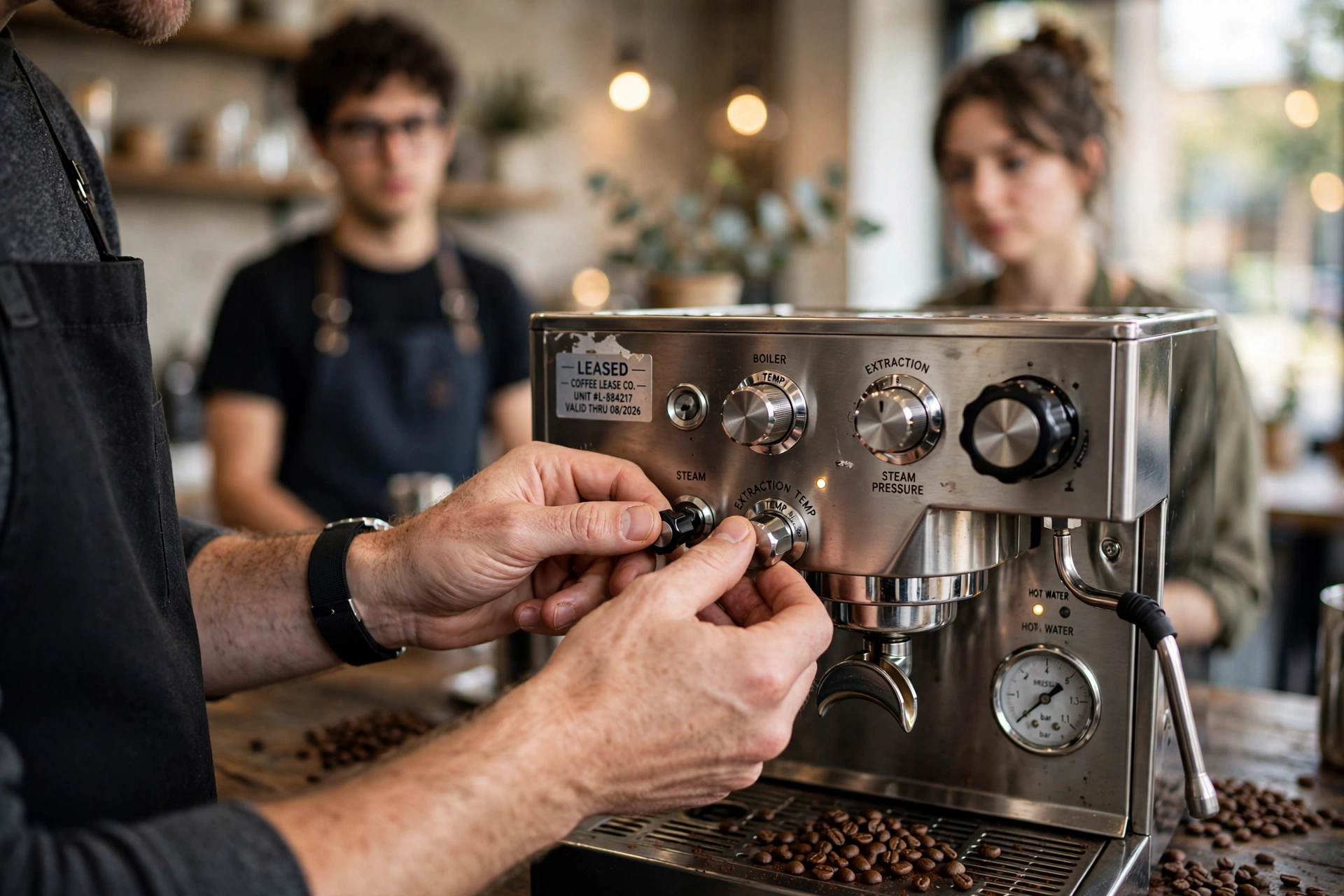
The difference lies in the engineering. A commercial espresso machine uses heavy-duty boilers and PID controllers to ensure that the water temperature doesn't fluctuate by more than a fraction of a degree between shots. If your temperature drops by even five degrees, the extraction of the Coffea arabica bean changes, resulting in sour, under-extracted coffee. This is why the Sensa Coffee Service in Charlotte, NC focuses on precision hardware; without that stability, your barista is fighting the machine rather than perfecting the craft.
According to the Specialty Coffee Association (SCA), adherence to strict brewing standards, which require specific temperature and pressure ranges, is the only way to achieve a "specialty" grade cup. If your equipment cannot hold those parameters under the stress of a 7:00 AM rush, you aren't selling specialty coffee; you're selling a gamble.

Why Does Quality Equipment Directly Impact Your Bottom Line?
The "worth" of a professional supply chain is measured in the reduction of "silent killers": waste, downtime, and labor inefficiency. When a business uses subpar equipment, the cost isn't found in the initial purchase price, but in the waste of expensive coffee beans and the loss of staff productivity.
1. Reducing Product Waste
Inconsistent temperature and pressure lead to "dial-in" waste. A professional setup allows a barista to calibrate the grind and dose quickly. In contrast, cheap equipment requires constant tweaking. If a shop wastes just five shots per hour due to equipment instability, that adds up to thousands of dollars in lost inventory annually.
2. Improving Labor Efficiency
Manual processes are slow. By utilizing automated coffee machines for clinics and medical offices, businesses remove the bottleneck of manual steaming and tamping. Data from industry reports suggests that automation in the beverage sector can reduce service time per customer by 30-40%, allowing for higher throughput during peak hours without adding more staff.
3. Mitigating Catastrophic Downtime
Equipment failure is not a matter of "if," but "when." The difference between a DIY supply approach and a managed one is the recovery time. A business with a managed contract can have a technician on-site in hours; a business buying from a generic online retailer might wait weeks for a part to ship from overseas.
The National Coffee Association USA (NCA) notes that consumer demand for "premium" and "specialty" coffee continues to rise. This means customers are more discerning. If your equipment produces a burnt or watery cup because the boiler cannot keep up with demand, you lose the customer for life. This "churn rate" is the most hidden cost of poor equipment supply.
How to Implement a Professional Equipment Strategy Step-by-Step
Moving from a fragmented "buy-as-you-go" approach to a professional supply strategy requires a shift in mindset from Capital Expenditure (CapEx) to Operational Expenditure (OpEx). Instead of spending $20,000 upfront on a machine that depreciates the moment it's installed, the most successful operators are moving toward managed memberships.
Step 1: Volume Projection and Capacity Planning
Before selecting a machine, calculate your "peak hour" volume. If you expect to serve 60 drinks per hour, you need a multi-group head machine with a boiler capacity that exceeds your peak demand by 20%. Under-sizing your equipment is a recipe for slow service and overheating.
Step 2: Water Quality Integration
The biggest mistake I see is ignoring water filtration. Most "equipment failures" are actually mineral buildup (scale) from hard water. A professional supply must include a commercial-grade filtration system. Without it, you are essentially pouring liquid limestone into your heating elements.
Step 3: Selecting a Managed Service Provider
Rather than managing five different vendors for beans, machines, and maintenance, consolidate. Busy Bean Coffee provides an all-inclusive managed membership. This means the equipment, installation, and full maintenance are bundled into one predictable monthly fee. This eliminates the "surprise" $1,200 repair bill in the middle of your busiest month.
Step 4: Staff Training and Calibration
Even the best machine is useless if the operator doesn't understand the variables. Professional supply includes "train-the-trainer" programs. Your team must understand how to maintain the espresso machine daily to prevent the buildup of oils and residue that ruin the flavor profile.
💡
Key Takeaway
Stop treating coffee equipment as a one-time purchase and start treating it as a critical utility. A managed membership model converts a volatile risk (equipment failure) into a predictable monthly operating cost.
For those operating in specific hubs, such as the Sensa Coffee Service in Raleigh NC (2026 Overview), the ability to get local, expert support for calibration is what ensures the "specialty" label actually means something to the end consumer.
Comparing the Three Paths to Equipment Acquisition
Not all supply paths are created equal. Depending on your budget and risk tolerance, you generally have three options. Most owners start with the "Budget" approach and quickly realize the hidden costs.
| Feature | Budget/Consumer Path | Generic Commercial Vendor | Managed Membership (Busy Bean) |
|---|---|---|---|
| Upfront Cost | Low | High (CapEx) | Zero to Low |
| Maintenance | DIY/Hope for the best | Pay-per-call (Expensive) | Included in monthly fee |
| Consistency | Poor (Thermal drift) | Moderate (Manual) | High (Calibrated/Automated) |
| Downtime Risk | Critical (Weeks) | Moderate (Days) | Low (Priority Support) |
| Best For | Home use/Tiny kiosks | Large corporations with internal techs | Hotels, Cafes, & Foodservice |
Now, here's where it gets interesting: the "Generic Commercial" route often leads to "vendor lock-in" where you are forced to buy low-quality beans to keep your warranty. A professional, independent supply like Busy Bean Coffee allows you to maintain high standards without being handcuffed by restrictive equipment contracts.

Common Misconceptions About Cafe Equipment
There is a persistent myth in the industry that "better beans make up for a bad machine." This is fundamentally false. You can source the most expensive, single-origin Arabica coffee in the world, but if your machine's pressure is unstable or your water temperature is too low, that bean's potential is wasted. The machine is the lens through which the bean is expressed; a blurry lens ruins the picture.
Another common misconception is that "automatic machines are for low-quality coffee." This was true ten years ago. However, in 2026, the precision of automated systems often exceeds that of a tired or undertrained human barista. When you implement a foodservice coffee program in Chicago IL: Complete Guide, the goal is "reproducible excellence." An automated system ensures that the 1st cup of the day is identical to the 500th.
Finally, some owners believe that "buying used equipment saves money." In reality, buying a used commercial machine without a full boiler inspection and gasket replacement is a gamble. You aren't saving money; you're inheriting someone else's neglected maintenance.
Frequently Asked Questions
Is a managed coffee membership actually cheaper than buying my own equipment?
Yes, when you factor in the Total Cost of Ownership (TCO). Buying your own equipment involves a massive upfront cost, plus the ongoing cost of preventative maintenance, part replacements (like gaskets and shower screens), and emergency repairs. In a managed membership, these are all internalized. Furthermore, the "opportunity cost" of a machine being down for three days is often higher than the entire annual cost of a membership. By shifting to an OpEx model, you preserve your cash flow for marketing and staffing.
How often does professional cafe equipment actually need maintenance?
Daily, weekly, and quarterly. Daily maintenance includes backflushing the group heads and cleaning the steam wands. Weekly maintenance involves deep-cleaning the hoppers and checking water levels. Quarterly, a professional technician should perform a "preventative" service, which includes replacing seals and checking the pump pressure. If you wait until the machine breaks to call a technician, you've already lost money. A managed service ensures these cycles happen automatically without the owner having to track them on a calendar.
Can "prosumer" machines handle a small commercial environment?
Generally, no. "Prosumer" machines are designed for the home, meaning they may make 5-10 drinks in a row, but they cannot handle a continuous flow for four hours. The heat exchanger or boiler in a prosumer machine will eventually "dip," causing the temperature to drop and the coffee to taste sour. For any business expecting more than 20 customers per hour, a true commercial supply is essential. This is why we recommend the Sensa Coffee Service in Mount Pleasant SC: Complete Guide for businesses that want to grow without outgrowing their hardware.
Does the type of equipment affect the flavor of the coffee?
Absolutely. The coffee roasting process sets the potential, but the equipment realizes it. Factors like grind uniformity (determined by the grinder) and thermal stability (determined by the machine) are the two most important variables. If your grinder produces "fines" (tiny dust-like particles), the water will channel through the puck, leading to a cup that is simultaneously bitter and sour. Professional equipment minimizes these variables, ensuring the natural notes of the bean shine through.
What happens if my equipment breaks during a peak period?
In a traditional supply model, you call a repair company and wait for an appointment. In a managed model like Busy Bean Coffee, you have a dedicated support structure. Because we provide the equipment and the service, we know exactly which model you have and which parts are likely to fail. This allows for faster diagnostics and often a "swap-out" or rapid repair that minimizes the impact on your revenue. This level of security is a core component of the Sensa Coffee Service in Columbia SC: Complete Guide | Busy Bean Coffee.
Final Thoughts on the Worth of Cafe Equipment Supply
The question isn't whether you can afford a professional cafe equipment supply, but whether you can afford the alternative. The "hidden" costs of cheap hardware, waste, customer churn, and catastrophic downtime, are far more damaging than a monthly membership fee. When you invest in high-end hardware and a managed service, you stop being a "machine mechanic" and start being a business owner again.
Whether you are setting up a new location or optimizing an existing one, the goal is the same: a consistent, high-quality product delivered with maximum efficiency. From the precision of the coffee bean grind to the stability of the water temperature, every detail matters. If you're ready to stop gambling with your uptime and start scaling your quality, explore the all-inclusive solutions at Busy Bean Coffee.
For more specialized insights, we recommend reviewing our Sensa Coffee Service in Jacksonville, FL guide to see how regional scaling works in practice.
Free Coffee Pairing Guide & Specialty Roast Cheat Sheet
Unlock the secrets of perfect brewing ratios, water temperatures, and specialty roast profiles. Download the guide.