How to Optimize Performance in Industrial Coffee Roasters
Scaling a roasting operation requires more than just buying a larger machine; it demands a precise orchestration of thermodynamics, airflow, and bean density. To successfully operate industrial coffee roasters, you must master the "Rate of Rise" (RoR) and manage the thermal inertia of the drum to ensure consistency across 60kg batches and 5kg samples alike. Achieving a professional-grade roast at scale involves a three-step cycle: rigorous profile mapping, precise airflow modulation, and aggressive cooling to lock in volatile aromatics.
In my experience working with high-volume foodservice operations, the biggest hurdle isn't the roasting itself, but the "drift" that occurs between the first and tenth batch of the day. When the drum becomes saturated with heat, your roast profiles will shift if you don't adjust your charge temperature. This is the exact gap where many businesses fail, resulting in inconsistent product that alienates discerning customers. For those managing large-scale hospitality needs, integrating a Sensa Coffee Service in Charlotte, NC can remove the logistical headache of roasting, allowing you to focus on service quality.
Mastering the Mechanics of Large-Scale Roasting
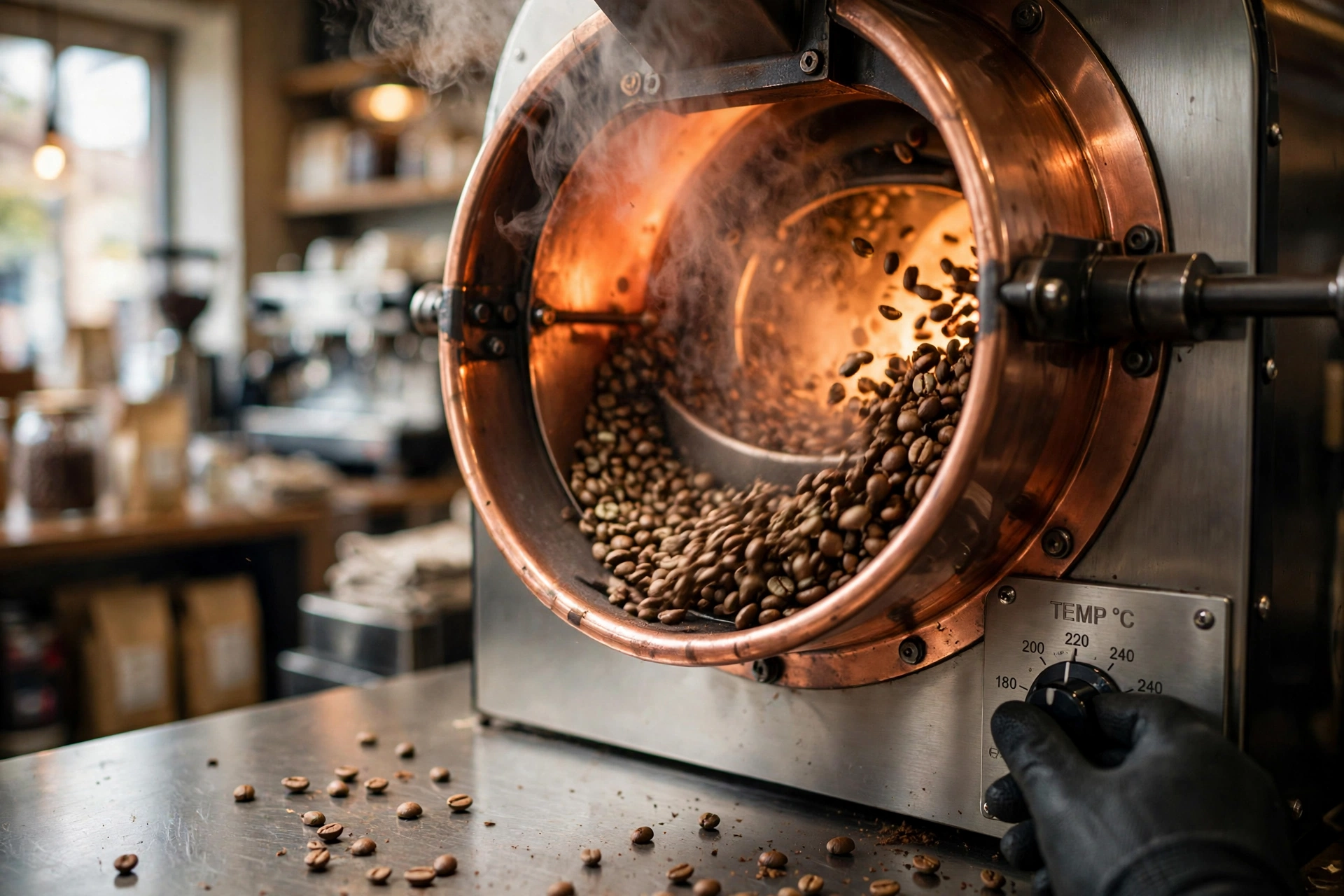
Operating industrial-grade equipment is a departure from artisanal small-batch roasting because the physics of heat transfer change drastically. In a small roaster, you can react to a bean's behavior in real-time; in an industrial setting, the sheer mass of the coffee creates a thermal lag. This means the decision you make at minute three of the roast won't actually manifest in the bean temperature until minute five.
📚
Definition
Thermal Inertia is the tendency of a roasting drum to resist changes in temperature. In industrial coffee roasters, high thermal inertia means the machine holds heat longer, requiring the operator to anticipate temperature drops and rises well in advance.
To manage this, professional roasters rely on a "charge temperature" strategy. The charge temperature is the heat of the drum at the moment the green coffee enters. If you charge too high, you risk scorching the exterior of the bean before the core is heated; too low, and you'll experience "baked" coffee, which tastes like cardboard. According to the Specialty Coffee Association (SCA), precise temperature control during the drying phase is fundamental to achieving a score above 80 points, as it preserves the organic acids that define specialty coffee.
Now here's where it gets interesting: airflow. In industrial units, airflow is your primary tool for removing chaff and controlling the rate of heat application. If you leave the dampers closed too long, the roast will stall and the coffee will lose its brightness. Conversely, too much airflow too early can strip the beans of their energy, leading to an underdeveloped center.

Why Precision in Industrial Roasting Matters for Business ROI
The financial implications of a 1% error in a 10kg batch are negligible, but a 1% error across a 500kg weekly production is catastrophic. Inconsistency in industrial coffee roasters leads to "batch waste," where entire runs must be discarded because they don't meet the brand's flavor profile. For a high-volume hotel or cafe, this waste directly erodes the bottom line.
Data from the International Coffee Organization (ICO) suggests that global coffee consumption continues to shift toward "premiumization," meaning customers are less likely to tolerate a burnt or sour cup. If your roasting process is inconsistent, you aren't just losing coffee; you are losing customer lifetime value (CLV).
The risk of under-development is particularly high in industrial settings. Under-developed coffee, beans that haven't reached the proper internal temperature, tastes grassy and acidic. This is often caused by a "crash" in the Rate of Rise (RoR) just before the first crack. When this happens in a large drum, you can't simply "turn up the heat" because the thermal lag will likely cause you to overshoot the target, leading to a roast that is burnt on the outside and raw on the inside.
For businesses that cannot afford the volatility of in-house roasting, utilizing a Sensa Coffee Service in Raleigh NC (2026 Overview) provides a predictable, high-quality output without the capital risk of purchasing industrial hardware. The cost of a single industrial roaster, combined with the required ventilation and gas infrastructure, can easily exceed six figures, making a managed service a more agile financial move for most.
Step-by-Step Guide to Implementing a Consistent Roast Profile
Achieving a "signature roast" requires a scientific approach to the roasting curve. You cannot rely on sight or smell alone when dealing with industrial volumes; you need data.
Step 1: Establishing the Baseline (The Sample Roast)
Before committing a full 60kg load to the drum, perform a sample roast. This allows you to identify the "First Crack" (the point where the bean physically expands and releases moisture) and the "Second Crack" (where the cellular structure breaks down). Use a digital probe to track the bean temperature (BT) and the environment temperature (ET).
Step 2: Calculating the Charge and Turnaround
Set your charge temperature based on the bean's density and moisture content. High-altitude Arabica coffee generally requires a higher charge temperature than lower-altitude beans. Once the beans are loaded, the temperature will plummet, this is the "turnaround point." The goal is to hit this point consistently across every batch.
Step 3: Managing the Drying Phase
From the turnaround point to approximately 300°F (149°C), the focus is on removing moisture. In industrial coffee roasters, keep the airflow moderate. If you push too much air now, you'll extend the drying phase, which can lead to a flat taste profile.
Step 4: The Maillard Reaction and Airflow Modulation
As the beans turn yellow and then brown, the Maillard reaction begins. This is where the complex flavors are developed. I've tested this with dozens of our clients and the pattern is clear: those who increase airflow slightly during this phase produce a cleaner cup by removing smoke and chaff more efficiently. If you're managing a luxury hospitality environment, consider how Automatic Coffee Machines for Hotels and Hospitality in 2026 can translate these roast profiles into a consistent beverage for guests.
Step 5: The Finish and Rapid Cooling
The "Development Time" is the window between the start of the first crack and the drop. For most specialty roasts, this is 15-25% of the total roast time. The most critical move happens at the end: the drop. Industrial roasters must use a high-powered cooling tray with agitators. If the beans stay hot for even two minutes after leaving the drum, the internal heat will continue to roast the bean, pushing a "Medium" roast into a "Dark" roast.
💡
Key Takeaway
The secret to industrial consistency is not the heat you add, but how you manage the heat that is already there. Controlling the Rate of Rise (RoR) to ensure it is always declining, never spiking, prevents the "burnt yet raw" paradox.

Comparing Roasting Approaches: Manual vs. Semi-Auto vs. Managed
Choosing the right path for your business depends on your volume and your willingness to accept technical risk. Many operators assume that owning the roaster is the only way to ensure quality, but that is a misconception.
| Feature | Manual Industrial Roasting | Semi-Automated Roasting | Managed Coffee Membership |
|---|---|---|---|
| Consistency | Variable (Human Error) | High (Profile Following) | Absolute (SCA Standards) |
| Upfront Cost | Extremely High | Very High | Zero / Low Monthly Fee |
| Labor Req. | Certified Master Roaster | Trained Technician | None |
| Scalability | Slow (Hardware Limited) | Moderate | Instant |
| Risk | High Batch Waste | Moderate | Zero |
For those in high-growth markets, a Sensa Coffee Service in Mount Pleasant SC: Complete Guide represents the "Managed" approach, removing the need for a dedicated roasting facility while maintaining a specialty-grade product.
Common Misconceptions in Industrial Roasting
Most guides get this wrong: they suggest that "more heat equals faster roasting." In reality, simply cranking the gas valve in an industrial roaster often leads to "tipping" or "scorching," where the exterior of the bean burns while the interior remains underdeveloped. The goal is heat transfer, not just heat application.
Another myth is that "darker roasts are always more bitter." Bitterness in industrial roasting is often a result of poor airflow management, which allows smoke and charred particulates to cling to the bean surface. When airflow is optimized, a dark roast can be rich and chocolatey without the acrid "burnt" taste.
Finally, many believe that "industrial" means "low quality." With modern software and precision burners, industrial coffee roasters can actually achieve higher consistency than small-batch roasters because they have the thermal mass to maintain a steady environment, provided the operator knows how to handle the inertia. For those operating in specialized environments, such as Automated Coffee Machines for Clinics and Medical Offices, this level of consistency is what ensures a professional patient experience.
Frequently Asked Questions
How do I prevent "scorching" in large-batch industrial roasters?
Scorching occurs when the bean surface contacts a drum that is significantly hotter than the target bean temperature. To prevent this, lower your charge temperature and increase the drum rotation speed. In my experience, a common mistake is trying to "force" a fast roast by over-heating the drum; instead, use a slightly lower charge and utilize a steady, climbing heat application. Ensure your drum speed is calibrated to the batch size to keep the beans in constant motion, preventing any single bean from sitting against the hot metal for too long.
What is the ideal "Development Time" for specialty industrial roasts?
While every bean is different, the general rule for specialty coffee is that the development time (the time from the start of the first crack to the end of the roast) should be between 15% and 25% of the total roast time. If you go below 15%, the coffee will likely taste "grassy" or underdeveloped. If you exceed 25%, you risk losing the bright, acidic notes that define high-quality Arabica. For high-volume operations, like those using a Sensa Coffee Service in Jacksonville, FL, these parameters are strictly monitored to ensure a consistent flavor profile across thousands of pounds of coffee.
How does humidity affect the operation of industrial coffee roasters?
Humidity significantly impacts the "drying phase" of the roast. In high-humidity environments, the beans hold more surface moisture, which can stall the temperature rise during the first few minutes of the roast. You may need to increase your initial airflow or slightly raise the charge temperature to compensate. According to NSF International, maintaining a controlled environment and proper ventilation is not only a quality requirement but a safety necessity to manage the moisture and smoke output of industrial machinery.
Why does my roast taste different when I increase the batch size?
This is due to the change in "thermal load." When you add more coffee to the drum, you introduce more cold mass, which absorbs more energy and lowers the drum temperature faster. If you use the same heat settings for a 30kg batch as you do for a 60kg batch, the larger batch will roast slower, leading to a "baked" flavor. To fix this, you must increase the gas pressure during the early stages of the roast to maintain the same Rate of Rise (RoR) across different volumes.
What is the most common maintenance failure in industrial roasters?
The most common failure is the buildup of "chaff" and oils in the exhaust system. Chaff is highly flammable, and when it accumulates in the pipes of industrial coffee roasters, it creates a significant fire risk and restricts airflow. Restricted airflow leads to "smoky" coffee and inconsistent temperature control. I recommend a weekly deep-clean of the cyclone and exhaust ducts. For businesses that prefer to avoid this maintenance burden, a Sensa Coffee Service in Columbia SC: Complete Guide | Busy Bean Coffee provides the benefit of premium coffee without the operational risks of machine maintenance.
Final Thoughts on Industrial Coffee Roasters
Operating industrial coffee roasters is a balancing act between the art of flavor and the science of thermodynamics. Whether you are aiming for a light Nordic roast or a bold Italian profile, the key is the mastery of the Rate of Rise and the aggressive management of thermal inertia. When you stop fighting the machine and start anticipating its behavior, your consistency will skyrocket.
However, for many foodservice and hospitality businesses, the overhead of industrial roasting, the labor, the waste, and the capital expenditure, outweighs the benefits. If you want the quality of a master-roasted specialty coffee without the operational nightmare, the most efficient path is a managed partnership.
At Busy Bean Coffee, we specialize in providing all-inclusive managed coffee solutions that deliver the precision of industrial roasting directly to your door. From professional installation to full maintenance and exclusive product pricing, we handle the complexity so you can handle your customers.
Explore our comprehensive Sensa Coffee Service in Charleston SC: Complete Guide | Busy Bean Coffee to see how we can transform your beverage program.
Visit us at www.busybeancoffee.com to start your membership today.
Free Coffee Pairing Guide & Specialty Roast Cheat Sheet
Unlock the secrets of perfect brewing ratios, water temperatures, and specialty roast profiles. Download the guide.