Which Industrial Coffee Roasters Should You Choose for Your Business Scale?
Selecting the right roasting hardware is often the most expensive mistake a growing coffee brand makes. I've seen dozens of entrepreneurs overbuy capacity, ending up with a massive drum they can't fill, or worse, underbuy and choke their growth within six months. When evaluating industrial coffee roasters, the "best" option is not the one with the most features, but the one where the thermal mass and airflow perfectly match your daily throughput and target flavor profile. For most mid-to-large scale operations in 2026, the decision boils down to a trade-off between the unmatched consistency of high-end drum roasters and the rapid scalability of fluid-bed (air) systems.
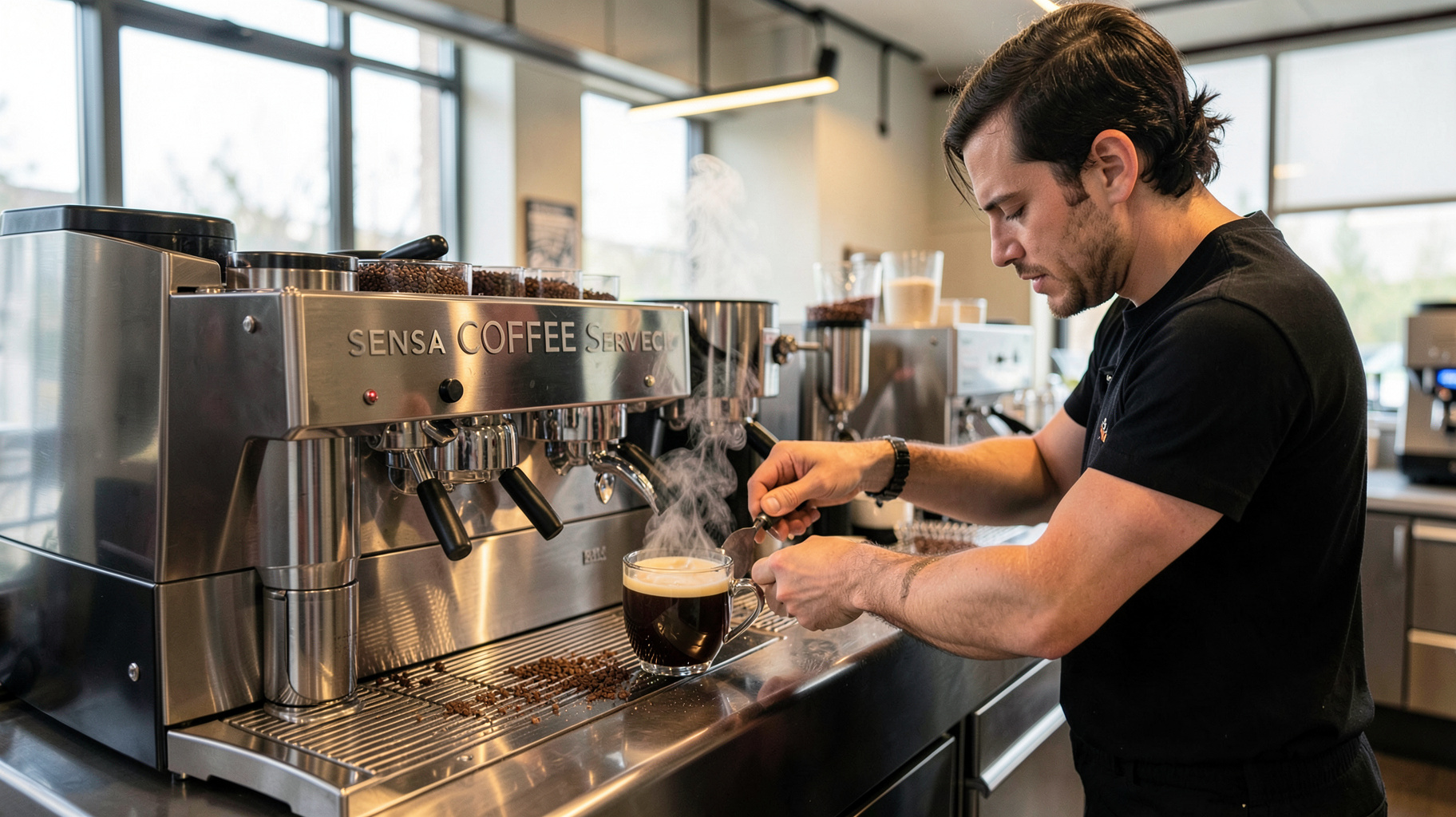
If you are operating a high-volume hospitality environment, you might find that managing the roasting process in-house is a logistical nightmare. In those cases, leveraging a Sensa Coffee Service in Charlotte, NC allows you to focus on guest experience while we handle the quality control of the bean.
The Mechanics of High-Volume Roasting: What You Need to Know
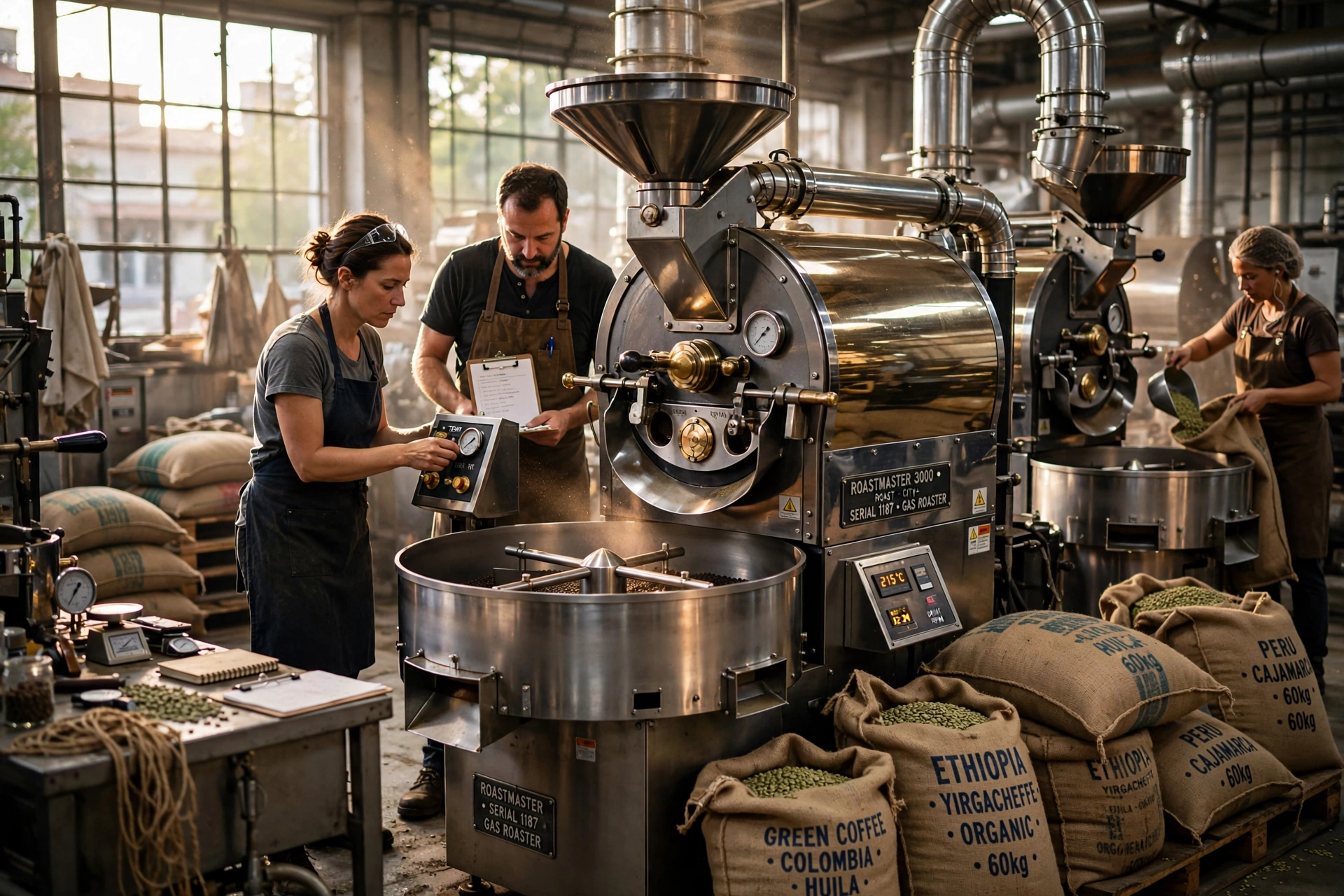
To decide which machine fits your operation, you first have to understand the physics of heat transfer. Industrial roasting is essentially the management of three types of heat: conductive (contact with the metal), convective (hot air), and radiant (the heat from the burner).
📚
Definition
Industrial coffee roasters are high-capacity thermal processing machines designed to roast large batches of green coffee beans (typically 15kg to 120kg+ per batch) with precision temperature control and automated cooling systems.
In my experience working with specialty roasters, the biggest point of contention is usually "Drum vs. Air." A traditional drum roaster uses a rotating cylinder to move the beans. This creates a high amount of conductive heat, which is why many purists claim it produces a "fuller" body. However, the mistake I made early on—and that I see constantly—is ignoring the "thermal lag." Large drums take a long time to heat up and cool down, which can lead to inconsistent batches if your roast profiles aren't meticulously logged.
According to the Specialty Coffee Association (SCA), the precision of the roast is heavily dependent on the ability to control the Rate of Rise (RoR). In an industrial setting, if your machine cannot modulate the heat quickly enough during the "first crack," you risk scorching the beans or producing a baked, flat flavor. This is where modern software integration comes in. Most 2026-era industrial roasters now integrate with Cropster or Artisan to allow for real-time curve adjustments.

Now here's where it gets interesting: the shift toward fluid-bed roasting. Unlike drums, air roasters suspend the coffee bean in a stream of hot air. This is almost pure convection. While some argue it lacks the "traditional" taste, the consistency is mathematically superior because the heat is applied evenly to every single bean simultaneously. For a business focusing on massive volume with a lean staff, air roasters are often the smarter play.
Why the Right Hardware Choice Impacts Your Bottom Line
The choice of roaster isn't just about taste; it's a capital expenditure (CapEx) decision that dictates your margins for the next decade. If you choose a machine that is too large, your energy costs per kilogram skyrocket. If you choose one too small, you'll be forced to run 24-hour shifts, increasing labor costs and wearing out the bearings and motors prematurely.
According to the National Coffee Association USA (NCA), the demand for specialty coffee continues to grow, but consumer expectations for consistency have never been higher. A 2% variance in roast color across batches can lead to a noticeable difference in extraction, resulting in wasted product and customer dissatisfaction. In a high-volume environment, a "bad batch" of 60kg of Coffea arabica isn't just a culinary error; it's a thousand-dollar loss in raw materials.
Furthermore, the regulatory environment adds another layer of complexity. Industrial roasters produce significant amounts of smoke and VOCs (volatile organic compounds). According to NSF International, equipment must meet strict sanitary and safety standards to be legal in commercial zones. Failing to invest in a high-quality afterburner or smoke filtration system can result in municipal fines or forced shutdowns.
If you are scaling a business in a medical or corporate setting, the equipment needs change. You don't need a roast-master's suite; you need reliability. This is why we recommend automated coffee machines for clinics and medical offices, which remove the volatility of manual brewing and focus on a consistent, high-quality output.
Practical Application: Building Your Roasting Decision Framework
When you are sitting down to decide which industrial coffee roasters to purchase, you need a framework that removes emotion from the equation. I've analyzed the growth curves of dozens of clients, and the pattern is clear: most businesses over-estimate their "peak" and under-estimate their "maintenance."
Here is the step-by-step process I recommend for auditing your needs:
- Calculate Your True Throughput: Don't look at your current sales; look at your 2026 projections. If you need 500kg per week, you don't need a 120kg roaster. You need a 30kg roaster running efficiently.
- Analyze Your Energy Infrastructure: Industrial roasters require massive gas lines or high-voltage electrical drops. Before buying, have an electrician verify if your panel can handle the load.
- Evaluate the Cooling Cycle: The roast doesn't end when the beans drop. If your cooling tray takes 8 minutes to bring the beans to room temperature, your total cycle time increases, effectively lowering your hourly output.
- Plan for the "Green" Logistics: Where will you store 5,000 lbs of green coffee? Where will the chaff go? Chaff is highly flammable; if your roaster doesn't have an efficient vacuum system, you're creating a fire hazard.
💡
Key Takeaway
The bottleneck in an industrial coffee operation is rarely the roasting time itself, but rather the cooling, bagging, and degassing phases. Optimize for the entire workflow, not just the heat.
For those who realize that the overhead of industrial roasting is too high, there is a more streamlined path. Instead of managing the volatility of raw beans and machinery, a foodservice coffee program in Chicago IL: Complete Guide provides the same premium quality without the operational risk.

Comparing the Industrial Options: Drum vs. Air vs. Hybrid
To make a final decision, you need to see the trade-offs side-by-side. Most guides will tell you "it depends," but based on the data, the distinctions are actually quite sharp.
| Feature | Traditional Drum Roaster | Fluid-Bed (Air) Roaster | Hybrid Systems |
|---|---|---|---|
| Heat Transfer | Conductive & Convective | Primarily Convective | Balanced Mix |
| Consistency | Variable (depends on load) | High (uniform air flow) | High |
| Batch Turnaround | Slower (Drum heat-up) | Extremely Fast | Moderate |
| Flavor Profile | Traditional, Heavy Body | Clean, Bright, Acidic | Versatile |
| Best For | Artisan Brands, Small-Mid Scale | Mass Market, High Volume | Versatile Specialty Roasters |
| Maintenance | High (Bearing/Drum wear) | Moderate (Fan/Filter) | Moderate |
The traditional drum roaster remains the gold standard for those who want to "craft" a specific profile. However, if your goal is to provide a consistent coffee service across multiple locations, the fluid-bed roaster wins on repeatability.
That said, hybrid systems are gaining traction in 2026. These machines allow the operator to adjust the ratio of conductive to convective heat. In my experience, these are the most "future-proof" investments because they allow you to pivot your brand's flavor profile without buying a new machine. Whether you are serving a Sensa Coffee Service in Raleigh NC (2026 Overview) or a boutique hotel, the ability to tweak the roast to the specific water chemistry of the region is a massive competitive advantage.
Common Misconceptions About Industrial Roasting
There are several myths in the industry that often lead businesses into expensive traps. Most guides get this wrong by prioritizing "capacity" over "control."
Myth 1: "A bigger roaster is always better for growth."
Wrong. A 120kg roaster is inefficient if you're only roasting 20kg batches. You lose a tremendous amount of heat to the empty space in the drum, and the roast profile will be completely different from your sample roasts. It is better to have a smaller, high-efficiency machine and run more batches than to struggle with a giant machine that is half-empty.
Myth 2: "Automatic roasters take the soul out of the coffee."
This is an outdated sentiment. In a professional environment, "soul" is actually "consistency." Using software to track the roast curve doesn't replace the barista or the roaster's palate; it simply removes the guesswork. When you're roasting 10 batches a day, manual temperature reading is an invitation for error.
Myth 3: "You can just put a roaster in any warehouse."
I see this constantly. People forget about the "chaff" and the "smoke." Industrial roasting produces a sticky, oily residue that coats every surface of a room. Without a professional-grade ventilation and filtration system, your warehouse will smell like a burnt tire factory, and you will likely face zoning violations from the city.
Frequently Asked Questions
Which industrial coffee roasters are best for starting a medium-sized specialty brand?
For a medium-sized brand, I recommend a 15kg to 30kg drum roaster with full software integration. This size provides the best balance between batch efficiency and the ability to maintain a "specialty" profile. Drum roasters allow for the nuance required in specialty coffee, while a 30kg capacity ensures you can meet wholesale demand without spending 20 hours a day in the roasting room. Ensure the machine has a high-efficiency cooling tray to keep your cycle times under 20 minutes.
How do I determine if I need a drum or an air roaster for my business?
The choice depends on your brand identity. If your brand is built on "tradition," "body," and "richness," a drum roaster is the way to go. If your brand focuses on "precision," "brightness," and "scalability," an air roaster is superior. Air roasters are generally easier to operate for non-experts and offer faster throughput, making them ideal for those who view coffee as a high-volume product rather than a boutique craft.
What are the hidden costs of installing an industrial roaster?
The machine is only about 60-70% of the total cost. You must budget for gas line installation, a professional exhaust stack, an afterburner to remove smoke, and a high-capacity vacuum for chaff collection. Additionally, you'll need a dedicated space for "degassing" the roasted beans before they are shipped. In many cases, the infrastructure costs for a Sensa Coffee Service in Mount Pleasant SC: Complete Guide can be as high as the cost of the machine itself.
Is it better to buy a new industrial roaster or a refurbished one?
Unless you have a dedicated on-site engineer, buy new. Industrial roasters are subject to extreme thermal stress. A refurbished machine may look great, but worn bearings or a warped drum can lead to "hot spots" that ruin expensive batches of Arabica coffee. Modern 2026 machines also feature significantly better energy efficiency and software integration that simply cannot be retrofitted into older models.
How does the roasting process affect the final coffee service quality?
The roast is where the flavor is locked in. If you over-roast, you destroy the delicate acids of the bean; if you under-roast, the coffee tastes like grass. This is why the choice of roaster is so fundamental. A machine that allows for precise temperature control ensures that whether you are providing a Sensa Coffee Service in Jacksonville, FL or a local cafe, the cup of coffee tastes exactly the same every single morning.
Final Thoughts on Industrial Coffee Roasters
Choosing between industrial coffee roasters is a decision that balances art with engineering. Whether you opt for the conductive warmth of a drum or the convective precision of a fluid-bed system, the goal is the same: consistency at scale. The most successful businesses in 2026 are those that stop trying to do everything themselves and instead partner with experts who can guarantee quality.
If the technical overhead of roasting—the gas lines, the smoke filters, the labor of a master roaster—feels like too much of a distraction from your core business, there is a better way. At Busy Bean Coffee, we provide the equipment and the expertise so you can enjoy the rewards of a premium coffee program without the industrial headaches.
For those looking to upgrade their hospitality game, explore our Automatic Coffee Machines for Hotels and Hospitality in 2026 to see how we bridge the gap between industrial quality and effortless operation.
Ready to elevate your business coffee experience? Visit www.busybeancoffee.com to discover our all-inclusive managed solutions.
Free Coffee Pairing Guide & Specialty Roast Cheat Sheet
Unlock the secrets of perfect brewing ratios, water temperatures, and specialty roast profiles. Download the guide.