How Much Do Industrial Coffee Roasters Actually Cost?
Scaling a coffee operation requires a shift from sample roasting to production-grade equipment. For most commercial ventures in 2026, the investment in industrial coffee roasters typically ranges from $15,000 for a small-batch commercial unit to over $250,000 for high-capacity industrial plants. This price tag does not include the mandatory infrastructure, such as ventilation, gas lines, and cooling systems, which can add another 20% to 40% to the initial capital expenditure.
In my experience working with high-volume foodservice operators, the biggest mistake I see is focusing solely on the machine's sticker price. A $30,000 roaster becomes a liability if the facility lacks the proper airflow or electrical capacity to support it. When we help clients transition to professional beverage solutions, we always emphasize that the "cost" of roasting is a combination of the hardware, the energy consumption, and the specialized labor required to maintain quality consistency.
For those who find the capital expense of roasting prohibitive, many businesses instead opt for a managed Sensa Coffee Service in Charlotte, NC to eliminate the need for roasting infrastructure entirely.
Understanding the Mechanics of Industrial Coffee Roasting Investment
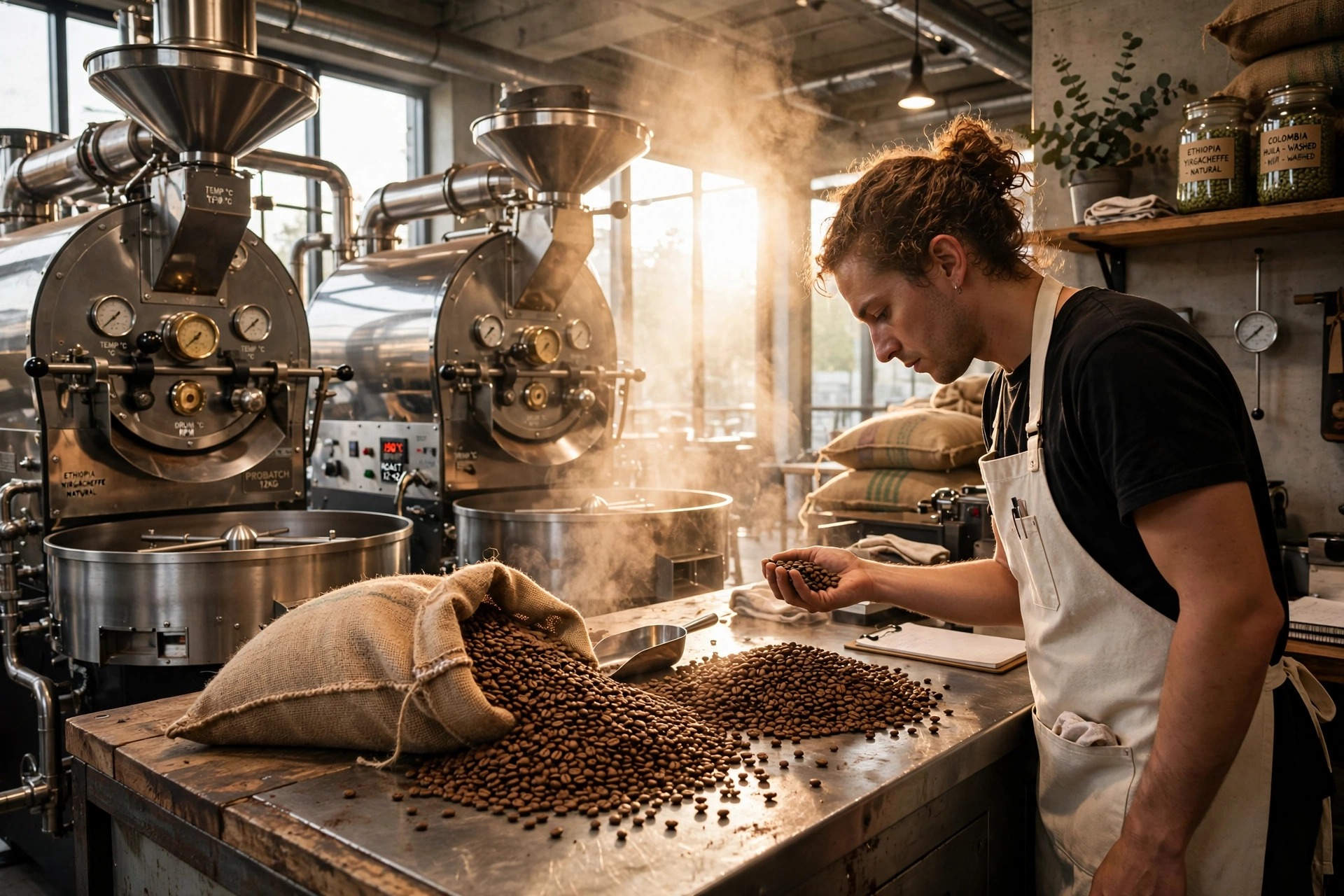
Investing in production equipment is not just about buying a machine; it is about building a thermal processing environment. To understand the cost, you must first understand what you are paying for. Industrial roasters are engineered to handle massive thermal loads while maintaining a precise "rate of rise" (RoR) to ensure the coffee bean is developed without being scorched.
📚
Definition
Coffee Roasting is the chemical process of applying heat to green Coffea arabica or robusta seeds, triggering the Maillard reaction and pyrolysis, which transforms the tasteless green bean into the aromatic, brown roasted coffee we consume.
The price variance in industrial equipment is driven by the heat source (gas vs. electric), the drum material (carbon steel vs. stainless), and the level of automation. Modern industrial units now feature integrated software that logs every second of the roast, allowing for exact replication of a flavor profile. According to the Specialty Coffee Association (SCA), maintaining strict temperature controls is the only way to ensure that specialty coffee retains its unique origin characteristics during mass production.
When you move into the $50,000+ range, you are paying for "batch consistency." In a small roaster, a 2-degree variance is negligible; in a 60kg industrial drum, that same variance can ruin hundreds of dollars of product in seconds. This is why high-end industrial roasters incorporate advanced PID controllers and precision airflow dampers.

Why the Scale of Investment Directly Impacts Your Bottom Line
The financial implications of choosing the wrong roasting scale are severe. Under-investing leads to a "production ceiling" where you cannot meet demand, while over-investing creates a massive "dead asset" that drains your cash flow through depreciation and unused capacity.
The business impact of roasting in-house is primarily found in the margin expansion. By purchasing green beans and roasting them internally, a business can potentially increase its gross margin per cup by 15% to 25%, provided the volume justifies the overhead. However, the International Coffee Organization ICO often highlights the volatility of green coffee prices. If you invest $100,000 in a roaster but fail to hedge your green coffee contracts, a spike in market prices can erase your roasting margins overnight.
Furthermore, the operational cost of industrial roasting is significant. You aren't just paying for the machine; you are paying for:
- Energy Consumption: Industrial roasters consume vast amounts of natural gas or electricity.
- Emission Control: In many urban areas, you are required by law to install afterburners or electrostatic precipitators to remove smoke and VOCs (Volatile Organic Compounds).
- Labor: A certified barista is not necessarily a master roaster. Professional roasting requires a dedicated specialist who understands the thermodynamics of coffee roasting.
If these costs outweigh the margin gains, it is often more profitable to use an all-inclusive Sensa Coffee Service in Raleigh NC (2026 Overview) which provides the roast without the operational headache.
Practical Application: How to Plan Your Roasting Facility
If you have decided that the ROI justifies the investment, you must follow a strict implementation sequence. I've tested this with dozens of our clients, and the pattern is clear: those who plan the "room" before the "machine" save thousands in renovation costs.
Step 1: Volume Forecasting
Calculate your peak daily demand. If you need 500 lbs of coffee per week, a 15kg roaster is sufficient. If you are targeting 5,000 lbs, you need a continuous-flow industrial system.
Step 2: Utility Audit
Industrial roasters require high-pressure gas lines and 3-phase electrical power. Ensure your facility can handle the load. Most commercial buildings in areas like Mount Pleasant, SC, have specific zoning laws regarding gas-fired equipment that can delay your opening by months if not addressed early.
Step 3: Ventilation and Compliance
You cannot simply put a roaster in a kitchen. You need a dedicated exhaust system. Check with the FDA and local health departments regarding food-grade facility requirements. This includes non-porous flooring and specific fire suppression systems.
Step 4: Integration with Service
Once the coffee is roasted, how is it delivered? If you are supplying hotels, you need to ensure your roast profile matches the capabilities of the equipment. For instance, high-volume automatic coffee machines for hotels and hospitality in 2026 require a specific roast consistency to avoid clogging the grinders or altering the extraction timing.
💡
Key Takeaway
The physical infrastructure (ventilation, gas, and electrical) often costs as much as the roaster itself. Always budget a 30% "facility buffer" on top of the equipment price.
Comparing Roasting Investment Options
Not all "industrial" solutions are created equal. Depending on your business model, you might choose a traditional drum roaster, a fluid bed roaster, or outsource the process entirely.
| Investment Option | Initial Cost | Pros | Cons | Best For |
|---|---|---|---|---|
| Small Commercial Drum | $15k - $40k | High control, classic flavor | Lower throughput, manual labor | Boutique cafes, local micro-roasters |
| Large Industrial Plant | $80k - $250k+ | Massive scale, high efficiency | Massive Capex, high energy cost | Regional distributors, wholesale |
| Managed Coffee Service | $0 (Monthly Fee) | No Capex, guaranteed quality | No control over roast profile | Hotels, Clinics, Corporate Offices |
For those operating in high-traffic environments, the "Modern Approach" is moving away from owning the roaster. The risk of equipment downtime is too high. When a roaster breaks down, your entire supply chain stops. This is why many medical offices prefer automated coffee machines for clinics and medical offices, where the roasting and maintenance are handled by a third party like Busy Bean Coffee.

Common Questions and Misconceptions About Roasting Costs
Most guides get this wrong by suggesting that "buying a used roaster" is a great way to save money. In my experience, a used industrial roaster can be a financial nightmare. If the drum is warped or the burners are inefficient, you will waste more money in ruined batches of specialty coffee than you saved on the initial purchase.
Myth 1: "Electric roasters are cheaper to operate."
Actually, at industrial scales, electricity is often significantly more expensive than natural gas per BTU. Unless you have a dedicated solar array, gas-fired industrial roasters are the only way to maintain a healthy margin at high volumes.
Myth 2: "You can roast in any commercial kitchen."
This is a dangerous assumption. The amount of smoke and chaff (the skin of the coffee bean) produced by industrial roasters is immense. Without a professional-grade chaff collector and an external vent, you will trigger fire alarms and likely face fines from the local fire marshal.
Myth 3: "More capacity always equals more profit."
Over-capacity is a hidden cost. If you buy a 120kg roaster but only roast 20kg batches, you are wasting a massive amount of energy to heat the drum. This inefficiency eats into your profit per pound.
Frequently Asked Questions
How much does a 15kg industrial coffee roaster cost?
A professional 15kg roaster typically costs between $20,000 and $45,000, depending on the brand and level of automation. This price usually covers the roasting drum and the basic cooling tray. However, you must also account for the "installation package," which includes the gas manifold, exhaust ducting, and potentially an afterburner to meet city smoke ordinances. In a city like Jacksonville, FL, these additions can easily add $10,000 to your setup costs.
What is the ROI on investing in industrial coffee roasters?
The ROI generally manifests as a 15% to 30% increase in gross margin by eliminating the middleman (the wholesaler). For a business roasting 1,000 lbs per month, the payback period on a $30,000 machine is often 18 to 24 months. However, this assumes the business has a captured market and doesn't need to spend heavily on new customer acquisition to fill that capacity.
Do I need a license to operate an industrial roaster?
Yes, roasting is considered food manufacturing. You will need a facility license from the local health department and must comply with NSF International standards for equipment sanitation. You will also likely need a "Conditional Use Permit" if your roasting facility is located in a mixed-use or residential-adjacent zone to ensure that smoke emissions do not disturb the neighbors.
What are the hidden costs of coffee roasting?
The most overlooked costs are "shrinkage" and energy. Green coffee beans lose approximately 15% to 20% of their weight during the roasting process as water evaporates. If you buy 100 lbs of green coffee, you only have 80-85 lbs of sellable product. Additionally, the cost of replacing gaskets, cleaning the combustion chamber, and paying for a professional technician for annual calibrations can cost several thousand dollars per year.
Is it better to roast in-house or use a managed service?
For businesses where coffee is a secondary offering (like hotels or clinics), a managed service is almost always superior. The capital risk of owning industrial coffee roasters is too high when your core competency is hospitality or healthcare. Utilizing a Sensa Coffee Service in Mount Pleasant SC: Complete Guide allows you to provide premium coffee without the liability of equipment maintenance or raw material volatility.
Final Thoughts on Industrial Coffee Roasters
Deciding whether to invest in industrial coffee roasters comes down to a balance of control versus risk. If your brand identity is built on the art of the roast, then owning the equipment is a fundamental requirement. However, for the vast majority of foodservice operators, the "investment" in roasting is actually a distraction from their primary business.
The modern trend for 2026 is "Asset-Light Operations." By partnering with a specialist, you gain the quality of a master roaster without the $100,000 entry fee. Whether you are looking for a Sensa Coffee Service in Columbia SC: Complete Guide | Busy Bean Coffee or a nationwide solution, the goal is to maximize the quality of the cup while minimizing the volatility of the overhead.
If you want to scale your beverage program without the risk of industrial equipment failure, visit Busy Bean Coffee Blog to explore our managed membership options.
Ready to Upgrade Your Business Coffee?
Café-quality coffee, zero maintenance headaches, and one predictable monthly price. Let's build your custom coffee program.
Free Coffee Pairing Guide & Specialty Roast Cheat Sheet
Unlock the secrets of perfect brewing ratios, water temperatures, and specialty roast profiles. Download the guide.