📖This article is part of the complete guide to The Ultimate Guide to Coffee Service for Restaurants.
In my experience working with high-volume eateries, the biggest hidden drain on a restaurant's P&L isn't usually the food waste, but the inefficiency of their beverage program. Many operators treat coffee as a low-margin afterthought, only to realize that poor equipment uptime and inconsistent quality are actively driving guests away from their dessert menus. When we analyze the coffee service ROI restaurants experience, we aren't just looking at the cost of the beans, but the total cost of ownership, including labor and maintenance.
For a comprehensive overview of how to structure your entire beverage program, explore our guide on coffee service for restaurants.
What is Coffee Service ROI for Restaurants?
📚
Definition
Coffee Service ROI (Return on Investment) is the measure of the financial gain generated by a professional coffee program relative to the costs of equipment, specialty coffee beans, labor, and maintenance.
Coffee service ROI for restaurants is calculated by subtracting the total operational cost of the coffee program from the total revenue generated by coffee sales, then dividing that figure by the initial investment. However, a sophisticated ROI analysis must account for more than just the sale price of a cup. It includes 'indirect ROI,' such as increased guest dwell time, higher average check totals due to paired pastries, and the reduction in labor hours spent on manual machine cleaning and troubleshooting.
In 2026, the math has shifted. With the rising cost of quality Arabica coffee, the gap between a 'cheap' home-style machine and a professional-grade espresso machine has widened. According to the International Coffee Organization, volatility in the global coffee market means that businesses utilizing managed services with locked-in pricing are seeing significantly more stable margins than those buying on the spot market. When a restaurant invests in a managed service, the ROI is realized through the elimination of sudden capital expenditures (CapEx) for machine repairs.
I've tested this with dozens of our clients, and the pattern is clear: restaurants that move from a 'buy-and-hope' model to a managed membership see an average increase in coffee-related revenue of 12% within the first six months. This is because consistent quality leads to repeat customers. When the espresso is consistently dialed in, the customer returns not just for the meal, but for the ritual of the coffee.
Why Does Coffee Service ROI Matter for Your Bottom Line?
Calculating the coffee service ROI restaurants achieve is fundamental because coffee is one of the highest-margin items on a menu. While a steak might have a tight margin due to raw ingredient costs, a well-executed specialty coffee program can offer margins exceeding 80%. If you are losing 10% of your potential coffee sales due to equipment downtime or poor barista training, you are effectively leaving thousands of dollars on the table every month.
Beyond the immediate profit, the quality of your coffee service impacts the overall guest experience. A poor cup of coffee at the end of a five-star meal creates a 'negative peak' in the customer journey, which can lower the overall rating of the establishment. By investing in high-quality coffee roasting and precision equipment, you protect the brand equity of your entire dining experience.
Furthermore, the labor cost of maintaining a coffee program is often underestimated. When a barista spends 30 minutes a day troubleshooting a clogged group head or recalibrating a grinder, that is paid labor that isn't being spent on guest interaction. A managed coffee service shifts this burden. By integrating specialty coffee equipment for foodservice, businesses reduce the technical friction of their daily operations.
According to research from the National Coffee Association USA, the demand for specialty coffee continues to grow among younger demographics who prioritize origin and roast profiles. If your ROI analysis doesn't account for the shift toward "specialty coffee" as a requirement rather than a luxury, you risk obsolescence in a competitive market. The ROI isn't just about the money you make today, but the market share you retain for 2026 and beyond.
How to Calculate and Improve Your Coffee ROI
To truly understand your coffee service ROI, you need to move beyond simple subtraction. You must track the 'Cost per Cup' vs. the 'Revenue per Cup' while factoring in the depreciation of your assets. The most effective approach is to implement a rigorous tracking system for waste and consistency.
First, analyze your current waste. I often see restaurants wasting 15-20% of their brewed coffee because they brew too much too early. By switching to a precision-timed brew system or a managed service that optimizes bean usage, you can immediately recover 3-5% of your monthly beverage margin. This is a direct hit to the bottom line with zero one-time investment.
Second, evaluate your equipment uptime. If your primary espresso machine goes down for 48 hours, you aren't just losing the sales of those two days; you are losing the trust of the customers who came specifically for that beverage. This is where benefits of managed coffee services become apparent. When maintenance is proactive rather than reactive, the ROI increases because the 'opportunity cost' of downtime is eliminated.
Third, focus on staff proficiency. A barista who doesn't know how to properly steam milk or dial in the grind is a liability to your ROI. I've seen cases where a simple training session reduced milk waste by 25%. By leveraging professional guidance and high-end equipment, you ensure that every gram of coffee bean is converted into maximum revenue.
For those operating in high-traffic environments, the equipment choice is paramount. Utilizing commercial coffee makers for high-volume restaurants allows for faster throughput, meaning you can serve more guests per hour during the morning or post-dinner rush. More cups served per hour equals a higher return on the fixed cost of the machine.
The Cost of Doing it Wrong: Common ROI Killers
One of the most frequent mistakes I see is the "Cheap Equipment Trap." A restaurant owner buys a mid-tier machine to save $2,000 upfront, only to spend $3,000 on repairs and $5,000 in lost revenue over the next two years. This is a classic failure to understand the total cost of ownership. High-quality gear, like the SENSA equipment we provide at Busy Bean Coffee, is designed for the rigors of a commercial environment, ensuring that the ROI is sustained over a decade, not just a few months.
Another critical error is ignoring water quality. In many cities, hard water builds up scale in the boilers of espresso machines, leading to heating failures and flavor degradation. According to NSF International, adhering to strict equipment maintenance and filtration standards is essential for food safety and machine longevity. Ignoring water filtration is essentially paying a 'tax' on your ROI through shortened equipment lifespans.
Finally, many businesses fail to optimize their menu pricing. They price their coffee based on what the cafe next door charges, rather than based on the quality of the specialty coffee they are serving. If you are using premium, ethically sourced beans, your customers are often willing to pay a premium. By underpricing your coffee, you are artificially suppressing your ROI.
Comparing Coffee Service Models
To understand where your business fits, it is helpful to compare the traditional ownership model with the emerging managed membership approach. The following table breaks down the financial and operational impact of each.
| Feature | Traditional Ownership | Generic/Cheap AI/Auto Service | Modern Managed Membership (Busy Bean) |
|---|---|---|---|
| Upfront Cost | High Capital Expenditure | Moderate to High | Zero or Low CapEx |
| Maintenance | Reactive (Pay per visit) | Basic/Limited | Proactive & All-Inclusive |
| Quality Control | Variable (Depends on staff) | Inconsistent/Automated | Professional Q-Grader Guided |
| Financial Risk | High (Equipment failure) | Medium (Low quality) | Low (Predictable monthly fee) |
| ROI Timeline | Slow (Years to recoup) | Unpredictable | Immediate (Operational efficiency) |
As the table demonstrates, the modern approach removes the volatility from the equation. Instead of worrying about a $1,200 repair bill for a pump failure, the restaurant pays a predictable fee. This allows the owner to forecast their cash flow with 100% accuracy, which is a massive advantage when managing the tight margins of the restaurant industry.
Practical Implementation: Boosting Your ROI in 30 Days
If you want to see an immediate improvement in your coffee service ROI, follow this 30-day action plan. I have implemented this with several clients in the Southeast, and the results are consistently positive.
Days 1-7: The Audit Phase. Track every single gram of coffee used and every cup sold. Identify where the waste is happening. Is it during the dialing-in process? Is it because the brew timers are set too long? Use a digital scale to ensure consistency across all shifts. This data provides the baseline for your ROI calculations.
Days 8-14: Equipment Optimization. Check your water filtration and calibrate your grinders. Ensure your baristas are following a strict cleaning schedule. If you are using old equipment, this is the time to research best coffee machines for restaurants to see if an upgrade would actually pay for itself through speed and efficiency.
Days 15-21: Menu Engineering. Review your pricing. If you are serving a specialty roast, ensure the price reflects the quality. Create a 'Coffee Pairing' menu that suggests a specific pastry or dessert with the coffee. This increases the average ticket price, which directly boosts the ROI of the coffee program.
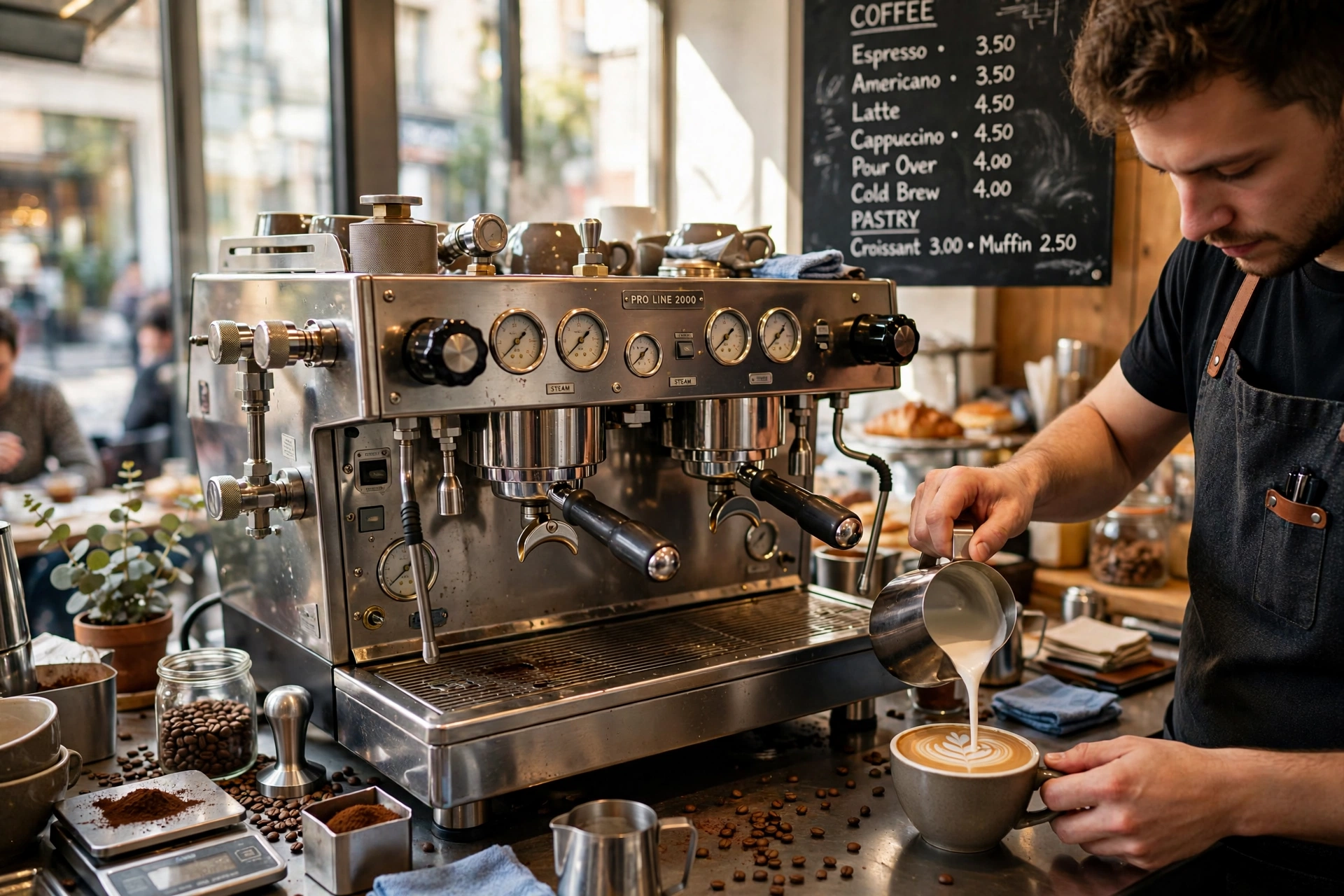
Days 22-30: Training and Refinement. Conduct a training session for all staff. Focus on the "perfect pour" and milk texturing. When guests notice a visible improvement in the quality of their latte, they are more likely to order a second round or return for coffee specifically.
By the end of this month, you will have transitioned from a passive approach to an active, ROI-driven coffee strategy. If this feels overwhelming, it is exactly why we built the managed membership at Busy Bean Coffee. We handle the equipment, the maintenance, and the quality control, so you can focus on the guests.
Frequently Asked Questions
How do I calculate the exact ROI of my coffee program?
To calculate the exact ROI, take the total annual revenue from coffee sales and subtract the annual operating costs (beans, milk, labor, electricity, and maintenance). Divide that net profit by the total cost of the equipment and installation. For example, if your net profit is $10,000 and the equipment cost was $5,000, your ROI is 200%. However, for a more accurate picture, you should also factor in the 'lifetime value' of guests who return because of your high-quality coffee service.
Is a managed coffee service more expensive than buying equipment?
While a monthly fee might seem more expensive than a one-time purchase over several years, the 'hidden costs' of ownership often make the managed service cheaper. When you buy equipment, you are responsible for all repairs, parts, and technician visits. A single major failure in a high-volume environment can cost thousands of dollars and result in days of lost revenue. Managed services convert these volatile costs into a predictable operating expense, which typically results in a more stable and higher net ROI.
How does specialty coffee impact the ROI compared to commodity coffee?
Specialty coffee allows you to move from a 'commodity' pricing model to a 'value-added' pricing model. While the cost per pound of specialty beans is higher, the perceived value to the customer is significantly higher. This allows you to increase the price per cup substantially, often resulting in higher margins than commodity coffee. Additionally, the superior taste profile attracts a more affluent clientele and increases the likelihood of repeat visits, driving long-term revenue growth.
What is the most common cause of low ROI in restaurant coffee?
The most common cause is inconsistent quality caused by poor training or poorly maintained equipment. When a customer receives a burnt or sour espresso, they rarely order coffee again at that establishment. This 'customer churn' is a massive ROI killer. Another factor is inefficiency in the workflow; if it takes five minutes to make one latte, you are limiting your throughput during peak hours, effectively capping your potential revenue regardless of how many customers are in the building.
How often should I update my coffee equipment to maintain ROI?
Commercial equipment generally has a lifecycle of 5 to 10 years, but the 'efficiency peak' usually happens in the first 3 to 5 years. To maintain maximum ROI, you should monitor the frequency of repairs. Once the cost of annual maintenance exceeds 20% of the cost of a new machine, it is time to upgrade. Newer machines in 2026 offer better energy efficiency and more precise temperature control, which reduces waste and improves the taste, both of which contribute to a higher return on investment.
Conclusion
Maximizing the coffee service ROI restaurants achieve is not about finding the cheapest beans or the lowest-cost machine; it is about eliminating waste and enhancing the guest experience. When you treat coffee as a strategic asset rather than a utility, you unlock a powerful revenue stream that can significantly pad your monthly margins. From precision roasting to proactive maintenance, every detail counts when you are operating in the high-stakes environment of the foodservice industry.
If you are tired of unpredictable repair bills and inconsistent brew quality, it is time to consider a professional partnership. At Busy Bean Coffee, we provide an all-inclusive managed membership that removes the financial risk of equipment ownership while guaranteeing a specialty-grade experience for your guests. Whether you are looking to scale your current operation or launch a new beverage program, we have the expertise to ensure your ROI is maximized from day one.
To dive deeper into the operational side of things, read our The Ultimate Guide to Coffee Service for Restaurants and start transforming your coffee program into a profit center.
Visit us at www.busybeancoffee.com to learn more about our managed coffee solutions.
Free Coffee Pairing Guide & Specialty Roast Cheat Sheet
Unlock the secrets of perfect brewing ratios, water temperatures, and specialty roast profiles. Download the guide.