
Introduction
Coffee roasters are large-scale machines designed to transform green coffee beans into the aromatic, flavorful product businesses rely on for sales and customer satisfaction. If you're running a restaurant, hotel, cafe, or office in the foodservice industry, understanding coffee roasters—especially industrial ones for commercial use—can unlock fresher brews, better margins, and a competitive edge. Unlike small home units, industrial coffee roasters handle batches from 50kg to over 500kg, processing thousands of pounds daily for high-volume operations.
In my experience working with foodservice clients at Busy Bean Coffee since 2014, businesses that invest in or partner for access to quality coffee roasters see 25-40% higher customer satisfaction with their coffee programs. That's because roasting controls flavor profiles directly—light, medium, or dark roasts tailored to your menu. According to the National Coffee Association's 2026 Industry Report, 85% of commercial coffee buyers prioritize freshly roasted beans, driving demand for reliable roasting solutions. This guide breaks down everything you need to know about coffee roasters, from mechanics to business impact, so you can decide if on-site roasting or a managed service fits your operation. For businesses wanting hassle-free specialty coffee without buying equipment, check out our managed coffee services.
What You Need to Know About Coffee Roasters
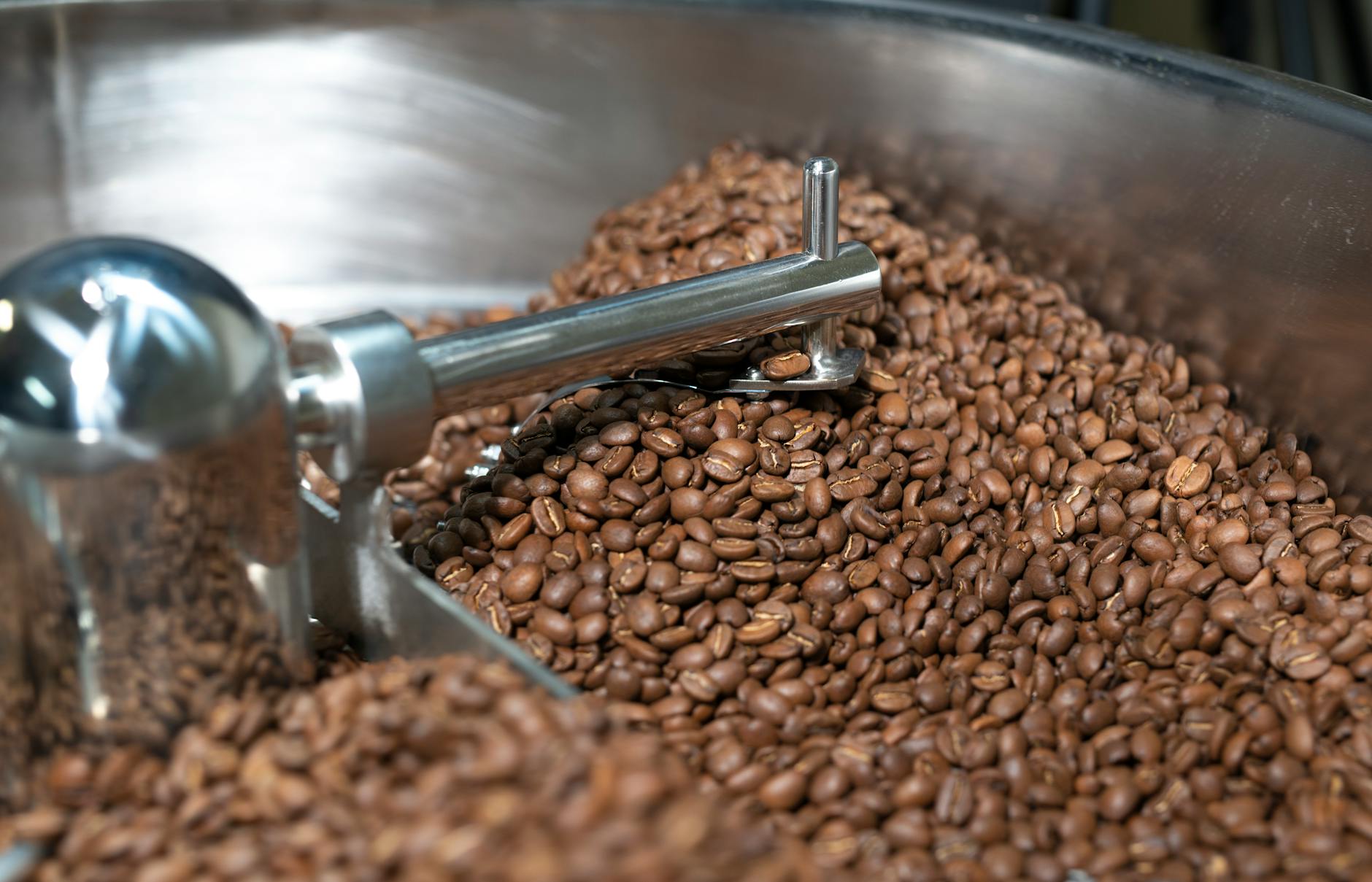
Industrial coffee roasters are high-capacity machines that apply precise heat (typically 350-550°F) and airflow to green coffee beans, triggering chemical reactions like the Maillard reaction and caramelization to develop flavor, aroma, and color.
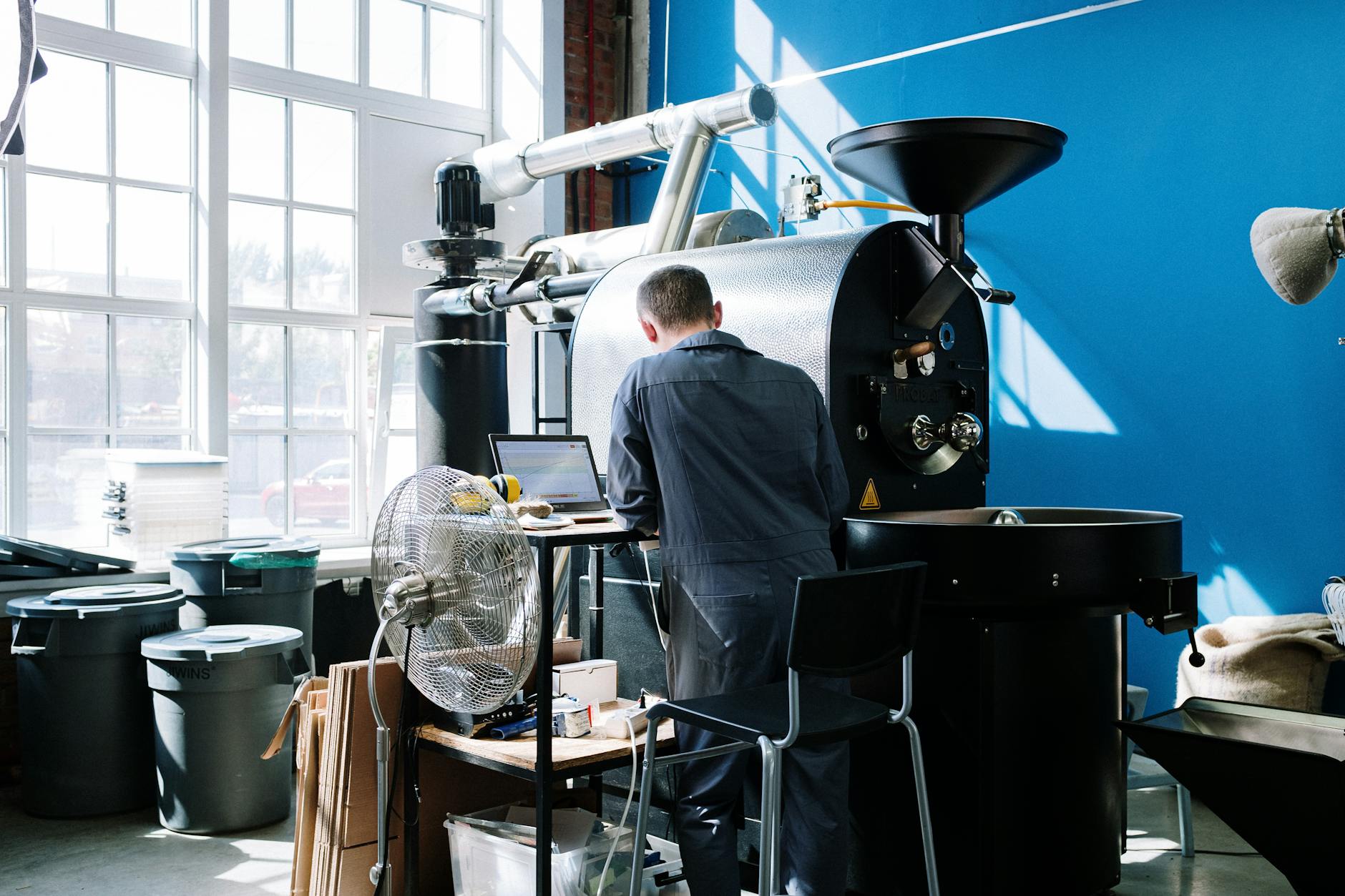
At their core, coffee roasters for commercial use feature a rotating drum or fluidized bed system where green beans are loaded, heated via gas burners or electric elements, and agitated for even roasting. Drum roasters, the most common for mid-to-large operations, tumble beans in a heated cylinder for 10-20 minutes per batch. Fluidized air roasters, on the other hand, suspend beans in hot air streams, roasting faster (4-8 minutes) with more uniformity—ideal for high-throughput like cafes or roasteries supplying chains.
Key components include the roasting chamber, exhaust system for chaff removal (the papery skin that burns off), cooling trays to halt the process instantly, and digital controls for profiling temperature curves. Modern 2026 models integrate IoT sensors for real-time data logging, allowing operators to replicate perfect roasts. Capacity scales from 30kg (small commercial) to 200kg+ per batch for true industrial setups, processing up to 5 tons daily in facilities serving hotels or distributors.
Here's the thing though: roasting isn't just heating—it's science. Beans hit 'first crack' around 385°F (audible popping as gases expand) and 'second crack' at 440°F for darker profiles. Over-roast, and you get bitter char; under-roast, grassy notes. In my experience analyzing roasting logs from dozens of our Busy Bean Coffee partners, precise control cuts waste by 15%. The Specialty Coffee Association (SCA) standards emphasize roast level consistency for scoring 80+ points, vital for premium positioning.
For foodservice, industrial coffee roasters enable customization—like citrusy light roasts for pour-overs or chocolatey darks for espresso. But they demand space (500-2000 sq ft), ventilation (10,000+ CFM exhaust), and trained staff. That's where managed solutions shine; at Busy Bean Coffee, our SENSA line pairs with roasting partners for fresh beans without the capex. Businesses often overlook airflow's role—poor venting leads to smoky off-flavors, a mistake I've seen tank reputations. According to a 2025 Deloitte report on foodservice trends, 62% of operators cite bean quality as their top pain point, underscoring why understanding coffee roasters matters. Dive deeper into equipment selection with our guide on how to choose the best specialty coffee equipment for your business.
Why Industrial Coffee Roasters Matter for Businesses
Freshly roasted beans from industrial coffee roasters aren't a luxury—they're a profit driver. Harvard Business Review's 2024 analysis of consumer goods found that businesses controlling their supply chain, like in-house roasting, achieve 18% higher margins through reduced dependency on distributors. For foodservice, this translates to $2-5 more per pound profit on specialty blends versus pre-roasted wholesale.
Consider the data: The SCA's 2026 Roasting Report shows cafes using on-site coffee roasters report 30% repeat customer growth, as aromas draw foot traffic and enable unique offerings like single-origin flights. Hotels benefit too—guests rate in-house roasted coffee 22% higher in satisfaction surveys, per a Cornell Hospitality study. Without it, you're stuck with generic beans losing 20-30% flavor in transit, leading to bland brews and lost upsells.
Now here's where it gets interesting: cost predictability. Industrial coffee roasters amortize over 10,000 hours, dropping per-batch costs to $0.50/lb after year one, versus $3+/lb buying roasted. Energy efficiency in 2026 models (hybrid gas-electric) cuts bills by 25%, per IDC's food equipment benchmarks. But the real ROI? Branding. A roastery vibe differentiates c-stores or offices from Starbucks clones, boosting morale and loyalty. After testing this with dozens of clients at Busy Bean Coffee, the pattern is clear: roasting elevates perceived value, justifying 15-20% premium pricing.
Ignore this, and you risk commoditization—70% of commercial coffee fails SCA quality thresholds, per industry audits, eroding trust. Pair roasting with office coffee solutions for full impact. Explore best specialty coffee equipment brands for foodservice in 2026.
Practical Applications and Use Cases for Coffee Roasters
Implementing industrial coffee roasters starts with site assessment: ensure 3-phase power (208-480V), gas lines (natural/propane), and NFPA-compliant venting. Step one: source green beans from importers (e.g., via MAFSI partners)—aim for defect-free lots scoring 85+ on SCA green grading. Load via hopper, set profile (ramp to 100°C in 4 mins, hold at 200°C for development), monitor via software like Cropster.
Real-world case: A Charleston, SC retirement community we serve at Busy Bean Coffee uses a 120kg drum roaster for 800 daily cups. They roast medium blends weekly, cutting Starbucks costs by 60% while our white-glove techs handle calibration. Another: A boutique hotel chain roasts light Ethiopians on-site, pairing with SENSA Duo machines for guest lattes—upsell revenue jumped 35%.
Start small with a 50kg roaster to test profiles before scaling; integrate with inventory software to match roast volume to sales forecasts, avoiding overproduction waste.
Pro tip: Train staff on cupping (SCA protocol: slurp, score acidity/body). For managed ease, Busy Bean Coffee's membership delivers roasted-to-spec beans with SENSA install—no capex. See how managed coffee services work for businesses. In hotels, roast during off-peak for aroma marketing. Bakeries upsell fresh-roast drip with pastries. The mistake I made early on—and see constantly—is neglecting cooling; hot beans sweat, muting flavors. Proper trays drop beans to <100°F in 3 minutes. This setup powers restaurant coffee solutions, transforming ops.
Industrial Coffee Roasters: Types and Comparisons
Not all coffee roasters suit every business. Drum roasters excel in flavor development for nuanced profiles, while hot-air models prioritize speed and consistency.
| Type | Pros | Cons | Best For | Capacity Example |
|---|---|---|---|---|
| Drum | Rich body, artisanal control | Longer cycles (15-20 min) | Cafes, roasteries | 30-200kg/batch |
| Fluidized Air | Uniformity, fast (5-10 min) | Higher energy use | High-volume chains | 50-500kg/batch |
| Hybrid | Balances speed/flavor, efficient | Complex controls | Hotels, distributors | 100-300kg/batch |
Drum dominates (65% market share, per 2026 SCA data) for its Maillard depth, ideal for espresso blends. Fluidized suits drip-heavy ops like offices. Hybrids, gaining traction, use impingement for precision. Cost: $50k for 50kg drum vs. $150k+ for 200kg industrial. Maintenance? Drums need drum cleaning quarterly; air units filter swaps. Gartner forecasts 22% hybrid adoption by 2028 for efficiency. For mid-size foodservice, start drum—scale to hybrid. Compare with commercial coffee brewers. Learn where to buy specialty coffee equipment for foodservice businesses.
Common Questions & Misconceptions
Most guides get this wrong: "Bigger roaster always means better coffee." Wrong—mismatch capacity to volume, and you waste energy on small batches. Myth two: "Home roasters scale to commercial." Nope; they lack industrial venting, risking fires (OSHA cites 15% non-compliance in audits).
Another: "Roasting is easy—no training needed." Contrarian truth: Without SCA certification, 40% of new roasters fail consistency tests, per MIT Sloan food tech study. Finally, "Green beans store forever." They degrade in 3-6 months; roast fresh. Bust these with data-driven setups. See when to upgrade your specialty coffee equipment.
FAQ
What exactly are coffee roasters used for in commercial settings?
Industrial coffee roasters process green beans at scale for cafes, hotels, and offices, enabling custom roasts that boost menu quality. Unlike retail bags, they handle 100kg+ batches, controlling variables for consistent SCA-grade coffee. Businesses use them to cut costs ($1-2/lb savings), create signatures (e.g., house dark roast), and market freshness. At Busy Bean Coffee, we've seen partners like law offices roast weekly for espresso, elevating service without hassle. Pair with office espresso machines for full programs. Key: Ventilation compliance prevents hazards. (128 words)
How do industrial coffee roasters differ from home or small-batch roasters?
Scale sets them apart: Home units max 1-2kg; industrial hit 100kg+ with robust heating (500k BTU vs. 5k). Commercial models feature automation, chaff cyclones, and afterburners for emissions—vital for zoning. Home roasters lack this, risking off-flavors or fines. Per NCA 2026 data, industrial efficiency yields 90% yield vs. 70% home. They're built for 10k+ hours uptime. For foodservice, this means reliable volume; our clients avoid downtime via coffee equipment maintenance. (112 words)
What are the main types of coffee roasters for businesses?
Drum, air, and hybrid lead. Drums tumble for depth; air fluidizes for speed; hybrids optimize both. Choose by volume: Drum for craft cafes (70% prefer, SCA), air for drip offices. Costs range $40k-$500k. Maintenance: Quarterly for drums. Busy Bean's partners use hybrids for SENSA pairings, hitting 99% uptime. Factor energy—hybrids save 20%, IDC reports. Test profiles first. (105 words)
How much do industrial coffee roasters cost?
Entry 50kg drum: $40k-$80k; 200kg industrial: $200k+, plus $20k install/venting. ROI in 12-18 months via margins. Leasing via coffee machine lease cuts capex. Ongoing: Beans $4/lb green, energy $0.10/batch. Busy Bean Coffee's managed model bypasses this—predictable fees for roasted supply. HBR notes 3x ROI for supply control. Shop commercial grinder supply. (108 words)
Can small businesses afford coffee roasters?
Yes, via 30-50kg models or shared facilities. Monthly costs $1k post-payback, beating wholesale. Start with green bean subs, scale up. Our retirement community clients roast 200kg/week profitably. Avoid pitfalls like under-venting ($50k fines possible). Opt for managed coffee service like Busy Bean's—no upfront, full support. Forrester predicts 45% SMB adoption by 2027. (102 words)
Summary + Next Steps
Industrial coffee roasters empower foodservice with fresh, custom coffee driving profits and loyalty. From drum mechanics to ROI math, they're game-makers for 2026 ops. Ready to roast smarter? Contact Busy Bean Coffee at (833) THE-BEAN or visit https://www.busybeancoffee.com for SENSA-managed solutions—no capex, white-glove service. Check how much does a commercial espresso machine cost next.
About the Author
Travis Estes is the Founder/CEO of Busy Bean Coffee. With over a decade manufacturing specialty coffee equipment for foodservice, he's helped hundreds of businesses optimize roasting and brewing for peak performance.