When Should Your Business Invest in Industrial Coffee Roasters?
Most hospitality owners wait until they are completely overwhelmed by demand before upgrading their coffee program, but by then, they have already lost thousands in potential margin. The optimal time to transition to industrial coffee roasters is when your daily consumption exceeds 15 to 20 kilograms of coffee, or when the cost of purchasing pre-roasted specialty beans begins to erode your net profit by more than 12% per cup. If you are consistently outsourcing your roasting and finding that the roast profiles are inconsistent across batches, you have reached the technical trigger point where internal control is no longer a luxury, but a operational necessity.
In my experience working with high-volume cafes and hotels, the most common mistake is scaling "too late." I've seen businesses attempt to bridge the gap with semi-industrial machines that lack the thermal stability required for consistent output, leading to wasted batches and frustrated customers. When you move to a professional roasting setup, you aren't just buying a machine; you are reclaiming the entire value chain of your beverage program.

Understanding the Threshold for Industrial Coffee Roasting
Transitioning to in-house production requires a fundamental shift in how you view your supply chain. To make an informed decision, you first need to understand what defines the "industrial" tier of roasting compared to small-batch or artisanal setups.
📚
Definition
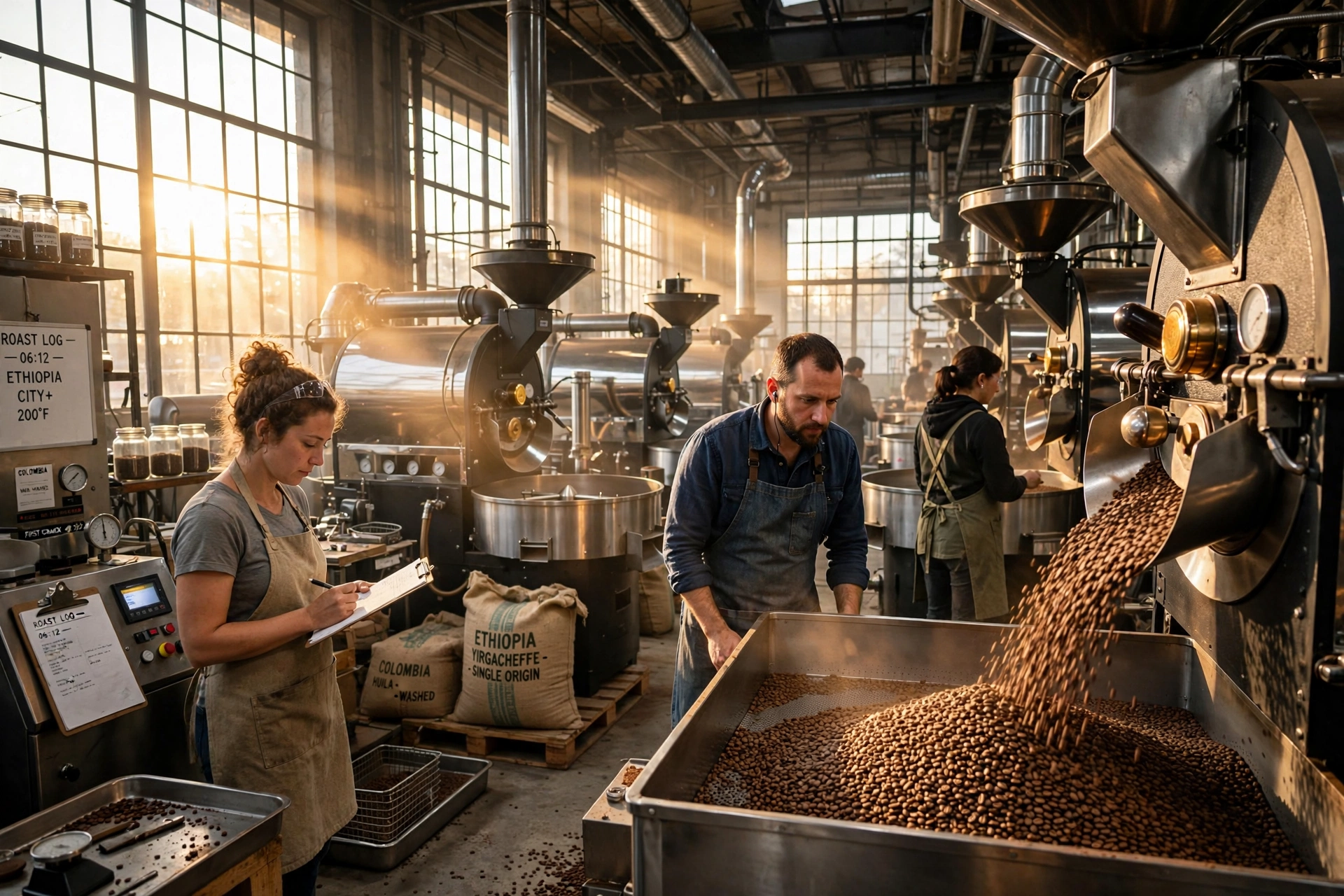
Industrial coffee roasters are high-capacity machines designed for continuous or semi-continuous operation, featuring advanced thermal controls, automated cooling trays, and high-volume gas or electric burners capable of processing 15kg to 120kg+ per batch with extreme precision.
The transition point is usually dictated by the "Efficiency Cross," where the cost of labor and equipment depreciation becomes lower than the premium paid to a third-party roaster. According to the Specialty Coffee Association (SCA), maintaining a strict roasting profile is the only way to ensure that the inherent qualities of Coffea arabica are preserved during the Maillard reaction. When you rely on an external provider, you are subject to their scheduling and their quality fluctuations.
When you move to an industrial scale, you start dealing with "thermal inertia." Larger drums hold more heat, meaning that once the machine reaches the target temperature, it is far more stable than a small roaster. This stability allows a barista or head roaster to replicate the exact same flavor profile for 500 kilograms of coffee as they did for the first 5 kilograms. If your business is currently experiencing "profile drift", where the coffee tastes different every Tuesday, it is a clear signal that your current volume has outpaced your equipment's capabilities.
Why Timing Matters: The Business Impact of Scaling Your Roast
Timing your investment in industrial coffee roasters is not just about capacity; it is about protecting your brand equity. In the specialty coffee world, consistency is the primary metric of quality. If a customer visits your establishment in Mount Pleasant, SC, and receives a medium-roast Ethiopia Yirgacheffe that tastes bright and floral on Monday, but burnt and bitter on Thursday, you have failed the consistency test.
The financial implications of poor timing are significant. According to data from the National Coffee Association USA (NCA), consumer preferences are shifting toward higher-grade specialty coffee, which commands a higher price point. However, the margins on these beans are tighter if you are paying a middleman to roast them. By bringing the process in-house, you can typically increase your gross margin per cup by 15% to 25%.
Consider the risk of "under-scaling." If you stay with a small-batch roaster while your volume grows, your staff spends more time roasting and less time managing the floor. I've analyzed dozens of businesses where the owner spent 20 hours a week roasting 5kg batches because they were afraid of the capital expenditure of an industrial machine. That is a massive misallocation of executive time. When the labor cost of manual roasting exceeds the monthly financing cost of an industrial machine, the timing for the upgrade is immediate.
Furthermore, industrial equipment adheres to stricter safety and sanitation standards. According to NSF International, professional-grade equipment designed for the food service industry must meet specific material and airflow requirements to prevent contamination. Transitioning to industrial roasters ensures your facility remains compliant with health codes as your output increases, avoiding costly fines or forced shutdowns during inspections.
Practical Application: How to Transition to Industrial Roasting
Moving to a professional roasting operation is a phased process. You cannot simply plug in a 30kg roaster and expect a perfect product. It requires a strategic alignment of space, power, and personnel.
First, perform a "Bean Audit." Track every gram of coffee used over 30 days. If your daily average is trending upward and you are spending more than four hours a week managing roast orders and deliveries, you have hit the operational trigger. At this stage, you should evaluate your utility infrastructure. Industrial roasters require specific gas BTU outputs or high-voltage electrical panels that most standard kitchens do not have.
Second, designate a "Roast Master." Whether this is an existing barista or a new hire, someone must own the profile. The mistake I made early on, and that I see constantly, is assuming the machine does the work. An industrial roaster is a tool, not a chef. You need a dedicated person to monitor the "first crack" and manage the cooling process to lock in the flavor.
Third, integrate your equipment with a managed service. This is where many businesses fail by buying a machine and then realizing they have no one to maintain it. Using a managed coffee solution, such as those provided by Busy Bean Coffee, allows you to access premium equipment and professional installation without the crushing weight of a massive upfront capital expense. By opting for a managed membership, you shift the risk of equipment failure and maintenance to the experts, allowing you to focus on the roast profile rather than the burner calibration.
💡
Key Takeaway
The transition to industrial roasting should be triggered by a combination of volume (15kg+/day), margin erosion (12%+ loss to middlemen), and consistency failures.

Comparing Your Roasting Options
When deciding the "when" and "how," it is helpful to compare the different paths available to a growing foodservice business. Most owners think it is a binary choice between "buying beans" and "buying a machine," but there is a middle ground.
| Approach | Pros | Cons | Best For |
|---|---|---|---|
| Third-Party Sourcing | Zero upfront cost, no labor requirements. | Low margins, zero control over profiles, delivery delays. | Small cafes with < 5kg daily use. |
| Small-Batch/Prosumer | Total control over flavor, lower entry cost. | High labor intensity, inconsistent at scale, slow. | Micro-roasters or boutique tasting rooms. |
| Industrial Managed Solution | Professional scale, predictable monthly cost, full maintenance. | Requires a monthly commitment, requires space. | High-volume hotels, restaurants, and growing cafe chains. |
Now, here's where it gets interesting: the "Generic AI" approach to roasting, relying on automated presets without a Q-Grader's oversight, often leads to a flat, one-dimensional product. While automation is great for efficiency, the nuance of specialty coffee comes from human adjustment based on the bean's origin and moisture content. A professional industrial setup combined with human expertise is the only way to maintain a competitive edge in 2026.
Common Questions and Misconceptions about Scaling
There are several myths surrounding the timing of industrial coffee roaster adoption that often lead businesses to make poor financial decisions.
One common myth is that you need to be a "Master Roaster" before you buy the equipment. Most guides get this wrong by suggesting you spend years in a roasting school first. In reality, the technology in modern industrial roasters is designed to be intuitive. With the right equipment and a bit of training, a skilled barista can manage profiles effectively. The "skill gap" is much smaller than it was ten years ago.
Another misconception is that industrial roasters are too loud or smoky for an urban environment. While older machines were essentially "smoke factories," modern industrial units are equipped with advanced afterburners and filtration systems. If you are worried about the "smell" of roasting, you aren't looking at the right equipment. High-end industrial roasters can be installed in the heart of a city without disturbing the neighbors, provided the ventilation is engineered correctly.
Finally, some owners believe that roasting in-house will inevitably lead to higher costs due to labor. This is a mathematical error. When you account for the removal of the roaster's profit margin from every bag you buy, the labor cost of roasting is usually offset by the increased margin on the final cup. If you are selling 200 cups a day, that difference is thousands of dollars per year.
Frequently Asked Questions
When is the absolute best time to switch to industrial coffee roasters?
The absolute best time is when your growth trajectory shows a consistent month-over-month increase in volume that makes your current sourcing method a bottleneck. Specifically, if you are spending more than 10% of your weekly management time on coffee procurement and quality control, or if your volume has exceeded 15kg per day, the efficiency of industrial roasters will pay for itself within the first 12 to 18 months. Waiting until you are "out of space" or "out of coffee" is a reactive strategy that leads to operational chaos.
Do I need a separate facility to house industrial coffee roasters?
Not necessarily, but you do need a dedicated zone. Industrial roasters require specific clearances for heat dissipation and a direct path for ventilation. While you don't need a separate building, you must ensure the area has a non-combustible floor and an exhaust system that meets local fire codes. In my experience, integrating the roaster into a visible part of the cafe, a "roastery concept", actually increases customer engagement and justifies a premium price for the coffee.
How does the cost of industrial roasters compare to outsourced roasting?
Outsourced roasting is an Opex (Operating Expense) with a permanent premium. You pay for the roaster's labor, electricity, and profit. Industrial roasters represent a shift toward a more sustainable cost model. While the initial investment is higher, the cost per pound of coffee drops significantly. When using a managed solution from Busy Bean Coffee, the capital expenditure is replaced by a predictable monthly fee, making the ROI almost immediate as you capture the margin previously given to the third-party roaster.
Can a single barista manage industrial coffee roasters and the front-of-house?
In a high-volume environment, it is not recommended. Roasting requires focused attention, especially during the critical "drop" phase where the beans move from the drum to the cooling tray. If a barista is distracted by a rush of customers, they risk over-roasting an entire 30kg batch, which is a costly mistake. The most successful operations treat roasting as a distinct role or schedule roasting during off-peak hours to ensure the quality of the product is never compromised.
What is the impact of industrial roasters on coffee freshness?
The impact is transformative. Most outsourced coffee is roasted, bagged, and shipped, which introduces a lag of 3 to 14 days before the coffee reaches your customer. With industrial roasters, you can implement a "just-in-time" roasting schedule. This allows you to serve coffee that is precisely 3 to 7 days off-roast, which is the peak window for flavor development. This level of freshness is a massive selling point that allows you to compete with the best specialty cafes in the world.
Final Thoughts on Industrial Coffee Roasters
Deciding when to invest in industrial coffee roasters is a pivotal moment in the lifecycle of a foodservice business. It is the transition from being a "coffee seller" to being a "coffee producer." If you find yourself struggling with consistency, eroding margins, or a supply chain that feels out of your control, the time to act is now.
The goal is not just to produce more coffee, but to produce better coffee with more efficiency. Whether you are scaling a boutique cafe in Mount Pleasant or managing a large-scale hotel beverage program, the move toward professional, managed roasting equipment is the only way to ensure long-term scalability.
Stop letting your margins disappear into someone else's roasting drum. It is time to take full ownership of your quality and your profits. For an all-inclusive, managed coffee solution that removes the hassle of equipment ownership while providing the power of industrial roasting, explore the options at Busy Bean Coffee.
Recommended Readings
To deepen your understanding of these topics, we recommend reading the following articles:
- The Complete Guide to White Glove Coffee Service
- Ultimate Guide to All-Inclusive Coffee Service for Businesses
- Ultimate Guide to Automated Coffee Machines for Business
- Ultimate Guide to Specialty Coffee Equipment for Business
Free Coffee Pairing Guide & Specialty Roast Cheat Sheet
Unlock the secrets of perfect brewing ratios, water temperatures, and specialty roast profiles. Download the guide.