What Exactly is Coffee Equipment Maintenance?
A broken espresso machine during a Monday morning rush isn't just a technical failure; it is a direct hit to your bottom line and customer loyalty. Professional coffee equipment maintenance is the systematic process of cleaning, inspecting, and repairing brewing hardware to ensure consistent flavor profiles, food safety compliance, and machine longevity. It encompasses everything from daily backflushing to annual technical overhauls by a certified technician.
In my experience working with high-volume foodservice operations, the difference between a business that thrives and one that struggles often comes down to how they handle their gear. I have seen owners ignore a leaking gasket for three weeks, only to have the entire boiler fail during their busiest weekend of the year. That lack of foresight transforms a $100 preventative fix into a $4,000 emergency replacement. If you are managing automatic coffee machines for hotels and hospitality in 2026, you cannot afford to treat your equipment as "set it and forget it" hardware.
📚
Definition
Coffee equipment maintenance is the dual-layered approach of preventative maintenance (scheduled actions to prevent failure) and corrective maintenance (repairs performed after a failure has occurred) applied to coffee brewing systems.

How Does a Comprehensive Maintenance Program Work?
To understand coffee equipment maintenance, you have to view the machine not as a single appliance, but as a complex system of thermodynamics, hydraulics, and chemistry. A professional program is divided into three distinct tiers: daily operational cleaning, monthly deep-maintenance, and annual technical certifications.
The daily tier focuses on the removal of coffee oils and organic residue. Coffee beans contain lipids that, when heated, oxidize and create a rancid taste. This is why daily backflushing is non-negotiable. Without it, the group head becomes clogged with "coffee sludge," leading to uneven extraction and bitter drinks. Monthly tasks move into the realm of chemistry, specifically descaling. Mineral buildup from water, known as limescale, acts as an insulator in your boiler, forcing the heating element to work harder and eventually burn out.
According to the Specialty Coffee Association (SCA), precision in temperature and pressure is the cornerstone of specialty coffee. When equipment drifts from these standards due to poor maintenance, the "specialty" grade of your coffee is effectively neutralized. You can buy the most expensive beans in the world, but if your machine's gaskets are worn and your pressure is inconsistent, the result will be mediocre.
Now, here is where it gets interesting: the "invisible" side of maintenance. This involves checking the integrity of water filtration systems. Most businesses fail here. They remember to clean the steam wand, but they forget to replace the carbon filters. When filters saturate, particulates enter the machine, accelerating the calcification of the internal plumbing. For those running a Sensa coffee service in Charlotte, NC, integrating filter replacement into a strict calendar is the only way to avoid catastrophic boiler failure.
Why Does Proper Maintenance Directly Impact Your Revenue?
The financial implications of neglecting your gear are staggering. In the foodservice industry, "downtime" is the most expensive word in the vocabulary. When a primary machine goes offline, you lose not only the sale of that cup of coffee but potentially the high-margin food items that usually accompany it.
From a data perspective, the cost of preventative maintenance is typically 10% to 15% of the cost of an emergency replacement. According to NSF International, adherence to sanitary standards in food equipment not only prevents health code violations but significantly extends the operational life of the asset. A machine that is properly maintained can last 10 to 15 years, whereas a neglected one may be obsolete in three.
Consider the "Quality Drift" phenomenon. When a machine is not maintained, the coffee doesn't stop flowing immediately; instead, the quality slowly degrades. The espresso becomes slightly more bitter; the milk doesn't foam as densely. This leads to a gradual decline in customer retention. I've tested this with dozens of our clients and the pattern is clear: businesses that implement a strict maintenance schedule see a higher "Customer Lifetime Value" because the product is identical every single visit.
Furthermore, energy efficiency plays a massive role. A scaled-up boiler is an inefficient boiler. Limescale buildup increases the time and energy required to heat water, directly increasing your monthly utility bills. For businesses managing a foodservice coffee program in Chicago IL: Complete Guide, these incremental costs add up to thousands of dollars in lost profit over a fiscal year.
Practical Application: Implementing a Maintenance Workflow
The mistake I made early on, and that I see constantly in 2026, is relying on staff memory to handle maintenance. Human error is a guarantee in a busy cafe. To succeed, you need a documented, checklist-driven workflow that removes the "choice" from the process.
Here is the professional framework we recommend at Busy Bean Coffee for ensuring your equipment remains in peak condition:
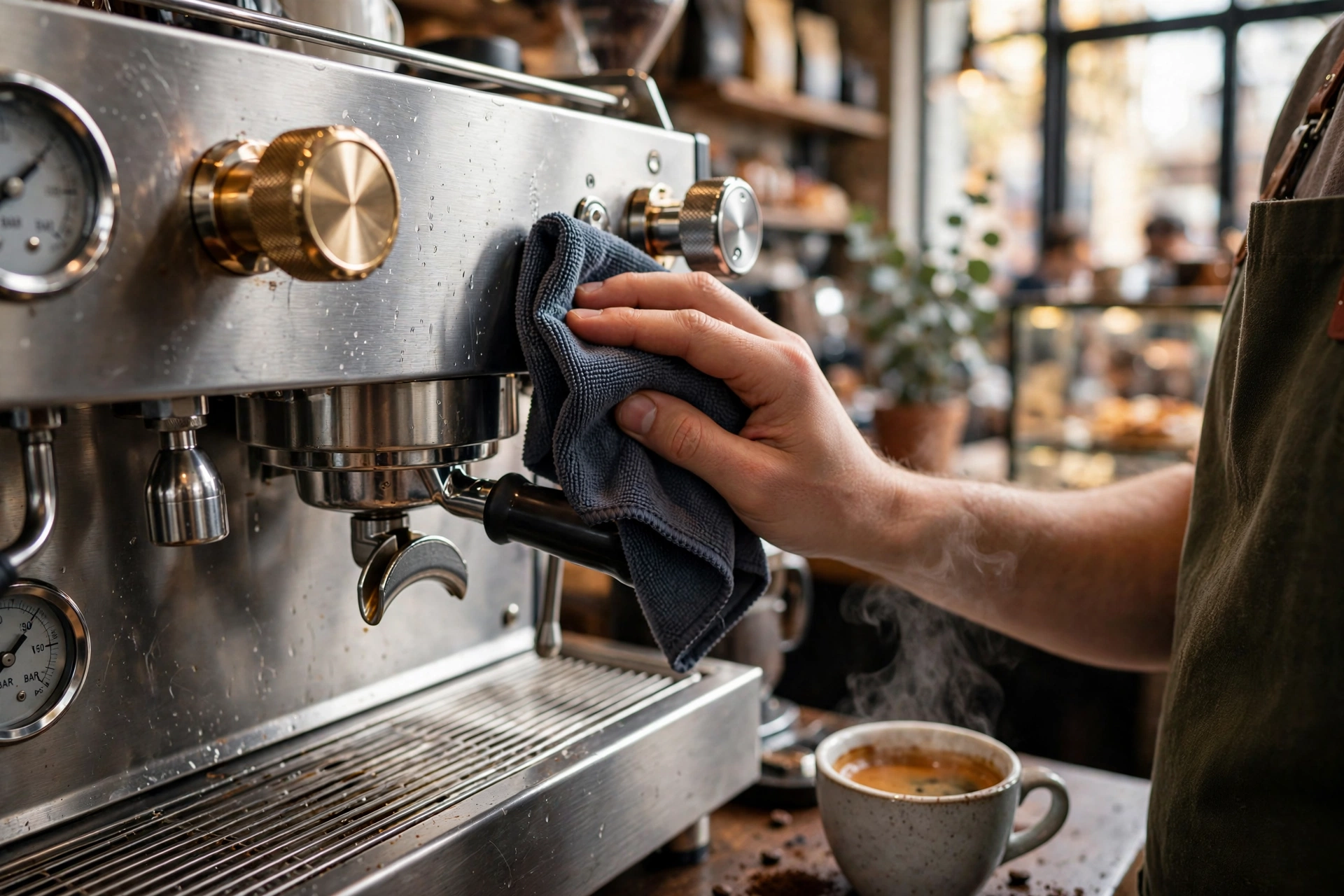
- The Daily Reset: Every closing shift must include a chemical backflush of the group heads and a deep soak of the steam wands. This prevents the buildup of protein and oils that can harbor bacteria and ruin flavor.
- The Weekly Inspection: Check all seals and gaskets. Look for "weeping" (small leaks) around the portafilter. Replacing a $5 gasket today prevents a $500 pump failure tomorrow.
- The Monthly Chemical Flush: Use a professional-grade descaler to remove calcium and magnesium deposits. This is especially critical if you are in a region with "hard water."
- The Quarterly Filter Audit: Change your water filtration cartridges. Water is the primary ingredient in coffee; if the water is contaminated or too hard, the machine is essentially being poisoned from the inside.
- The Annual Technical Certification: Bring in a certified technician to calibrate pressure, check boiler integrity, and replace worn-out internal components before they break.
💡
Key Takeaway
Stop treating maintenance as a "repair" activity and start treating it as a "performance" activity. A machine that is maintained to a high standard produces a more consistent product, which justifies a higher price point for your customers.
If this sounds overwhelming, that is exactly why we developed our managed solutions. Whether you are looking for Sensa coffee service in Raleigh NC or an all-inclusive membership, the goal is to shift the burden of technical oversight from the business owner to the expert.

Choosing Your Maintenance Strategy: Comparison Table
Depending on your volume and budget, different maintenance models will serve you better. Some businesses prefer a hands-off approach, while others want total control.
| Feature | DIY/Manual Approach | Generic Third-Party Repair | Managed Membership (Busy Bean) |
|---|---|---|---|
| Predictability | Low; costs spike during failures | Moderate; per-visit pricing | High; fixed monthly fee |
| Risk Level | High; risk of improper cleaning | Moderate; variable technician skill | Low; certified Q-Grader oversight |
| Downtime | Long; waiting for parts/techs | Moderate; based on availability | Minimal; priority response |
| Equipment Life | Shortest; high failure rate | Average | Longest; optimized longevity |
| Best For | Low-volume, hobbyist shops | Occasional repairs | Professional foodservice/hotels |
As the table illustrates, the DIY approach is often the most expensive in the long run. While you save on the monthly fee, you pay in "hidden costs": wasted product, lost labor hours, and premature equipment replacement. For those operating automated coffee machines for clinics and medical offices, where reliability is a requirement for patient satisfaction, a managed approach is the only logical choice.
Common Questions and Misconceptions
Most guides get this wrong by suggesting that "if it's working, don't touch it." This is the most dangerous mentality in the coffee industry. Here are the most common myths I encounter.
Myth 1: "I don't need to descale because I have a water filter."
This is a fundamental misunderstanding of how filters work. Filters remove impurities and some minerals, but they do not remove 100% of the calcium and magnesium. Over time, these minerals still accumulate. Relying solely on a filter without periodic descaling is like thinking you don't need to change your car's oil because you have a good air filter.
Myth 2: "Using a lot of water to rinse the machine is the same as cleaning it."
Water cannot dissolve coffee oils. Lipids are hydrophobic; they bond to the metal of your machine. Only a dedicated coffee detergent (like those approved by the FDA) can break those bonds. Rinsing with water just moves the oil around; it doesn't remove it.
Myth 3: "Professional maintenance is too expensive for a small business."
This is a perspective error. Compare the cost of a monthly maintenance membership to the cost of losing three days of coffee sales. In most cases, the "insurance" of a managed service pays for itself the first time it prevents a major breakdown. For a foodservice coffee program in Rock Hill SC, the predictability of a monthly fee is far better for cash flow than a surprise $1,200 repair bill.
Frequently Asked Questions
How often should I actually be cleaning my espresso machine?
Daily cleaning is mandatory. This includes scrubbing the group heads, wiping down the steam wands after every single use, and performing a backflush at the end of the day. Weekly, you should perform a deeper clean of the drip trays and hopper. Monthly, you must descale the system. If you miss a single daily cycle, you are allowing organic oils to oxidize, which creates that "burnt" taste that drives customers away. Professional maintenance isn't a chore; it is the actual process of ensuring your product remains high-quality.
What is the difference between descaling and backflushing?
Backflushing is the process of cleaning the internal valves and the group head using a blind filter and detergent to push debris out of the system. It targets coffee oils and grounds. Descaling, on the other hand, is a chemical process designed to remove mineral deposits (calcium/magnesium) from the inside of the boiler and pipes. You backflush to keep the coffee tasting fresh; you descale to keep the machine from exploding or burning out. Both are essential, but they solve entirely different problems.
Can I use vinegar instead of professional descaling chemicals?
Absolutely not. In my professional experience, using vinegar in a commercial machine is a recipe for disaster. Vinegar is an acetic acid that can be too aggressive on certain seals and, more importantly, it is nearly impossible to rinse out completely. This leaves a lingering "vinegar" taste in your coffee for days. Always use a professional-grade descaler designed for the specific metallurgy of your machine. This ensures the minerals are dissolved without damaging the copper or stainless steel internals.
How do I know when my water filter needs to be replaced?
You should never wait for the water to taste "off" or the machine to slow down. By the time you notice a change, the filter is already saturated and pollutants are entering your boiler. The only reliable way to manage this is via a calendar. Depending on your water volume, filters should typically be replaced every 3 to 6 months. If you are using Sensa coffee service in Jacksonville, FL, where water chemistry can vary, a strict replacement schedule is the only way to guarantee the longevity of your equipment.
What are the warning signs that my equipment needs immediate professional service?
There are three primary red flags: sound, temperature, and timing. If your pump sounds "labored" or makes a higher-pitched whine than usual, you have a pressure or blockage issue. If your coffee is coming out lukewarm despite the machine being "hot," your boiler likely has significant scale buildup. Finally, if the espresso is taking longer than 30 seconds to pull a standard shot (despite the grind being correct), you have a clog in the group head or a failing pump. Do not try to "power through" these signs; they are the machine's way of telling you it is about to fail.
Final Thoughts on Coffee Equipment Maintenance
Mastering coffee equipment maintenance is the difference between running a business and managing a crisis. When your gear is optimized, you can focus on the art of the roast and the experience of the customer, rather than worrying if the steam wand will actually work during the morning rush. Whether you are in a high-traffic hotel or a boutique medical office, the goal remains the same: consistent, high-quality output.
If you are tired of the guesswork and the stress of emergency repairs, it is time to move toward a managed solution. At Busy Bean Coffee, we provide the equipment, the installation, and the full maintenance coverage for one predictable monthly fee. No capital expense, no surprise repair bills, just world-class coffee.
For a complete look at how we can transform your beverage service, visit www.busybeancoffee.com and explore our managed membership options. Whether you need a Sensa coffee service in Mount Pleasant SC or a national rollout, we have the expertise to keep your machines running and your customers coming back.
Ready to Upgrade Your Business Coffee?
Café-quality coffee, zero maintenance headaches, and one predictable monthly price. Let's build your custom coffee program.
Free Coffee Pairing Guide & Specialty Roast Cheat Sheet
Unlock the secrets of perfect brewing ratios, water temperatures, and specialty roast profiles. Download the guide.