📖This article is part of the complete guide to Ultimate Guide to Wholesale Barista Equipment for Businesses.
In my experience working with senior living facilities, the most common failure isn't the quality of the bean, but the mismatch between equipment capacity and resident flow. I once consulted for a facility in Mount Pleasant, SC, where they installed a home-grade machine in a common area; within three weeks, the pump failed due to the constant demand of 50 residents. When you scale beverage services for seniors, the cost of downtime isn't just a financial loss, it is a quality-of-life issue for the residents. For a comprehensive overview of scaling your setup, explore our guide on wholesale barista equipment.
What is Retirement Community Coffee Equipment Wholesale?
📚
Definition
Retirement community coffee equipment wholesale refers to the bulk procurement and strategic sourcing of commercial-grade brewing systems, grinders, and accessories specifically selected to meet the high-volume, high-reliability needs of assisted living and independent senior residential complexes.
Retirement community coffee equipment wholesale is not simply about buying machines in bulk to save a few dollars; it is about implementing a standardized beverage infrastructure across multiple touchpoints—such as the main dining hall, welcome center, and private lounges. In these environments, the equipment must balance high output with extreme ease of use, often requiring interfaces that are intuitive for staff who may not be trained baristas. Because these facilities operate 24/7, the wholesale approach focuses on industrial-grade components that can withstand continuous operation without requiring daily technical intervention.
When we source for these communities, we prioritize the use of Coffea arabica beans paired with machines that maintain precise thermal stability. According to the Specialty Coffee Association (SCA), maintaining a water temperature between 195°F and 205°F is essential for extracting the nuanced flavors of specialty coffee without introducing bitterness. For retirement communities, this means moving away from basic percolators toward wholesale-grade thermal carafes and super-automatic espresso machines that guarantee consistency regardless of who is operating the machine.
Why Does Quality Coffee Equipment Matter for Senior Living Facilities?
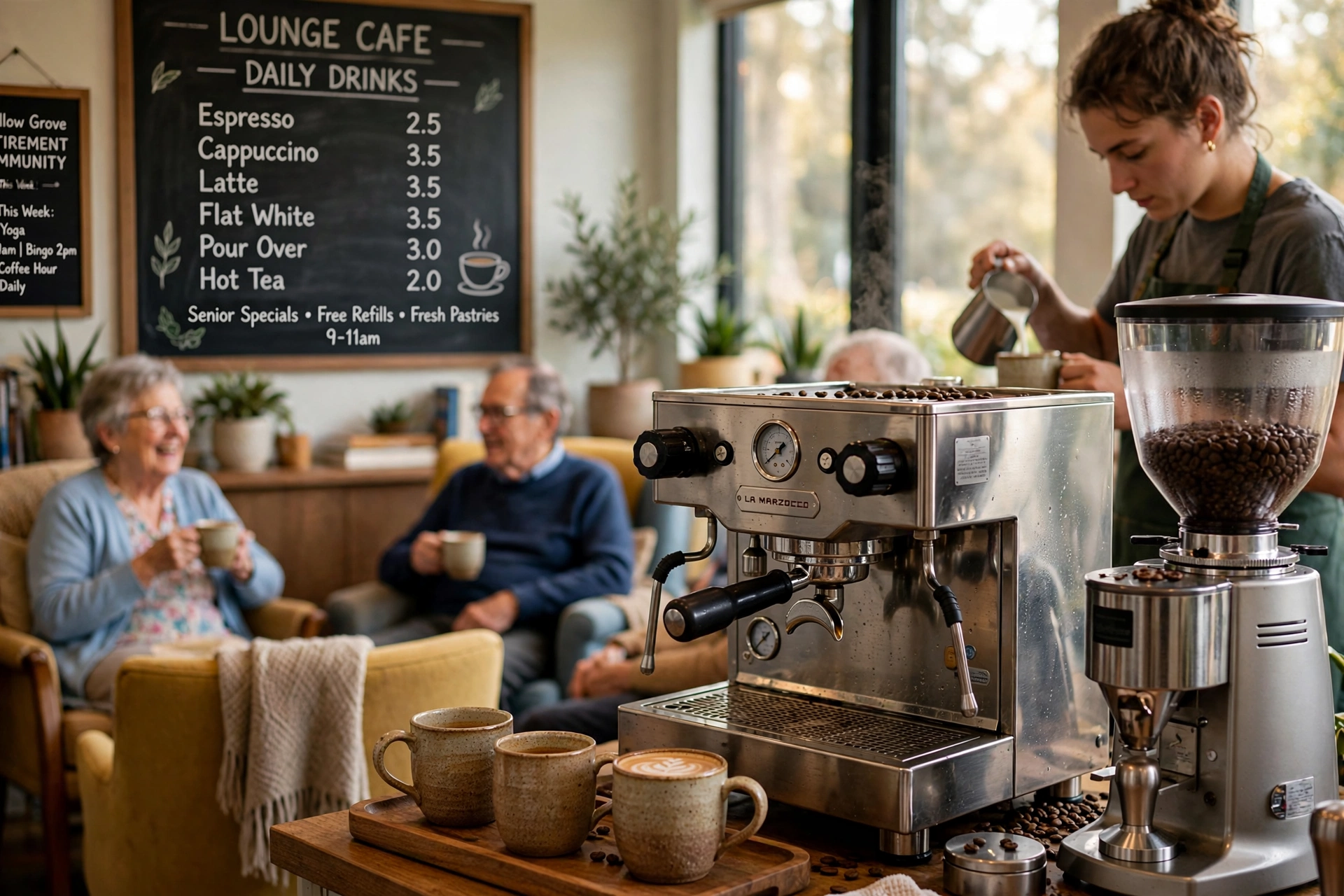
The primary reason high-quality equipment is essential in senior living is that coffee service often serves as the central social catalyst for residents. In a setting where social isolation can lead to cognitive decline, the "coffee hour" is more than a beverage break; it is a vital health intervention. By investing in professional wholesale equipment, facilities can create a destination within the community that encourages residents to leave their rooms and engage with peers.
From an operational standpoint, the move to wholesale-grade equipment reduces the total cost of ownership. A consumer-grade machine replaced every 12 months is significantly more expensive than a single professional-grade installation that lasts a decade. Furthermore, safety and hygiene are paramount. According to NSF International, commercial equipment must meet strict sanitary standards (such as NSF/ANSI 4) to prevent bacterial growth in heating elements, which is a critical risk factor in environments serving elderly populations with compromised immune systems.
Moreover, the ability to offer a variety of beverages—from a bold espresso to a light-roast drip—allows facilities to cater to the diverse palates of residents. When using commercial coffee grinders wholesale for businesses, facilities can ensure that the grind size is perfectly calibrated for the specific brewing method, preventing the over-extraction that leads to a burnt taste, which many seniors find off-putting.
How to Implement a Coffee Program in a Retirement Community
Implementing a successful coffee program requires a phased approach that separates "high-traffic' zones from "intimate' zones. You cannot use the same equipment in the main lobby that you use in a small library nook. The goal is to create a seamless flow that provides specialty coffee without creating bottlenecks during peak morning hours.
Step 1: Volume Mapping
Calculate your peak-hour demand. If you have 200 residents and 30% want coffee between 7:00 AM and 9:00 AM, you need a system capable of producing 60 servings per hour without a drop in temperature. This is where wholesale drip coffee equipment for high-volume use becomes essential. Thermal servers are preferred over hot plates, as the latter continue to cook the coffee, destroying the flavor profile of the specialty coffee.
Step 2: Equipment Selection
For the main dining area, a super-automatic espresso machine is often the best choice. It handles the grinding, tamping, and frothing in one touch. To complement this, adding wholesale milk frothers for commercial baristas allows staff to create lattes and cappuccinos that rival high-end cafes, increasing the perceived value of the community's amenities.
Step 3: Staff Training and Ergonomics
Equipment must be installed at a height that is accessible for both staff and residents who may use walkers or wheelchairs. Training should focus on simple cleaning cycles. If a machine is too complex to clean, it will be neglected, leading to equipment failure. At Busy Bean Coffee, we emphasize a "set and forget" mentality where the machine does the heavy lifting.
Step 4: Integration of Consumables
Wholesale equipment is only half the battle. To maintain the quality of the coffee bean, you must implement a rotation system. Using a high-quality Arabica coffee roast ensures a smoother, less acidic cup that is generally better tolerated by seniors.
Traditional vs. Generic vs. Professional Coffee Solutions
Many facilities start with a "traditional' approach—buying several home-use pots from a big-box store. Others try the "generic AI' approach, using cheap automated brewers with no oversight. The professional approach, utilized by Busy Bean Coffee, integrates equipment with a managed service model.
| Feature | Traditional Approach | Generic/Cheap AI Approach | Professional Managed Approach |
|---|---|---|---|
| Equipment Grade | Consumer/Home | Entry-level Commercial | Industrial/Sensa Grade |
| Maintenance | Reactive (Fix when broken) | Minimal/None | Proactive/Preventative |
| Consistency | Variable (Human error) | Mediocre (Fixed settings) | High (Q-Grader Calibrated) |
| Long-term Cost | High (Frequent replacements) | Medium (Rapid degradation) | Low (Predictable Monthly Fee) |
| Health Safety | Low (Non-NSF) | Variable | High (NSF/FDA Compliant) |
Common Mistakes to Avoid in Retirement Coffee Sourcing
One of the most frequent errors I see is the "Feature Overload" trap. Facilities often buy the most expensive machine with 50 different beverage options, only to find that 90% of residents only want a standard black coffee or a simple latte. This creates a steep learning curve for staff and leads to underutilization of expensive hardware. Focus on reliability and a few high-quality options rather than a dozen mediocre ones.
Another critical mistake is ignoring water filtration. In many parts of the Southeast, such as when setting up Sensa Coffee Service in Charlotte, NC, the water hardness can be significant. Without a commercial-grade filtration system, calcium buildup will destroy a wholesale espresso machine in months. Pure water is not just about taste; it is about protecting your investment from scale.
Finally, many managers overlook the "grind-to-brew" ratio. Using pre-ground coffee in a high-volume setting leads to oxidation and a flat taste. By incorporating commercial coffee grinders wholesale for businesses, you ensure the coffee is ground seconds before brewing, preserving the volatile aromatic compounds that make specialty coffee enjoyable.
Implementation Guide for Facility Managers
To transition from a basic coffee setup to a professional wholesale program, follow this checklist. First, conduct a "Coffee Audit." Observe where residents naturally gather and at what times. If you find a cluster of residents in a lounge at 3:00 PM, that is a prime location for a satellite coffee station. This is similar to how we optimize Sensa Coffee Service in Mount Pleasant SC - Complete Guide for local luxury complexes.
Next, evaluate your labor. Do you have a dedicated barista, or is the coffee handled by nursing or dining staff? If the latter, you must prioritize super-automatic equipment. These machines remove the variable of human skill, ensuring that the 100th cup of the day tastes exactly like the first. Pair these with essential barista tools wholesale packages for easy cleanup and maintenance.
Lastly, consider the financial model. Buying equipment outright creates a massive capital expenditure (CapEx). Instead, a managed coffee membership—like the one offered by Busy Bean Coffee—converts this into a predictable operational expense (OpEx). This allows the facility to access top-tier Sensa equipment without a huge upfront hit to the budget, including full maintenance and professional installation.
Frequently Asked Questions
How do I determine the right machine capacity for my facility?
To calculate capacity, multiply your total resident population by the expected peak-hour uptake percentage (typically 20-40%). If you have 300 residents and a 30% peak, you need a system capable of 90 cups per hour. For this volume, a combination of a high-capacity wholesale drip system and one super-automatic espresso machine is usually the most efficient configuration to prevent long queues and resident frustration.
Are super-automatic machines better than semi-automatic for senior living?
Yes, in almost every retirement setting, super-automatic machines are superior. Semi-automatic machines require a trained barista to grind, tamp, and steam milk, which is rarely feasible in a facility managed by general staff. Super-automatics provide a "one-touch" experience that ensures consistent quality and drastically reduces the time spent per cup, allowing staff to focus more on resident care and less on beverage production.
How often should wholesale coffee equipment be serviced in a 24/7 environment?
In a high-volume retirement community, preventative maintenance should occur quarterly. This includes descaling, replacing gaskets, and calibrating grinders. According to the National Coffee Association USA (NCA), regular maintenance can extend the life of commercial equipment by up to 50%. Waiting for a machine to break before fixing it results in lost revenue and dissatisfied residents.
Which coffee bean is best for an elderly population?
We recommend high-quality Coffea arabica with a medium roast. Arabica beans are generally smoother and have lower caffeine concentrations than Robusta, making them gentler on the stomach and less likely to interfere with sleep patterns or medications. A medium roast provides a balanced flavor profile that appeals to the broadest range of tastes without being overly bitter or acidic.
Is water filtration really necessary for wholesale machines?
It is absolutely essential. Commercial machines use high-pressure pumps and precision heating elements that are highly susceptible to mineral buildup. In regions like the Southeast, failure to install a professional water filtration system will lead to scale accumulation, which slows down brew times and can eventually cause the boiler to fail. Investing in filtration is the single most effective way to protect your wholesale investment.
Reference Sources
For deeper context on this topic, these sources provide additional authoritative perspectives:
- Wikipedia — general knowledge reference
- GitHub — development and technology documentation
- The New York Times — news and journalistic updates
These references help establish a complete view of the subject matter.
Conclusion
Scaling your beverage service through retirement community coffee equipment wholesale is about more than just procurement; it is about enhancing the social fabric of your community. By moving away from fragile consumer gear and embracing industrial-grade, NSF-compliant systems, you ensure that your residents enjoy a premium experience while your staff enjoys a simplified workflow. Whether you are looking to upgrade a single dining hall or implement a community-wide system like we do with Sensa Coffee Service in Savannah GA - Complete Guide, the focus must remain on reliability, ease of use, and flavor consistency.
If you are tired of the constant cycle of replacing broken home-grade machines, it is time to consider a professional managed solution. At Busy Bean Coffee, we specialize in removing the hassle of equipment ownership, providing the hardware, the beans, and the maintenance for one predictable fee. For a deeper dive into pricing and equipment options, read our Ultimate Guide to Wholesale Barista Equipment for Businesses.
Visit www.busybeancoffee.com to see how we can transform your facility's coffee experience.
Free Coffee Pairing Guide & Specialty Roast Cheat Sheet
Unlock the secrets of perfect brewing ratios, water temperatures, and specialty roast profiles. Download the guide.