Why Invest in Commercial Espresso Machines? The Real Cost of Cutting Corners
Running a high-volume foodservice operation with consumer-grade equipment is a recipe for operational failure. When you rely on home machines to serve a crowd, you aren't just risking a mediocre cup of coffee; you are risking your equipment's lifespan and your staff's sanity. Investing in professional commercial espresso machines is worth it because these systems are engineered for thermal stability, high-pressure consistency, and extreme durability, allowing a business to maintain a profit margin that home machines simply cannot sustain.
In my experience working with dozens of hotels and cafes, the most expensive mistake a founder can make is trying to "save" $5,000 by buying three prosumer machines instead of one industrial workhorse. Within six months, those prosumer machines usually suffer from pump failure or heating element burnout due to constant duty cycles. A true commercial unit is built to pull 200 shots a day, every day, for a decade, while maintaining the exact temperature required for specialty coffee.
For those managing larger hospitality footprints, looking into Automatic Coffee Machines for Hotels and Hospitality in 2026 reveals that the shift toward automation isn't just about speed, it is about removing the variance that kills customer loyalty.
The Core Mechanics: What Makes Commercial Equipment Different?
To understand why the investment is justified, we must look at the engineering. A home machine is designed to make two lattes in the morning and then sit idle for twelve hours. A professional system is designed for continuous operation.
📚
Definition
Thermal Stability is the ability of a machine to maintain a constant temperature throughout the entire extraction process, preventing the coffee from tasting sour (under-extracted) or bitter (over-extracted).
The primary difference lies in the boiler system and the pump. Commercial machines utilize large-capacity boilers, often dual-boiler systems, that separate the brewing water from the steam wand. This means a barista can steam milk and pull a shot simultaneously without a drop in pressure. According to the Specialty Coffee Association (SCA), precise temperature control within a narrow window is fundamental to achieving the flavor profiles expected in specialty coffee.
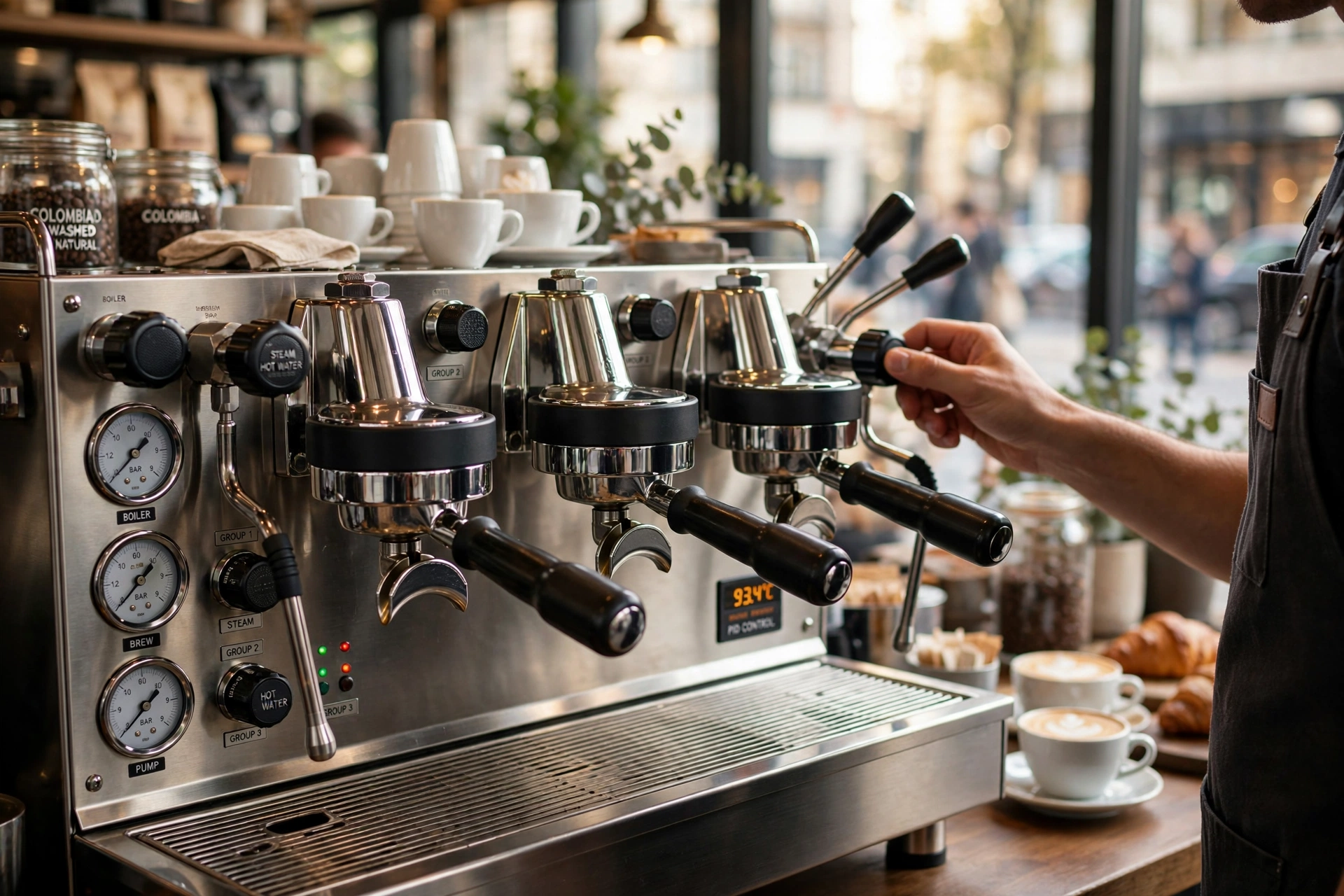
When we analyze the pump systems, commercial units use rotary vane pumps rather than the vibration pumps found in cheap machines. Rotary pumps are quieter, more durable, and can be plumbed directly into a water line. This eliminates the constant need for staff to refill tanks, which is a significant labor drain in a busy environment. If you are operating a medical facility, you might find that Automated Coffee Machines for Clinics and Medical Offices provide the best balance of this professional power with a simplified interface.
The build quality also differs. We are talking about heavy-gauge stainless steel and brass, designed to withstand the corrosive nature of water and the mechanical stress of thousands of portafilter locks. When you buy a commercial machine, you are buying an asset that holds its value and can be repaired part-by-part, whereas consumer machines are often "disposable" electronics.
Why the Investment Matters: The Data of Profitability
The "worth" of a machine is measured in ROI, not just the initial price tag. When you operate a coffee program, your two biggest variables are labor cost and waste. Cheap equipment spikes both.
1. Throughput and Labor Efficiency
A single-group home machine might take 2 minutes to recover its temperature between shots. In a morning rush, that is an eternity. A commercial machine with a PID (Proportional-Integral-Derivative) controller maintains a steady state, allowing for back-to-back extractions. According to research from the National Coffee Association USA (NCA), consumer coffee habits are shifting toward "premiumization," meaning customers expect café-quality drinks even in non-traditional settings. If your equipment cannot keep up with the rush, you are literally leaving money on the table as customers walk out of the line.
2. Consistency and Waste Reduction
Inconsistent temperature leads to "dialing in" errors. If the machine drifts by 3 degrees, the shot is ruined. In a high-volume shop, wasting five shots per hour due to temperature swings adds up to thousands of dollars in lost coffee beans and milk annually.
3. Equipment Downtime
The consequence of not acting, or choosing the wrong gear, is the "Death Spiral of Downtime." When a prosumer machine breaks, it often stays broken for weeks because parts aren't standardized. Commercial equipment is supported by a global infrastructure of technicians. If you are scaling a business in a specific region, such as using a Sensa Coffee Service in Charlotte, NC, you gain the advantage of managed maintenance, ensuring your uptime remains near 100%.
4. Sanitation and Compliance
Professional machines are built to meet strict health codes. According to NSF International, equipment used in commercial food prep must meet specific materials and design standards (like NSF/ANSI 4) to prevent bacterial growth. Home machines do not meet these standards, which can lead to failed health inspections and potential liability.
Practical Application: How to Transition to a Professional Program
Moving from a "coffee corner" to a professional beverage program requires more than just buying a machine; it requires a systems approach. The mistake I see constantly is businesses buying a high-end machine but pairing it with a cheap grinder. In the world of espresso, the grinder is actually more important than the machine.
Here is the step-by-step framework for a successful implementation:
- Audit Your Peak Volume: Calculate exactly how many drinks you serve during your busiest 60-minute window. If you are doing more than 15 drinks per hour, a single-group machine is insufficient.
- Water Filtration Strategy: Commercial machines are sensitive to mineral buildup. You must install a professional filtration system. Scaling is the number one killer of espresso machines; without a softener, your expensive investment will be ruined in 18 months.
- Staff Training: A commercial machine is a tool, not a magic box. Your team needs to understand "tamping," "distribution," and "milk aeration."
- Managed Solutions: For most businesses, the capital expense (CapEx) of buying a $15,000 machine is too high. This is where a managed service becomes the smarter financial move.
At Busy Bean Coffee, we've streamlined this by offering an all-inclusive managed coffee membership. Instead of worrying about the upfront cost or the horror of a broken boiler on a Monday morning, our clients get premium SENSA equipment, professional installation, and full maintenance for a predictable monthly fee. This shifts the cost from a risky capital investment to a manageable operational expense.
💡
Key Takeaway
The most sustainable way to implement professional coffee is to move from a "purchase and pray" model to a managed membership that includes equipment, maintenance, and specialty beans.
If you are managing locations in the Southeast, exploring a Sensa Coffee Service in Raleigh NC (2026 Overview) can show you how this managed model stabilizes your monthly budget while elevating the guest experience.
Comparison: Prosumer vs. Commercial vs. Managed Solutions
To decide which path is right for your business, you need to look at the trade-offs. Most guides will tell you to just "buy the best," but the "best" depends on your balance sheet.
| Feature | Prosumer/Home Machine | Generic Cheap Commercial | Busy Bean Managed Solution |
|---|---|---|---|
| Daily Capacity | 5-10 drinks | 50-100 drinks | Unlimited/High-Volume |
| Thermal Stability | Low (drifts often) | Moderate | High (Industrial Grade) |
| Maintenance | DIY (High Risk) | Paid per visit (Slow) | All-Inclusive (Fast) |
| Initial Cost | Low ($500-$2k) | High ($5k, $15k) | Low Monthly Fee |
| Longevity | 1-3 years (Commercial use) | 5-7 years | Perpetual (Upgrades included) |
| Best For | Office breakrooms (Small) | Small startups with cash | Hotels, Cafes, Clinics |
Now here's where it gets interesting: the "Generic Cheap Commercial" route is often a trap. These are machines that look professional but use lower-grade components. They provide a false sense of security until the first major component fails, and you realize there is no service contract in place.
Common Questions and Misconceptions
There are several myths circulating in the hospitality industry regarding espresso equipment. Most guides get this wrong by focusing on the "brand name" rather than the "duty cycle."
Myth 1: "An expensive home machine is the same as a commercial one."
This is the most dangerous misconception. A "prosumer" machine may have a fancy PID and a polished finish, but it lacks the boiler volume to handle a rush. After three lattes, the steam pressure drops, and your barista is standing there waiting for the machine to heat up while customers wait. Commercial machines have the "thermal mass" to keep going indefinitely.
Myth 2: "Automatic machines produce lower quality coffee."
This is an outdated view from ten years ago. Modern automated systems, especially those provided by Busy Bean Coffee, use precision grinding and volumetric dosing that actually increases consistency. In a high-turnover staff environment, an automated machine prevents the "Monday Morning Coffee" effect, where the drink tastes different depending on who is operating the machine.
Myth 3: "Maintenance is just a once-a-year thing."
If you only service your machine once a year, you are neglecting it. Commercial espresso machines require daily backflushing and weekly deep cleans. Failing to do this doesn't just ruin the taste; it voids warranties and leads to catastrophic pump failure. This is why managed services are so valuable, they bake the maintenance schedule into the service.
Frequently Asked Questions
Are commercial espresso machines actually worth the high price?
Yes, because they transition the equipment from a liability to an asset. When you factor in the cost of downtime, the waste of ruined shots due to temperature instability, and the labor lost to slow production, a professional machine pays for itself within the first year. A machine that can produce a consistent 90-second extraction every single time allows you to increase your transactions per hour, directly impacting your top-line revenue.
How do I know if my business needs a commercial machine or a prosumer one?
The decision comes down to your "peak hour" volume. If you serve more than 10 customers per hour during your rush, you need commercial equipment. Prosumer machines are designed for sequential use, not parallel use. If you find your staff is waiting for the machine to "recover" or "reheat" between drinks, you have already outgrown your equipment and are losing money through inefficiency.
What is the biggest risk of using a non-commercial machine in a business?
The primary risk is "catastrophic failure" during a peak period. Consumer machines are not rated for continuous duty cycles. When the pump fails on a home machine, it is often not repairable. In a business setting, a machine failure doesn't just mean no coffee; it means lost revenue, frustrated employees, and a damaged brand reputation. Furthermore, they often fail to meet FDA food safety standards regarding materials and drainage.
Will an automated machine be as good as a manual one?
In a commercial environment, "consistency" beats "perfection." While a world-class barista can pull a slightly better shot on a manual machine, they cannot do it 200 times a day without fatigue. Automated commercial machines ensure that the 200th drink is exactly as good as the first. For 95% of foodservice businesses, the reliability and speed of an automated system far outweigh the marginal gains of a manual process.
How does a managed coffee membership save me money?
It eliminates the "Capex Shock." Instead of spending $10,000 to $20,000 upfront on a machine and grinder, you pay a predictable monthly fee. This preserves your cash flow for other growth areas. Additionally, the membership covers the "invisible costs" of coffee: technician visits, replacement gaskets, water filter changes, and equipment upgrades. When the machine is managed, the risk of an unexpected $1,000 repair bill disappears.
Final Thoughts on Commercial Espresso Machines
Deciding whether commercial espresso machines are worth it comes down to one question: Do you want a coffee hobby or a coffee business? Hobbies are about the process; businesses are about the result. Professional equipment is the only way to guarantee a result that is consistent, scalable, and profitable.
If you continue to use underpowered equipment, you are accepting a ceiling on your growth. You are accepting slower lines, inconsistent quality, and the inevitable crash of a machine that wasn't built for the job. The transition to a professional setup, especially through a managed membership, removes the friction of ownership and lets you focus on your guests.
Whether you are looking for a Sensa Coffee Service in Jacksonville, FL or a Business Coffee Membership in Boston MA: Complete Guide, the goal remains the same: premium quality without the operational headache.
Stop gambling with your equipment and start scaling your beverage program. Visit Busy Bean Coffee to find the perfect all-inclusive solution for your business.
Free Coffee Pairing Guide & Specialty Roast Cheat Sheet
Unlock the secrets of perfect brewing ratios, water temperatures, and specialty roast profiles. Download the guide.