What are Industrial Coffee Roasters and How Do They Work?
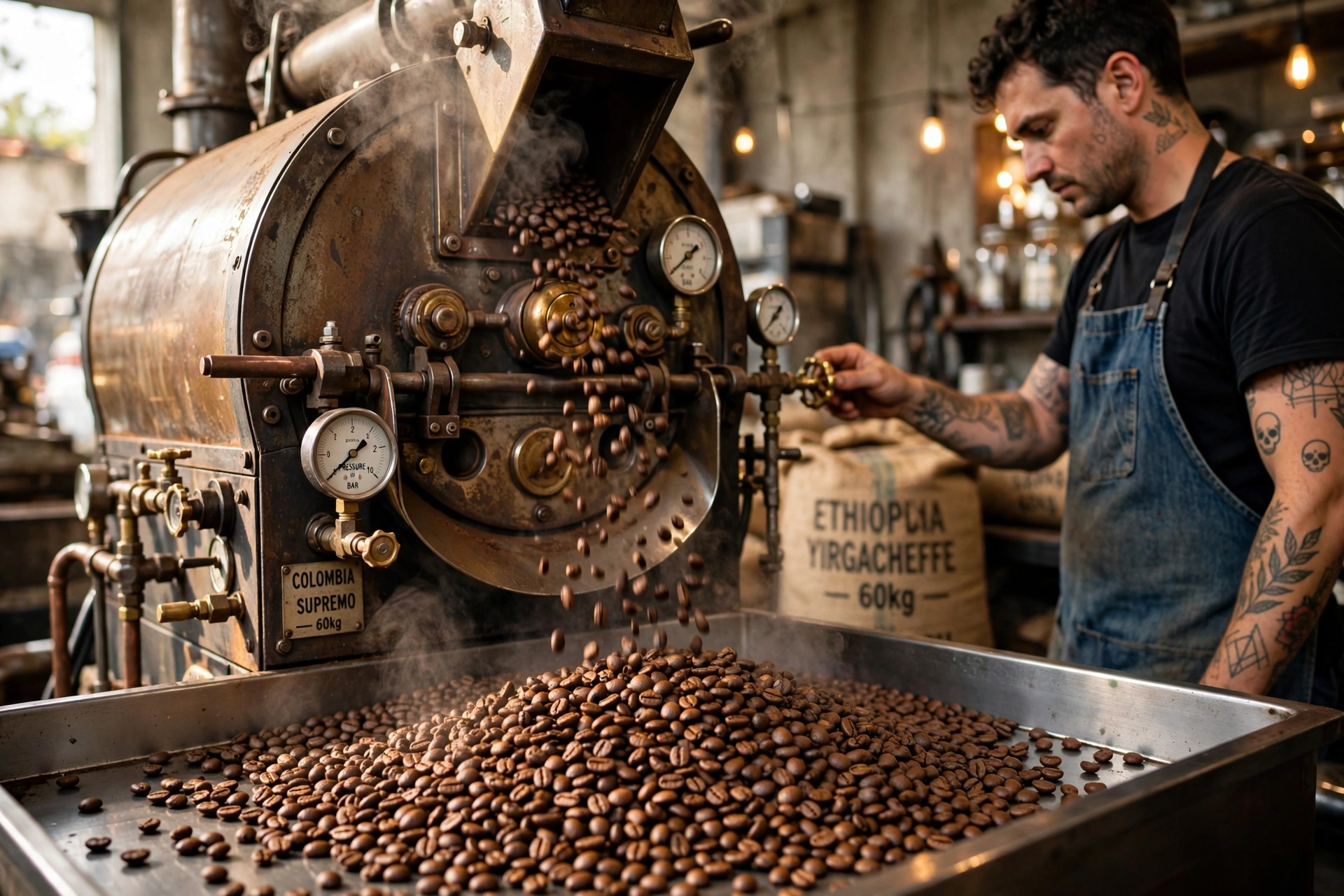
Scaling a coffee business from a home kitchen to a commercial operation requires a fundamental shift in how heat is applied to the bean. When a business reaches a certain volume, manual batches are no longer viable; this is where industrial coffee roasters become the backbone of the operation. These are high-capacity, precision-engineered machines designed to roast large quantities of green coffee beans consistently while maintaining a specific flavor profile across thousands of pounds of product.
Unlike small sample roasters, industrial systems utilize advanced thermodynamics, combining convection and conduction, to ensure that every coffee bean in a 60kg or 120kg batch reaches the same internal temperature. This consistency is what allows a brand to scale without losing the "specialty" quality that defines their market position. For businesses integrating these into a larger ecosystem, such as those utilizing a Sensa Coffee Service in Charlotte, NC, the roasting phase is the most critical variable in the entire supply chain.
📚
Definition
Industrial coffee roasters are heavy-duty thermal processing machines capable of roasting large volumes of coffee beans (typically from 15kg to 600kg per batch) using precise controls for temperature, airflow, and drum rotation to achieve commercial-scale consistency.

To understand how they work, one must look at the heat transfer. Most industrial roasters use a rotating drum. The beans are heated by the drum's metal walls (conduction) and the hot air flowing through the bean mass (convection). In my experience working with high-volume roasting facilities, the biggest challenge isn't getting the beans hot; it's managing the "Rate of Rise" (RoR). If the heat spikes too early, you sear the outside of the bean while the center remains raw. If it's too slow, you "bake" the coffee, resulting in a flat, bread-like flavor.
According to the Specialty Coffee Association (SCA), precision in the roasting process is what separates specialty grade coffee from commodity coffee. The SCA emphasizes that the ability to control the roast curve, the visual representation of temperature over time, is what allows roasters to highlight the unique terroir of Coffea arabica. Industrial roasters facilitate this by using software that tracks these curves in real-time, allowing a head roaster to replicate a perfect "light roast" across ten consecutive batches without a single degree of variance.
Why Does Industrial Roasting Matter for Business Scalability?
The transition to industrial roasting is not just about capacity; it is about the economics of precision. When you move from a 1kg batch to a 60kg batch, the margin for error shrinks. A mistake in a small batch is a waste of a few dollars; a mistake in an industrial batch can cost a company thousands of dollars in lost inventory and ruined reputations.
The primary driver here is consistency. In a professional Foodservice Coffee Program in Chicago IL: Complete Guide, the customer expects the espresso to taste exactly the same on Tuesday morning as it did on Friday afternoon. This is impossible to achieve without the stability provided by industrial-grade equipment. These machines provide the thermal mass necessary to resist external temperature swings, ensuring that the roast remains stable regardless of whether it's a humid July day or a freezing January morning.
From a data perspective, the efficiency gains are staggering. According to the International Coffee Organization (ICO), the global demand for specialty coffee continues to grow, forcing producers to optimize their throughput. An industrial roaster allows a business to move from "batch roasting" to "continuous roasting" in some cases, significantly lowering the labor cost per pound of coffee produced.
If a business fails to invest in the right roasting infrastructure, they hit a "quality ceiling." I've seen dozens of clients try to scale by simply buying more small roasters. This is a classic mistake. Managing five small roasters is a logistical nightmare and leads to inconsistent product. One large industrial roaster is more energy-efficient, easier to clean, and produces a uniform product that meets the rigorous standards of any professional barista.
The financial implications are also tied to waste reduction. Industrial machines feature advanced "chaff collectors" and integrated cooling trays. In a small setup, chaff (the skin of the bean) can become a fire hazard and a mess. In an industrial setting, this is managed via powerful centrifugal fans, which not only keep the facility safe but also allow the roaster to maintain a cleaner environment, which is essential for meeting FDA food safety guidelines.
How to Implement an Industrial Roasting Strategy
Implementing a roasting program is not as simple as plugging in a machine. It requires a holistic approach to the "green-to-cup" pipeline. The process begins with the selection of the roast profile, which is a blueprint for how the bean should be treated.
First, you must establish a "Sample Roast." This is where the Q-Grader tests a small amount of coffee to find the "sweet spot." Once that profile is locked in, the challenge is translating that profile to an industrial scale. This involves calculating the "charge temperature", the temperature of the drum when the beans are first dropped in. Because industrial drums have massive thermal mass, the charge temperature must be carefully calibrated to avoid scorching the beans.
Second, the airflow must be managed. In industrial roasters, the "Airflow" controls how quickly smoke and chaff are removed from the drum. Too little air, and the coffee tastes smoky; too much, and you strip away the volatile aromatic compounds that give specialty coffee its complex flavor. This is where the expertise of the roastmaster is essential.
Third, the cooling phase is just as important as the roasting phase. Industrial roasters use large perforated trays with high-powered suction fans. To stop the cooking process instantly, the beans must be cooled to room temperature within 3 to 5 minutes. If they sit in a pile while hot, "carry-over cooking" occurs, which can push a precise medium roast into an over-roasted, bitter territory.
For businesses that want the quality of industrial roasting without the massive capital expenditure and technical headache of managing a plant, we recommend a managed approach. This is where Busy Bean Coffee excels. By leveraging our infrastructure and professional roasting expertise, businesses can provide a world-class beverage program without needing to become roasting engineers themselves. Whether you are setting up a Sensa Coffee Service in Raleigh NC (2026 Overview) or a large corporate office, the goal is the same: consistent, high-quality output.
💡
Key Takeaway
The secret to industrial roasting is not the heat, but the control of the "Rate of Rise" (RoR) and the speed of the cooling process to lock in flavor profiles.

Choosing the Right Roaster: Drum vs. Fluid Bed vs. Continuous
Not all industrial roasters are created equal. The choice depends on the volume, the desired flavor profile, and the budget. The most common debate in the industry is between drum roasters and fluid bed (air) roasters.
Drum roasters are the gold standard for traditional flavor. They use the metal drum to provide conduction heat, which helps develop the body and richness of the coffee. This is the preferred method for most coffee roasting professionals who want a classic, bold profile. Fluid bed roasters, on the other hand, suspend the beans in a stream of hot air. This results in a faster roast and often a "cleaner" taste, but it can lack the depth provided by drum conduction.
Continuous roasters represent the cutting edge. Instead of batches, coffee flows through a series of roasting chambers in a constant stream. This is used by the largest global brands to ensure 100% uniformity across millions of pounds.
| Roaster Type | Heat Method | Consistency | Best For | Pros | Cons |
|---|---|---|---|---|---|
| Drum Roaster | Conduction + Convection | High | Specialty Roasters | Rich flavor, traditional | Slower throughput |
| Fluid Bed | Pure Convection | Very High | High-speed commercial | Fast, very consistent | Less "body" in flavor |
| Continuous | Hybrid / Flow | Absolute | Global Distribution | Maximum efficiency | Massive cost, complex |
Now, here's where it gets interesting: many modern industrial roasters are now "hybrid" systems. They use a drum for the initial heat absorption but integrate high-velocity air systems to manage the final stages of the roast. This gives the roaster the best of both worlds, the body of a drum roast with the precision and speed of an air roaster. When we evaluate equipment for our partners, like those using Sensa Coffee Service in Mount Pleasant SC: Complete Guide, we look for this level of versatility.
Common Misconceptions About Industrial Roasting
There are several myths that persist in the industry, often perpetuated by "home-roaster" blogs that don't understand the physics of scale.
One of the most common myths is that "darker roasts are always 'industrial' or 'cheap'." In reality, the roast level (light, medium, or dark) has nothing to do with the size of the machine. A 120kg industrial roaster can produce a delicate, tea-like Ethiopian Yirgacheffe just as well as a 500g sample roaster. The difference is simply the target temperature and the duration of the roast.
Another misconception is that automated roasting software replaces the roastmaster. Most guides get this wrong. While software can track the temperature, it cannot "taste" the coffee. The software is a tool, not a decision-maker. The roastmaster must still decide when to "drop" the beans based on the sound of the "first crack" (the audible popping of the bean as it expands) and the visual color of the bean.
Lastly, some believe that industrial roasting inherently destroys the "soul" of the coffee. On the contrary, when done correctly, industrial roasting preserves the soul by removing the volatility of human error. In my early days of roasting, I remember a batch where I relied too much on a timer and not enough on the bean's actual temperature. I ruined 20kg of prime Arabica coffee. An industrial system with a calibrated probe would have alerted me to the temperature spike before the damage was done.
Frequently Asked Questions
What is the difference between a commercial and an industrial coffee roaster?
The primary difference lies in the throughput and the level of automation. A commercial roaster is typically designed for a small-to-medium local cafe or a small roasting company, often handling batches from 1kg to 15kg. Industrial roasters are designed for mass production, handling 30kg to 600kg per batch. Industrial machines also incorporate more robust safety features, such as automated fire suppression and high-capacity smoke scrubbers, to comply with urban zoning and environmental laws. They are built for 24/7 operation, whereas commercial roasters are typically used for a few hours a day.
How do industrial roasters ensure every bean is roasted equally?
Industrial roasters achieve uniformity through a combination of drum agitation and precise airflow. The drum rotates at a specific RPM (revolutions per minute), which keeps the beans in constant motion, preventing any single bean from staying in contact with the hot metal for too long. Simultaneously, high-pressure blowers push hot air through the bean mass. This ensures that the center of the batch receives as much heat as the outer edges. Without this constant movement and air circulation, the batch would suffer from "unevenness," where some beans are burnt and others are under-roasted.
Is industrial roasting more energy-efficient than small-batch roasting?
Yes, significantly. When you roast 60kg of coffee in one industrial drum, the energy required to heat the machine is spread across a much larger volume of product. Small-batch roasting requires the machine to be heated up and cooled down multiple times to achieve the same output, which wastes a tremendous amount of electricity or gas. Furthermore, many modern industrial roasters feature heat exchangers that recycle the energy from the exhaust to pre-heat the incoming air, further reducing the carbon footprint and operational costs.
What are the sanitary requirements for industrial roasting facilities?
Industrial roasting facilities must adhere to strict health and safety standards. This includes the use of NSF-certified equipment to ensure that no contaminants enter the food chain. The NSF International provides standards for food equipment that industrial roasters must meet, particularly regarding the materials used in the drum and the cooling trays. Facilities must also manage "chaff" (the skin of the coffee bean), which is highly flammable and can attract pests if not removed via industrial vacuum systems.
Can industrial roasters be used for different types of coffee beans?
Absolutely, but it requires different "profiles." For example, Coffea arabica is more delicate and typically requires lower temperatures to preserve its acidity and floral notes. In contrast, Robusta beans are hardier and can withstand higher heat. An industrial roaster allows the operator to save these specific profiles into a computer. When it's time to switch from a light-roast Arabica to a dark-roast blend, the operator simply loads the corresponding profile, and the machine adjusts the heat and airflow automatically to suit that specific bean type.
Final Thoughts on Industrial Coffee Roasters
Understanding the mechanics of industrial coffee roasters is essential for any business looking to move from a boutique operation to a scalable brand. The ability to produce consistent, high-quality coffee at scale is the only way to maintain a competitive edge in a market where consumers are increasingly knowledgeable about specialty coffee. From managing the Rate of Rise to ensuring a rapid cool-down, the technical precision of these machines is what allows a brand to guarantee excellence in every cup.
However, for most foodservice businesses, the goal isn't to own the roaster, but to own the result. The complexity of industrial roasting, the maintenance, the staffing, and the capital investment, can be a distraction from the core mission of serving customers. This is why a managed coffee solution is often the smartest business move. By partnering with Busy Bean Coffee Blog, you get the benefits of industrial-scale precision and Q-Grader expertise without the overhead of running a roasting plant.
Whether you are looking to upgrade your current setup or are designing a new beverage program from scratch, remember that consistency is your most valuable asset. For more information on implementing a professional coffee solution, explore our Sensa Coffee Service in Jacksonville, FL or other regional guides to see how we bring industrial precision to local businesses.
Ready to Upgrade Your Business Coffee?
Café-quality coffee, zero maintenance headaches, and one predictable monthly price. Let's build your custom coffee program.
Free Coffee Pairing Guide & Specialty Roast Cheat Sheet
Unlock the secrets of perfect brewing ratios, water temperatures, and specialty roast profiles. Download the guide.