How to Master Professional Coffee Equipment Maintenance for Maximum ROI
A single lime scale buildup in a boiler or a clogged group head can drop your beverage quality by 20% in a matter of days, leading to immediate revenue loss. To effectively execute coffee equipment maintenance, you must implement a tiered system of daily, weekly, and quarterly interventions that target three specific areas: chemical cleanliness, mechanical calibration, and water filtration integrity. By shifting from reactive repairs to a proactive schedule, businesses can extend the lifespan of an espresso machine by 3 to 5 years and ensure every shot of specialty coffee meets professional standards.

What Exactly is Professional Coffee Equipment Maintenance?
At its core, professional maintenance is the systematic process of preserving the mechanical integrity and sanitary conditions of beverage hardware to ensure consistency in extraction. It is not merely about wiping down counters; it is a technical discipline that involves managing the chemistry of water and the physics of pressure.
📚
Definition
Coffee equipment maintenance is the scheduled application of preventative measures, including backflushing, descaling, and gasket replacement, designed to prevent equipment failure and maintain the chemical purity of the coffee extraction process.
In my experience working with high-volume cafes in Mount Pleasant, SC, I have seen a recurring pattern: owners often confuse "cleaning" with "maintenance." Cleaning is the removal of visible debris; maintenance is the prevention of invisible degradation. For example, while a barista might wipe the steam wand every ten seconds, the internal heat exchanger may be accumulating calcium carbonate. If left unchecked, this creates "hot spots" in the boiler, leading to temperature instability and a bitter, burnt flavor profile in the espresso.
According to the Specialty Coffee Association (SCA), the precision of water chemistry is the most overlooked variable in equipment longevity. Because coffee is 98% water, the minerals present in your local supply directly dictate how often your equipment requires deep maintenance. In regions with hard water, the rate of scale accumulation can be 5x faster than in soft-water areas, making a standardized "once-a-year" service call completely inadequate for most businesses.
Why Does Equipment Upkeep Directly Impact Your Bottom Line?
The financial implications of neglecting your machines are far more severe than the cost of a monthly service contract. When a primary espresso machine goes offline during a morning rush, the loss is not just the immediate sale of a latte, but the potential lifetime value of a customer who perceives your business as unreliable.
Equipment downtime is a silent profit killer. According to research by the National Coffee Association USA (NCA), consumer expectations for consistency are at an all-time high. A machine that hasn't been calibrated or maintained will produce "channeling" in the coffee puck, resulting in under-extracted, sour shots. When a customer tastes a subpar beverage, the probability of them returning drops significantly.
From a capital expenditure perspective, the data is clear: preventative maintenance reduces the Total Cost of Ownership (TCO). A commercial espresso machine is a high-precision instrument. When gaskets leak or pump pressures fluctuate, the machine works harder to maintain temperature, increasing energy consumption by as much as 15% and wearing out the heating elements prematurely.
Furthermore, sanitation is a regulatory requirement. The U.S. Food and Drug Administration (FDA) maintains strict guidelines on food-contact surfaces. Milk residue in steam wands or old coffee oils in the group head aren't just flavor spoilers; they are biohazards. A failed health inspection due to poor coffee equipment maintenance can result in fines that dwarf the cost of a professional managed service plan.
How to Implement a Step-by-Step Maintenance Protocol
Executing a professional maintenance routine requires a disciplined approach. You cannot treat a high-end espresso machine like a home brewer. To achieve the results we see at Busy Bean Coffee, you must divide your efforts into three distinct horizons: Daily, Weekly, and Quarterly.
The Daily Ritual: Sanitation and Surface Integrity
The goal here is to prevent the buildup of organic oils and proteins.
- Backflushing: Use a blind filter and professional detergent to clear the three-way solenoid valve. This removes coffee oils that turn rancid and bitter.
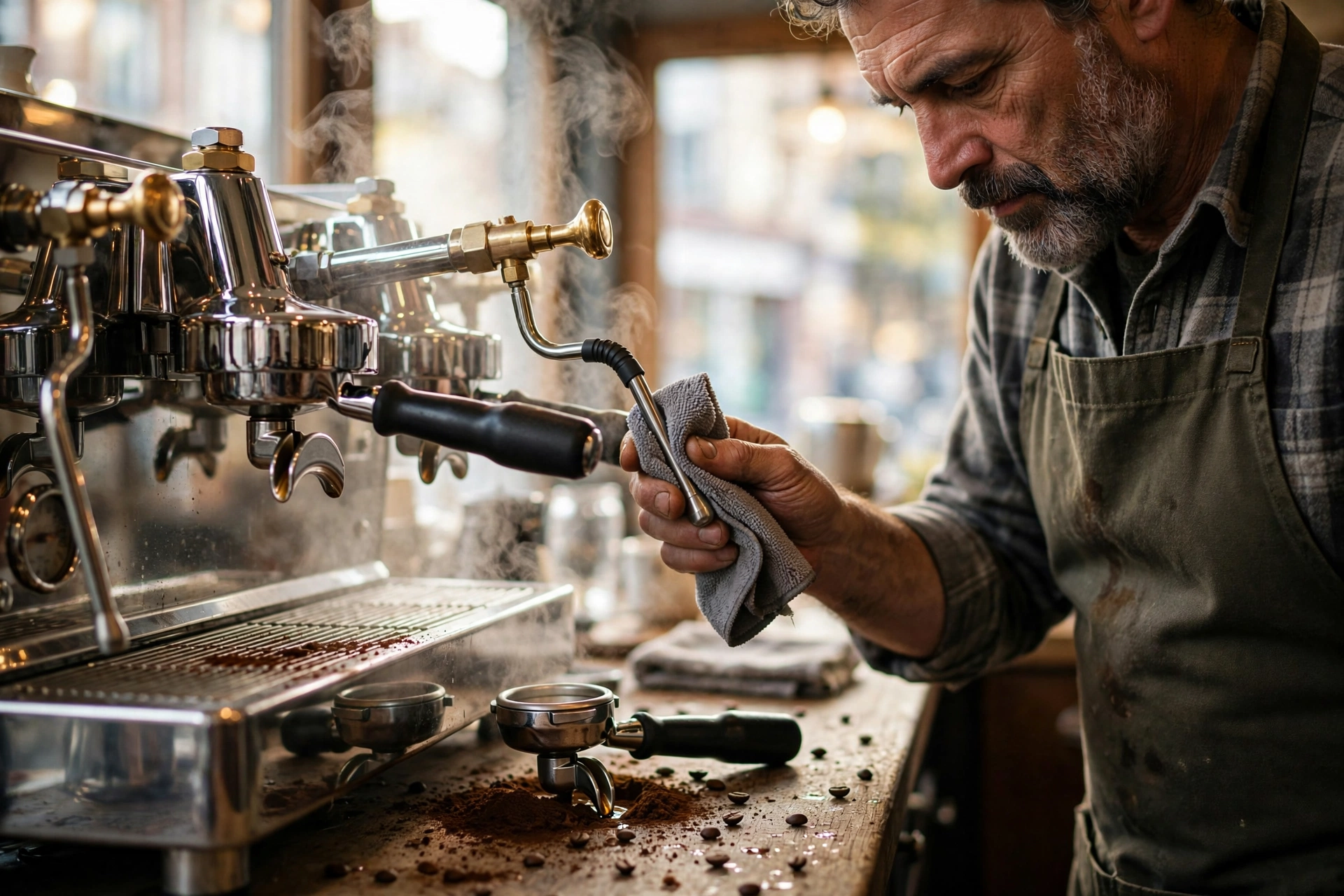
- Steam Wand Purging: Purge before and after every use. At the end of the day, soak the wand tips in a food-safe milk cleanser to remove protein buildup.
- Group Head Scrubbing: Use a nylon brush to clean the shower screen. This prevents "clumping" and ensures an even distribution of water.
- Hopper Cleaning: Wipe the interior of the bean hopper to remove coffee oils that can oxidize and affect the flavor of the Arabica coffee.
The Weekly Deep-Dive: Mechanical Calibration
Once a week, you must move beyond surface cleaning to system checks.
- Shower Screen Removal: Remove the screens and gaskets. Scrub the interior of the group head where detergent cannot reach during backflushing.
- Water Filter Check: Check the pressure gauges on your filtration system. If the pressure is dropping, your filter is saturated and needs replacement.
- Drip Tray De-scaling: Deep clean the drip tray and drainage lines with a mild descaler to prevent slime buildup and odors.
The Quarterly Overhaul: Component Replacement
This is where the expertise of a Q-Grader and technician becomes essential.
- Gasket Replacement: Rubber gaskets harden over time, leading to leaks. Replacing them every quarter ensures a perfect seal and consistent pressure.
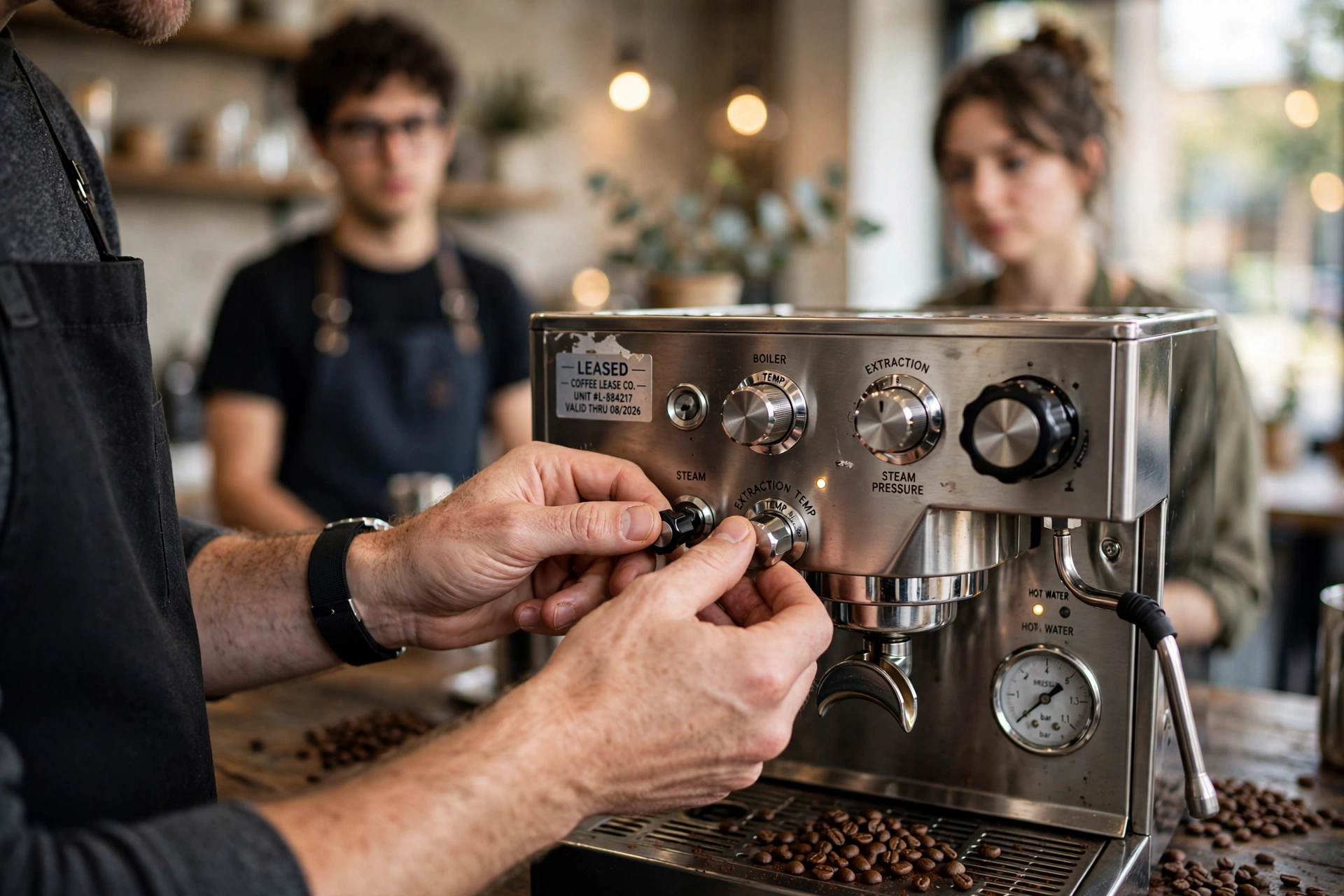
- Pump Pressure Adjustment: Verify that the pump is delivering exactly 9 bars of pressure. Even a 0.5 bar variance can change the taste of a specialty coffee.
- Boiler Inspection: Check for mineral deposits. If scale is present, a professional descaling process using food-grade acids is required.
💡
Key Takeaway
The most expensive mistake a business can make is waiting for a machine to break before calling a technician. Transitioning to a managed service, like the all-inclusive membership at Busy Bean Coffee, eliminates the guesswork and ensures your equipment never becomes a liability.

Comparing Maintenance Approaches: Which Is Right for Your Business?
Not every business has the same capacity for technical labor. Depending on your volume and staffing, you will likely fall into one of three categories. The following table compares the traditional "fix-it-when-it-breaks" model against a professional managed approach.
| Feature | Reactive Maintenance | Budget/DIY Approach | Busy Bean Managed Service |
|---|---|---|---|
| Downtime | High (Days or Weeks) | Moderate (Hours to Days) | Minimal (Proactive swaps) |
| Consistency | Poor (Erratic flavor) | Variable (Depends on staff) | High (Standardized Q-Grade) |
| Upfront Cost | Low (until it breaks) | Moderate (Buying tools) | Predictable Monthly Fee |
| Equipment Life | Shortened (High wear) | Average | Maximized (Expert care) |
| Best For | Very low-volume kiosks | Owner-operators with tech skill | Growth-oriented foodservice |
Most guides get this wrong by suggesting that DIY is the "cheaper" option. In reality, the cost of one lost Saturday morning due to a blown gasket often exceeds the entire annual cost of a professional maintenance plan. When you factor in the cost of labor for a staff member to spend three hours scrubbing a machine they aren't trained to fix, the "savings" vanish.
Common Misconceptions About Equipment Care
There are several myths in the coffee industry that lead to catastrophic equipment failure. I've seen these patterns repeated in dozens of clients before they switched to our managed solutions.
Myth 1: "If the coffee tastes fine, the machine is clean."
This is a dangerous assumption. By the time you taste the "burnt" flavor of old oils or the "flatness" of scale buildup, the damage is already deep within the heat exchanger. Maintenance is about preserving the potential for quality, not just reacting to a bad cup.
Myth 2: "Vinegar is a great natural descaler for commercial machines."
Absolutely not. Using vinegar in a professional espresso machine can leave behind a lingering acetic smell and, more importantly, it is often not strong enough to break down heavy calcium deposits. Professional descalers are formulated to be food-safe and highly targeted to specific mineral types without corroding the copper or brass components.
Myth 3: "More pressure always means better coffee."
Some operators try to "fix" a dying pump by cranking up the pressure. This actually causes the coffee puck to compress too tightly, leading to "channeling" where water finds a single path through the coffee. This results in a shot that is simultaneously sour and bitter. Maintenance is about stability, not maximization.
Frequently Asked Questions
How often should I replace the group head gaskets?
In a high-volume environment, gaskets should be replaced every three months. Over time, the heat and pressure of pulling shots cause the rubber to compress and harden. Once the gasket loses its elasticity, you will notice water leaking from the sides of the portafilter. Replacing them quarterly prevents "leaking" which can lead to inconsistent pressure and temperature drops during the extraction process, ensuring your specialty coffee remains consistent.
Can I use any water filter for my espresso machine?
No, the filter must be specifically designed for the mineral profile of your local water. For example, in Mount Pleasant, SC, the water hardness differs from other regions. You need a filter that balances the removal of chlorine and excess calcium while leaving enough minerals to enhance the flavor of the coffee. Using a generic filter can either lead to rapid scale buildup or, conversely, "hungry water" that leaches metals from your boiler, ruining the taste.
What is the difference between backflushing and descaling?
Backflushing is a cleaning process that removes coffee oils and particulates from the group head and solenoid valve using a blind filter. It is a daily task. Descaling is a chemical process that removes mineral deposits (scale) from the inside of the boiler and heat exchangers. Descaling is a deeper, less frequent task. You can backflush every day for a year, but if you never descale, your machine will eventually suffer a total boiler failure.
How do I know if my pump pressure is incorrect?
The most reliable way is to use a calibrated manometer. If you notice that your espresso shots are flowing too quickly (under-extraction) or dripping painfully slowly (over-extraction) despite using the same grind size and dose, your pump pressure is likely fluctuating. In my experience, a pump that has drifted more than 0.5 bars off its target will noticeably change the mouthfeel and acidity of the beverage.
Does using a managed service actually save money?
Yes, because it converts an unpredictable capital risk into a predictable operational expense. When you buy a machine outright, you are responsible for the $500+ emergency repair bills and the lost revenue during downtime. A managed service, like the one provided by Busy Bean Coffee, includes professional installation, full maintenance, and high-end SENSA equipment for one monthly fee. This allows you to forecast your budget with 100% accuracy.
Final Thoughts on Coffee Equipment Maintenance
Mastering coffee equipment maintenance is the difference between running a hobby and running a professional foodservice business. When you treat your hardware as a precision instrument rather than a kitchen appliance, you protect your margins and your brand reputation. The transition from reactive "firefighting" to a proactive maintenance culture allows your baristas to focus on what actually matters: the art of the pour and the customer experience.
If you are tired of the stress associated with equipment failure and the hidden costs of DIY maintenance, it is time to upgrade your approach. At Busy Bean Coffee, we provide an all-inclusive managed coffee membership that removes the burden of maintenance entirely, giving you premium equipment and expert support for one predictable fee.
Stop guessing and start growing. Visit www.busybeancoffee.com to see how our managed solutions can stabilize your operations and elevate your coffee quality in 2026.
Recommended Readings
To deepen your understanding of these topics, we recommend reading the following articles:
- The Complete Guide to White Glove Coffee Service
- Ultimate Guide to All-Inclusive Coffee Service for Businesses
- Ultimate Guide to Automated Coffee Machines for Business
- Ultimate Guide to Specialty Coffee Equipment for Business
Free Coffee Pairing Guide & Specialty Roast Cheat Sheet
Unlock the secrets of perfect brewing ratios, water temperatures, and specialty roast profiles. Download the guide.