How to Choose Industrial Coffee Roasters for Your Business
The transition from a sample roaster to high-volume production is where most specialty coffee businesses either scale successfully or fail due to operational bottlenecks. Selecting industrial coffee roasters requires a precise balance between batch capacity, thermal stability, and the specific heat transfer method that matches your target roast profile. To do this correctly, you must first calculate your peak hourly demand, assess your facility's ventilation and gas infrastructure, and then select a machine that allows for repeatable precision without sacrificing the nuance of the coffee bean.
In my experience working with growing roast houses, the most expensive mistake is buying for where you are today rather than where you will be in 24 months. I have seen dozens of owners purchase a 15kg roaster only to realize six months later that their growth trajectory requires a 30kg unit, forcing them to sell their equipment at a loss and halt production for a second installation.
What Exactly Defines Industrial Coffee Roasting Equipment?
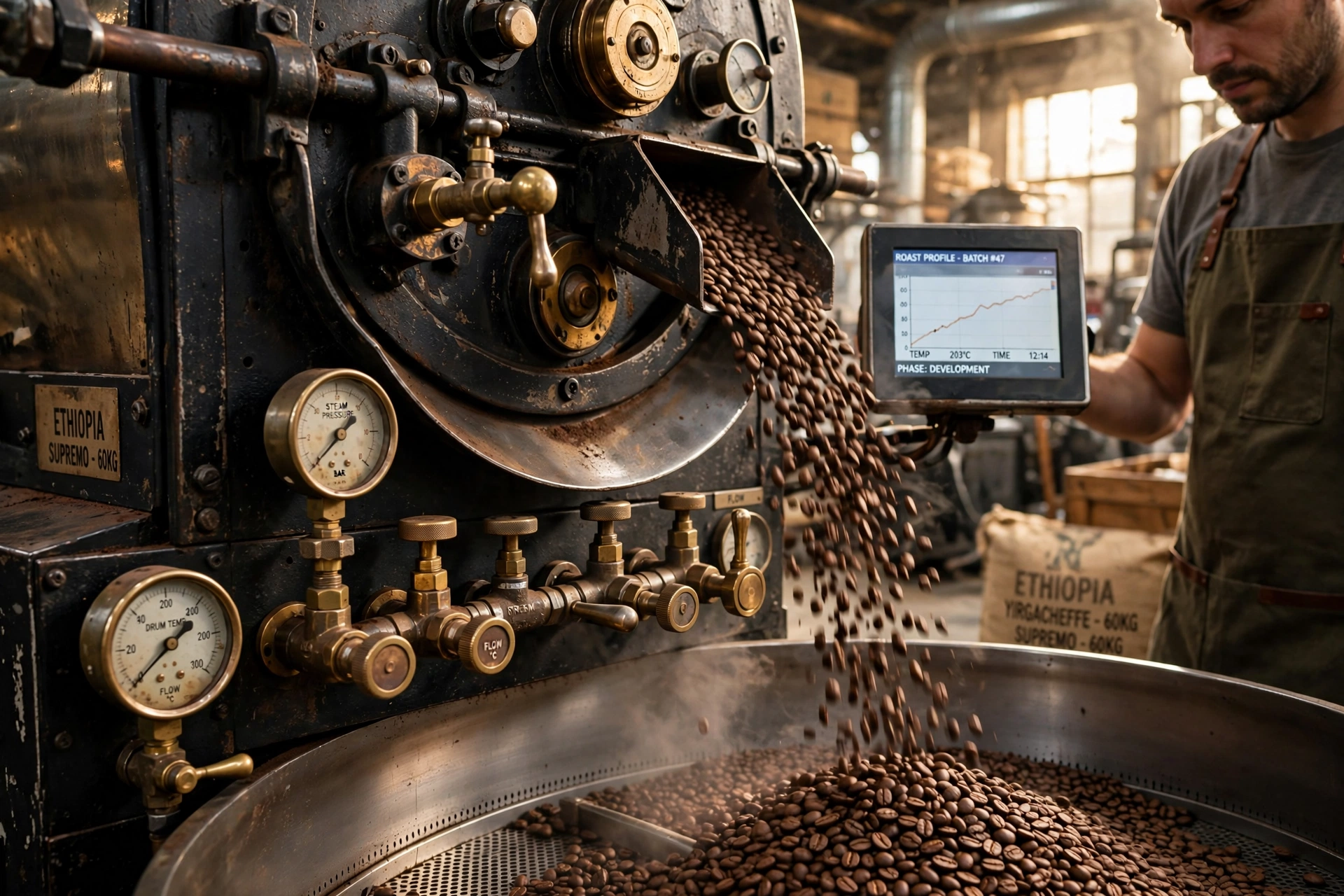
When we talk about industrial coffee roasters, we are moving beyond the realm of "prosumer" or "small-batch" machines. We are discussing equipment designed for continuous operation, high thermal mass, and rigorous safety certifications. These machines are engineered to handle the immense heat required to transform raw green coffee into a roasted product while maintaining a consistent "rate of rise" (RoR) across multiple batches.
📚Definition
Thermal Mass refers to the ability of the roaster's drum and chassis to retain heat. High thermal mass prevents the temperature from dropping significantly when a new batch of cold green coffee is loaded, which is essential for consistency in industrial settings.
Industrial roasting differs from small-scale roasting primarily in the scale of heat management. In a small roaster, a few degrees of fluctuation might be acceptable; in an industrial setting, a 2-degree variance across a 60kg batch can result in hundreds of pounds of wasted product. This is why industrial units prioritize advanced airflow controls and precise burner modulation.
According to the
Specialty Coffee Association (SCA), the standards for roasting must prioritize the preservation of the chemical precursors that create flavor, meaning the equipment must be able to control the "Maillard reaction" phase with extreme precision. If your equipment cannot maintain a steady airflow or precise heat application during this window, you are simply burning beans rather than roasting them.
The complexity of these machines also involves the cooling process. An industrial roaster is only as good as its cooling tray. If the beans continue to roast (carry-over cooking) after they leave the drum, the profile is ruined. Industrial units utilize high-powered suction fans and rotating arms to drop the bean temperature to room temperature in under four minutes.
Why the Right Roaster Choice Directly Impacts Your Bottom Line
Choosing the wrong industrial coffee roasters isn't just a matter of "bad taste"; it is a direct threat to your operational margins. In a high-volume environment, the cost of "scrap" (batches that don't meet quality standards) can eat 5% to 10% of your monthly profit. If your machine lacks the precision to repeat a roast profile, you are essentially gambling with your raw materials.
From a business perspective, the efficiency of your roast cycle, the time from loading to cooling, determines your maximum revenue ceiling. For example, if a 30kg roaster has a total cycle time of 20 minutes, your theoretical maximum is 90kg per hour. If you miscalculate your growth and need to hit 150kg per hour, you face a choice: buy a second machine (doubling your footprint and labor) or replace the first one.
Data from the
National Coffee Association USA (NCA) suggests that the specialty coffee segment continues to demand higher transparency and quality. This means consumers are no longer accepting "generic" dark roasts; they want origin-specific profiles. Achieving these specific profiles at scale requires equipment that offers granular control over the air-to-fuel ratio and drum speed.
Furthermore, there is the issue of regulatory compliance. Industrial roasting produces significant smoke and particulate matter. According to
NSF International, commercial food equipment must meet strict sanitary and safety standards. Installing a roaster that isn't NSF certified or lacks proper afterburners can lead to city fines or, worse, the forced closure of your facility due to air quality violations.
The financial risk extends to labor. A machine with a manual discharge is fine for one batch, but for a 12-hour shift, it is a recipe for worker burnout. Automated loading and discharging systems, while more expensive upfront, reduce labor costs and eliminate the risk of human error during the most critical part of the roast.
How to Select Industrial Coffee Roasters: A Step-by-Step Implementation Guide
Selecting the right equipment is a process of elimination. You don't start by looking at brands; you start by looking at your data.
Step 1: Calculate Your Actual Throughput Needs
Do not guess. Look at your last three months of sales and project your growth for the next two years. If you are currently selling 500kg per month and growing at 10% monthly, you will be at nearly 1,500kg in a year.
Pro Tip: Calculate your "effective capacity." A 15kg roaster does not actually produce 15kg of roasted coffee per batch; you must account for the 12% to 20% weight loss during the roasting process.
Step 2: Evaluate Heat Transfer Methods
You must decide between convection and conduction.
- Conduction-heavy roasters (traditional drums) provide a more "classic" body and sweetness but can be harder to control at high volumes.
- Convection-heavy roasters (fluid bed or high-airflow drums) allow for faster roasts and a cleaner, more acidic profile, which is often preferred for light-roast specialty coffees.
Step 3: Audit Your Infrastructure
Before ordering, check your gas line pressure and your electrical phase. Most industrial roasters require 3-phase power for the motors and cooling fans. If your warehouse only has single-phase power, you are looking at a massive electrical upgrade cost that could exceed the price of the roaster itself.
Step 4: Assess the Control System
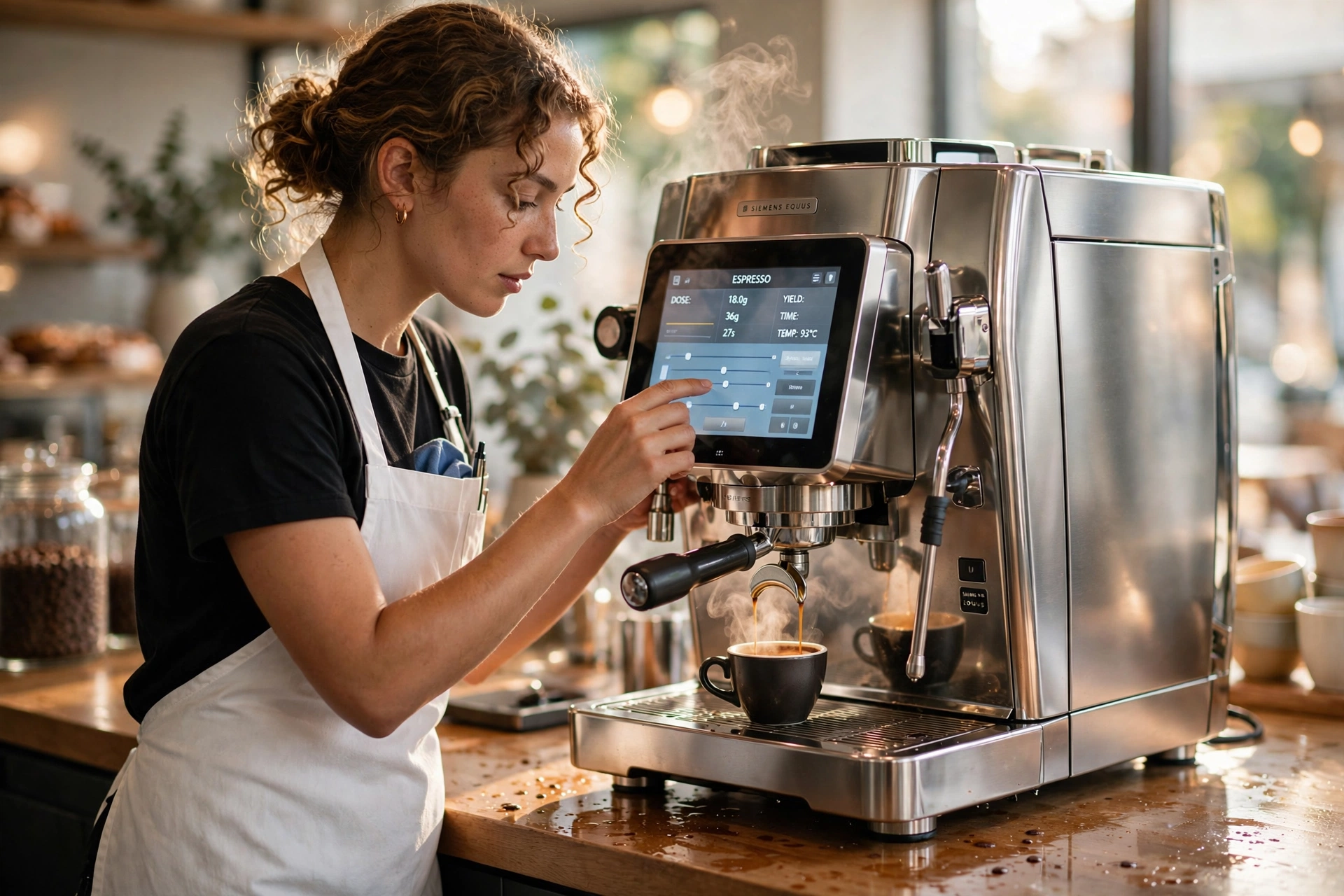
Avoid "analog-only" machines unless you have a master roaster who can feel the bean's progress. Look for integrated software that allows you to save profiles, track the Rate of Rise (RoR), and export data for quality control. This is where Busy Bean Coffee focuses its managed solutions; we ensure the equipment isn't just a piece of steel, but a precision instrument integrated with a digital workflow.
Step 5: Plan for Exhaust and Emission Control
Determine if you need a smoke precipitator or an afterburner. If you are roasting in a dense urban area, an afterburner is non-negotiable to eliminate the smell and smoke that will otherwise lead to neighbor complaints and city citations.
💡Key Takeaway
The most critical metric in industrial roasting is not the batch size, but the repeatability of the roast profile. A machine that can repeat a profile within 1 degree of variance across 10 batches is infinitely more valuable than a larger machine that fluctuates.
Comparing Industrial Roasting Approaches
Depending on your business model, the "best" roaster varies. A boutique roaster focusing on rare microlots needs different equipment than a commercial roaster supplying a regional hotel chain.
| Approach | Pros | Cons | Best For |
|---|
| Traditional Drum | Excellent body, high thermal stability, classic flavor profiles. | Slower heating, higher risk of "scorching" if not managed. | Specialty cafes, traditional roast houses. |
| Fluid Bed / Air | Extremely fast, highly consistent, easy to clean, low scorching risk. | High energy cost, can produce "flatter" flavor profiles if overdone. | High-volume commercial supply, light-roast specialists. |
| Hybrid / Managed | Scalable, lower upfront CAPEX, professional maintenance included. | Monthly membership fee instead of full ownership. | Fast-growing businesses, hotel/restaurant groups. |
Now, here's where it gets interesting: many businesses choose a Traditional Drum roaster because it's the "industry standard," but then struggle with consistency as they scale. In my experience, the Hybrid approach, where you utilize managed services like those provided by Busy Bean Coffee, allows you to scale your output without the crippling capital expense of owning and maintaining multiple industrial units.
Common Misconceptions About Industrial Roasting
Most guides get this wrong by telling you to "buy the biggest machine you can afford." That is terrible advice. Here is the reality:
Myth 1: Bigger is always better.
If you buy a 60kg roaster but only roast 5kg batches to keep up with small-batch orders, you are wasting an immense amount of energy heating a massive drum for a tiny amount of coffee. This ruins your efficiency and can actually lead to uneven roasting because the thermal mass is too high for the load.
Myth 2: "Automatic" means you don't need a skilled roastmaster.
Automation handles the execution, not the strategy. A machine can follow a curve, but it cannot tell you if the coffee bean's moisture content has changed due to a new shipment. You still need a Q-Grader or an experienced barista to taste the output and adjust the profile.
Myth 3: The roast profile is the only thing that matters.
The "hidden" part of roasting is the cooling and degas phase. Many roastmasters obsess over the drum temperature but ignore the cooling tray. If the beans don't cool rapidly, the roast continues internally, leading to "baked" flavors that no amount of precision in the drum can fix.
Frequently Asked Questions
How do I determine the correct batch size for my industrial roaster?
To determine your batch size, you must calculate your "Maximum Daily Demand" (MDD). Take your highest sales day of the year and multiply it by 1.2 to account for growth. Divide that total by the number of hours your staff is willing to roast per day. If you need to produce 300kg in an 8-hour window, you need a throughput of 37.5kg per hour. Since a roast cycle (loading, roasting, cooling, unloading) typically takes 15-20 minutes, you will have roughly 3 to 4 cycles per hour. Therefore, a 10kg to 12kg roaster would be your baseline.
What is the difference between a direct-fired and indirect-fired roaster?
In a direct-fired roaster, the flame touches the drum or the beans, providing rapid heat but increasing the risk of "tipping" or scorching the beans. Indirect-fired roasters use a heat exchanger or a double-wall drum, where the heat is transferred through the metal. This results in a more gentle, consistent heat application. For industrial specialty coffee, indirect heating is generally preferred because it allows for the nuanced control required to highlight the acidity and floral notes of high-altitude Coffea arabica.
How much ventilation is required for industrial coffee roasters?
Ventilation is not just about a vent in the wall; it is about CFM (Cubic Feet per Minute) of airflow. You need enough suction to pull the chaff out of the drum and the smoke out of the building. Most industrial units require a dedicated exhaust system with a centrifugal fan and a heavy-duty ducting system. According to the
FDA, food production areas must maintain specific air quality and hygiene standards, which means your ventilation must prevent smoke from recirculating into the roasting or packaging areas.
Do I need a separate machine for different roast levels?
No, you do not need separate machines, but you do need "profile flexibility." A high-quality industrial roaster can handle everything from a light cinnamon roast to a dark French roast by adjusting the charge temperature and the air-flow rate. The key is ensuring your machine has a wide enough temperature range and responsive burners. However, if you are roasting 90% dark and 10% light, the "seasoning" of the drum (the oil buildup) can affect the light roasts. In those cases, meticulous cleaning or separate drums are helpful.
What are the maintenance requirements for industrial roasters?
Industrial roasters require a rigorous maintenance schedule to prevent fire hazards. Chaff collection bins must be emptied daily, as accumulated chaff is highly flammable. The drum should be inspected for wear every quarter, and the gas burners must be calibrated annually to ensure energy efficiency. If you use a managed service like Busy Bean Coffee, these maintenance cycles are handled for you, removing the risk of unplanned downtime during your peak season.
Final Thoughts on Selecting Industrial Coffee Roasters
Choosing the right industrial coffee roasters is a strategic decision that determines your company's ability to scale. If you prioritize throughput over precision, you will struggle with quality. If you prioritize a "classic" feel over modern data, you will struggle with consistency. The goal is to find equipment that mirrors your business growth, flexible, precise, and efficient.
Whether you are scaling a small cafe or launching a regional distribution center, the focus must remain on the bean. High-quality roasting is the bridge between a raw agricultural product and a premium beverage. By following a data-driven approach to equipment selection, you ensure that your brand is defined by the quality of your coffee, not the limitations of your hardware.
If you are overwhelmed by the capital expenditure of buying new industrial equipment or the stress of maintaining it, consider a managed approach. At Busy Bean Coffee, we provide all-inclusive coffee solutions that remove the hardware headache, allowing you to focus on the art of the roast and the growth of your business.
Explore our managed coffee solutions and equipment options at
www.busybeancoffee.com.
Ready to Upgrade Your Business Coffee?
Café-quality coffee, zero maintenance headaches, and one predictable monthly price. Let's build your custom coffee program.
Free Coffee Pairing Guide & Specialty Roast Cheat Sheet
Unlock the secrets of perfect brewing ratios, water temperatures, and specialty roast profiles. Download the guide.