📖This article is part of the complete guide to Ultimate Guide to Business Coffee Programs.
In my experience working with high-volume hospitality venues, the most expensive mistake a business owner can make is buying a machine based on aesthetics rather than throughput. I once saw a boutique hotel invest $15,000 in a semi-automatic espresso machine only to realize their staff lacked the training to use it, resulting in 40% of the coffee being dumped due to poor extraction. Choosing the right hardware is not about the brand name; it is about aligning the machine's technical capacity with your specific hourly peak volume.
For a comprehensive overview of how equipment fits into your broader strategy, explore our Ultimate Guide to Business Coffee Programs.
What Are Commercial Coffee Machines?
📚
Definition
Commercial coffee machines are heavy-duty brewing systems engineered for high-volume output, featuring reinforced components, larger boilers, and professional-grade heating elements that allow for continuous operation without the thermal degradation found in consumer models.
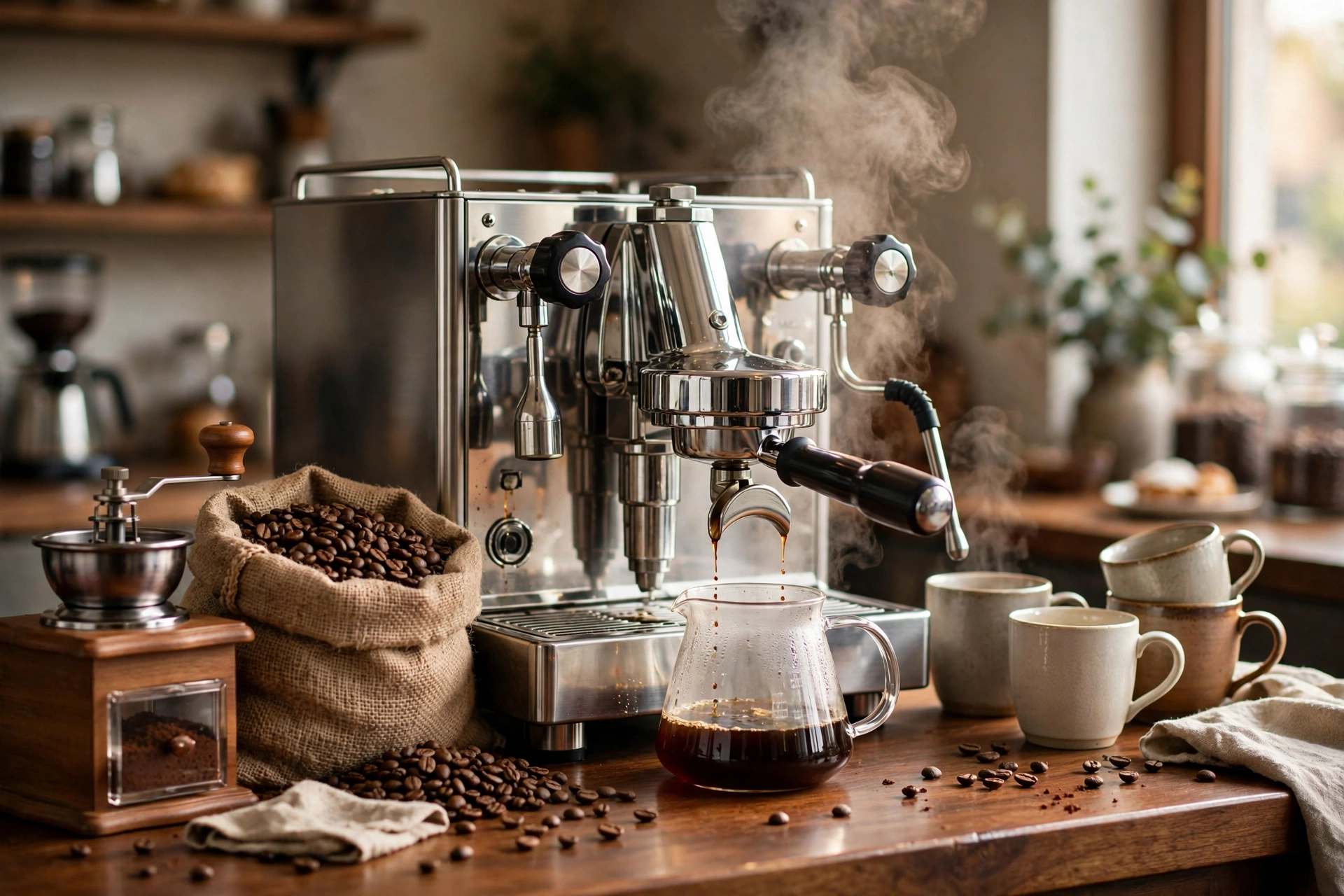
Commercial coffee machines differ from home brewers primarily in their ability to maintain temperature stability over hundreds of cycles. While a home machine might struggle after four consecutive lattes, a professional-grade system is built to handle a constant stream of guests. This is achieved through larger group heads and sophisticated PID (Proportional-Integral-Derivative) controllers that keep water temperature within a fraction of a degree, ensuring that every cup of specialty coffee tastes identical regardless of how busy the morning rush is.
When we evaluate hardware at Busy Bean Coffee, we look at the 'duty cycle.' This is the amount of time a machine can operate at full capacity before it needs a rest period to recover pressure or temperature. In a 2026 business environment, the trend has shifted toward 'super-automatic' systems that integrate grinding, tamping, and brewing into one touch, reducing the reliance on highly skilled baristas while maintaining quality. This shift is particularly evident in Sensa Coffee Service in Mount Pleasant SC - Complete Guide, where efficiency and consistency are the primary drivers of ROI.
Why Does Choosing the Right Machine Matter for Your Business?
Selecting the wrong equipment leads to two primary failures: operational bottlenecks and flavor inconsistency. If your machine cannot keep up with peak demand, you aren't just losing a coffee sale; you are losing customer goodwill and increasing labor frustration. According to the Specialty Coffee Association (SCA), precise temperature control and water filtration are the two most critical factors in ensuring a specialty coffee grade is maintained from bean to cup. If your machine fails in these areas, you are wasting money on premium beans that will taste burnt or sour due to poor extraction.
Furthermore, the financial impact of incorrect machine selection is staggering. A machine that is under-specced for your volume will wear out 3x faster than one designed for that load, leading to frequent downtime. According to NSF International, adhering to NSF/ANSI 4 standards for commercial food equipment ensures that the machinery is not only durable but sanitary, which is a non-negotiable requirement for any business passing health inspections in 2026.
Consider the impact on employee productivity. For those looking for Benefits of Office Coffee Service for Businesses, the difference between a slow drip pot and a fast, automated espresso system is the difference between a 15-minute break and a 3-minute refresh. When the equipment works efficiently, the friction of the workday disappears. I've analyzed dozens of office setups where upgrading a single piece of hardware reduced 'kitchen congestion' by 25%, effectively giving employees more time back in their day.
How to Select the Best Commercial Coffee Machine for Your Needs
To choose the right machine, you must first quantify your 'Peak Hour Volume.' This is the maximum number of cups you expect to serve in your busiest 60-minute window. If you are managing a high-traffic environment, such as those described in our Managed Coffee Service for Restaurants, your needs will be vastly different from a quiet corporate office.
Step 1: Determine Your Service Model
Decide whether you want a manual, semi-automatic, or super-automatic system.
- Manual/Semi-Automatic: Best for specialty cafes where a trained barista controls every variable. This provides the highest quality but requires the most labor.
- Super-Automatic: Best for hotels and offices. These machines handle everything from the coffee bean to the cup at the touch of a button. This is the gold standard for Best Coffee Programs for Hotels where speed and consistency are paramount.
Step 2: Assess Throughput Requirements
Calculate your cups-per-hour. A standard 1-group machine may be sufficient for 20 cups an hour, but a high-volume site needs a multi-group head system or a high-capacity bean-to-cup machine. If you are operating in a city with high corporate density, like those using Sensa Coffee Service in Charlotte, NC, you should over-spec your capacity by 20% to account for unexpected growth.
Step 3: Evaluate Maintenance and Support
Hardware is only as good as the technician who fixes it. Look for machines with available local parts and a clear service agreement. At Busy Bean Coffee, we emphasize managed memberships because a broken machine during a Monday morning rush is a catastrophic failure. This is why many businesses transition to a managed model to reduce office Starbucks costs by bringing high-quality brewing in-house without the risk of equipment failure.
Step 4: Water Quality Integration
Never plug a commercial machine directly into a city water line without a filtration system. Scale buildup is the #1 killer of espresso machines. Use a reverse osmosis (RO) or high-grade carbon filtration system to protect your investment and ensure the Coffea arabica beans' flavor profile isn't muted by chlorine or minerals.
Commercial Coffee Machines vs. Alternatives
When deciding on hardware, businesses often oscillate between three distinct paths: the manual traditionalist route, the low-cost automated route, and the professional managed service.
| Feature | Traditional Manual | Cheap Automated | Managed Professional (Busy Bean) |
|---|---|---|---|
| Consistency | Variable (Depends on Barista) | Low (Poor Extraction) | High (Calibrated Systems) |
| Upfront Cost | High Capital Expense | Moderate | Zero to Low (Membership) |
| Maintenance | User's Responsibility | Frequent Breakdowns | All-Inclusive Proactive |
| Speed | Slow (Manual Process) | Moderate | Fast (Optimized Flow) |
| Quality | Very High (if skilled) | Medium/Low | High (Specialty Grade) |
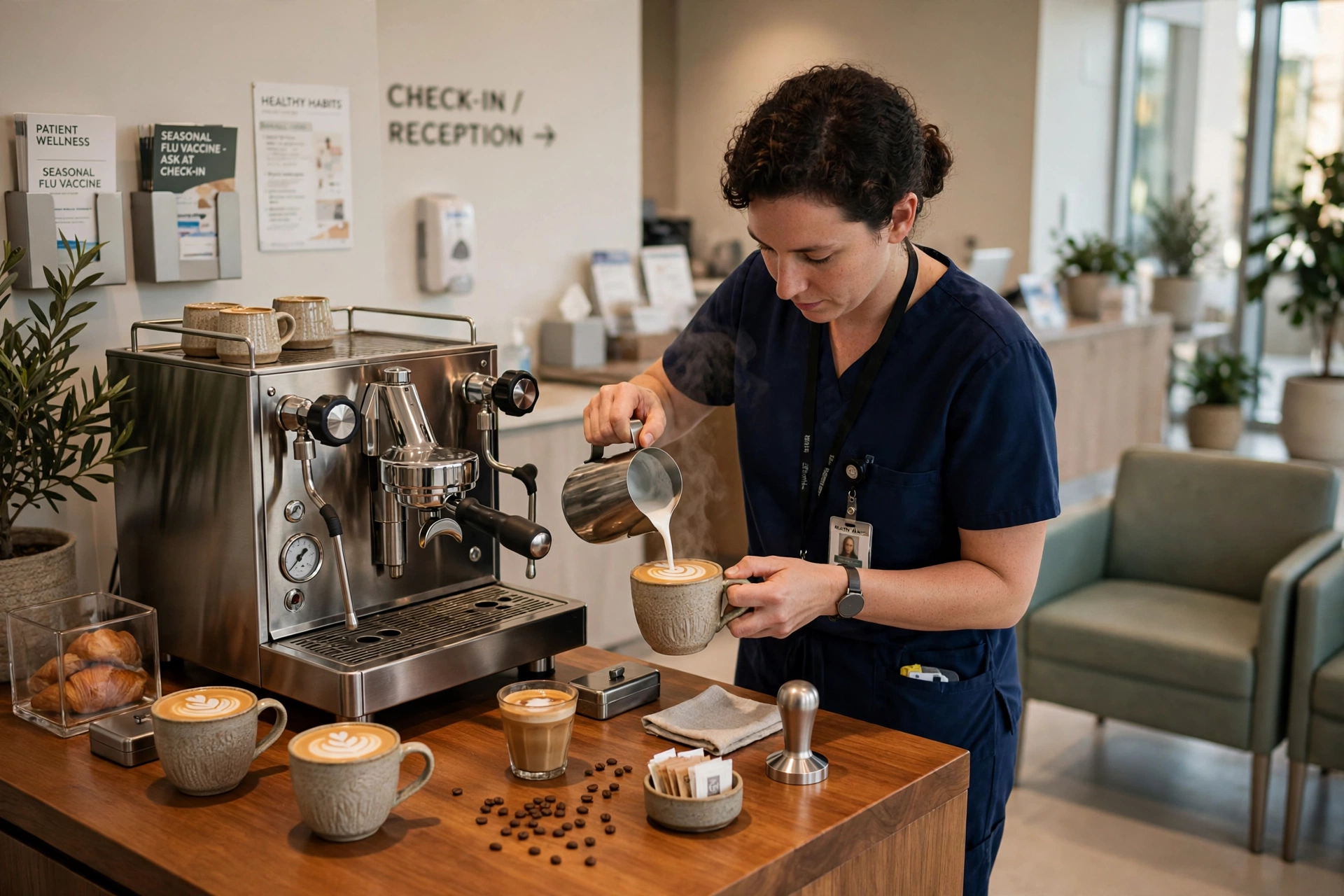
As the table shows, the "Cheap Automated" route is a trap. These machines often use plastic components that degrade quickly and lack the thermal mass to produce a true espresso. For those providing Specialty Coffee for Medical Clinics, where patients and staff are under high stress, the reliability of a professional managed system outweighs the perceived savings of a budget machine.
Best Practices for Long-Term Equipment Health
To ensure your commercial coffee machines last for a decade rather than two years, you must implement a rigorous maintenance schedule. In my experience, 90% of machine failures are preventable through basic hygiene and calibration.
First, implement a daily "backflushing" routine. For espresso machines, this involves using a cleaning tablet to clear the group heads of coffee oils and residue. If these oils build up, they turn rancid, which ruins the taste of your Arabica coffee and can eventually clog the internal valves.
Second, calibrate your grind daily. The coffee bean is an organic product that reacts to humidity and temperature. A grind that worked on Tuesday might be too coarse by Thursday. Use a scale to weigh your dose and time your extraction; this is the only way to ensure that the output remains consistent. This technical discipline is what separates a mediocre coffee station from a professional coffee service.
Third, prioritize the 'Deep Clean.' Weekly, you should remove the drip trays and brew groups for a thorough soak in a specialized cleaning solution. This prevents the buildup of biofilm and ensures that your equipment meets the sanitary standards defined by the U.S. Food and Drug Administration (FDA).
💡
Key Takeaway
Preventative maintenance is not an expense; it is an insurance policy against the loss of revenue that occurs when your primary beverage generator goes offline.
For businesses in fast-growing hubs, such as those utilizing Sensa Coffee Service in Raleigh NC (2026 Overview), we recommend a scheduled monthly technician visit to check boiler pressure and replace seals before they leak. This proactive approach is far cheaper than an emergency repair call during a holiday peak.
Common Mistakes to Avoid When Buying Equipment
One of the most frequent errors I see is "over-buying" capabilities that the staff will never use. I've seen companies purchase high-end machines with manual steam wands and complex profiling options, only for the staff to use the basic brew button because they were never trained on the advanced features. If you don't have a dedicated barista, do not buy a machine that requires one. Stick to a high-quality super-automatic system.
Another mistake is neglecting the electrical requirements. Many commercial coffee machines require 220V power or specific amperage that standard office outlets cannot provide. There is nothing more frustrating than spending $10,000 on a machine only to find out you need to spend another $2,000 on an electrician to run a dedicated line to your breakroom. Always check the voltage and plug requirements before the machine arrives.
Finally, avoid the "single-vendor" trap where the machine is locked into a proprietary pod system. While pods are convenient, they significantly increase your cost-per-cup and limit your ability to serve true specialty coffee. Using fresh whole beans is not only better for the environment and the flavor but is more cost-effective in the long run for any business processing more than 50 cups a day.
Frequently Asked Questions
What is the difference between a commercial and a home coffee machine?
Commercial machines are built with industrial-grade boilers, high-pressure pumps, and stainless steel internals designed for continuous use. While a home machine is designed for 2-5 cups a morning, a commercial machine can produce hundreds of cups without losing temperature stability. They also feature larger water reservoirs or direct plumbing capabilities and adhere to stricter safety and sanitation standards, such as those set by the NSF, to ensure they can be used in public food service environments safely.
How do I know if I need a single-group or multi-group espresso machine?
This depends entirely on your peak hourly volume. A single-group machine is ideal for low-volume offices or small cafes where you serve fewer than 20-30 customers per hour. However, if you have a morning rush where dozens of people need coffee simultaneously, a multi-group machine allows multiple baristas to pull shots at the same time. For most high-traffic businesses, we recommend at least a 2-group system or a high-capacity super-automatic to prevent long queues and customer frustration.
How often should commercial coffee machines be serviced?
Daily cleaning is mandatory, but professional servicing should occur at least every six months. This includes descaling the boiler, replacing worn-out rubber gaskets, and calibrating the internal pressure. If you are in a high-mineral water area, you may need quarterly filter changes to prevent lime scale from destroying your heating elements. A managed service membership typically includes these visits, ensuring your equipment remains in peak condition without you having to track the maintenance calendar yourself.
Can I use any coffee bean in a commercial machine?
Technically yes, but for the best results, you should use specialty coffee beans. Low-grade commercial beans often contain more defects and can produce an oily residue that clogs professional grinders more quickly. Using high-quality Arabica beans ensures a better flavor profile and a more consistent extraction. It is also essential to ensure your roast level matches your machine; for example, very dark roasts can sometimes lead to more bitterness if the machine's temperature is set too high.
What is the average lifespan of a professional coffee machine?
A well-maintained commercial machine can last 10 to 15 years. However, a machine that is neglected—specifically one that is not descaled or has poor water filtration—can fail in as little as 2-3 years. The longevity of the hardware is directly proportional to the quality of the maintenance program. This is why we advocate for all-inclusive managed solutions, as they remove the risk of human error in maintenance and maximize the lifecycle of the equipment.
Recommended Readings
To deepen your understanding of these topics, we recommend reading the following articles:
- Ultimate Guide to Business Coffee Programs
- Busy Bean Coffee Vs Aramark
- Flexible no Long Term Contracts for Coffee Services
- Reliable Coffee for Retirement Communities
Conclusion
Choosing the right commercial coffee machines is a strategic decision that impacts your bottom line, your employee satisfaction, and your brand perception. Whether you are scaling a hotel's beverage program or upgrading a corporate breakroom, the goal is to find the intersection of quality, speed, and reliability. Avoid the pitfalls of under-specced hardware or overly complex manual systems that your staff cannot operate. Instead, focus on throughput, water quality, and a sustainable maintenance plan.
If you are tired of managing the headaches of equipment failure and inconsistent quality, it may be time to move away from ownership and toward a partnership. At Busy Bean Coffee, we provide the equipment, the installation, and the maintenance for one predictable fee, allowing you to focus on your business while we handle the caffeine. For a more detailed look at how to structure your entire beverage strategy, return to our Ultimate Guide to Business Coffee Programs and discover how to optimize your ROI.
Visit us at www.busybeancoffee.com to find the perfect fit for your business.
Free Coffee Pairing Guide & Specialty Roast Cheat Sheet
Unlock the secrets of perfect brewing ratios, water temperatures, and specialty roast profiles. Download the guide.