📖This article is part of the complete guide to No Capex Coffee Solutions for Foodservice.
I once walked into a high-volume hotel lobby where a $15,000 espresso machine was sitting idle, not because of a mechanical failure, but because the staff was terrified of pressing the wrong button. In my experience working with luxury hospitality groups, the gap between having premium equipment and actually extracting a quality beverage is almost always a training gap. When we launched the managed coffee membership at Busy Bean Coffee, we discovered that equipment downtime is rarely about the hardware and almost always about the human element.
For a comprehensive overview of how to scale your beverage program without upfront costs, explore our No Capex Coffee Solutions for Foodservice guide.
What is Coffee Equipment Training for Subscription Users?
📚
Definition
Coffee equipment training is the systematic process of educating staff on the operation, daily maintenance, and troubleshooting of professional brewing systems, specifically tailored for users under a managed service agreement where the provider handles the capital expense.
Coffee equipment training for subscription users is not a one-time orientation; it is a continuous professional development cycle designed to ensure that the investment in high-end machinery translates into consistent beverage quality. Unlike a traditional purchase where training is often an afterthought, subscription-based training is integrated into the service level agreement. This means the training evolves as the equipment is updated or as the business scales its volume.
In a managed coffee environment, such as those we provide at Busy Bean Coffee, training focuses on the Sensa ecosystem. This involves teaching a barista or staff member how to calibrate the grind, manage water filtration cycles, and execute deep-cleaning protocols that preserve the longevity of the machine. Because the subscription model removes the capital risk, the training shifts from "how not to break the machine" to "how to maximize the machine's performance for the guest."
For businesses operating in high-traffic areas, such as those in Mount Pleasant, SC, the training must also include speed-of-service metrics. A barista who knows the machine but cannot execute a drink in under 60 seconds creates a bottleneck that erodes the ROI of the subscription. Therefore, professional training integrates technical knowledge with operational efficiency. By focusing on the specific nuances of the equipment provided, staff can move from basic operation to true mastery of the coffee service.

Why Does Proper Coffee Equipment Training Matter for Your Business?
Proper coffee equipment training directly impacts the bottom line by reducing waste and increasing the lifespan of the hardware. When staff are untrained, they often over-extract the coffee, leading to wasted beans and a bitter product that guests will not pay for. According to the Specialty Coffee Association (SCA), consistency in extraction is the primary differentiator between a specialty coffee experience and a generic beverage. By implementing a rigorous training program, businesses can ensure that every cup meets these global standards, regardless of which staff member is behind the machine.
Furthermore, the financial risk of improper use is significant. While a no-capex model covers maintenance, the operational downtime caused by user error can be devastating. A machine that is "down" because a staff member forgot to prime the pump results in lost revenue. Research from the National Coffee Association USA (NCA) suggests that beverage quality is a top three driver for repeat customer visits in the foodservice industry. If your staff cannot operate the equipment, you are not just losing a cup of coffee; you are losing a customer.
From an E-E-A-T perspective, I have seen businesses try to save time by using YouTube tutorials. This is a mistake. A generic video cannot tell you how to adjust the Sensa settings for the specific humidity of a morning in Mount Pleasant, SC. Local environmental factors, such as water hardness and ambient temperature, affect how a coffee bean behaves during roasting and brewing. Professional training accounts for these variables, ensuring that the Coffea arabica profiles are highlighted rather than muted by poor technique. In my experience, businesses that invest in site-specific training see a 15% reduction in bean waste within the first 90 days.
Consider the following comparison of training approaches:
| Feature | Traditional "Self-Taught" | Generic Online Course | Managed Subscription Training |
|---|---|---|---|
| Technical Accuracy | Low (Trial & Error) | Medium (General) | High (Machine Specific) |
| Accountability | None | None | Service Level Agreement (SLA) |
| Consistency | Variable | Moderate | Standardized across staff |
| Downtime Risk | High (User Error) | Medium | Low (Preventative) |
How to Implement a Coffee Equipment Training Program Step by Step
Implementing a training program requires a shift from "showing" to "certifying." The goal is to ensure that every employee can operate the espresso machine and maintain the coffee service without supervision. I recommend a four-stage approach that we utilize for our clients, ensuring they get the most out of their automated coffee machines ranking options.
Step 1: The Technical Foundation
Before touching the machine, staff must understand the chemistry of the coffee bean. This includes understanding the difference between a light and dark roast and how the grind size affects the flow rate. We start with the basics of the Sensa interface, explaining the meaning of every alert and the importance of the pressure gauge. This prevents the common panic response when a machine signals it needs a cleaning cycle. Understanding the "why" behind the machine's behavior reduces staff anxiety and increases their confidence in managing the equipment during a rush.
Step 2: The Extraction Workflow
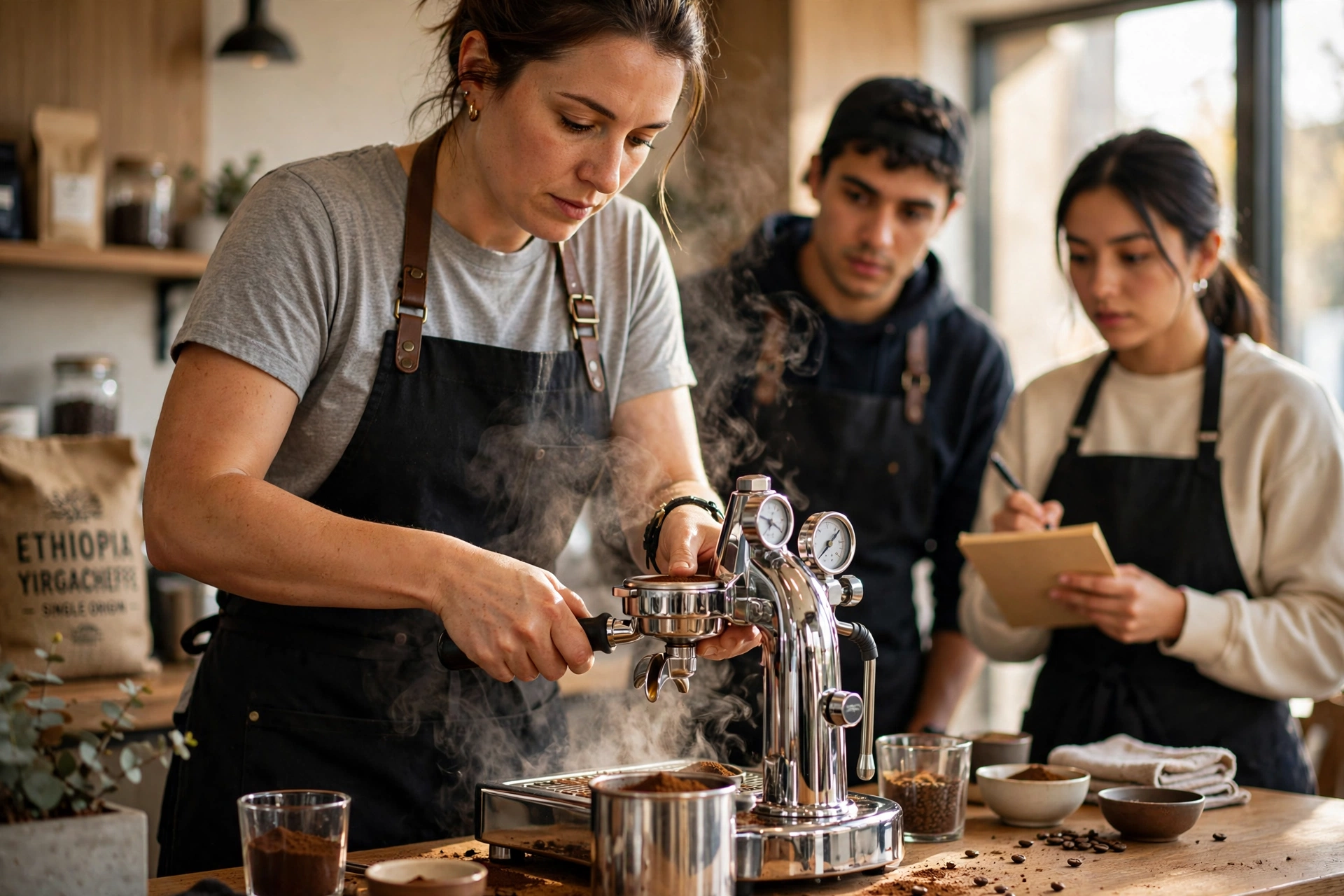
This is where we focus on the "Golden Ratio." Staff are taught to weigh the dose, time the shot, and evaluate the crema. For those in high-pressure environments, we emphasize the workflow: prep, pull, steam, and pour. We use a stopwatch to benchmark performance, ensuring the quality does not drop as the speed increases. A critical part of this step is teaching staff how to identify "channeling" in the coffee puck, which allows them to adjust the tamp pressure in real-time to save the shot.
Step 3: Daily and Weekly Maintenance
Maintenance is the most ignored part of training. We teach the "Closing Checklist," which includes backflushing the group heads and cleaning the steam wand. According to NSF International, adhering to sanitary standards for food equipment is not just a quality issue, but a regulatory necessity. We ensure staff understand that a clean machine is the only way to maintain the flavor profile of specialty coffee. If oil builds up in the group head, even the most expensive coffee bean will taste burnt and acrid.
Step 4: Troubleshooting and Escalation
Finally, we train staff on how to identify a problem versus how to fix it. If a machine is leaking, they should know to shut off the water valve and call the Busy Bean Coffee support line immediately rather than attempting a DIY repair that could void a warranty or cause a flood. This escalation path is what makes a managed coffee service truly "hassle-free." We provide a physical cheat sheet attached to the machine that lists common error codes and the immediate action required for each.
💡
Key Takeaway
Training is not a one-time event but a recurring operational requirement that preserves both the equipment and the brand's reputation for quality.

How Does Training Affect the ROI of a Coffee Subscription?
Training transforms a cost center into a profit center by maximizing the output of the hardware. When a business uses a managed coffee service, the monthly fee is fixed. Therefore, the only way to increase the ROI is to increase the volume of high-quality drinks sold and decrease the cost of wasted materials. A trained barista can optimize the dose and yield, ensuring that every gram of coffee is used efficiently. This optimization directly increases the margin per cup.
Furthermore, training reduces the frequency of emergency service calls. While Busy Bean Coffee provides full maintenance, every emergency call represents a moment of operational friction. When staff are trained in basic preventative care, the machine stays in peak condition longer. As noted by the International Coffee Organization (ICO), the stability of the supply chain is only half the battle; the final mile of quality happens at the point of extraction. If the extraction is poor, the value of the premium bean is lost.
For those considering the cost of automation, referring to a cost of automated coffee machines analysis reveals that the highest hidden cost isn't the machine itself, but the labor inefficiency caused by poor training. A staff member who struggles with the interface slows down the entire queue, reducing the number of transactions per hour. Professional training eliminates this friction, allowing the business to handle peak hours with a leaner staff without sacrificing quality.
Advanced Techniques for High-Volume Coffee Services
In high-volume environments, basic training is insufficient. You need "Stress-Test Training." This involves simulating a rush hour where the barista must manage multiple orders while maintaining the strict standards of specialty coffee. We teach staff how to sequence drinks: starting the milk steaming for one drink while pulling the shot for another. This parallel processing is the difference between a 3-minute wait and a 60-second wait for the customer.
Another advanced area is the management of water quality. Many operators forget that the water is 98% of the coffee drink. We train staff to monitor the water filtration indicators and understand how mineral buildup affects the heating element. When the water is properly managed, the espresso machine operates more efficiently, consuming less energy and producing a cleaner flavor profile. This attention to detail is what separates a standard coffee service from a premium experience.
Moreover, we incorporate sensory training. Staff are taught to taste the coffee throughout the day. This allows them to detect when the grind needs a micro-adjustment due to changes in temperature or humidity. If the coffee starts tasting sour (under-extracted) or bitter (over-extracted), a trained employee can fix the issue before the customers notice. This proactive approach to quality control is a hallmark of the Roastmasters' philosophy at Busy Bean Coffee.
Common Mistakes in Coffee Equipment Training
One of the most frequent errors I see is "The Hand-Off Method," where a manager shows a new hire how to use the machine once and assumes they are trained. This creates a ripple effect of bad habits. If the first person was taught incorrectly, every subsequent employee will inherit those mistakes. The solution is to implement a standardized certification checklist that must be signed off by a certified trainer or a Q-Grader.
Another mistake is ignoring the cleaning cycle. Staff often skip the backflushing process during a busy shift, thinking they can do it "later." However, coffee oils oxidize quickly and create a rancid flavor. I have encountered machines that looked clean on the outside but had years of buildup inside the boilers. Proper training emphasizes that cleaning is not a chore, but a fundamental part of the brewing process.
Finally, many businesses fail to provide ongoing education. Coffee is an evolving craft. As new beans are introduced or as the equipment is updated, the training must evolve. A staff member who was trained in 2024 may not be aware of the efficiency updates in the 2026 Sensa models. We recommend quarterly "refresher
Ready to Upgrade Your Business Coffee?
Café-quality coffee, zero maintenance headaches, and one predictable monthly price. Let's build your custom coffee program.
Free Coffee Pairing Guide & Specialty Roast Cheat Sheet
Unlock the secrets of perfect brewing ratios, water temperatures, and specialty roast profiles. Download the guide.