How Do You Properly Execute Coffee Equipment Maintenance?
A single malfunctioning group head or a clogged steam wand can derail an entire morning rush, costing a cafe hundreds of dollars in lost revenue within an hour. Effective coffee equipment maintenance is not about occasional deep cleans; it is the systematic process of daily, weekly, and quarterly interventions designed to prevent mineral buildup and mechanical failure. To maintain a professional beverage program, you must combine chemical backflushing, water filtration monitoring, and precision calibration of your grinders to ensure that every cup meets specialty coffee standards.
In my experience working with high-volume hospitality clients, the most common point of failure isn't a lack of effort, but a lack of a written schedule. When we implement Automatic Coffee Machines for Hotels and Hospitality in 2026, we find that businesses with a documented checklist reduce their equipment downtime by nearly 40%.

What Exactly is Coffee Equipment Maintenance?
At its core, coffee equipment maintenance is the practice of preserving the mechanical integrity and hygienic standards of beverage hardware to ensure flavor consistency and operational longevity. It encompasses everything from the simple act of wiping down a steam wand to the complex process of replacing gaskets and shower screens.
📚
Definition
Backflushing is the process of forcing cleaning solution backward through a three-way solenoid valve in an espresso machine to remove coffee oils and residue from the internal group head.
Maintaining a system requires an understanding of the chemistry involved. For instance, coffee beans leave behind lipids and oils that oxidize over time, creating a rancid taste if not removed. Simultaneously, water contains minerals like calcium and magnesium that precipitate into "scale," which can choke off heating elements and narrow water pipes.
According to the Specialty Coffee Association (SCA), precise temperature stability and water quality are the two most critical variables in extracting a high-quality beverage. If your equipment is not maintained, you cannot maintain temperature stability. A scale-covered boiler will struggle to reach the target temperature, leading to under-extraction and sour coffee. This is why professional maintenance isn't just about "cleaning" but about "calibration."
Now, here's where it gets interesting: many operators mistake a "clean" machine for a "maintained" machine. You can have a sparkling exterior and a boiler full of lime scale. True maintenance involves internal diagnostics, such as checking the pump pressure and inspecting the integrity of the O-rings, which prevent leaks and pressure loss. For those operating in high-demand areas, such as those utilizing Sensa Coffee Service in Charlotte, NC, this level of rigor is the only way to avoid mid-shift collapses.
Why Does Equipment Upkeep Impact Your Bottom Line?
Neglecting your hardware is effectively a hidden tax on your business. When a machine fails, the cost isn't just the repair bill; it's the "opportunity cost" of every customer who walks away because you can't serve them.
Research from the National Coffee Association USA (NCA) indicates that consumer expectations for specialty coffee quality have reached an all-time high. A single "off-tasting" cup caused by dirty equipment can permanently damage a customer's perception of your brand. From a financial perspective, the cost of preventative maintenance is typically 10% to 20% of the cost of an emergency replacement.
Consider the impact of scale buildup. When mineral deposits accumulate in a boiler, the machine must work harder to heat the water. This leads to increased energy consumption and a higher risk of the heating element burning out. According to data from the International Coffee Organization (ICO), the global shift toward higher-end specialty coffee requires more precise temperature control, making the risk of scale-related failure even more critical for modern businesses.
Beyond the machinery, there is the safety element. The U.S. Food and Drug Administration (FDA) has strict guidelines regarding food-contact surfaces. Coffee milk residue in a steam wand is a breeding ground for bacteria. Failure to implement a strict cleaning protocol doesn't just hurt the taste; it puts your business at risk of health code violations.
The mistake I made early on, and that I see constantly, is thinking that a new machine doesn't need maintenance for the first six months. In reality, the "break-in" period is when you should be most vigilant, establishing the habits that will prevent a total system failure in year two. For clinics or offices using Automated Coffee Machines for Clinics and Medical Offices, where staff may not be trained baristas, having a managed service that handles this complexity is often the only viable path to consistency.
How to Implement a Professional Maintenance Schedule
To execute coffee equipment maintenance effectively, you must move from a reactive "fix it when it breaks" mindset to a proactive "prevent it from breaking" strategy. This requires a tiered approach based on frequency.
Daily Maintenance (The Foundation)
Daily tasks are about hygiene and immediate flavor preservation.
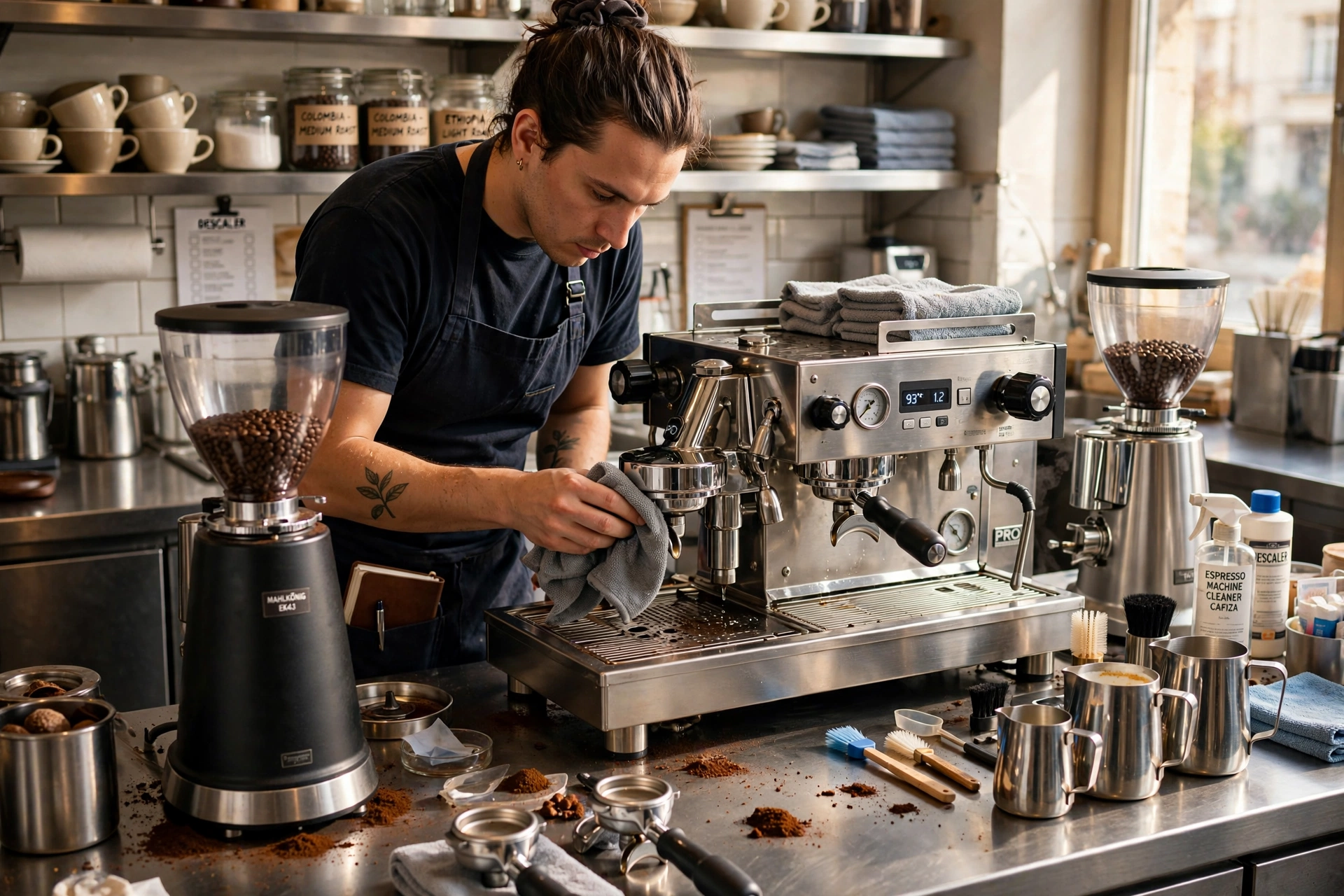
- Group Head Scrubbing: Use a nylon brush to clean the gasket area.
- Chemical Backflushing: Use a blind filter and espresso machine detergent to clear internal oils.
- Steam Wand Purging: Wipe and purge the wand after every single use.
- Drip Tray Sanitization: Scrub and sanitize the tray to prevent mold and odors.
Weekly Maintenance (The Deep Clean)
Weekly tasks address the buildup that daily cleaning misses.
- Shower Screen Removal: Unscrew the shower screens and soak them in cleaning solution to remove compacted coffee pucks.
- Grinder Hopper Cleaning: Empty the beans and wipe the hopper with a dry cloth. Never use soap inside the hopper, as it can contaminate the beans.
- Water Filter Check: Inspect the filtration system for leaks or "end of life" indicators.
Monthly and Quarterly Maintenance (The Technical Review)
This is where the professional-grade work happens.
- Gasket Replacement: Replace group head gaskets every 3-6 months to prevent leaks.
- Boiler Descaling: Depending on water hardness, run a descaling agent through the system.
- Pump Calibration: Ensure the pump is delivering the correct bars of pressure (typically 9 bars for espresso).
💡
Key Takeaway
The most effective way to ensure equipment longevity is to treat maintenance as a non-negotiable part of your labor cost, not an optional chore.
For businesses that find this level of detail overwhelming, Busy Bean Coffee offers an all-inclusive managed solution. Instead of guessing when to change a gasket or hoping your water filter is working, we provide the equipment and the professional maintenance as part of a predictable monthly fee. This removes the technical burden from your staff, allowing them to focus on the customer experience. If you are operating a high-traffic location, such as those needing Sensa Coffee Service in Raleigh NC (2026 Overview), a managed approach is the most scalable option.

Comparing Maintenance Strategies
Not all maintenance approaches are equal. Depending on your budget and technical skill, you will likely fall into one of these three categories.
| Feature | Manual/DIY Approach | Cheap Third-Party Techs | Managed Service (Busy Bean Coffee) |
|---|---|---|---|
| Reliability | Low (Human error common) | Moderate (Inconsistent) | High (Standardized protocols) |
| Cost Structure | Variable/Emergency | Per-visit/Hourly | Predictable Monthly Fee |
| Downtime Risk | High (Wait for parts/fix) | Moderate (Scheduling delays) | Low (Proactive replacements) |
| Quality Control | Inconsistent | Basic | Q-Grader Certified |
| Best For | Very small, low-volume kiosks | Budget-constrained shops | Hotels, Cafes, Medical Offices |
As the table demonstrates, the manual approach is often a gamble. When a barista forgets to backflush for three days, the flavor profile of the coffee shifts. A "cheap" technician might fix the leak but ignore the scale buildup in the boiler, leading to another failure two weeks later. The managed approach, such as the one we provide for Sensa Coffee Service in Augusta GA: Complete Guide | Busy Bean Coffee, treats the machine as a critical asset that requires a preventative lifecycle strategy.
Common Questions and Misconceptions
Most guides on coffee equipment maintenance get this wrong by suggesting that "more cleaning is always better." In reality, over-cleaning with the wrong chemicals can actually damage your machine.
Myth 1: "I can use vinegar for descaling everything."
This is a dangerous misconception. While vinegar is a mild acid, it is not powerful enough to remove heavy calcium deposits in commercial boilers, and it leaves a distinct, lingering taste that can ruin specialty coffee. Professional descalers are formulated to target minerals without affecting the flavor of the water.
Myth 2: "If the coffee tastes fine, the machine is clean."
Flavor is a lagging indicator. By the time you taste "burnt" or "bitter" notes caused by oil buildup, the residue has already formed a thick layer on the shower screen. The goal of maintenance is to ensure the taste never changes, meaning you clean based on the calendar, not the taste buds.
Myth 3: "Water filters only need to be changed once a year."
This is a recipe for disaster. Depending on the mineral content of your local water, especially in regions like those served by Sensa Coffee Service in Jacksonville, FL, filters can become saturated in three months. When a filter expires, the minerals flow directly into your boiler, accelerating scale buildup by 10x.
Frequently Asked Questions
How often should I actually backflush my espresso machine?
In a commercial environment, backflushing should be performed at least once daily. For extremely high-volume shops, I recommend a "mini-flush" every four hours during peak shifts and a full chemical backflush at the end of the day. Failing to do this allows coffee oils to polymerize on the group head, which creates a bitter, acrid taste that no amount of high-quality beans can fix. If you notice the espresso flow is becoming uneven or "channeling," it is a sign that your backflushing routine is insufficient.
What is the most common cause of espresso machine failure?
The overwhelming majority of failures are caused by poor water quality and subsequent scale buildup. When calcium carbonate accumulates in the heating elements, it creates an insulating layer that forces the element to overheat to reach the target water temperature. This eventually leads to a "burnt out" element or a cracked heat exchanger. This is why we emphasize the importance of high-grade filtration and regular descaling. According to NSF International, adherence to equipment sanitation and water standards is the only way to ensure the long-term viability of food-contact machinery.
Do I really need to replace my gaskets every few months?
Yes, absolutely. Group gaskets are made of rubber or silicone, and they are subject to constant heat and pressure. Over time, they lose their elasticity and become "compressed." When this happens, water leaks around the portafilter instead of flowing through the coffee puck. This leads to messy countertops and inconsistent pressure. Replacing gaskets is a low-cost intervention that prevents the high-cost frustration of a leaking machine during a rush. It is a fundamental part of any Foodservice Coffee Program in Chicago IL: Complete Guide.
Can I use a dishwasher to clean my portafilters and baskets?
While it's tempting to throw everything in the dishwasher, I strongly advise against it. Many commercial dishwasher detergents are highly caustic and can strip the finish off your portafilters or leave a chemical residue in the holes of the basket. The best method is to soak them in a solution of warm water and espresso detergent, then rinse them thoroughly with fresh water. This preserves the metal and ensures that no soap flavor ends up in your customer's cup.
How do I know if my coffee grinder needs professional servicing?
You should look for three red flags: inconsistent grind distribution, a noticeable change in the sound of the motor (grinding or straining), and "clumping" of the coffee grounds. Grinder burrs dull over time, and when they do, they stop cutting the bean and start crushing it. This produces more "fines" and leads to a muddy, inconsistent extraction. If you are managing a large-scale operation, such as those utilizing Sensa Coffee Service in Columbia SC: Complete Guide | Busy Bean Coffee, professional burr calibration should be part of your quarterly checklist.
Final Thoughts on Coffee Equipment Maintenance
Mastering coffee equipment maintenance is the difference between a business that struggles with inconsistent quality and one that scales effortlessly. When you treat your machinery with the same respect as your coffee beans, you protect your investment and guarantee a superior experience for every customer. Whether it is a daily backflush or a quarterly boiler inspection, these steps are the foundation of a profitable beverage program.
If the thought of managing schedules, ordering chemicals, and troubleshooting gaskets feels like a burden, it's time to move to a managed model. Busy Bean Coffee takes the guesswork out of the process, providing high-end SENSA equipment and total maintenance coverage for one predictable fee. We ensure your machines are always in peak condition, so you can focus on growing your business.
To secure your equipment's future and eliminate downtime, visit www.busybeancoffee.com and discover how our managed coffee solutions can transform your operation. For more insights on optimizing your setup, check out our Sensa Coffee Service in Mount Pleasant SC: Complete Guide.
Ready to Upgrade Your Business Coffee?
Café-quality coffee, zero maintenance headaches, and one predictable monthly price. Let's build your custom coffee program.
Free Coffee Pairing Guide & Specialty Roast Cheat Sheet
Unlock the secrets of perfect brewing ratios, water temperatures, and specialty roast profiles. Download the guide.