How Do You Master Professional Coffee Equipment Maintenance?
A single scale buildup in a heat exchanger or a clogged group head can slash your beverage quality by 30% in a single afternoon. To maintain peak performance, you must implement a tiered schedule consisting of daily chemical backflushing, weekly deep-cleaning of grinders, and quarterly professional descaling of boilers. Consistent coffee equipment maintenance is not about preventing total machine failure; it is about protecting the volatile flavor compounds of specialty coffee and ensuring your hardware doesn't become a bottleneck for your revenue.

What Exactly Is Commercial Coffee Equipment Maintenance?
At its core, professional maintenance is the systematic process of removing organic coffee oils and inorganic mineral deposits from the fluid and mechanical paths of your brewing system. This goes far beyond simply wiping down a steam wand. It involves a chemical and mechanical intervention to ensure that the water chemistry, temperature stability, and pressure profiles remain within the strict parameters required for high-end extraction.
📚
Definition
Descaling is the chemical process of removing calcium and magnesium carbonate deposits (limescale) from the internal heating elements and piping of a coffee machine using an acid-based solution.
In my experience working with high-volume cafes in Mount Pleasant, South Carolina, the most common failure isn't a broken pump, but "flavor drift." This happens when rancid coffee oils build up in the group head gaskets and shower screens. These oils oxidize, creating a bitter, acrid taste that no amount of bean quality can fix. According to the Specialty Coffee Association (SCA), precise temperature control and cleanliness are fundamental to achieving a score of 80+ for specialty coffee, as any residue directly alters the solubility and taste of the brew.
Effective maintenance requires a three-pronged approach: daily hygiene, weekly technical audits, and annual preventative overhauls. When these are ignored, the machine works harder to heat water through a layer of scale, leading to premature heating element burnout and erratic pressure. This is why professional Q-Graders insist on a rigid maintenance log; if you cannot prove when the machine was last serviced, you cannot guarantee the quality of the cup.
Why Does Rigorous Equipment Upkeep Impact Your Bottom Line?
The financial implication of neglecting your gear is far more severe than the cost of a few cleaning tablets. When a commercial espresso machine fails during a morning rush, the loss isn't just the cost of the repair, but the total loss of throughput and customer trust. In a typical foodservice environment, an hour of downtime during peak hours can cost a business between $200 and $1,000 in lost sales, depending on the volume.
Beyond the immediate downtime, there is the issue of equipment longevity. A machine that is properly maintained can last 10 to 15 years, whereas a neglected machine often requires a total boiler replacement or a new motherboard within 3 to 5 years. According to NSF International, maintaining sanitary standards in food equipment is not only a quality issue but a regulatory necessity to prevent biofilm accumulation in water lines.
Furthermore, the energy efficiency of a scaled boiler is significantly lower than a clean one. Limescale acts as an insulator, meaning your machine must consume more electricity to reach the same water temperature. I've seen clients reduce their energy overhead by nearly 15% simply by implementing a quarterly descaling cycle and upgrading their filtration system. When you factor in the cost of wasted beans due to poor extraction and the cost of emergency technician call-outs, the ROI of a proactive maintenance plan is immediate.
How to Implement a Step-by-Step Maintenance Routine
To avoid the "panic-repair" cycle, you need a codified system. Most shops fail because they rely on the memory of a barista rather than a written checklist. Here is the professional standard for keeping your gear in peak condition.
Daily Maintenance: The Hygiene Phase
The goal of daily maintenance is the removal of organic matter. Coffee oils are hydrophobic and sticky; if they aren't removed daily, they polymerize into a hard varnish.
- Backflushing: Use a blind filter and specialized espresso cleaner. Run the pump for 5 seconds, then off for 5 seconds, repeated 5 times. This pushes chemicals back into the 3-way solenoid valve to clear debris.
- Steam Wand Purge: Purge the wand before and after every single drink. At the end of the shift, soak the tips in warm water (no soap, which can leave a residue) and scrub with a dedicated brush.
- Grinder Clearing: Use a vacuum or a brush to clear the chute of the grinder. Do not use compressed air, as this pushes dust deeper into the motor housing.
Weekly Maintenance: The Technical Audit
Weekly tasks focus on the components that don't clog instantly but degrade over time.
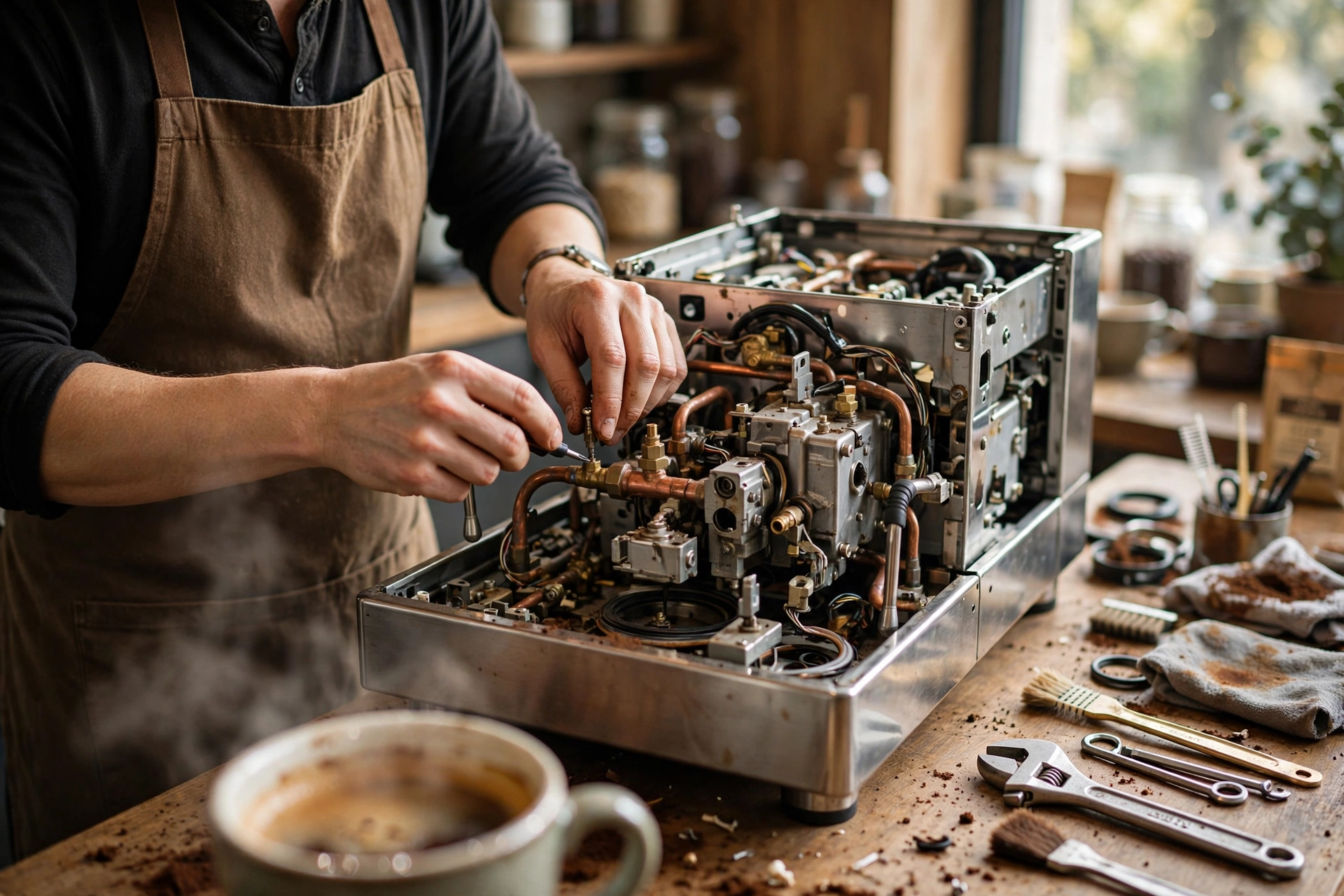
- Shower Screen Removal: Use a screwdriver to remove the shower screen and the dispersion block. Scrub these with a brush and cleaner. I’ve found that screens often harbor "coffee mud" that creates channeling in the puck.
- Hopper Cleaning: Empty the coffee beans and wash the hopper with warm, soapy water. Coffee beans contain oils that go rancid when exposed to air and light; a dirty hopper imparts a "stale" taste to fresh beans.
- Water Filter Check: Check the pressure gauges on your filtration system. If the pressure drop is too high, your filter is saturated and needs replacement.
Quarterly Maintenance: The System Reset
This is where you address the inorganic buildup.
- Full Descaling: Depending on your water hardness, run a descaling agent through the boilers. This removes the mineral crust that destroys heating elements.
- Gasket Replacement: Group head gaskets harden over time. Replace them every 3 months to prevent leaks and ensure a proper seal during extraction.
- Burr Inspection: Inspect your grinder burrs for dullness. If you notice the grind shifting or the coffee tasting "flat," it's time to calibrate or replace the burrs.
💡
Key Takeaway
Daily cleaning prevents flavor degradation, but quarterly technical maintenance prevents catastrophic hardware failure. Never confuse hygiene with maintenance.
For businesses that find this overhead overwhelming, this is exactly why we developed the managed solution at Busy Bean Coffee. We take the guesswork out of the equation by providing high-end SENSA equipment and handling the professional maintenance, so the staff can focus on the art of the brew rather than the chemistry of descaling.

Comparing Maintenance Approaches: Manual vs. Managed
Many owners struggle to decide whether to handle maintenance in-house or outsource it to a partner. The "DIY" approach often seems cheaper on paper but hides significant "invisible costs," such as labor hours and the risk of improper chemical use.
| Approach | Pros | Cons | Best For |
|---|---|---|---|
| Manual/DIY | Low upfront cost, total control over schedule. | High risk of error, inconsistent logs, unexpected downtime. | Home baristas or very small, low-volume kiosks. |
| Generic Service | Professional tools, periodic visits. | Reactive "break-fix" model, high emergency fees, no equipment ownership. | Businesses with a moderate budget and basic needs. |
| Busy Bean Managed | Predictable monthly cost, preventative care, premium equipment. | Monthly membership fee, reliance on a single provider. | High-volume cafes, hotels, and restaurants prioritizing quality. |
The mistake I made early on, and that I see constantly, is believing that "if it's still pouring coffee, it's fine." In the specialty coffee world, there is a massive difference between a machine that works and a machine that performs. A machine that is barely functioning might still produce a beverage, but it won't produce a cup that justifies a premium price.
Common Misconceptions About Coffee Gear Care
Most guides get this wrong by suggesting that more chemicals equal a cleaner machine. In reality, over-cleaning with caustic agents can strip the seasoning from certain components or leave a chemical aftertaste if not rinsed properly.
Myth 1: "Vinegar is a great natural descaler."
This is a dangerous misconception. While acetic acid (vinegar) can break down some minerals, it is far too weak for commercial-grade scale and leaves a pungent smell and taste that can linger in the boiler for weeks. Professional descalers are formulated to be food-safe and rinse clean.
Myth 2: "If I have a water filter, I don't need to descale."
No filter is 100% efficient. Even the best reverse osmosis systems can have "breakthrough" moments where minerals leak through. As noted by the International Coffee Organization (ICO), water chemistry is the most volatile variable in coffee production. Relying solely on a filter without checking the internal boiler state is a gamble with your hardware.
Myth 3: "Newer machines don't require as much maintenance."
If anything, modern high-precision machines are more sensitive. A machine with PID temperature control and volumetric dosing relies on precise flow rates. A tiny amount of scale in a flow meter can throw off your dosing by several grams, ruining your recipe consistency.
Frequently Asked Questions
How often should I actually replace my group head gaskets?
In a high-volume environment, you should replace your group head gaskets every three months. Gaskets are made of rubber or silicone, and the constant heat and pressure cause them to compress and harden over time. Once a gasket loses its elasticity, you will notice water leaking from the sides of the portafilter during extraction. This not only creates a mess but can lead to pressure drops that affect the quality of the espresso. I recommend keeping a stock of at least five gaskets on hand so you can swap them instantly without waiting for a shipment.
What is the difference between backflushing and descaling?
These are two entirely different processes targeting different types of buildup. Backflushing is a hygiene task; it uses an alkaline detergent to remove coffee oils and organic particles from the group head and solenoid valves. It is done daily. Descaling is a technical task; it uses an acidic solution to remove mineral scale (calcium/magnesium) from the boiler and heat exchangers. Descaling is done quarterly or bi-annually. If you use a descaling agent to backflush, you risk damaging the seals; if you use backflush powder to descale, you will achieve absolutely nothing because the alkaline powder cannot dissolve minerals.
Can I use a pressure washer or steam cleaner on my machine?
You should never use a high-pressure washer on the internal components of an espresso machine. The force can rupture gaskets, damage delicate sensors, or push water into the electrical housing. However, a handheld steam cleaner is excellent for the exterior chassis and the areas around the drip tray. The key is to ensure that no water enters the electronics or the pump housing. For the group head, stick to a nylon brush and specialized cleaning powder. Using the wrong tool can scratch the polished surfaces of your equipment, which then creates "trap points" for more coffee oils to accumulate.
My coffee tastes bitter even after cleaning; what am I missing?
If your equipment is clean but the taste is still bitter, you are likely dealing with one of two things: rancid oils in the grinder or a calibration issue with your water temperature. Check your grinder's burrs; if they are coated in old oil, they will impart a burnt flavor to the fresh grounds. Additionally, verify that your brew temperature is between 195°F and 205°F. If the machine is scaled up, the PID might read the correct temperature, but the actual water hitting the puck could be overheating due to restricted flow. This is why a professional technician's audit is essential.
Do I need a different cleaning routine for Arabica versus Robusta beans?
While the mechanical process of cleaning is the same, the frequency may change. Robusta beans typically contain more oils and a different chemical composition than Coffea arabica. In my experience, shops that roast or serve a high percentage of Robusta find that their group heads clog slightly faster and their steam wands build up milk residue more aggressively. If you are running a blend with high Robusta content, I suggest increasing your backflushing frequency to twice daily, once at lunch and once at closing, to maintain a clean flavor profile.
Recommended Readings
To deepen your understanding of these topics, we recommend reading the following articles:
- The Complete Guide to White Glove Coffee Service
- Ultimate Guide to All-Inclusive Coffee Service for Businesses
- Ultimate Guide to Automated Coffee Machines for Business
- Ultimate Guide to Specialty Coffee Equipment for Business
Conclusion
Mastering coffee equipment maintenance is the difference between running a hobby and running a professional beverage business. By implementing a strict daily, weekly, and quarterly schedule, you protect your investment, ensure the purity of your specialty coffee, and eliminate the stress of unexpected breakdowns. Remember that the goal is consistency; your customers should taste the same high-quality profile on a Tuesday morning as they do on a Saturday afternoon.
If the technical burden of maintaining high-end gear feels like it's taking away from your time as a business owner, it might be time to switch to a managed approach. At Busy Bean Coffee, we provide the equipment, the installation, and the professional maintenance for one predictable monthly fee. Stop worrying about descaling cycles and start focusing on your customers.
Visit www.busybeancoffee.com to explore our all-inclusive coffee solutions and bring professional-grade reliability to your business.
Free Coffee Pairing Guide & Specialty Roast Cheat Sheet
Unlock the secrets of perfect brewing ratios, water temperatures, and specialty roast profiles. Download the guide.