📖This article is part of the complete guide to Coffee Solutions for Restaurants.
In my experience working with high-volume bistros and fine-dining establishments, the most common mistake is treating coffee equipment as an afterthought. I have seen restaurants invest $20,000 in a professional range only to pair it with a consumer-grade machine that fails during a Saturday brunch rush. When the equipment doesn't match the kitchen's throughput, you aren't just losing coffee quality; you are creating a bottleneck that slows down your entire service window.
For a comprehensive overview of how to integrate these tools into your business model, explore our guide on coffee solutions for restaurants.
What Exactly is the Right Coffee Equipment for Restaurant Kitchens?
📚
Definition
Coffee equipment for restaurant kitchens refers to the collective hardware, ranging from industrial espresso machines and precision grinders to water filtration systems and brewers, designed to withstand the rigorous duty cycles of a commercial food service environment.
Choosing the right coffee equipment for restaurant kitchens is not about buying the most expensive machine; it is about matching the hardware to your specific service volume and staffing capabilities. In a professional setting, the equipment must handle continuous operation without overheating and maintain thermal stability across hundreds of consecutive shots. This differs fundamentally from home or small-office gear, which is designed for intermittent use.
For most 2026 restaurant operations, this means a combination of high-pressure extraction tools and precision grinding. If you are operating a full-service kitchen, your equipment must also adhere to strict health and safety codes. For example, according to NSF International, commercial food equipment must meet specific sanitary design standards to prevent contamination and ensure easy cleaning in high-heat environments.

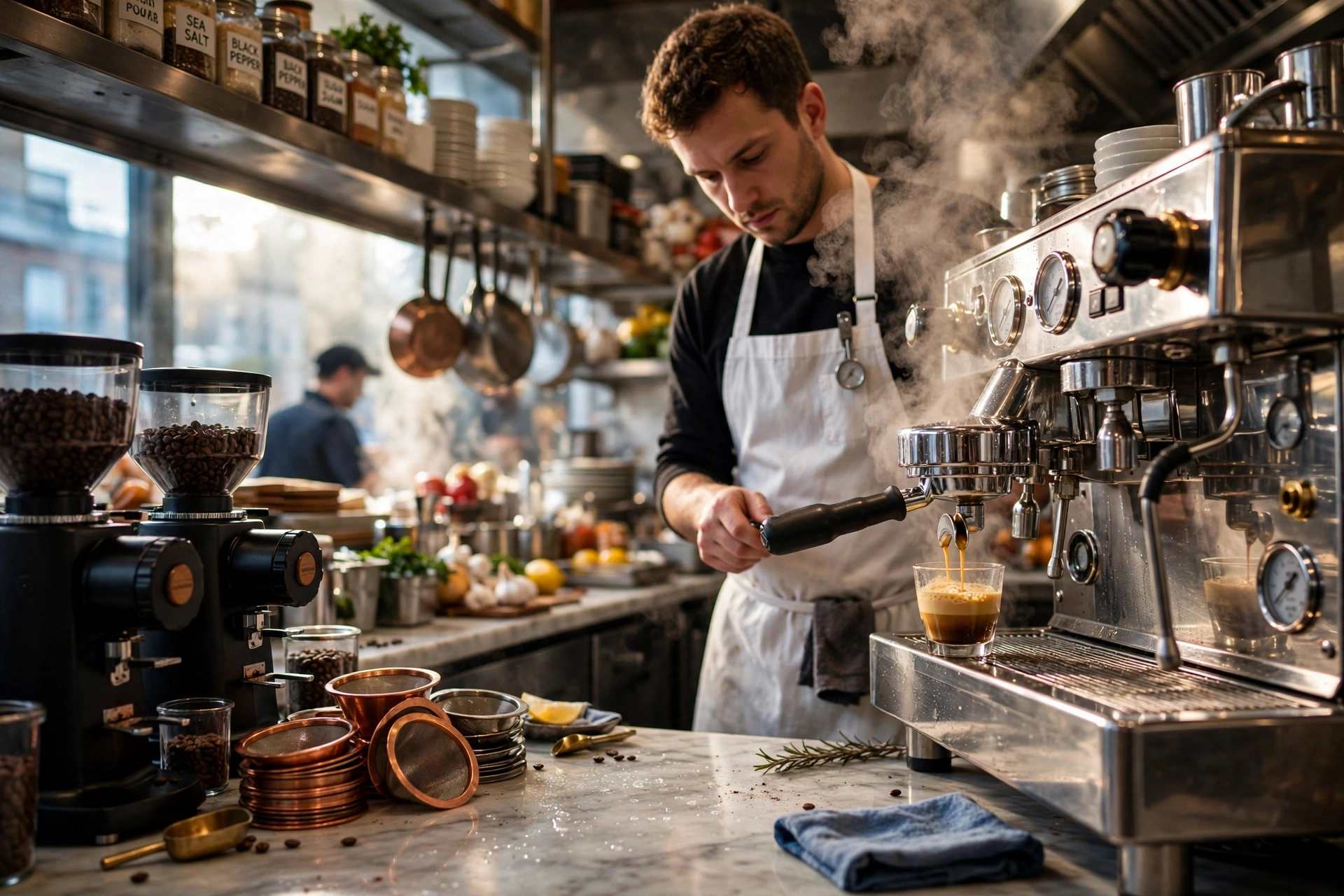
When we implement systems at Busy Bean Coffee, we focus on the "Golden Triangle": the grinder, the machine, and the water. If any one of these fails, the quality of your Coffea arabica beans, no matter how expensive they are, will be wasted. A professional espresso machine must offer independent PID temperature control to ensure that the water hitting the coffee puck is exactly the temperature required for optimal extraction, typically between 195°F and 205°F.
Why Does Proper Equipment Choice Matter for Your Bottom Line?
Investing in the correct coffee equipment for restaurant kitchens directly impacts your labor costs and customer retention. When a barista has to fight with an inconsistent grinder or a slow-heating boiler, the ticket time for a simple latte increases. In a fast-paced restaurant, a two-minute delay in coffee delivery can disrupt the timing of the entire table's experience, potentially delaying the clearing of the table for the next party.
According to the Specialty Coffee Association (SCA), precision in temperature and pressure is the only way to consistently achieve a "specialty" grade cup. If your equipment fluctuates, you produce bitter or sour coffee, leading to wasted product (waste cost) and dissatisfied guests. In a 2026 market where consumers are more educated about coffee roasting and flavor profiles, a poor cup of coffee can actually damage the perceived quality of your food.
Furthermore, the operational efficiency of your gear reduces long-term maintenance expenses. Low-grade machines in high-volume environments lead to frequent breakdowns. By opting for an all-inclusive managed service, like those provided by Busy Bean Coffee, restaurants shift the risk of equipment failure from their own balance sheet to a service provider. This transforms a volatile capital expenditure into a predictable monthly operating expense.
Beyond the technicals, there is the issue of space. Restaurant kitchens are notoriously cramped. The right equipment choice considers the "footprint per cup." Using an automated espresso machine can reduce the physical space needed for a dedicated coffee station while maintaining the quality of a hand-crafted beverage. For those scaling their operations in specific hubs, looking at specialized setups like a Sensa Coffee Service in Charlotte, NC can provide a blueprint for maximizing small-space efficiency.
How to Select and Install Coffee Equipment in Your Kitchen
Selecting the right hardware requires a data-driven approach. You must first calculate your peak hourly volume. If you serve 50 coffees per hour during breakfast, you need a multi-group machine. If you only serve coffee after dinner, a single-group high-performance machine may suffice.
Step 1: Define Your Service Model
Determine if you need a traditional manual workflow or an automated one. Automated machines are ideal for restaurants where the primary staff are cooks or servers rather than trained baristas. These machines ensure that every cup is identical, regardless of who presses the button.
Step 2: Prioritize Water Filtration
This is the most ignored step in restaurant kitchen planning. Coffee is 98% water. If your water is too hard, you will develop limescale buildup that destroys your boiler. If it's too soft, the coffee will taste flat. A professional reverse osmosis or carbon filtration system is non-negotiable.
Step 3: Match the Grinder to the Machine
A high-end espresso machine is useless if paired with a cheap grinder. You need a burr grinder with micro-adjustments. This allows the barista to "dial in" the grind size based on the humidity and age of the coffee bean, ensuring a perfect extraction every time.
Step 4: Plan for Power and Plumbing
Commercial coffee equipment often requires 220V power and a direct water line. Ensure your kitchen's electrical grid can handle the load without tripping breakers during peak hours. For those expanding into new regions, considering a Sensa Coffee Service in Raleigh NC (2026 Overview) can help identify local plumbing and electrical requirements for commercial grade installs.
Step 5: Establish a Maintenance Schedule
Coffee equipment is an investment in machinery. Daily backflushing, weekly deep cleans, and quarterly technician visits are essential. Ignoring these leads to catastrophic failure during your busiest shifts.

Comparing Equipment Procurement Strategies
When deciding how to acquire your coffee equipment for restaurant kitchens, you generally have three paths. Most owners start with the traditional route, only to realize the hidden costs of ownership.
| Feature | Traditional Purchase | Cheap/Generic AI Machines | Managed Membership (Busy Bean) |
|---|---|---|---|
| Upfront Cost | Very High (CapEx) | Low to Moderate | Zero/Low |
| Consistency | Variable (Depends on Staff) | Low (Frequent Errors) | High (Calibrated Gear) |
| Maintenance | Pay-per-visit (Expensive) | Self-managed (Risky) | All-inclusive (Predictable) |
| Equipment Quality | High (if budget allows) | Entry-level | Premium SENSA Grade |
| Scalability | Slow (Must buy more) | Moderate | Rapid (Modular Upgrades) |
As the table demonstrates, the managed approach eliminates the "maintenance anxiety" that plagues restaurant owners. Instead of worrying about a broken pump on a Sunday morning, you have a partner ensuring the gear is always operational.
Common Mistakes to Avoid When Equipping Your Kitchen
In my years as a Q-Grader, I've seen the same three errors repeated across hundreds of kitchens. Avoiding these will save you thousands of dollars in the first year alone.
Mistake 1: Over-specifying Equipment
Buying a 3-group espresso machine for a small bistro that only sells 20 coffees a day is a waste of capital and counter space. Match your equipment to your actual volume, not your "dream" volume. If you are starting small in a city like Augusta, utilizing a Sensa Coffee Service in Augusta GA: Complete Guide | Busy Bean Coffee allows you to start with the right size and scale as you grow.
Mistake 2: Neglecting the "Last Inch" of Quality
Many restaurants buy the best machine but use cheap plastic pitchers or outdated thermometers. The final 1% of the process, the steaming of the milk and the pouring of the cup, is where the customer perceives the value. Invest in high-quality stainless steel pitchers and digital thermometers to ensure the milk is textured correctly.
Mistake 3: Ignoring Staff Training
Even the best coffee equipment for restaurant kitchens is useless in the hands of an untrained employee. If your staff doesn't know how to purge the group head or clean the steam wand, the machine's lifespan will be cut in half, and the coffee will taste burnt. Training must be a recurring part of your operational budget.
Mistake 4: Underestimating Power Needs
I have seen kitchens install a professional machine only to find it shares a circuit with a toaster or a blender. When both run simultaneously, the power trips. Always have a dedicated circuit for your espresso machine to prevent voltage drops that can damage the sensitive electronic boards of modern machines.
Mistake 5: Failing to Track Waste
If your equipment is not calibrated, your baristas will "dial in" the grinder by wasting pounds of coffee every morning. Professional equipment with programmable dosing and precision timers reduces this waste, directly increasing your margin per cup. For more on maximizing these margins, see our guide on how much restaurants make selling specialty coffee.
Frequently Asked Questions
Do I really need a commercial espresso machine if I have a small restaurant?
Yes, because home or "prosumer" machines are not designed for the thermal load of a commercial environment. A commercial machine uses larger boilers and more robust heating elements that can maintain a constant temperature while pulling multiple shots back-to-back. Using a non-commercial machine in a restaurant often leads to "temperature surfing," where the coffee quality varies wildly from the first cup to the tenth. This inconsistency is unacceptable in a professional setting where brand reputation is everything.
How does water filtration affect the lifespan of my coffee equipment?
Water filtration is the single most important factor in equipment longevity. Minerals like calcium and magnesium in city water create scale buildup inside the heat exchangers and boilers. Over time, this scale acts as an insulator, forcing the machine to work harder to heat the water, which eventually burns out the heating element. According to the International Coffee Organization (ICO), water quality is a primary variable in global coffee production and consumption. In the kitchen, a high-quality filtration system can extend the life of your machine by several years and prevent costly descaling shutdowns.
What is the difference between a manual and an automatic espresso machine for a kitchen?
Manual machines require a trained barista to grind, tamp, and time the shot, offering the highest potential for quality but requiring significant skill. Automatic (or super-automatic) machines handle the grinding, tamping, and extraction with a single button press. For most restaurants that aren't dedicated cafes, automatic machines are superior because they remove the human error variable. They ensure that a guest receives the same quality latte whether it's 8:00 AM or 8:00 PM, regardless of who is behind the counter.
How often should I service my restaurant coffee equipment?
Daily maintenance (cleaning steam wands, backflushing) must happen every shift. However, professional servicing should occur at least quarterly. This includes replacing rubber gaskets, checking water pressure, and calibrating the grinder. If you use a managed service like Busy Bean Coffee, these visits are typically handled for you. Ignoring quarterly maintenance often leads to "catastrophic failure," where a small $20 gasket leak turns into a $2,000 boiler replacement because the machine was run dry.
How do I choose between a drip brewer and an espresso machine?
This depends on your customer's behavior. If your guests primarily want a quick cup of black coffee with their meal, a high-capacity commercial drip brewer is essential. If you are looking to increase your average check size through specialty lattes and cappuccinos, an espresso machine is required. Many successful restaurants implement a hybrid approach: a high-quality batch brewer for high-volume black coffee and a precision espresso machine for premium specialty drinks. This maximizes both speed of service and revenue potential.
Conclusion
Selecting the right coffee equipment for restaurant kitchens is a strategic decision that balances capital expenditure, operational efficiency, and guest experience. From ensuring your water filtration meets FDA sanitary standards to choosing between manual and automated workflows, every detail impacts your bottom line. In the 2026 landscape, the trend is clearly moving away from heavy ownership and toward flexible, managed memberships that provide premium SENSA equipment without the stress of maintenance.
If you are tired of managing broken machines and inconsistent quality, it's time to shift your perspective. Instead of buying a machine that depreciates the moment it hits your counter, consider a partnership that ensures your coffee program is always performing at its peak. For more information on optimizing your beverage program, visit our comprehensive guide on coffee solutions for restaurants.
Ready to elevate your guest experience without the headache of equipment ownership? Explore our managed coffee memberships at www.busybeancoffee.com.
Ready to Upgrade Your Business Coffee?
Café-quality coffee, zero maintenance headaches, and one predictable monthly price. Let's build your custom coffee program.
Free Coffee Pairing Guide & Specialty Roast Cheat Sheet
Unlock the secrets of perfect brewing ratios, water temperatures, and specialty roast profiles. Download the guide.