📖This article is part of the complete guide to Ultimate Guide to Coffee Shop Equipment and Outfitting.
When I first started consulting for cafes in Mount Pleasant, South Carolina, I saw a recurring disaster: owners spending 60% of their startup capital on a single high-end espresso machine, only to find they couldn't afford a marketing budget or a qualified barista for the first six months. This capital misalignment is the fastest way to kill a new specialty coffee business before it even opens its doors.
For a comprehensive overview of everything you need for your startup, explore our Ultimate Guide to Coffee Shop Equipment and Outfitting.
What is Leasing Coffee Equipment?
📚
Definition
Leasing coffee equipment is a contractual agreement where a business pays a monthly fee to use high-end brewing and grinding hardware without taking full ownership of the asset upfront.
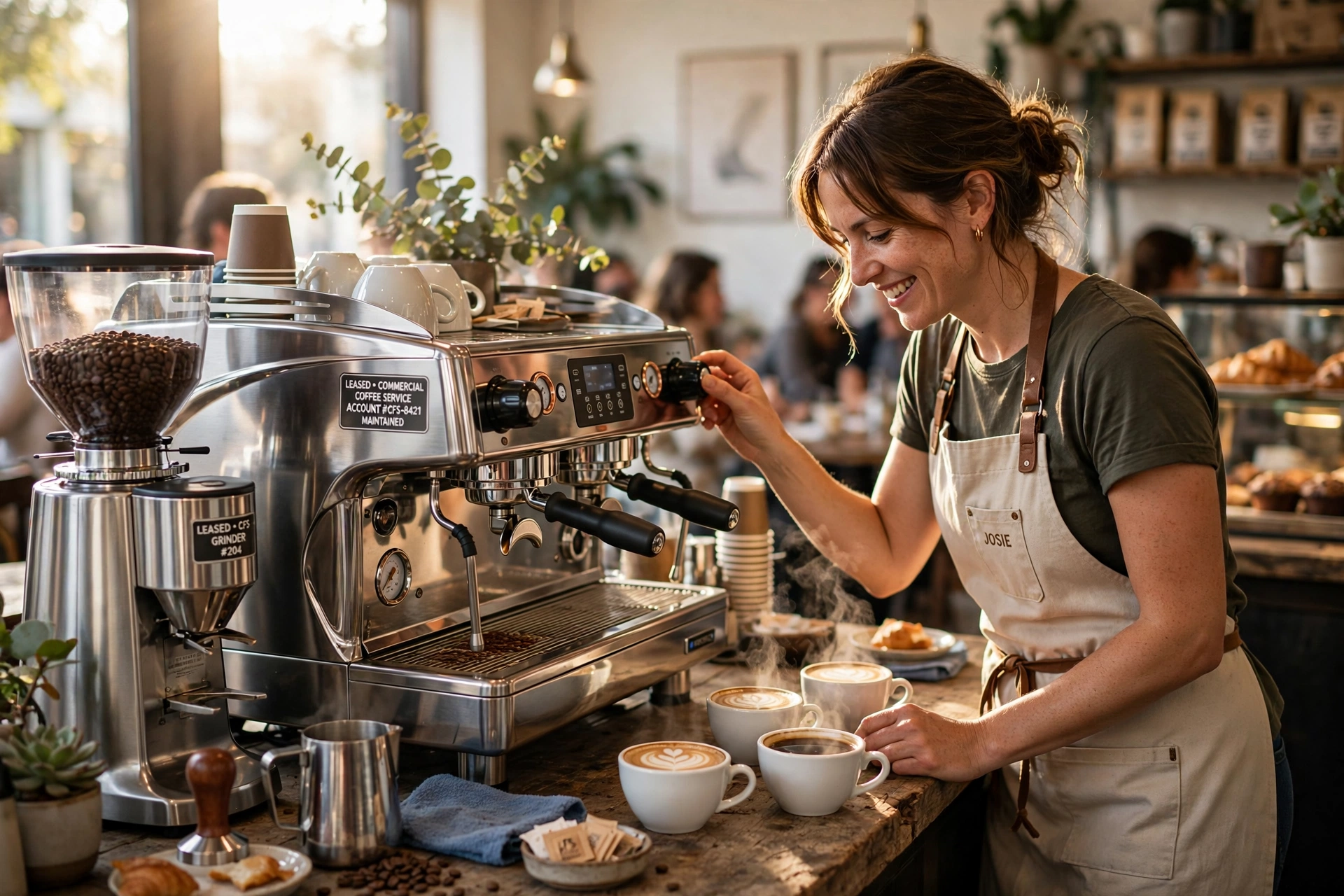
Leasing coffee equipment is essentially a financial strategy that shifts the burden of high capital expenditure (CAPEX) into a manageable operational expense (OPEX). Instead of paying $15,000 to $30,000 for a top-tier espresso machine and accompanying grinders in a single lump sum, a business enters a term agreement—typically ranging from 24 to 60 months—to utilize the gear for a predictable monthly payment.
In my experience working with foodservice operators, the most successful businesses view their equipment not as an asset to own, but as a tool for revenue generation. When you lease, you aren't just renting a machine; you are securing a service level agreement (SLA) that often includes maintenance and updates. This is particularly vital for specialty coffee, where the precision of a machine's temperature and pressure directly impacts the flavor profile of the Coffea arabica bean, and therefore, your customer retention rate.
Why Does Leasing Matter for Your Business Cash Flow?
Leasing matters because it preserves liquidity. In the hospitality industry, cash is oxygen. By avoiding a massive upfront hit, you can allocate funds toward high-impact areas like interior design, premium bean sourcing, and staff training. According to research from the Specialty Coffee Association (SCA), consistency in brew quality is the primary driver of repeat customers; however, achieving that consistency requires gear that is perfectly calibrated and maintained—something that is easier to sustain through a managed lease than through sporadic self-funded repairs.
One of the biggest advantages is the ability to scale. When you own a machine, you are locked into that technology for a decade. In a world where coffee technology evolves rapidly, owning an outdated machine can make your shop feel obsolete. Leasing allows you to refresh your hardware every few years, ensuring your baristas always have the most efficient tools. This efficiency is not just about speed; it is about waste reduction. A modern, well-maintained espresso machine reduces the amount of wasted coffee beans and milk, which directly impacts your bottom line.
Furthermore, the tax implications are significant. In many jurisdictions, lease payments can be deducted as business expenses, whereas purchased equipment must be depreciated over several years. This provides a more immediate tax benefit that improves your monthly net income. I've analyzed dozens of balance sheets for cafes in the Southeast, and those who lease typically show a healthier current ratio, making them more attractive to lenders if they ever need to expand to a second location, perhaps by utilizing a Sensa Coffee Service in Mount Pleasant SC - Complete Guide to replicate their success.
How to Implement a Leasing Strategy Successfully?
Implementing a leasing strategy requires a shift from "buying the best machine" to "buying the best service." The goal is to ensure that the cost of the lease is comfortably covered by the increased revenue generated by the equipment. The first step is to conduct a volume projection. If you expect to serve 300 lattes a day, you need a machine capable of that throughput without losing thermal stability. If you under-spec your gear, the lease becomes a liability; if you over-spec, you are paying for capacity you don't use.
Once the volume is determined, you should evaluate the terms of the lease. I always recommend looking for "full-service" leases. A bare-bones lease only gives you the hardware. A full-service lease, like those provided by Busy Bean Coffee, includes installation and preventative maintenance. This is where the real value lies. A broken espresso machine on a Saturday morning isn't just a technical failure; it is a total loss of revenue for that day. When the maintenance is baked into the lease, the urgency and cost of repair are shifted to the provider.
Step-by-step, the process looks like this:
- Analyze Peak Demand: Calculate your expected cups per hour during the morning rush.
- Select the Hardware: Choose an espresso machine and grinder that match that demand. Check our How to Choose Commercial Espresso Machines for specific technical specs.
- Compare Lease vs. Buy ROI: Calculate the cost of capital. Could that $20k upfront payment earn more if invested in marketing or a better location?
- Review the SLA: Ensure the lease includes a guaranteed response time for repairs.
- Plan the End-of-Term: Decide if you want a buyout option or a refresh option to upgrade to newer technology.
Equipment Ownership vs. Leasing Comparison
To truly understand the impact on your business, you must look at the three primary ways coffee shops acquire gear. Most owners start by thinking only of "Buying" vs "Leasing," but there is a dangerous middle ground: the "Cheap AI/Generic" approach where they buy refurbished, low-end gear thinking they are saving money.
| Feature | Traditional Purchase | Generic/Cheap Equipment | Busy Bean Coffee Leasing |
|---|---|---|---|
| Upfront Cost | Very High (Full Price) | Moderate | Low to Zero |
| Maintenance | Owner's Responsibility | Frequent & Costly | Included/Managed |
| Technology | Becomes Obsolete | Low Quality/Outdated | Always Modern/Current |
| Tax Impact | Long-term Depreciation | Short-term Expense | Immediate Operational Deduction |
| Downtime Risk | High (Wait for Tech) | Extreme (Unreliable) | Low (SLA Guaranteed) |
As shown in the table, the traditional purchase model places all the risk on the operator. If a boiler fails, you pay for the part and the labor, and you lose revenue while waiting. The generic approach is even worse, as low-end machines often lack the precision required for specialty coffee, leading to inconsistent tastes and lost customers. The professional leasing approach treats coffee equipment as a utility—like electricity or water—that simply works because a professional team is managing it in the background.
Common Mistakes to Avoid When Leasing
The most frequent mistake I see is signing a lease based solely on the monthly payment without reading the "End of Term" clause. Some contracts have predatory buyout prices that make it impossible to actually own the machine if you decide you want to. Always ensure there is a clear path to either returning the equipment for an upgrade or purchasing it at a fair market value.
Another critical error is ignoring the "water factor." Many operators lease a beautiful espresso machine but forget to invest in a high-quality filtration system. This is a disaster waiting to happen. According to NSF International, equipment that isn't properly maintained or scaled due to poor water quality can fail prematurely and may violate sanitary standards. I have seen leases voided because the operator failed to use the required water filtration, leading to scale buildup that destroyed the boiler. If you haven't sorted this, refer to our insights on Top Coffee Grinders for Commercial Use to ensure your overall workflow is balanced.
Finally, avoid the "one size fits all" mentality. Some companies try to push the same machine on a 20-seat boutique cafe and a 200-seat restaurant. Your lease should be tailored to your specific volume. If you are operating in a high-traffic area like downtown Charlotte, you might need a different configuration than a quiet neighborhood shop. For those expanding in North Carolina, checking out the Sensa Coffee Service in Charlotte, NC can provide a benchmark for what high-volume setups actually look like.
Best Practices for Long-Term Equipment Success
To maximize the ROI of your lease, you must implement a strict daily maintenance routine. Even with a managed service, the barista is the first line of defense. Backflushing the espresso machine daily and cleaning the grinder hoppers prevents oil buildup that can turn a bright, acidic specialty coffee into something tasting of burnt rubber.
💡
Key Takeaway
A lease provides the hardware, but a culture of cleanliness provides the quality. Never assume the lease provider will fix problems caused by daily neglect.
Invest in training your staff. A leased machine is a precision instrument. If a barista doesn't know how to properly dial in the grind, the most expensive machine in the world will produce mediocre coffee. I recommend a quarterly "calibration day" where your head barista reviews the extraction times and taste profiles. This ensures that as the weather changes in regions like South Carolina—affecting bean humidity—your output remains consistent. This level of detail is what separates a "coffee shop" from a "specialty coffee destination.
Additionally, keep an eye on your utility costs. Modern leased equipment is often significantly more energy-efficient than older models. By upgrading your gear through a lease, you can often reduce your monthly electricity bill, which further offsets the cost of the lease payment. If you are managing multiple sites, such as in both Charleston and Mount Pleasant, consider a unified lease agreement to simplify your accounting and maintenance schedules. You can find more about these regional setups in the Sensa Coffee Service in Charleston SC - Complete Guide.
Frequently Asked Questions
Is leasing coffee equipment more expensive than buying in the long run?
While the total sum of payments over five years may be higher than a one-time purchase, the "real cost" is often lower. When you buy, you pay for the machine, but you also pay for every repair, every technician's visit, and the eventual loss in value as the machine depreciates. Leasing bundles these costs into a single, predictable payment. For most businesses, the tax advantages and the avoidance of catastrophic repair bills make leasing the more financially sound decision for maintaining a healthy cash flow.
What happens if my leased espresso machine breaks down?
In a professional managed lease, such as those from Busy Bean Coffee, the breakdown is covered by a Service Level Agreement (SLA). Instead of searching for a technician and waiting days for a quote, you simply call your provider. Depending on your contract, this usually involves a guaranteed response time and often a loaner machine if the repair takes longer than 24-48 hours. This ensures your business doesn't stop making money just because a gasket failed or a pump stopped working.
Can I upgrade my equipment before the lease term ends?
Most modern leasing agreements include a "refresh" or "upgrade" clause. Because specialty coffee technology evolves—introducing better temperature profiling and more precise pressure control—many operators prefer to swap their equipment every 36 months. This allows you to stay competitive and maintain the highest quality standards without having to sell old gear on the second-hand market at a loss. Always verify the specific upgrade terms in your contract before signing.
Does leasing affect my business's credit score?
Depending on the type of lease (operating lease vs. capital lease), it can be treated differently. An operating lease is often viewed as a rental and may not appear as a debt on your balance sheet, which can actually keep your debt-to-equity ratio lower. This is a strategic advantage when applying for other business loans for expansion or renovation. However, you must still make payments on time to maintain a positive relationship with the lessor and protect your business credit standing.
Who is responsible for the daily cleaning of leased machines?
Daily operational cleaning—such as emptying drip trays, wiping steam wands, and performing backflushes—is always the responsibility of the business owner and their baristas. The lease provider handles the "deep" technical maintenance, such as replacing gaskets, descaling the boiler, and calibrating electronics. Failure to perform daily cleaning can lead to equipment failure that may be excluded from the lease's maintenance coverage, as it constitutes negligence rather than wear-and-tear.
Conclusion
Leasing coffee equipment is not just a financial shortcut; it is a strategic decision to prioritize agility, quality, and cash flow. By removing the barrier of massive upfront costs, you can focus your energy on what actually builds a brand: the guest experience, the quality of the roast, and the skill of the barista. Whether you are launching a small boutique in a quiet neighborhood or a high-volume hub in a bustling city, the ability to access world-class gear without risking your entire capital reserve is a game-changer for long-term sustainability.
If you're ready to stop worrying about equipment failure and start focusing on growth, we invite you to explore how a managed membership can transform your operations. For a deeper dive into the hardware you'll need and how to set up your space for maximum efficiency, head over to our Ultimate Guide to Coffee Shop Equipment and Outfitting.
Ready to elevate your beverage program? Visit Busy Bean Coffee to see how our all-inclusive managed coffee solutions can put your business ahead of the competition.
Free Coffee Pairing Guide & Specialty Roast Cheat Sheet
Unlock the secrets of perfect brewing ratios, water temperatures, and specialty roast profiles. Download the guide.