📖This article is part of the complete guide to Ultimate Guide to Coffee Shop Equipment and Outfitting.
How Do You Choose and Operate Commercial Espresso Machines for Maximum Profit?
Setting up a high-volume beverage station often starts with a costly mistake: buying a machine based on brand name rather than throughput capacity. In my experience working with dozens of hotels and cafes in Mount Pleasant, SC, the most common failure point isn't the coffee bean quality, but the mismatch between the machine's boiler recovery time and the actual rush-hour demand. To successfully implement commercial espresso machines in a business setting, you must align your equipment's group head count, steaming power, and water filtration system with your projected hourly transaction volume to avoid "bottlenecking" your revenue.
What Exactly Defines Commercial-Grade Espresso Equipment?
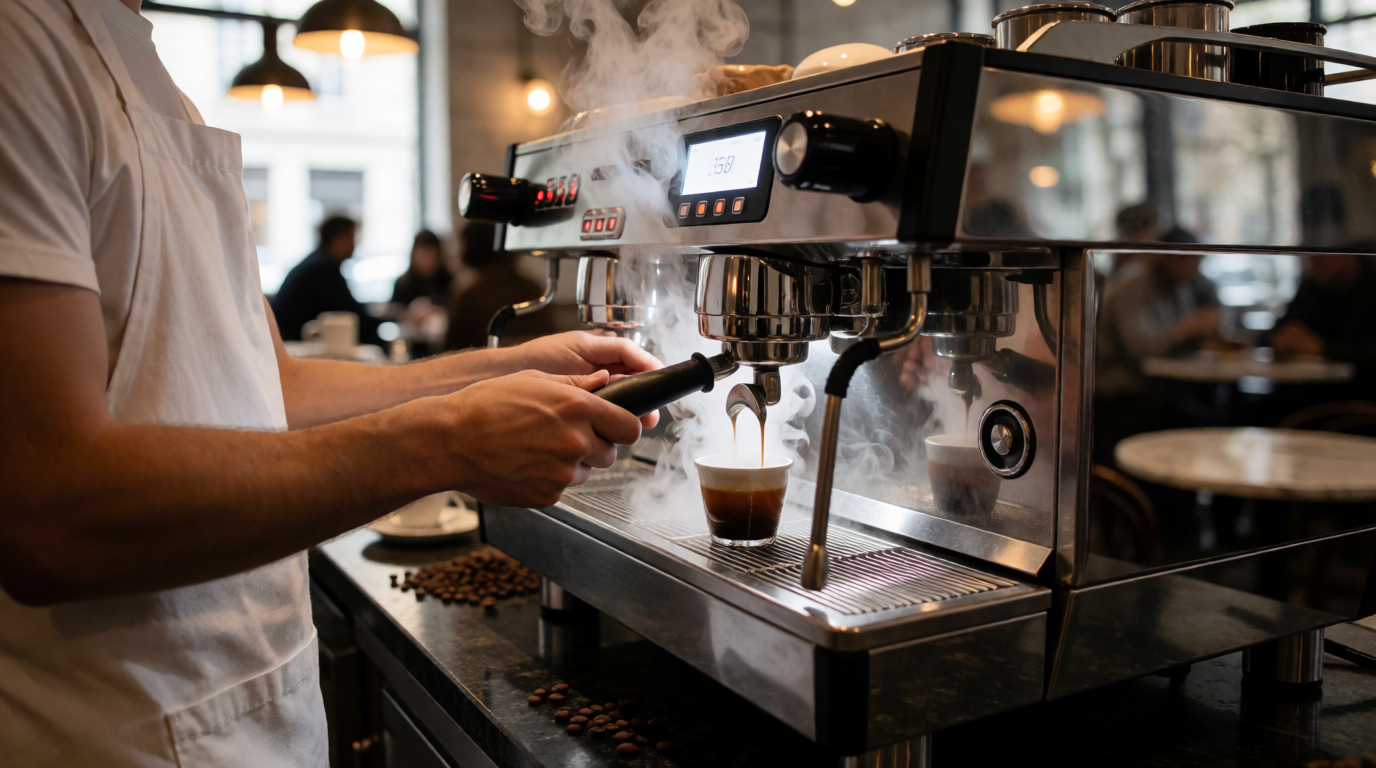
When we talk about professional gear, we aren't just talking about a larger version of a home machine. Commercial espresso machines are engineered for thermal stability and continuous operation, meaning they can pull 200 shots a day without the temperature fluctuating by more than a fraction of a degree. This is achieved through massive boilers and sophisticated PID (Proportional-Integral-Derivative) controllers that maintain a precise heat envelope.
📚
Definition
Thermal Stability is the ability of an espresso machine to maintain a constant water temperature throughout the entire extraction process, preventing the coffee from tasting sour (under-extracted) or bitter (over-extracted).
The distinction lies in the internal components. While a home machine might have a small thermoblock, a true commercial unit utilizes heavy-duty brass or stainless steel boilers. For instance, a multi-boiler system allows the machine to steam milk and pull shots simultaneously without one process stealing heat from the other. This is fundamental for any business where speed of service is a KPI.
According to the Specialty Coffee Association (SCA), the standard for a "specialty" beverage requires precise control over variables like water temperature (typically between 195°F and 205°F) and pressure (9 bars). If your equipment cannot maintain these narrow windows under the stress of a morning rush, you aren't serving specialty coffee; you're serving inconsistent caffeine. The hardware must be robust enough to handle the mineral-heavy water systems found in many commercial buildings, which is why integrated or external filtration is a requirement, not an option.
Why Does the Right Equipment Choice Directly Impact Your Bottom Line?
The financial implications of choosing the wrong machine manifest in two ways: wasted labor and lost customers. If a barista has to wait 30 seconds for a boiler to recover between drinks, and you serve 100 customers an hour, you are losing significant throughput. That "wait time" is a hidden tax on your payroll.
From a quality control perspective, inconsistency is a profit killer. If the first latte of the day is perfect but the twentieth is burnt because the machine is overheating, you lose the lifetime value of that customer. Research from the National Coffee Association USA (NCA) highlights that consumer preferences are shifting toward high-quality, specialty-grade experiences. When customers perceive a drop in quality, they don't complain; they simply stop coming back.
Furthermore, the cost of downtime is astronomical. A broken group head on a Friday morning in a busy Mount Pleasant cafe can cost thousands of dollars in unrealized revenue. This is why I always emphasize the importance of NSF-certified equipment. According to NSF International, adhering to sanitation and safety standards like NSF/ANSI 4 not only ensures health code compliance but also indicates a level of build quality that survives the rigors of a commercial environment.
The mistake I made early on—and that I see constantly with new owners—is underestimating the "total cost of ownership." A cheaper machine often leads to higher electricity bills due to poor insulation and more frequent technician visits. Investing in a high-efficiency, managed solution like those provided by Busy Bean Coffee removes this volatility by bundling maintenance into a predictable monthly cost, ensuring that "equipment failure" never becomes a line item on your loss statement.
How to Set Up and Calibrate Your Commercial Espresso Machines Step-by-Step
Implementing these machines is not as simple as plugging them in. It requires a calibrated ecosystem of water, power, and bean chemistry. If you treat a commercial espresso machine like a kitchen appliance, you will likely burn out the heating element or scale the boiler within six months.
Step 1: Water Filtration and Chemistry
Before a single drop of water enters the machine, you must install a commercial-grade filtration system. Hard water is the enemy of espresso machines. Calcium and magnesium deposits build up inside the heat exchangers, restricting flow and eventually causing the machine to overheat. You need a system that handles both sediment filtration and chemical softening.
Step 2: Dialing In the Grind
Once the machine is powered and the boilers have reached temperature, the barista must "dial in." This involves adjusting the grind size of the coffee bean to achieve a specific extraction time—usually 25 to 30 seconds for a standard double shot. If the water rushes through too quickly (under-extraction), the coffee tastes salty; if it drips too slowly (over-extraction), it tastes charred.
Step 3: Temperature Stabilization
Flush the group heads. This removes any stale water and ensures the metal components are fully saturated with heat. In a high-volume setting, this "purging" happens between every single shot to ensure the temperature remains locked.
Step 4: Milk Texture Calibration
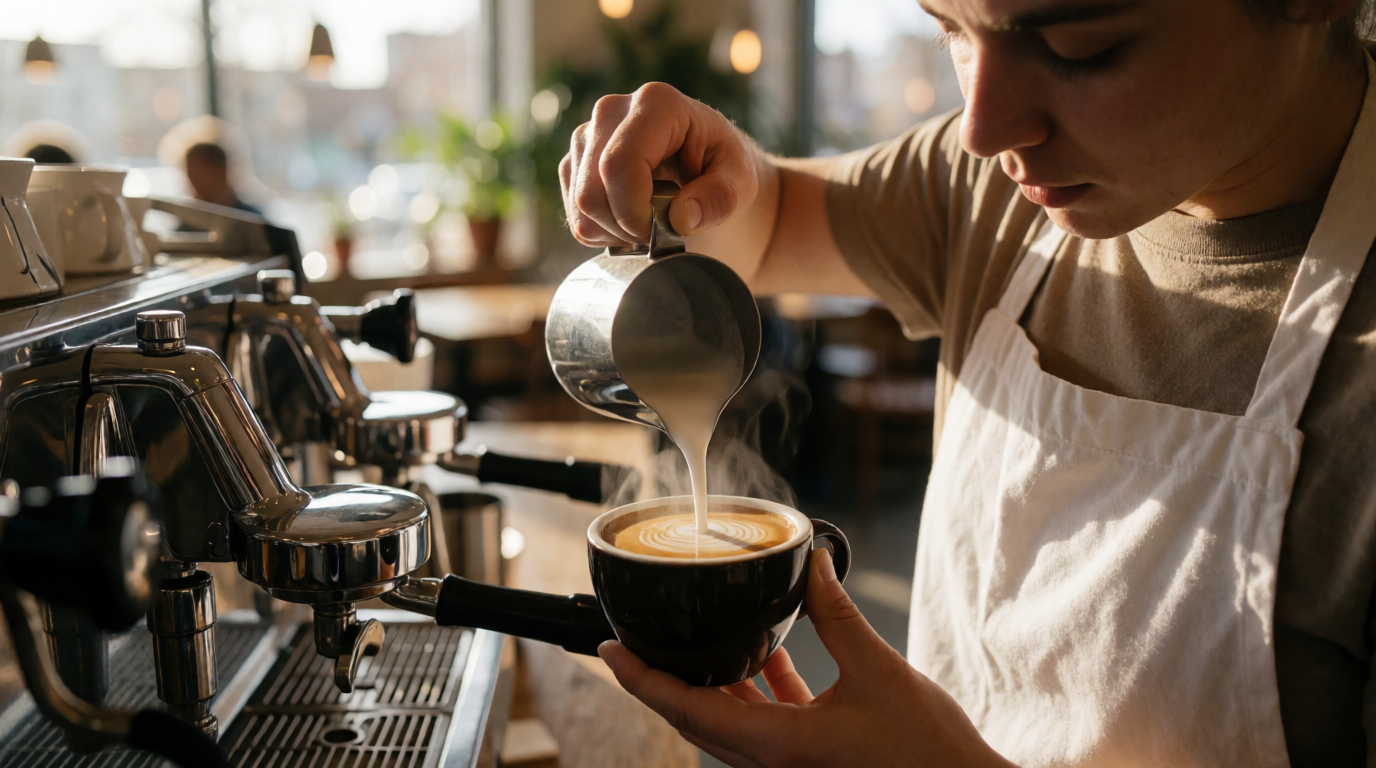
The steam wand must be purged of condensation before and after every use. The goal is "microfoam"—milk that has such small bubbles it looks like wet paint. This requires a specific technique of stretching the milk (incorporating air) and then spinning it (homogenizing the bubbles).
Step 5: Continuous Monitoring
The environment changes throughout the day. Humidity and temperature affect how coffee beans behave in the hopper. A professional barista must re-adjust the grinder every few hours to maintain consistency.

💡
Key Takeaway
The machine is only as good as the water going into it and the calibration coming out of it. Without a dedicated water filtration strategy and a disciplined "dialing-in" process, even a $20,000 machine will produce mediocre coffee.
At Busy Bean Coffee, we simplify this entire process. Instead of leaving you to struggle with water chemistry and technical calibration, we provide an all-inclusive managed service. We handle the professional installation, calibrate the equipment to your specific roast, and provide the ongoing maintenance that keeps your uptime at nearly 100%.
Comparing Your Equipment Options: Which Path Should You Take?
Not every business needs a three-group powerhouse. A small hotel lobby has different needs than a dedicated specialty cafe. The following table breaks down the three primary ways businesses currently approach their beverage hardware.
| Approach | Pros | Cons | Best For |
|---|---|---|---|
| Traditional Purchase | Full ownership, no monthly fees. | Huge upfront capital expense, all maintenance risk is on you. | Large corporations with internal facility teams. |
| Budget/Consumer-Plus | Low entry cost, easy to buy. | Poor thermal stability, frequent breakdowns, inconsistent quality. | Very low-volume offices or breakrooms. |
| Managed Solution (Busy Bean) | Zero upfront CAPEX, guaranteed uptime, professional maintenance. | Monthly subscription fee. | Cafes, hotels, and restaurants focused on growth and quality. |
Here is the thing though: most owners choose the "Budget/Consumer-Plus" route to save money initially, only to spend three times that amount in repairs and lost customers within two years. When you opt for a professional-grade setup, you are paying for the reliability of the components.
Now, here's where it gets interesting: the "Traditional Purchase" model is becoming obsolete for many. Why? Because the coffee industry moves fast. A machine that is top-of-the-line in 2026 might be outdated by 2029. A managed service allows you to stay current without having to liquidate old assets and take on massive new loans every few years.
Common Questions and Misconceptions About Commercial Coffee
Most guides get this wrong by focusing purely on the "specs" of the machine. They talk about boiler size and pump pressure but ignore the human and operational element. Let's clear up a few common myths.
Myth 1: "More group heads always mean more money."
Not necessarily. If your staff isn't trained to operate a multi-group machine efficiently, those extra heads just sit there wasting energy. A two-group machine operated by a skilled barista is faster than a four-group machine operated by an amateur. The key is matching your machine's capacity to your actual peak-hour flow, not your hoped-for flow.
Myth 2: "Automatic machines are just as good as manual ones."
This depends on your definition of "good." Super-automatic machines (that grind, tamp, and brew at the touch of a button) are great for convenience but often lack the nuance of a manually operated machine. If you are targeting the "specialty coffee" market, your customers can tell the difference. Manual control allows the barista to adjust for the specific characteristics of the Arabica coffee beans being used.
Myth 3: "You can just use a standard water filter from a big-box store."
This is a recipe for disaster. Commercial espresso machines have incredibly tight tolerances. A standard charcoal filter removes taste and odor, but it doesn't manage the mineral content that causes scale buildup. You need a professional-grade water softener or reverse osmosis system to protect your investment.
Frequently Asked Questions
How often should commercial espresso machines be serviced?
For a high-volume business, a deep-clean and calibration check should happen daily, but professional preventative maintenance should occur every three to six months. This includes replacing gaskets, checking pump pressure, and descaling the boilers if necessary. In my experience, waiting until the machine breaks to call a technician is the most expensive way to run a business. A proactive schedule prevents the "Friday morning breakdown" and extends the life of the heating elements significantly.
What is the difference between a single-boiler and a dual-boiler machine?
A single-boiler machine uses one tank of water for both brewing coffee and steaming milk. This means the machine must change temperatures between the two tasks, which creates a significant delay. A dual-boiler machine has two separate boilers—one dedicated to the group head and one for the steam wand. This allows for simultaneous operations and much tighter temperature control, which is essential for maintaining the quality of specialty coffee during a rush.
How do I calculate how many group heads I actually need?
To calculate this, look at your peak hour. A single group head can typically handle about 20-30 drinks per hour if the barista is efficient. If you expect 60-90 drinks during your morning rush, a two-group machine is the minimum. If you are pushing 120+ drinks an hour, you need a three-group machine to ensure that the "wait time" doesn't drive customers away. Remember, it is better to have a slightly larger machine that is under-stressed than a small machine running at 100% capacity constantly.
Why is water quality so important for espresso machines?
Water is the primary solvent in coffee and the primary medium for heating in the machine. If your water is too "hard" (high mineral content), those minerals precipitate out as scale when heated, clinging to the inside of your pipes and boilers. This acts as an insulator, forcing the machine to work harder to heat the water, which eventually burns out the element. Moreover, minerals like chlorine or excess sulfur will ruin the flavor profile of high-end Arabica beans.
Can I use a home espresso machine in a small cafe?
Technically, you can, but it is a bad business decision. Home machines are designed for 2-4 drinks a day; they cannot recover temperature fast enough to handle a queue of five people. Within a few months, the plastic components and small pumps will fail under the pressure of commercial use. Furthermore, most home machines aren't NSF-certified, which can lead to issues with health inspectors in certain jurisdictions. Investing in true commercial espresso machines is an investment in your brand's reliability.
Final Thoughts on Commercial Espresso Machines
Choosing the right equipment is the difference between a business that scales and one that struggles with constant technical failures. When you prioritize thermal stability, water chemistry, and throughput capacity, you create a foundation for consistent quality and higher profit margins.
If the technical complexity of sourcing, installing, and maintaining these systems feels overwhelming, you don't have to do it alone. At Busy Bean Coffee, we provide a complete, all-inclusive managed coffee solution that takes the guesswork out of the equation. We provide the premium equipment, handle the installation, and ensure your machines are always performing at their peak.
Ready to upgrade your beverage service without the capital risk? Visit us at www.busybeancoffee.com and let's build a coffee program that actually works for your business.
Recommended Readings
To deepen your understanding of these topics, we recommend reading the following articles:
- Ultimate Guide to Coffee Shop Equipment and Outfitting
- Top Commercial Coffee Machines for
- Coffee Equipment Maintenance Services
Free Coffee Pairing Guide & Specialty Roast Cheat Sheet
Unlock the secrets of perfect brewing ratios, water temperatures, and specialty roast profiles. Download the guide.