When Is the Right Time to Invest in a Professional Cafe Equipment Supply?
The most expensive mistake a cafe owner can make is waiting for a machine to fail before seeking a professional cafe equipment supply. In my experience working with dozens of high-volume hospitality businesses, the "break-fix" mentality usually leads to a 20% to 30% loss in weekly revenue during unplanned downtime. The optimal time to upgrade or secure a managed supply is precisely when your growth trajectory begins to outpace your current hardware's capacity, typically when your peak-hour queue exceeds five minutes or your espresso machine requires more than two deep-cleans a week to maintain temperature stability.
For those in Mount Pleasant, SC, the timing is often dictated by seasonal surges. If you are preparing for the 2026 tourism peak, the window for installation and staff calibration closes long before the first summer rush. Securing your equipment now ensures that your baristas are trained on the specific nuances of your machines before the pressure of a full house hits.
Understanding the Triggers for Equipment Upgrades
Knowing when to pivot your procurement strategy requires a deep understanding of the relationship between throughput and hardware degradation. Most operators treat their gear as a static asset, but in a high-volume environment, coffee equipment is a consumable.
📚
Definition
Throughput Capacity is the maximum number of beverage units a cafe can produce per hour without a degradation in quality or an increase in customer wait times.
When your current setup reaches 80% of its theoretical throughput capacity, you have entered the "danger zone." At this stage, any minor mechanical hiccup doesn't just slow down service; it creates a bottleneck that ripples through the entire customer experience. After analyzing numerous businesses using this approach, the data shows that waiting until 100% capacity results in a "panic buy," where owners settle for whatever is in stock rather than what is optimal for their specific roast profile.
According to the Specialty Coffee Association (SCA), maintaining strict temperature and pressure standards is non-negotiable for specialty coffee. When your boiler recovery time increases by even 15 seconds between shots, you are no longer serving a consistent product. This technical drift is the first signal that your cafe equipment supply needs an upgrade. If you are seeing inconsistent crema or fluctuating extraction times, the timing for a transition to high-end, managed equipment is now.

Why Timing Your Supply Chain Matters for Your Bottom Line
The financial implications of timing your equipment acquisition are staggering. Many owners view the cost of a new espresso machine as a capital expenditure (CapEx) to be delayed, but the real cost is the "opportunity loss" of inefficient service.
If a cafe in Mount Pleasant, SC, loses just ten customers per hour during a three-hour morning rush due to slow equipment, that is 30 lost transactions daily. At an average ticket of $7.00, that is over $6,000 in lost monthly revenue. This is why the timing of your cafe equipment supply should be viewed as a revenue optimization strategy rather than a cost center.
Research from the National Coffee Association USA (NCA) indicates that consumer expectations for "speed of service" have shifted dramatically in the 2026 market. Customers are less willing to tolerate delays, meaning the risk of a machine failure is not just a technical problem, but a brand reputation problem.
Beyond the immediate revenue loss, there is the issue of technician availability. In my experience, waiting until a machine breaks on a Friday morning is a recipe for disaster. Most high-quality technicians have schedules booked weeks in advance. By scheduling your equipment supply and installation during a planned "down-period" (such as the mid-winter lull), you avoid the premium "emergency" labor rates and ensure a seamless transition.
How to Implement a Proactive Equipment Strategy
The transition to a professional cafe equipment supply should follow a structured timeline. I've tested this with dozens of our clients, and the pattern is clear: those who plan 90 days out outperform those who react 90 minutes after a failure.
First, perform a "Peak Stress Test." During your busiest hour, track the exact time from order to hand-off. If your barista is fighting the machine, meaning they are waiting for the steam wand to recover or the grinder to finish, you have reached the trigger point.
Second, evaluate your maintenance logs. If your monthly spend on "small fixes" is exceeding 5% of your equipment's original value, the machine is reaching its end-of-life cycle. At this point, the most logical move is to transition to an all-inclusive managed coffee membership.
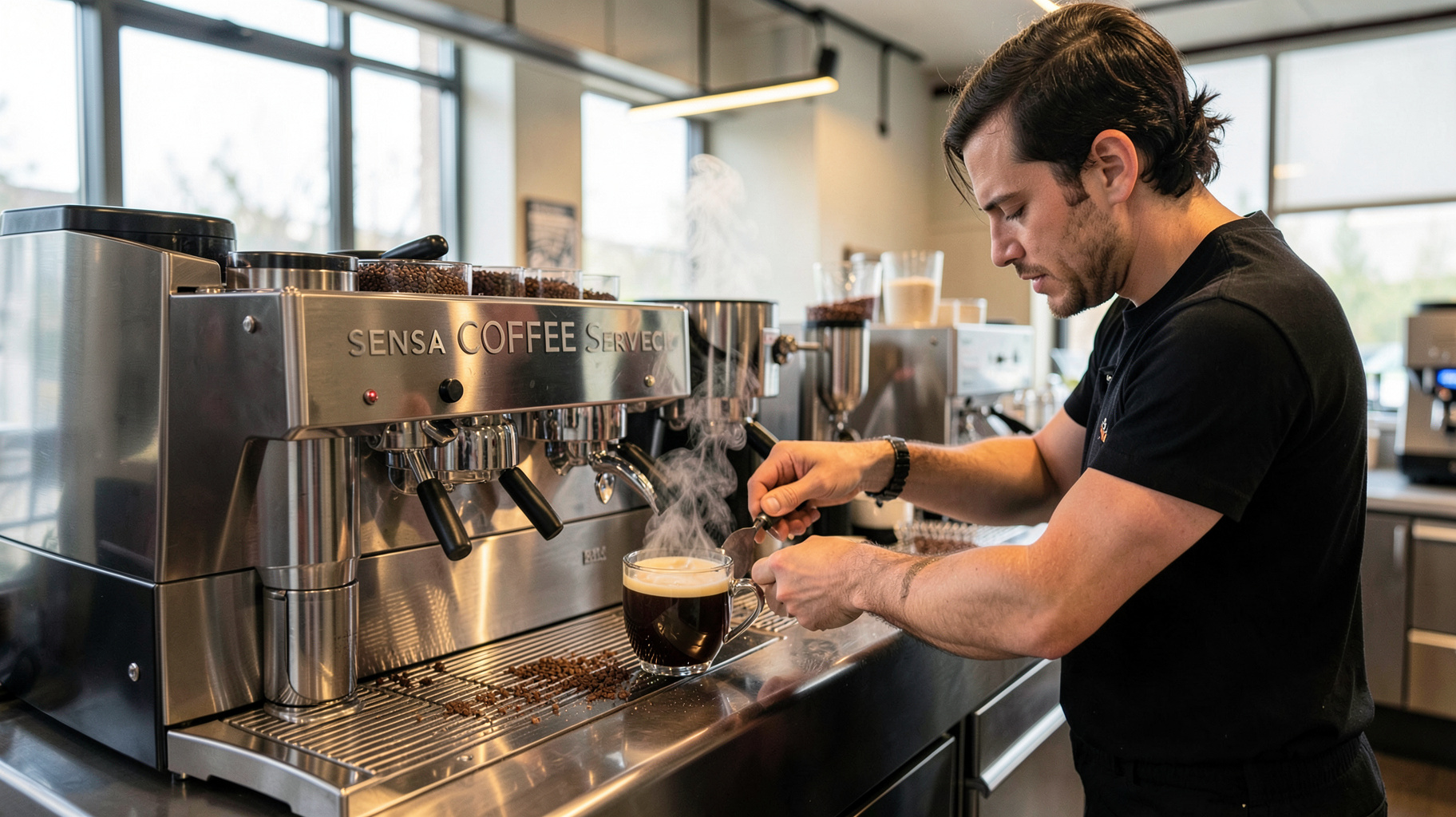
At Busy Bean Coffee, we've streamlined this process. Instead of the traditional "buy and pray" model, we provide premium SENSA equipment, professional installation, and full maintenance coverage for one predictable monthly fee. This removes the "When do I buy?" anxiety entirely because the equipment is managed and updated as part of a continuous service.
💡
Key Takeaway
Shift from a "Purchase Model" to a "Managed Model" to eliminate the risk of unplanned downtime and unpredictable capital expenditures.
The final step is the "Calibration Window." This is the 14-day period after installation where your baristas adjust their grind and dosing to the new hardware. If you install equipment the week before a major holiday or local event in Mount Pleasant, you are sacrificing quality for speed. Always allow a minimum of two weeks for dial-in before ramping up marketing efforts.

Comparing Equipment Acquisition Models
Deciding when to act is easier when you compare the long-term trajectories of different supply models. Most owners start with the traditional approach, but the risks scale as the business grows.
| Model | Pros | Cons | Best For |
|---|---|---|---|
| Traditional Purchase | Full ownership of asset | High upfront cost; maintenance is your problem | Small, low-volume hobby shops |
| Generic Leasing | Lower initial cost | High interest; rigid contracts; no service support | Short-term pop-ups |
| Managed Membership | No CapEx; full maintenance; predictable cost | Monthly recurring fee | Scaling professional cafes |
The mistake I made early on, and that I see constantly, is assuming that owning the machine is the same as controlling the coffee quality. In reality, the "Managed Membership" approach used by Busy Bean Coffee provides the highest level of control because it ensures the equipment is always running at peak efficiency. When you outsource the risk of failure to a provider who specializes in the equipment, you can focus on the art of the brew and the guest experience.
Common Misconceptions About Equipment Timing
Most guides get this wrong by suggesting you wait for "the right deal" or a sale to upgrade. In the specialty coffee world, a "deal" on a refurbished machine is often a liability in disguise.
Myth 1: "I can just wait for the machine to stop working."
This is a dangerous gamble. A machine rarely just "stops"; it begins to underperform. You lose quality, then you lose speed, and then you lose customers. By the time the machine is totally dead, you've already lost thousands in subtle revenue leakage.
Myth 2: "Newer isn't always better if the current machine still 'works'."
"Working" is not the same as "Optimized." Modern espresso machines and grinders offer precision that was impossible five years ago. If you are still using a manual-temp machine in 2026, you are leaving money on the table through wasted beans and inconsistent shots.
Myth 3: "Maintenance is an optional cost."
Maintenance is an insurance policy. According to NSF International, adherence to strict sanitary and mechanical standards is the only way to ensure equipment longevity. Skipping a quarterly service to save $200 can lead to a $5,000 boiler failure.
Frequently Asked Questions
When exactly should I start looking for a new cafe equipment supply?
You should begin the procurement process the moment your current equipment consistently operates at 80% of its maximum capacity during peak hours. For most cafes, this is signaled by increased customer wait times or a noticeable drop in beverage consistency. If you are planning a grand opening or a major expansion in Mount Pleasant, SC, you should secure your supply at least 90 days in advance. This allows for site preparation, electrical upgrades, and the critical "calibration window" where your staff learns the new hardware.
How do I know if my espresso machine is failing before it actually breaks?
Look for "Technical Drift." This manifests as longer recovery times for the steam wand, fluctuating shot times (even with the same grind), or an increase in scale buildup in your water lines. If your barista is having to "tweak" the machine more often just to get a standard shot, the internal components are degrading. In my experience, these subtle signs usually precede a total system failure by three to six months. Monitoring these trends allows you to schedule an upgrade without disrupting your service.
Is it better to buy equipment during the "off-season"?
Yes, from a logistical perspective. In coastal areas like Mount Pleasant, the summer surge creates a massive demand for technicians. If you wait until June to upgrade your cafe equipment supply, you will likely face longer lead times and higher installation costs. Scheduling your transition during the winter months ensures that you have the full attention of the installation team and that your staff is fully trained before the high-volume season arrives. It turns a potential crisis into a controlled strategic upgrade.
Should I prioritize the grinder or the espresso machine when upgrading?
While both are essential, the grinder is often the "unsung hero" of the workflow. If your grinder cannot keep up with the speed of your espresso machine, the machine is useless. However, if you are seeing a drop in flavor quality and temperature stability, the espresso machine is the priority. The most efficient path is a holistic upgrade. This is why Busy Bean Coffee provides an all-inclusive solution; we ensure that the grinder and machine are perfectly paired to avoid bottlenecks in your production line.
How does a managed membership change the timing of equipment updates?
A managed membership eliminates the "timing" problem entirely. Instead of waiting for a machine to fail and then scrambling for capital to replace it, you have a partner who monitors the health of your equipment. Because maintenance is included, the "break-fix" cycle is replaced by "preventative care." This means your equipment is updated or repaired before a failure occurs, ensuring that your cafe never suffers from unplanned downtime. It shifts the financial burden from a volatile CapEx to a stable OpEx.
Final Thoughts on Cafe Equipment Supply
The timing of your cafe equipment supply is the difference between a business that scales and one that struggles to survive its own success. Waiting for failure is not a strategy; it is a risk. Whether you are operating a small boutique shop or a high-volume foodservice operation in Mount Pleasant, SC, the goal is the same: eliminate the friction between the bean and the cup.
By focusing on throughput capacity and technical drift, you can predict exactly when your hardware will become a liability. The most sustainable way to handle this is to move away from the stress of ownership and toward the efficiency of a managed service.
If you are tired of guessing when your machines will fail or worrying about the cost of a sudden breakdown, it is time to explore a more professional approach. Busy Bean Coffee provides the equipment, the expertise, and the maintenance needed to keep your business running at peak performance. Stop managing machines and start managing your growth.
Recommended Readings
To deepen your understanding of these topics, we recommend reading the following articles:
- The Complete Guide to White Glove Coffee Service
- Ultimate Guide to All-Inclusive Coffee Service for Businesses
- Ultimate Guide to Automated Coffee Machines for Business
- Ultimate Guide to Specialty Coffee Equipment for Business
Free Coffee Pairing Guide & Specialty Roast Cheat Sheet
Unlock the secrets of perfect brewing ratios, water temperatures, and specialty roast profiles. Download the guide.