Which Maintenance Strategy is Best for Your Coffee Business?
The difference between a profitable morning rush and a catastrophic equipment failure usually comes down to a few grams of mineral buildup in a boiler. In my experience working with high-volume cafes and hotels, I've seen a $20,000 espresso machine become a glorified paperweight simply because the operator chose the "cheapest" maintenance path. When deciding which coffee equipment maintenance approach to adopt, the answer depends entirely on your volume and your tolerance for downtime. For most professional operations, a Managed Maintenance Membership is the gold standard, as it replaces unpredictable emergency repair costs with a fixed monthly operational expense.
For a comprehensive overview of how to optimize your entire beverage program, explore our complete guide to specialty coffee solutions.
What Exactly Constitutes Professional Coffee Equipment Maintenance?
To choose the right strategy, you first have to understand that professional maintenance is not just "cleaning." It is a tiered system of preventative and corrective actions designed to preserve the integrity of the brew and the longevity of the hardware.
📚
Definition
Coffee equipment maintenance is the scheduled process of cleaning, calibrating, and replacing worn components, such as gaskets, group head screens, and pump seals, to ensure a machine operates within the manufacturer's technical specifications.
Most operators mistake "backflushing" for maintenance. While backflushing is a daily requirement, true maintenance involves deep-system interventions. This includes descaling boilers to remove calcium carbonate, replacing water filters based on gallonage rather than dates, and calibrating grinder burrs to ensure consistent particle size. If you are using Coffea arabica (Arabica coffee), the oils are more complex and can build up more aggressively in the internal plumbing if not treated with professional-grade detergents.
According to the Specialty Coffee Association (SCA), strict adherence to equipment standards is the only way to ensure that the sensory profile of the coffee is not compromised by the machinery. When a machine is poorly maintained, the temperature stability fluctuates, and the extraction becomes uneven, meaning you are wasting expensive specialty coffee beans on a cup that tastes bitter or sour.

Why Does Your Choice of Maintenance Model Directly Impact Your Bottom Line?
The financial risk of choosing the wrong maintenance model is staggering. When an espresso machine goes down during a Saturday morning peak, you aren't just losing the cost of the coffee; you are losing the labor costs of your baristas who are standing idle and the potential lifetime value of customers who walk out the door because you can't serve them.
Research from the National Coffee Association USA (NCA) indicates that consistency in quality is the primary driver of customer retention in the specialty coffee sector. Maintenance is the invisible engine of that consistency. A machine with scale buildup in the heat exchanger will struggle to maintain a stable 200°F (93°C), leading to under-extracted shots.
In my experience, the mistake I see most constantly is the "Break-Fix" mentality. Business owners wait for the machine to leak or the pump to fail before calling a technician. This is the most expensive way to run a business. An emergency call-out fee, combined with the cost of expedited parts and lost revenue, often totals 5x to 10x the cost of a preventative maintenance contract. For instance, replacing a $15 group gasket every six months prevents a $500 leak repair and potential water damage to the surrounding cabinetry.
Furthermore, safety and compliance are non-negotiable. According to NSF International, commercial food and beverage equipment must meet strict sanitary standards to prevent bacterial growth. Neglected equipment, especially milk steaming wands and drainage trays, can lead to health code violations that jeopardize your business license.
How to Implement a High-Performance Maintenance Schedule
Implementing a maintenance plan requires a transition from reactive habits to a proactive system. Whether you are managing a single cafe or a large hotel chain in Mount Pleasant, SC, the framework remains the same: Daily, Weekly, Monthly, and Quarterly.
The Daily Protocol
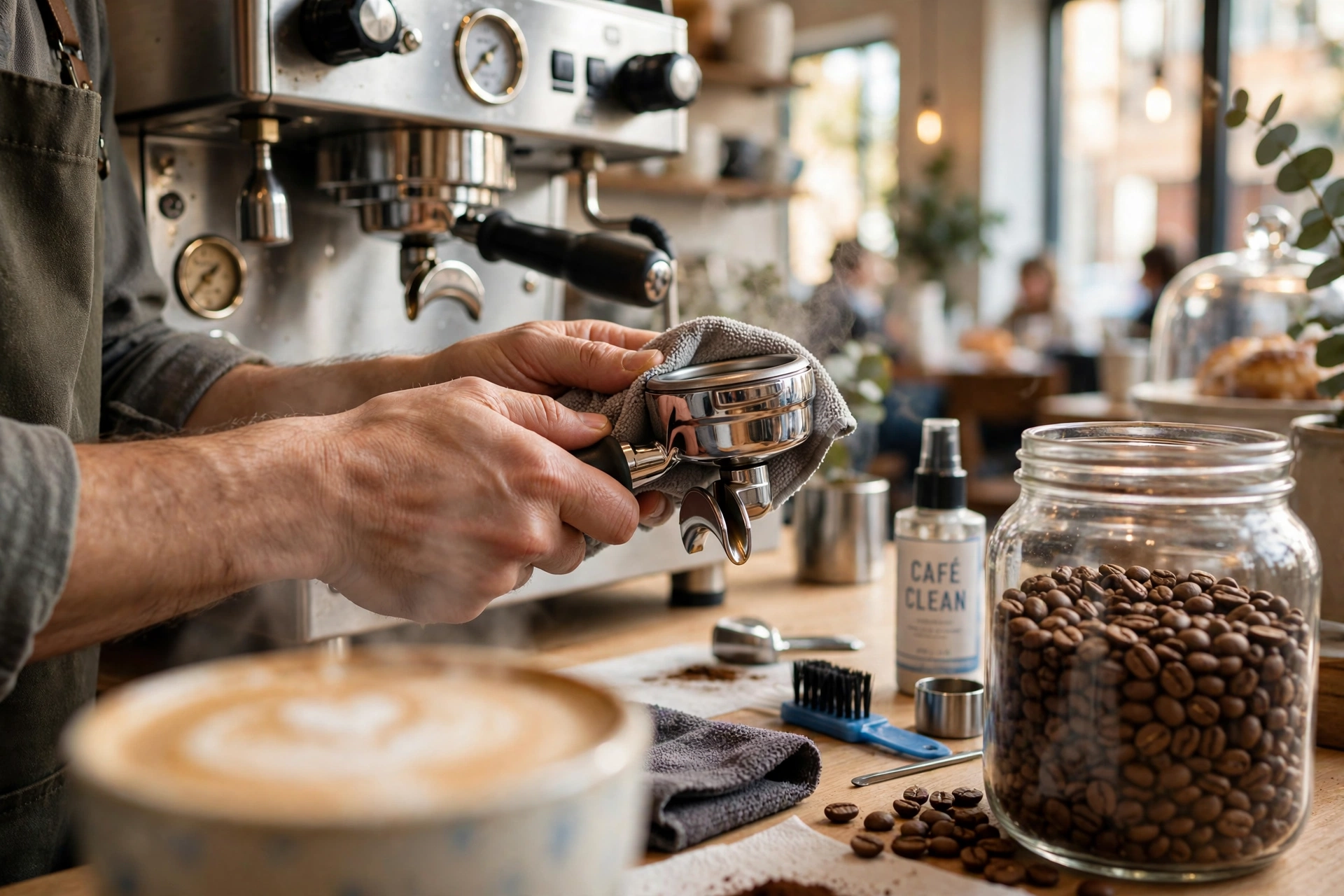
This is the "hygiene" phase. It includes backflushing the group heads with a blind filter and detergent, scrubbing the steam wands, and emptying the drip trays. If your staff skips this for even two days, the coffee oils oxidize and create a rancid flavor that no amount of high-quality roasting can hide.
The Weekly Protocol
Every seven days, you should perform a deeper soak of the portafilters and baskets. This removes the stubborn "coffee sludge" that accumulates in the crevices. You should also check the water filtration system's pressure gauges to ensure there is no blockage.
The Monthly and Quarterly Deep-Dive
This is where Busy Bean Coffee provides the most value. Quarterly maintenance involves opening the machine to check for leaks, replacing worn seals, and descaling the boilers. In a high-volume environment, the gaskets harden and crack. If they aren't replaced, you get "leaking" portafilters that create a mess and cause pressure drops.
💡
Key Takeaway
The most effective way to eliminate equipment downtime is to move from a "Break-Fix" model to a "Managed Membership" model, shifting the risk of hardware failure from the business owner to the service provider.
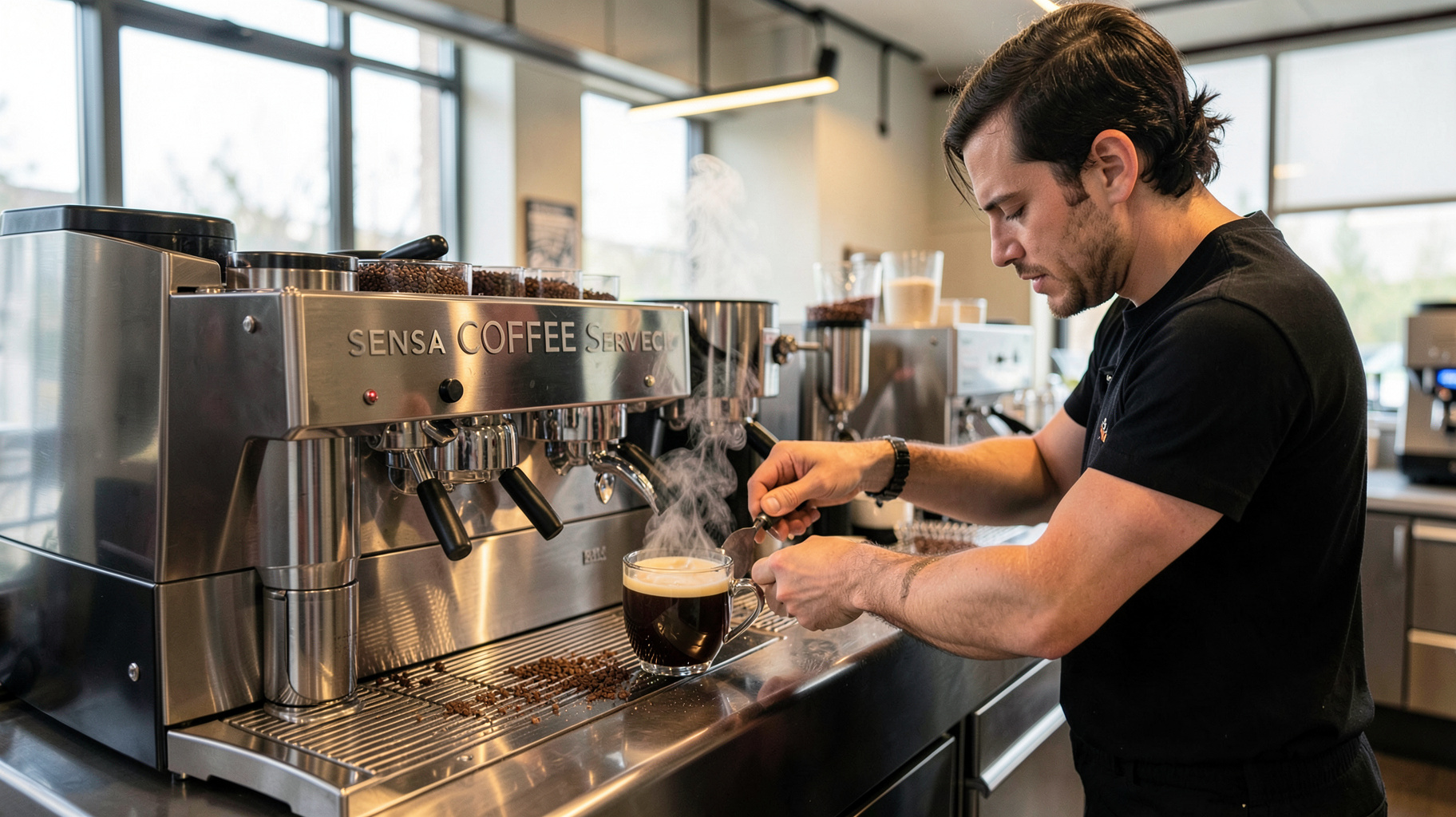
If you are using a managed solution from Busy Bean Coffee, this entire cycle is automated. We provide the SENSA equipment and handle the installation, maintenance, and professional calibration, so your team can focus on the art of being a barista rather than the mechanics of a boiler.

Which Maintenance Path is Right for You? (The Decision Framework)
Choosing between DIY, an on-call technician, or a managed membership depends on your scale and technical appetite. Most owners believe DIY is the cheapest, but they fail to account for the "hidden cost of incompetence", the time spent trying to fix a machine and making the problem worse.
Now, here is where it gets interesting: the "middle ground" (the on-call technician) is often the most dangerous. You are at the mercy of their schedule. If three other cafes in Mount Pleasant have a breakdown on the same day, you are third in line.
| Feature | DIY / Internal | On-Call Technician | Managed Membership (Busy Bean) |
|---|---|---|---|
| Upfront Cost | Low (Parts only) | Medium (Hourly rate) | Predictable Monthly Fee |
| Downtime Risk | High (Trial and error) | Medium (Wait for slot) | Low (Priority Support) |
| Expertise | Variable | Professional | Specialized Q-Grader Oversight |
| Equipment Quality | User's Choice | User's Choice | Premium SENSA Equipment |
| Scalability | Poor | Moderate | Excellent |
| Best For | Home enthusiasts | Very low-volume kiosks | Professional Foodservice/Hotels |
If you are running a commercial operation, the "Managed" approach is the only one that offers true peace of mind. It transforms your coffee service from a capital expense (buying expensive machines and paying for repairs) into an operational expense.
Common Misconceptions About Coffee Equipment Maintenance
Most guides get this wrong by suggesting that "more cleaning" is the same as "better maintenance." Here are the three most common myths I encounter in the field.
Myth 1: "If the coffee tastes fine, the machine is fine."
This is a dangerous assumption. Scale buildup in a boiler happens invisibly. You won't notice a change in taste until the scale creates a significant thermal barrier, causing the temperature to swing wildly. By the time you taste the difference, the boiler may be nearly choked, requiring a full tearday and expensive part replacement.
Myth 2: "Using distilled water prevents the need for maintenance."
While distilled water removes minerals, it can actually be too aggressive, leaching minerals from the metal components of your machine and causing corrosion. The goal is "balanced" water, enough minerals to protect the metal and enhance flavor, but not so many that they crystallize into scale. This is why professional water filtration is a core part of any maintenance strategy.
Myth 3: "Cheap generic detergents are just as good as professional ones."
Absolutely not. Generic detergents often leave a residue or, worse, contain chemicals that can etch the aluminum parts of your group heads. Professional-grade detergents are formulated to break down coffee lipids without damaging the machine's internal seals.
Frequently Asked Questions
How often should I realistically replace my group gaskets?
In a professional setting, gaskets should be replaced every three to six months, depending on your volume. Gaskets are made of rubber and are subject to constant heat and pressure. Over time, they lose their elasticity and "set," which leads to leaks around the portafilter. If you notice water dripping from the side of the group head during a shot, your gaskets have already failed. Waiting until they leak completely can lead to water entering the electronics of the machine.
Does the type of coffee bean affect how I maintain my equipment?
Yes, significantly. Different beans have different oil contents. For example, darker roasts generally produce more oils and "sludge" than lighter roasts. If you are serving a variety of specialty coffee roasts, you will find that the group heads clog more quickly. This requires a more aggressive backflushing schedule. Using high-quality coffee bean selections from a reputable roaster like Busy Bean Coffee ensures that the oils are clean and consistent, but the physical buildup remains a constant factor that requires professional cleaning.
Can I use vinegar for descaling my commercial espresso machine?
I strongly advise against using vinegar in commercial equipment. Vinegar is an acetic acid that can be too harsh on certain seals and can leave a lingering taste in the system that is incredibly difficult to flush out. Professional descaling agents are designed to target calcium and magnesium specifically without compromising the integrity of the copper or brass components in your boiler. Using the wrong chemical can lead to "pitting" in the metal, which creates permanent weak points in the boiler.
Why is water filtration considered part of maintenance?
Water filtration is the "first line of defense" in coffee equipment maintenance. Most equipment failures are caused by water chemistry. If your filter is saturated, minerals flow directly into your boiler, accelerating scale buildup. A professional filtration system doesn't just clean the water; it balances the mineral content to protect the machine and optimize the flavor of the espresso. Replacing filters based on the actual volume of water processed is a critical maintenance step that prevents 80% of common machine failures.
What is the difference between a "service" and a "repair"?
A repair is reactive; it happens after something has already broken. A service is preventative; it is a scheduled check-up designed to prevent the break from happening. A typical service includes checking all pressures, testing the heating elements, replacing worn O-rings, and calibrating the grind. When you choose a managed solution, you are paying for continuous service so that you never have to deal with a costly, unexpected repair.
Final Thoughts on Coffee Equipment Maintenance
Choosing the right approach to coffee equipment maintenance is not about finding the cheapest option, but about identifying the one that minimizes risk. For a professional business, the "WHICH" is clear: a managed service that combines premium hardware with expert oversight is the only way to ensure 100% uptime and consistent quality.
Whether you are upgrading a hotel lobby or launching a new cafe, don't let your hardware be the bottleneck of your growth. By shifting your focus from "fixing things when they break" to a managed membership, you protect your margins and your brand.
Ready to stop worrying about equipment failure? Experience the peace of mind that comes with a fully managed coffee solution. Visit Busy Bean Coffee to see how our all-inclusive memberships can transform your beverage service.
Recommended Readings
To deepen your understanding of these topics, we recommend reading the following articles:
- The Complete Guide to White Glove Coffee Service
- Ultimate Guide to All-Inclusive Coffee Service for Businesses
- Ultimate Guide to Automated Coffee Machines for Business
- Ultimate Guide to Specialty Coffee Equipment for Business
Free Coffee Pairing Guide & Specialty Roast Cheat Sheet
Unlock the secrets of perfect brewing ratios, water temperatures, and specialty roast profiles. Download the guide.