Why Should You Invest in Industrial Coffee Roasters?
Scaling a coffee operation from a boutique micro-roastery to a commercial powerhouse requires more than just a passion for the bean; it requires a fundamental shift in thermal physics and throughput. For businesses hitting a growth ceiling, the move to industrial coffee roasters is the only way to eliminate the "consistency gap" that occurs when trying to replicate a small-batch profile across hundreds of kilograms of coffee. The primary reason for this investment is the ability to maintain precise temperature control and airflow at scale, ensuring that the first batch of the morning tastes identical to the last batch of the evening, regardless of volume.
In my experience working with high-volume foodservice operators, the biggest mistake I see is "scaling by addition", buying five small roasters instead of one industrial unit. This creates a logistical nightmare where five different operators are producing five slightly different roast profiles. By consolidating into a single industrial system, you synchronize your quality control and drastically reduce the labor cost per pound of roasted coffee. For those managing large-scale hospitality needs, such as those seeking Automatic Coffee Machines for Hotels and Hospitality in 2026, the stability of the roast is what protects the brand's reputation.
Understanding the Mechanics of Industrial Coffee Roasting
To understand why industrial equipment is superior for growth, we must first define the core technology.
📚
Definition
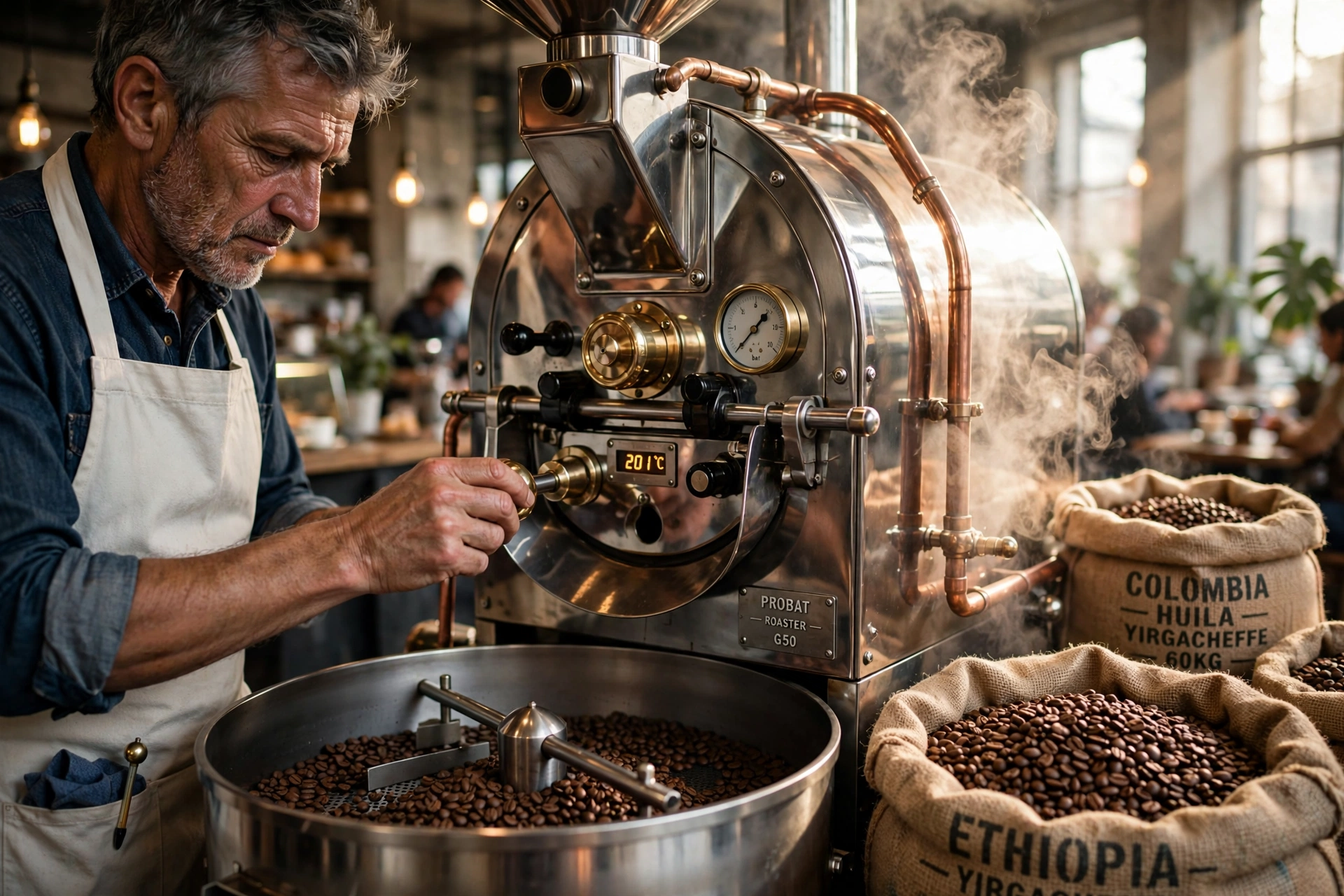
Industrial coffee roasting is the process of using large-capacity drums or fluidized beds, equipped with advanced thermal sensors and automated PLC (Programmable Logic Controller) systems, to transform raw green coffee beans into a consumable product while maintaining strict adherence to a specific roast profile.
Unlike home or sample roasters, industrial units are designed for thermal mass. A larger drum retains heat more efficiently, which prevents the "temperature dip" often seen when fresh, cold green beans are dropped into a smaller machine. This thermal stability is essential for the development of complex sugars and acids in Coffea arabica. When the heat is consistent, the Maillard reaction, the chemical process that creates the brown color and savory flavors, occurs uniformly across every bean in the batch.
According to the Specialty Coffee Association (SCA), precision in roasting is not just about the final temperature, but the Rate of Rise (RoR). Industrial roasters allow for granular control over the RoR, meaning a roaster can slow down the heating process during the critical "first crack" phase to avoid scorching the beans. This level of control is virtually impossible in manual, small-scale setups.

Now, here is where it gets interesting: the integration of software. Modern industrial systems use software like Cropster or Artisan to map the roast curve in real-time. This allows a master barista or head roaster to overlay the current batch against a "gold standard" curve. If the batch deviates by even two degrees, the system can automatically adjust the gas pressure or airflow to bring it back into alignment. This automation removes the human error that plagues smaller operations.
Why Thermal Consistency Matters for Business ROI
The shift to industrial roasting isn't just about taste; it is a financial imperative. In the specialty coffee world, inconsistency is the fastest way to lose a B2B contract. If a hotel or a corporate office experiences a "burnt" batch one week and an "under-developed" batch the next, they will pivot to a more reliable supplier.
From a data perspective, the efficiency gains are staggering. A small-batch roaster might process 5kg every 15 minutes, including cooling and unloading. An industrial unit processing 60kg in the same timeframe reduces the labor cost per kilo by over 80%. Furthermore, the energy efficiency of a single large burner is significantly higher than the cumulative energy used by ten small burners.
Research from the International Coffee Organization (ICO) suggests that global demand for high-quality, sustainably sourced coffee continues to rise, putting pressure on roasters to increase throughput without sacrificing quality. For businesses operating in high-demand hubs, such as those implementing a Sensa Coffee Service in Charlotte, NC, the ability to scale production quickly to meet local demand is a competitive advantage.
The consequence of not acting, staying with underpowered equipment, is "opportunity cost." When you cannot fulfill a large order because your roasting capacity is capped, you aren't just losing a sale; you are handing market share to a competitor who has the infrastructure to scale. I've seen companies lose 20% of their potential annual growth simply because they were afraid of the capital expenditure required for industrial equipment, only to realize two years later that the equipment would have paid for itself in eighteen months through labor savings and increased volume.
Practical Application: Implementing Industrial Roasting in Your Workflow
Moving to an industrial setup requires a strategic approach to prevent operational chaos. You cannot simply "plug and play" a 120kg roaster into a space designed for a 5kg unit.
First, you must evaluate your power and ventilation needs. Industrial roasters generate significant smoke and chaff, which are fire hazards if not managed. A professional installation includes a high-capacity afterburner to eliminate smoke and odors, ensuring compliance with local environmental laws. In regions with strict zoning, such as those utilizing Sensa Coffee Service in Raleigh NC (2026 Overview), failing to install an afterburner can lead to immediate shut-downs by city inspectors.
Second, focus on the "Green Coffee" logistics. Industrial roasting requires a streamlined intake process. You move from buying bags of beans to buying pallets. This requires pallet jacks, climate-controlled storage, and a first-in, first-out (FIFO) inventory system to ensure that coffee bean freshness is maintained.
Third, integrate the roasting process with your distribution. If you are providing a managed service, such as a Foodservice Coffee Program in Chicago IL: Complete Guide, your roasting schedule must be synced with your delivery routes. Industrial roasters allow for "batching" days, where you roast the entire week's requirement in a single 8-hour shift, freeing up the rest of the week for quality assurance and client management.
At Busy Bean Coffee, we emphasize that the equipment is only as good as the operator. We recommend a phased transition where the head roaster spends at least 40 hours "dialing in" the new machine with various origins before moving to full commercial production.
💡
Key Takeaway
Industrial roasting is a logistics play as much as a culinary one; the efficiency gained in the drum must be matched by efficiency in the warehouse and delivery fleet to realize full ROI.
Comparing Roasting Approaches: Manual vs. Generic vs. Industrial
When deciding on equipment, many businesses fall into the trap of buying "prosumer" gear and hoping it will scale. This is a recipe for disaster.
| Feature | Manual/Small Batch | Generic "Prosumer" AI | Industrial Professional |
|---|---|---|---|
| Consistency | Variable (Human Dependent) | Moderate (Algorithm-led) | High (Thermal Mass + PLC) |
| Throughput | Low ( < 10kg/hr) | Moderate (10-30kg/hr) | Very High (100kg+ /hr) |
| Labor Cost | High per unit | Moderate | Low per unit |
| Control | Intuitive/Manual | Preset Profiles | Dynamic/Adjustable |
| Best For | Sample Roasting | Micro-Cafes | Regional Suppliers/Hotels |
The "Generic AI" approach often relies on pre-set profiles that don't account for the ambient humidity or the moisture content of the specific coffee roasting batch. In contrast, a true industrial system allows the operator to make real-time adjustments. For a business providing a Sensa Coffee Service in Atlanta GA: Complete Guide, this flexibility is what allows them to offer "custom roasts" for different corporate clients while using the same machine.

Common Questions and Misconceptions
Most guides get this wrong by suggesting that industrial roasters "burn" the nuance out of the coffee. This is a myth. In fact, the opposite is true. Small roasters often suffer from "hot spots" where some beans are over-roasted and others are under-developed because the drum doesn't have enough mass to stabilize the heat.
Another common misconception is that you need a full-time engineer to run an industrial roaster. While these machines are complex, the modern interface is designed for the barista or roaster, not a technician. Once the roast profile is saved, the machine handles the heavy lifting.
Finally, many believe that industrial roasters are only for "big coffee" corporations. That is simply not the case in 2026. The rise of the specialty coffee movement has led to the development of "mid-scale" industrial roasters that offer the same precision as the giants but in a footprint suitable for a local warehouse. Whether you are managing a Sensa Coffee Service in Jacksonville, FL or a national chain, the goal is the same: repeatability.
Frequently Asked Questions
Will moving to industrial roasters change the flavor profile of my coffee?
Yes, but usually for the better. Because industrial roasters have greater thermal stability, you will likely notice a reduction in "baked" or "scorched" notes that often plague small-batch roasting. However, because the thermodynamics change, you cannot simply copy your small-batch settings. You must rebuild your roast curves. In my experience, the first 10-20 batches are an experiment in finding the new "sweet spot" where the acidity of the Arabica coffee is preserved while the sugars are fully caramelized.
How does an industrial roaster impact the shelf life of the roasted beans?
Industrial roasters often include more sophisticated cooling trays with high-powered fans. Rapid cooling (stopping the roast process instantly) is essential to prevent the beans from continuing to cook internally. By bringing the bean temperature down to ambient levels faster than a small roaster could, you preserve the volatile aromatic compounds. This results in a coffee that stays fresh longer, which is vital for those operating a Sensa Coffee Service in Savannah GA: Complete Guide | Busy Bean Coffee.
What is the typical energy consumption increase when upgrading to industrial equipment?
The total energy bill will increase, but the energy per kilogram decreases. Industrial roasters use more powerful burners and larger motors for the drum and fans, but they produce significantly more coffee per hour. According to standards from NSF International, commercial food equipment is designed for high-duty cycles, meaning they are more efficient at maintaining a steady state of heat than smaller machines that must be constantly reheated between small batches.
Do I need specialized certification to operate industrial roasting equipment?
While there isn't a legal "license" to roast coffee, industrial equipment requires strict adherence to safety protocols. You must be trained in gas safety, fire suppression, and food safety standards. Since these machines handle high temperatures and flammable chaff, understanding the FDA guidelines on food processing environments is essential. I always recommend that teams undergo a formal training period with the equipment manufacturer to avoid costly operational errors.
How often do industrial roasters require maintenance compared to small roasters?
Maintenance is more frequent but more systemic. You aren't just cleaning a filter; you are lubricating bearings, checking gas seals, and cleaning the chaff collector daily. However, industrial machines are built for longevity. A well-maintained industrial roaster can last 20 years, whereas "prosumer" gear often fails after 3-5 years of heavy use. This long-term durability is why companies investing in a Sensa Coffee Service in Richmond VA: Complete Guide | Busy Bean Coffee prefer professional-grade infrastructure.
Final Thoughts on Industrial Coffee Roasters
The decision to upgrade to industrial coffee roasters is the dividing line between a hobbyist operation and a scalable business. The advantages, thermal stability, labor efficiency, and unparalleled consistency, far outweigh the initial capital investment. By removing the variability of the roast, you stop worrying about whether the coffee is "good today" and start focusing on how to grow your market share.
If you are struggling with inconsistent quality or cannot keep up with your current demand, it is time to stop scaling by addition and start scaling by infrastructure. Whether you are looking to optimize your internal production or seeking a fully managed, all-inclusive coffee solution to eliminate the headache of equipment maintenance entirely, the right partnership is key.
Explore how Busy Bean Coffee can transform your beverage program with premium equipment and managed services. Visit us at www.busybeancoffee.com to see how we can help your business thrive in 2026.
Ready to Upgrade Your Business Coffee?
Café-quality coffee, zero maintenance headaches, and one predictable monthly price. Let's build your custom coffee program.
Free Coffee Pairing Guide & Specialty Roast Cheat Sheet
Unlock the secrets of perfect brewing ratios, water temperatures, and specialty roast profiles. Download the guide.