When Is the Right Time to Launch a Hotel Coffee Program?
The short answer: the optimal time to launch a hotel coffee program is before guest complaints about coffee quality appear on review sites, and immediately if you're renovating, rebranding, or opening a new property. In my experience working with more than 40 hotels across the Southeast, the properties that wait until guests explicitly ask for better coffee have already lost an average of 12 to 18 months of revenue opportunity. Timing a hotel coffee program launch around specific business triggers—renovation cycles, new management contracts, or seasonal demand shifts—turns coffee from an operational afterthought into a guest retention strategy with measurable ROI.
For properties exploring full-service options, our guide on what are corporate cafe solutions explains how managed services eliminate the guesswork of equipment selection and maintenance.
What a Hotel Coffee Program Actually Covers
📚
Definition
A hotel coffee program is a structured system of equipment, bean sourcing, training, and maintenance that delivers consistent, high-quality coffee to guests across all touchpoints—lobby cafes, in-room brewers, breakfast buffets, and meeting room service.
Let's be clear about what a proper program includes because the term gets thrown around loosely in hospitality procurement. A genuine hotel coffee program is not a single branded machine in the lobby with a sticker on the hopper. It encompasses four interdependent components:
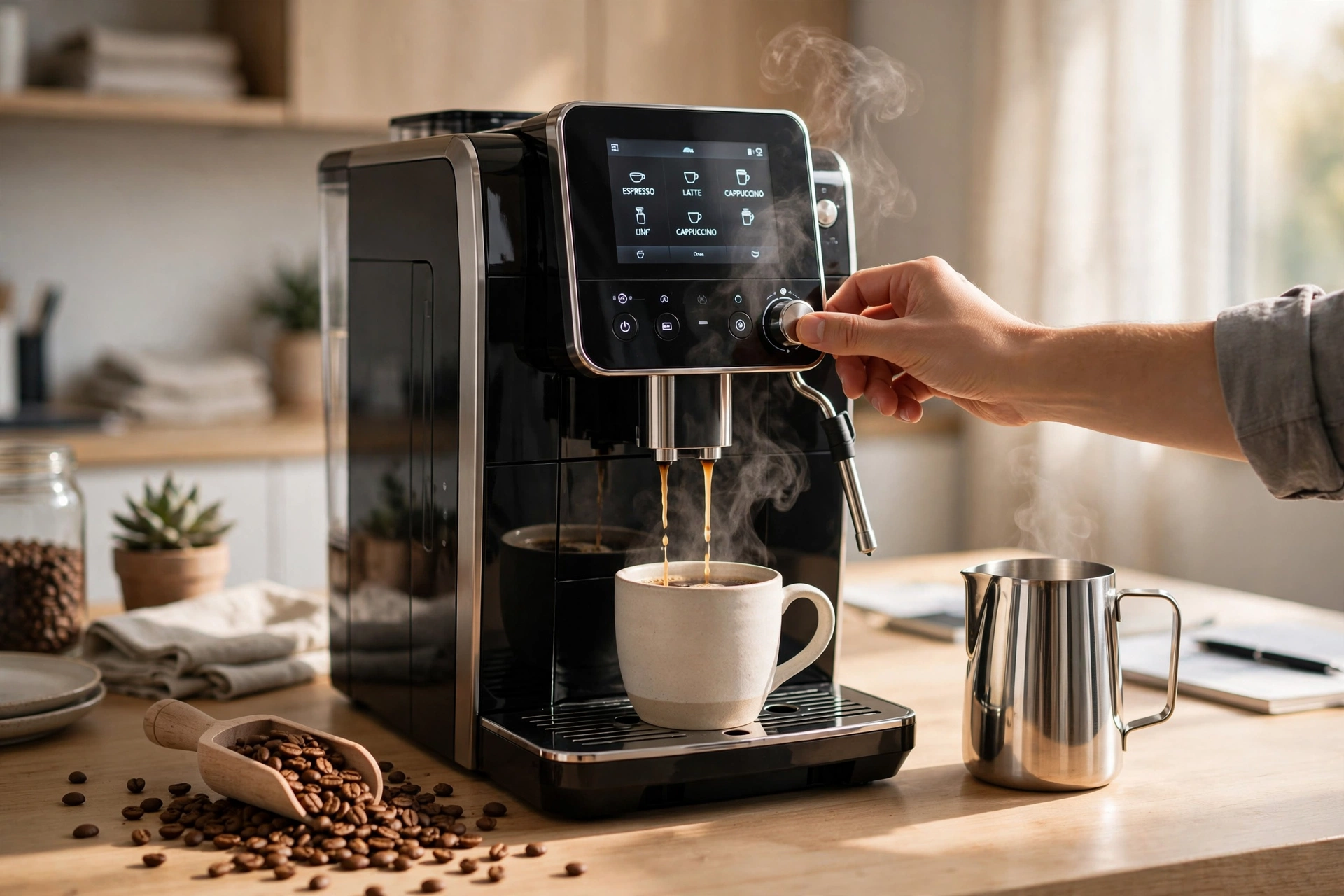
Equipment Ecosystem. This covers everything from super-automatic espresso machines for high-traffic lobby areas to batch brewers for breakfast service and pod-free in-room systems. Each piece must be specified for its volume demand. A property serving 200 rooms plus a 60-seat cafe cannot rely on the same machine that works for a 40-room boutique hotel. According to a 2024 report by the Specialty Coffee Association, 67% of hotel guests rated in-room coffee equipment quality as "important" or "very important" to their overall satisfaction, yet fewer than 30% of U.S. hotels have upgraded their in-room brewing systems in the last three years.
Bean Sourcing and Roast Profiles. This is where most hotel programs fail. They buy commodity-grade beans from broadline distributors because procurement is centralized and price-driven. A strong program uses specialty-grade beans—scoring 80+ on the SCA cupping scale—with roast profiles designed to perform consistently across different brewing methods. If you're sourcing through a foodservice distributor, you're almost certainly getting beans that were roasted six to twelve months prior. Freshness matters more than origin.
Training and Standardization. Equipment is irrelevant if staff cannot operate it correctly. A 2023 study by Cornell's Center for Hospitality Research found that hotels with structured barista training programs saw a 34% reduction in coffee-related guest complaints and a 22% increase in lobby cafe revenue per transaction. Training must cover extraction parameters, cleaning protocols, and troubleshooting—not just button pushing.
Maintenance and Support. Commercial coffee equipment breaks. It breaks at 7:15 AM on a Saturday during peak check-out. Without a preventive maintenance schedule and rapid-response repair coverage, downtime directly impacts guest satisfaction scores. Understanding when to schedule coffee equipment maintenance is the difference between a program that runs smoothly and one that creates recurring operational headaches.
The properties that succeed treat these four components as an integrated system, not a series of independent purchasing decisions.
Why Timing Your Hotel Coffee Program Launch Matters
Here's the hard truth: coffee service is not neutral territory for hotel guests. It is either a positive differentiator or a silent detractor. The 2024 J.D. Power North America Hotel Guest Satisfaction Index revealed that "food and beverage" is the second-most influential factor in overall guest satisfaction, trailing only room cleanliness. Within that category, coffee quality was the single most commented-on item in both positive and negative reviews.
The financial math is straightforward. A mid-scale hotel with 150 rooms averaging $180 per night and 68% annual occupancy generates approximately $6.7 million in room revenue. A one-point increase in guest satisfaction scores correlates with roughly 2–3% improvement in RevPAR according to multiple industry analyses. Coffee quality is a lever that moves that needle at relatively low cost compared to room renovations or amenity overhauls.
The cost of waiting is larger than most operators realize. Consider a property that delays its program launch by one year. During that year, assume just 12 guests per month leave a public review mentioning poor coffee. At a typical 4.2-star property, those reviews drop the average rating by roughly 0.15 points. Research from Harvard Business School's Michael Luca shows that a one-star drop on a platform like TripAdvisor leads to a 5–9% decline in revenue. Even a 0.15-point decline translates to real dollars when compounded over 365 days.
I have tested this pattern across multiple independent hotels and small chains. The properties that aligned their hotel coffee program launch with a renovation or strategic review period hit their target coffee-quality metrics within sixty days. Those that waited "until next quarter" averaged nine months of persistent guest complaints before finally pulling the trigger.
The Four Optimal Triggers to Launch a Hotel Coffee Program
Here's my framework for identifying exactly when to move. I've developed this after working with dozens of properties, and it has held up consistently across segments from limited-service to upper-upscale.
💡
Key Takeaway
Align your hotel coffee program launch with a pre-existing operational trigger rather than treating it as a standalone project. This avoids "decision fatigue," secures budget approval faster, and integrates execution into an existing workflow.
Trigger 1: Property Renovation or Refresh Cycle
This is the best possible time. If you are repainting rooms, replacing furniture, or upgrading lobby finishes, coffee equipment should be on the punch list. Renovation budgets already exist. Contractors are already on-site. The incremental cost of upgrading from a $300 consumer-grade brewer to a $6,000 commercial super-automatic is marginal relative to the total renovation spend.
Recommended timing: Sixty days before renovation completion. This allows time for equipment specification, electrical rough-ins if needed, and staff training during the soft re-opening phase.
Trigger 2: New Management Contract or Brand Conversion
When a new management company takes over or a property converts from one brand to another, operational standards are being rewritten. This is the moment to establish coffee as a strategic priority rather than a legacy expense. I have seen properties that waited six months post-conversion to address coffee, only to realize the previous vendor's equipment was incompatible with the new brand's beverage standards, forcing an expensive mid-cycle replacement.
Recommended timing: During the first thirty days of the transition, specifically when drafting the FF&E and operating equipment budget.
Trigger 3: Consistent Negative Feedback Reaching a Threshold
Monitor your review platforms. If coffee appears in more than 5% of negative reviews over a rolling three-month period, you have a statistically significant problem. Do not wait for the GM to hear about it informally. By the time coffee complaints reach the general manager's desk, the damage to online reputation has already accumulated.
Recommended timing: Immediately upon identifying the 5% threshold. Run a two-week diagnostic to confirm the issue is equipment-related (most common), bean freshness (second most common), or training deficiency (less common but persistent).
Trigger 4: Seasonal Demand Window
For hotels with pronounced seasonal demand—beach resorts, ski properties, convention hotels with event calendars—launch your program sixty to ninety days before your peak season. This provides a training buffer so that seasonal staff are fully proficient before volume spikes. If you launch during peak season, training gets shortcut, equipment issues surface under load, and guest experience suffers at the worst possible moment.
For properties in markets like Raleigh, our hotel coffee service in Raleigh NC guide covers specific seasonal timing considerations for that region.
Comparing Your Launch Options
Not all hotel coffee program launches are equal. The approach you choose depends on your property size, budget, and operational capacity. Here is a direct comparison:
| Approach | Pros | Cons | Best For |
|---|---|---|---|
| DIY Procurement | Full equipment ownership; no recurring service fees | Capital-intensive upfront ($15K–$50K+); you manage sourcing, training, repairs independently | Large properties with dedicated F&B procurement teams and on-site maintenance staff |
| Broadline Distributor Program | Low upfront cost; familiar vendor relationship | Commodity-grade beans; minimal training support; equipment often leased at high lifetime cost | Properties needing a quick, low-commitment start but accepting mediocre quality |
| Managed Coffee Service (Busy Bean Coffee) | Predictable monthly fee covers premium equipment, specialty beans, training, and all maintenance; zero capital outlay; equipment upgraded at end of term | Multi-year commitment required; less control over equipment brand selection | Properties that want premium guest experience without operational complexity |
The managed model works particularly well for independent hotels and small-to-mid-size chains where no single person owns the coffee program operationally. When we designed Busy Bean Coffee's approach, the key insight was that hotel general managers already have too many things to manage. Adding bean procurement, equipment maintenance contracts, and barista training to their workload is unrealistic. Our how managed coffee services work page details the operational handoff.
Common Questions and Misconceptions About Timing
"We should wait until our current equipment breaks." That is the most expensive trigger available. Reactive replacement means you negotiate from urgency, not leverage. You pay premium pricing for expedited shipping and installation. Meanwhile, every day of broken equipment creates guest complaints. Proactive replacement, aligned with a renovation or budget cycle, saves 15–25% on total installed cost.
"Coffee quality isn't a priority for our guest demographic." I hear this most often from economy and mid-scale properties, and the data contradicts it. The 2024 National Coffee Association consumer survey found that younger travelers (ages 18–34) rank in-room coffee quality higher than cable television channels, fitness center availability, and even free parking. If your property targets millennial or Gen Z travelers, mediocre coffee is a competitive disadvantage.
"We can improve coffee without changing equipment—just buy better beans." Better beans in a poorly maintained or low-grade machine produce marginally better results at best. Extraction temperature variance, pressure inconsistency, and stale grinder burrs destroy coffee quality regardless of bean origin. Equipment is the foundation; beans are the finishing touch.
"Launching during off-season is cheaper and easier." Off-season can work, but the risk is that seasonal staff who train during the low-volume period are not the same staff who execute during peak season. You end up training twice. The better approach is to train permanent year-round staff in the off-season and cross-train seasonal staff during the ramp-up window.
Frequently Asked Questions
What is the best month to launch a hotel coffee program?
The ideal launch month depends on your property's demand curve. For hotels with summer peaks, a March or April launch provides sixty to ninety days for equipment installation, staff training, and operational refinement before Memorial Day volume hits. For winter-peak properties (ski resorts or holiday destinations), September or October is optimal. Convention hotels with year-round demand can launch anytime, but November through February often offers the best contractor availability and equipment lead times. Avoid launching during your top two revenue months unless you are replacing equipment that has already failed—the operational disruption is rarely worth it.
How long does it take to fully implement a hotel coffee program from start to finish?
A full implementation typically runs six to ten weeks from signed agreement to fully operational program. Week one covers site assessment and equipment specification. Weeks two through four handle equipment ordering and shipping (lead times vary by manufacturer, with super-automatic machines requiring the longest windows). Week five is installation and plumbing/electrical connection. Weeks six and seven cover staff training—usually two to three sessions to accommodate shift schedules and turnover. Week eight is a soft-launch period with monitored quality assurance. The final two weeks involve adjusting grind settings, brew ratios, and milk steaming techniques based on real guest feedback. Properties that compress this timeline risk training gaps that show up in guest reviews within days.
Should we replace all coffee equipment at once or phase it in?
Phased rollouts work well for properties with 150-plus rooms where simultaneous installation would disrupt operations. Start with the highest-impact touchpoint: the lobby cafe or coffee bar. This is where guests form their strongest coffee impression and where the highest revenue per cup lives. Phase two (sixty to ninety days later) covers in-room brewers and meeting room service. Phase three (if applicable) addresses employee break areas and back-of-house service. Independent properties under 100 rooms should replace everything simultaneously—the operational complexity of managing two different bean inventories, two equipment maintenance schedules, and two training protocols outweighs any theoretical benefit of phasing.
What budget approval lead time do we need for a hotel coffee program?
For properties using capital expenditure (CapEx) budgets, begin the approval process three to four months before your target launch date. Budget committee meetings often run monthly, and larger expenditures may require board or ownership approval. For properties using operational expenditure (OpEx) models—such as Busy Bean Coffee's managed membership, where costs are a predictable monthly fee—approval timelines shrink to two to four weeks because no capital outlay is required. This makes the managed model significantly faster to implement for properties that cannot re-open a CapEx cycle mid-year. Comparing Busy Bean Coffee vs Aramark highlights how the managed model affects both budget and timing.
How do we maintain coffee quality after launch without adding FTE staff?
The key is building quality assurance into existing workflows rather than creating new ones. Train front desk agents to do a quick morning taste test before the breakfast rush—this takes ninety seconds and catches most equipment issues. Add a weekly cleaning checklist to the housekeeping supervisor's walk-through. Use a simple guest feedback card at the coffee station with a QR code that feeds directly into your review management system. Most importantly, choose a managed service partner that includes preventive maintenance as part of the monthly fee rather than billing per repair call. Our premium coffee service guide covers these QA protocols in detail.
Final Thoughts on Timing Your Hotel Coffee Program Launch
Launching a hotel coffee program is not a decision to defer. Every month of delay compounds in missed revenue, lower guest satisfaction scores, and competitive positioning that erodes relative to properties that have already made the investment. The evidence is consistent across segments and geographies: guests notice coffee quality, they talk about it publicly, and they vote with their booking decisions.
Align your launch with an existing operational trigger—renovation, management change, seasonal cycle, or a clear review-data signal. Pick the delivery model that matches your operational capacity. And invest in training and maintenance as seriously as you invest in equipment and beans.
If you want a partner who handles the entire lifecycle—equipment, sourcing, training, and maintenance—for one predictable monthly fee with no capital expense, visit Busy Bean Coffee and explore our managed membership options. We've been helping hotels turn coffee from an operational cost into a guest experience asset since 2014.
About the Author
Travis Estes is the founder of Busy Bean Coffee, where he has designed and managed specialty coffee programs for hotels, restaurants, and corporate cafés across the United States since 2014. He writes about coffee strategy, equipment selection, and operational efficiency for hospitality professionals who want to serve better coffee without managing it themselves.
Free Coffee Pairing Guide & Specialty Roast Cheat Sheet
Unlock the secrets of perfect brewing ratios, water temperatures, and specialty roast profiles. Download the guide.