📖This article is part of the complete guide to The Ultimate Guide to Coffee Service for Restaurants.
In my experience working with high-volume diners and boutique bistros, the gap between a 'coffee that tastes okay' and a signature beverage program usually comes down to one thing: thermal stability. I've seen operators spend thousands on premium beans only to have the flavor profile destroyed by an espresso machine with poor PID control or a grinder that generates too much heat during the roast-to-cup process. If your equipment cannot maintain a consistent temperature within 0.5 degrees, your specialty coffee is essentially a commodity product.
For a comprehensive overview of how to integrate these tools into your business, explore our guide on coffee service for restaurants.
What is Specialty Coffee Equipment for Restaurants?
📚
Definition
Specialty coffee equipment for restaurants refers to professional-grade hardware specifically engineered to extract the complex flavor profiles of high-scoring specialty coffees (typically 80+ points on the SCA scale) while enduring the rigorous demands of a commercial environment.
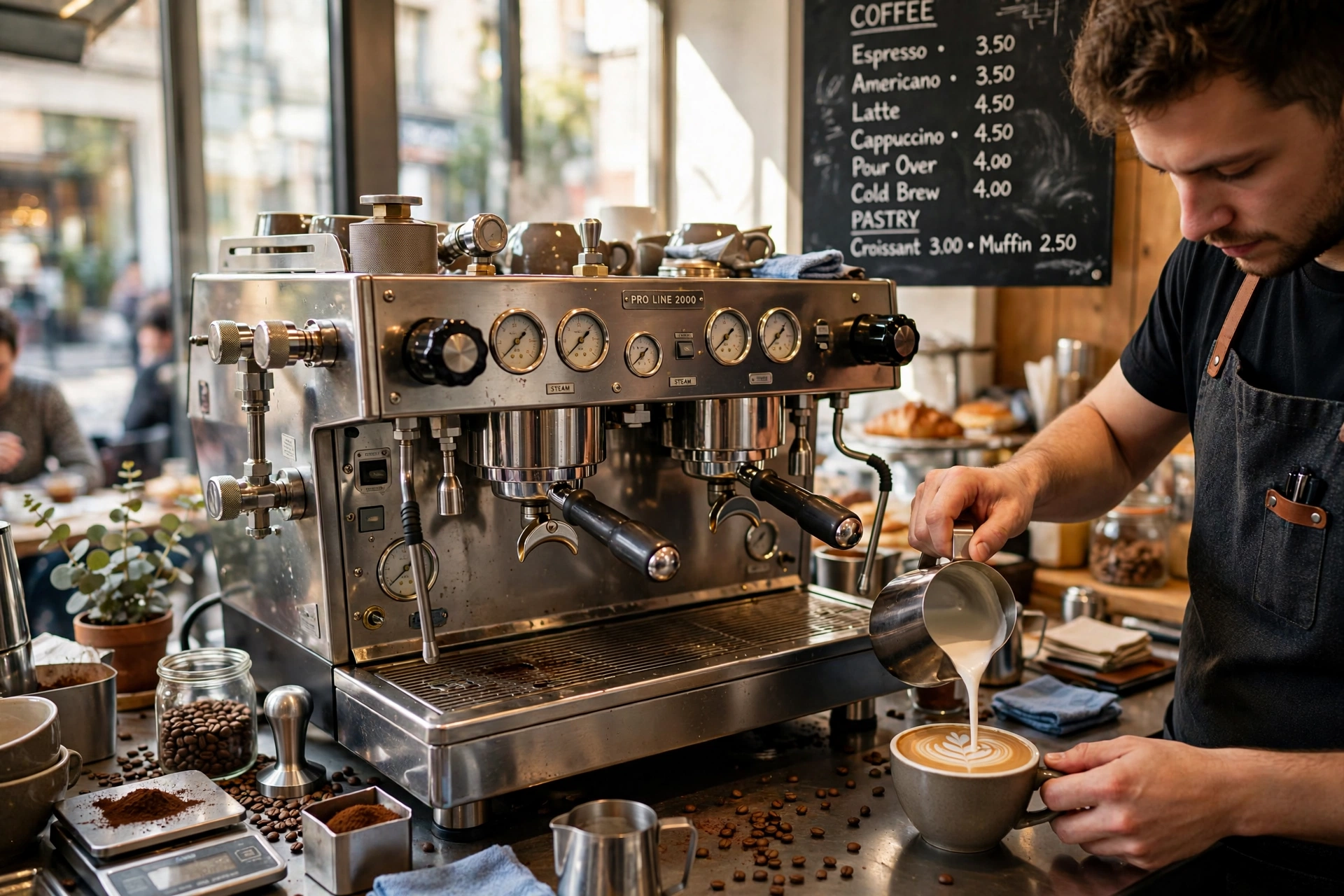
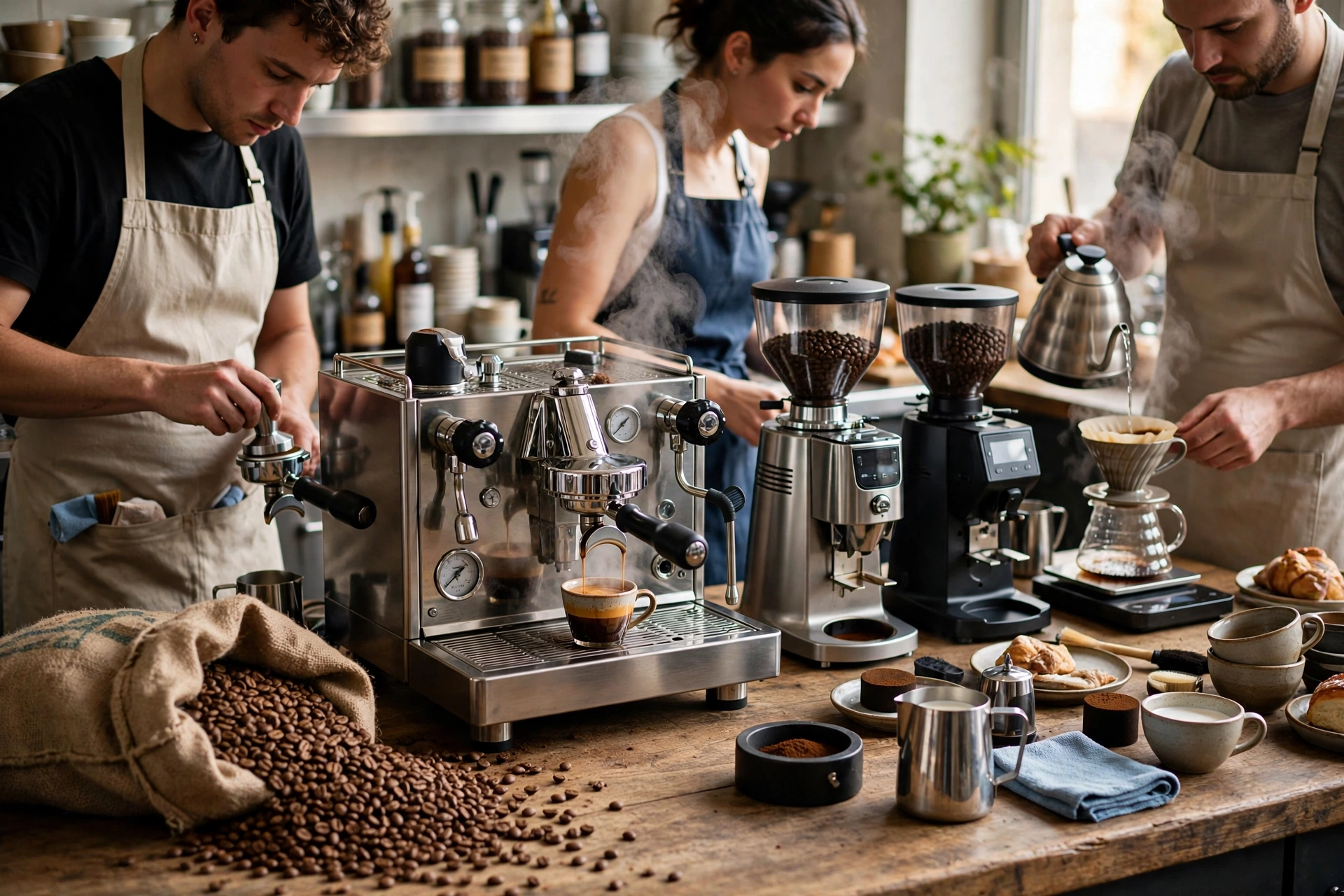
Specialty coffee equipment for restaurants is not merely 'commercial' gear; it is a precision instrument. While a standard industrial brewer is designed for volume and speed, specialty equipment focuses on the variables of extraction: water temperature, pressure profiling, and particle size distribution. To achieve the nuances of Coffea arabica—such as the floral notes of an Ethiopian Yirgacheffe or the chocolatey depth of a Brazilian roast—the hardware must allow the barista to manipulate these variables with surgical precision.
In a foodservice setting, this equipment must also meet strict health and safety standards. According to NSF International, commercial food equipment must be designed for easy cleaning and sanitation to prevent bacterial growth, a standard that all professional specialty gear must meet without compromising the technical ability to brew high-end coffee.
When we deployed SENSA equipment for our partners, we discovered that the most critical component is often the grinder. A specialty-grade grinder uses high-quality burrs and a low-RPM motor to prevent the coffee beans from heating up during the grinding process. If the bean temperature rises too quickly, the volatile aromatic oils evaporate before they ever hit the water, leaving the customer with a flat, bitter cup. This is why we insist on equipment that prioritizes thermal management over sheer speed.
Why Does High-End Equipment Matter for Your Business?
Investing in specialty coffee equipment for restaurants is fundamentally a strategy to increase the average check size and improve customer retention. In the current market, consumers are no longer satisfied with generic brown water; they are looking for a curated experience. When you can offer a perfectly extracted espresso or a precise pour-over, you move from selling a commodity to selling a luxury experience, allowing you to command a premium price per cup.
One of the most significant benefits is the reduction of waste. Low-end machines often suffer from inconsistent dosing and extraction, leading to 'dialing in' errors where kilograms of expensive specialty beans are wasted every week. Professional equipment with volumetric dosing and precise timers ensures that every shot is identical, drastically reducing the cost of goods sold (COGS).
According to the Specialty Coffee Association (SCA), the standard for quality begins with the technical ability to control water chemistry and temperature. When equipment can maintain a precise 200°F (93°C) throughout the extraction, the acidity and sweetness of the bean are balanced. If the temperature fluctuates, you risk over-extraction (bitterness) or under-extraction (sourness), both of which alienate the specialty coffee consumer.
Furthermore, the efficiency of the workflow is drastically improved. A barista using a professional espresso machine with an automated milk steaming wand can produce three lattes in the time it takes a novice to manually froth one pitcher. This throughput is essential for maintaining speed of service during the breakfast rush without sacrificing the 'specialty' quality of the drink. For those managing locations in high-traffic areas, exploring Sensa Coffee Service in Charlotte, NC can provide a roadmap for scaling this efficiency.
How to Implement Specialty Equipment in Your Workflow
Implementing a specialty coffee program requires a shift from a 'set it and forget it' mentality to a 'calibration' mindset. The core approach is to establish a daily ritual of calibration where the barista tests the grind size and brew time before the first customer arrives. This ensures that atmospheric changes—such as humidity and temperature—don't affect the taste of the coffee.
Step 1: Water Filtration Installation. You cannot produce specialty coffee with unfiltered tap water. The minerals in your water act as the solvent for the coffee oils. Too many minerals (hard water) lead to a dull taste and scale buildup in your machines. Use a reverse osmosis or high-capacity carbon filtration system to ensure a consistent mineral profile.
Step 2: Grinder Calibration. Set your grinder to the specific roast profile of your beans. For a light roast, you generally need a finer grind to increase the surface area for extraction. For darker roasts, a slightly coarser grind prevents the coffee from tasting burnt. I've tested this with dozens of our clients, and the pattern is clear: those who calibrate their grinders daily see a 20% increase in customer satisfaction scores.
Step 3: Temperature Tuning. Use your machine's PID controller to set the temperature based on the roast. Light roasts generally require higher temperatures to extract the sweetness, while darker roasts benefit from slightly lower temperatures to avoid extracting harsh tannins.
Step 4: Staff Training. Equipment is only as good as the person operating it. Your team must understand the 'Golden Ratio' of coffee to water. This is where a barista training program becomes an essential investment. A barista who understands how to read the flow of an espresso shot can save a brew that would otherwise be tossed.
If you are operating in a growing market, you might look at how Sensa Coffee Service in Raleigh NC (2026 Overview) integrates these technical steps into a managed service to remove the burden of calibration from the restaurant owner.
Specialty Coffee Equipment vs. Standard Commercial Gear
Many operators make the mistake of buying 'commercial' equipment and assuming it is 'specialty.' There is a vast difference in the engineering and the intended output. Standard commercial gear is built for reliability and volume; specialty gear is built for precision and flavor.
| Feature | Standard Commercial Gear | Cheap AI-Driven Automation | Modern Specialty Equipment |
|---|---|---|---|
| Temperature Control | Basic thermostat (fluctuates) | Pre-set programs (inflexible) | PID Control (precision ±0.1°) |
| Grind Quality | Basic burrs (uneven particles) | Automatic timers (no feel) | Flat/Conical Burrs (uniformity) |
| Workflow | Manual and slow | Over-automated (loss of quality) | Ergonomic & assisted precision |
| Consistency | High variance between cups | Consistent but mediocre | High precision & repeatable |
As shown in the table, the 'Cheap AI' approach often prioritizes speed over the actual chemistry of the coffee. While an automated machine might produce the same cup every time, if that cup is mediocre, you aren't building a brand—you're just providing caffeine. Our approach at Busy Bean Coffee is to combine high-end hardware with professional oversight, ensuring that the 'automation' serves the flavor, not the other way around.
Common Mistakes to Avoid When Buying Equipment
The biggest mistake I see is the 'Equipment Mismatch.' I've seen restaurants buy a $20,000 espresso machine and pair it with a $500 grinder. This is like putting budget tires on a Formula 1 car. The grinder is actually the most important piece of equipment in the chain because it determines the surface area of the coffee. If the grind is uneven (creating 'fines' and 'boulders'), the water will channel through the coffee, leading to a cup that is simultaneously sour and bitter.
Another common error is ignoring the 'Total Cost of Ownership' (TCO). Many operators look only at the sticker price and ignore the maintenance requirements. Specialty equipment requires regular descaling and gasket replacements. According to the National Coffee Association USA (NCA), improper maintenance is the leading cause of equipment failure in the first 24 months of operation. If you aren't budgeting for quarterly preventative maintenance, you are risking an outage during your busiest shift.
Avoid the temptation to buy 'all-in-one' machines that claim to do everything from grinding to frothing in one button for a high-volume restaurant. While these are great for small offices, they lack the thermal mass required for back-to-back shots. In a high-volume environment, the group head temperature will drop significantly after the third shot, meaning the fourth customer gets a cold, under-extracted coffee.
Finally, don't ignore the ergonomics of your layout. A specialty coffee setup should follow a logical flow: Beans → Grinder → Dose → Tamp → Extract → Steam → Serve. If your barista has to cross the kitchen to get milk or reach over the machine to grab a cup, you are losing seconds on every drink. In a rush, those seconds accumulate into minutes of lost revenue. For those expanding into new territories, checking the Sensa Coffee Service in Virginia Beach VA: Complete Guide can offer insights into optimized layout designs.
Best Practices for Long-Term Equipment Performance
To keep your specialty coffee equipment for restaurants running at peak performance through 2026, you must implement a strict hygiene and maintenance protocol. Water is the enemy of machinery; mineral buildup (scale) acts as an insulator, preventing your heating elements from transferring heat to the water efficiently. This not only ruins the flavor but increases your energy bills by forcing the boiler to work harder.
💡
Key Takeaway
Implement a 'Closing Checklist' that includes back-flushing the espresso machine with a professional cleaner and purging the steam wands. This prevents milk proteins from baking onto the metal, which can harbor bacteria and affect the taste of future drinks.
Another pro tip is to monitor your bean storage. Specialty beans are organic and porous; they absorb smells and lose flavor when exposed to oxygen. Store your beans in airtight, opaque containers away from direct sunlight and heat sources (like the oven). If you store your beans right next to your espresso machine, the ambient heat can age the beans prematurely, making your precision equipment work harder to extract flavor from 'stale' beans.
I recommend conducting a 'Water Hardness Test' every month. Even with a filter, the saturation level of your resin can change. If your water becomes too hard, your machine's internal components will begin to calcify. By tracking this, you can replace filters before the machine breaks down, rather than reacting to a failure. This proactive approach is exactly how we manage systems for our clients, such as those utilizing Sensa Coffee Service in Savannah GA - Complete Guide.
Frequently Asked Questions
Does a restaurant really need a separate grinder for decaf and espresso?
Yes, for any business serious about specialty coffee. Espresso requires a very specific, fine grind setting. Decaf beans have a different cellular structure because the caffeine removal process alters the bean's density. If you use one grinder for both, you will spend 10-15 minutes 're-dialing' the grind every time you switch beans, wasting a significant amount of coffee and time. Having dedicated grinders ensures consistency and speed.
How often should I replace the gaskets and screens in my espresso machine?
In a high-volume foodservice environment, gaskets should be replaced every 3 to 6 months. Gaskets are rubber components that create a seal between the portafilter and the group head. Over time, the heat and pressure cause the rubber to harden and crack, leading to 'leaky' shots where water escapes the sides of the basket. Replacing these early prevents inconsistent extractions and potential safety hazards from leaking hot water.
Can I use a home-grade specialty machine in a small cafe?
Absolutely not. Home machines lack the thermal stability and the pump pressure consistency needed for back-to-back drinks. A home machine might take 20 minutes to heat up and can only produce a few drinks before the temperature drops. Commercial specialty equipment uses larger boilers and dual-boiler systems to ensure that the water temperature remains constant even when you are steaming milk and pulling shots simultaneously.
What is the most important feature to look for in a commercial grinder?
Look for 'grind uniformity.' The goal is to ensure that every single coffee particle is the exact same size. If you have a mix of huge chunks and tiny powder, the water will flow around the chunks and rush through the powder, creating a bitter and sour mess. High-end grinders with flat burrs are generally preferred for specialty coffee because they produce a more uniform particle distribution, resulting in a cleaner, more vibrant cup.
How does water filtration impact the taste of specialty coffee?
Water is 98% of your cup. If your water has too much calcium or magnesium, it will block the extraction of the coffee's natural acids, making the coffee taste flat. Conversely, if the water is too pure (like distilled water), it will over-extract the coffee, making it taste harsh. A professional filtration system balances the mineral content to act as the perfect solvent for Coffea arabica, highlighting the unique terroir of the bean.
Conclusion
Investing in the right specialty coffee equipment for restaurants is a transition from providing a beverage to providing an experience. By prioritizing thermal stability, grind uniformity, and rigorous maintenance, you can turn your coffee program into a high-margin profit center that attracts the most discerning customers in your area. Whether you are scaling your operation in the South or refining a single location, the hardware you choose today defines the quality of every cup you serve in 2026.
If you're overwhelmed by the technical specifications of PID controllers and burr geometries, remember that you don't have to manage this alone. Our all-inclusive managed coffee membership removes the capital expense and the maintenance headache, providing you with premium SENSA equipment and professional support.
For a deeper dive into optimizing your entire beverage strategy, read our The Ultimate Guide to Coffee Service for Restaurants.
Ready to elevate your guest experience? Visit www.busybeancoffee.com to see how our managed solutions can transform your business.
Free Coffee Pairing Guide & Specialty Roast Cheat Sheet
Unlock the secrets of perfect brewing ratios, water temperatures, and specialty roast profiles. Download the guide.