📖This article is part of the complete guide to Ultimate Guide to Office Coffee Service Memberships.
Spending $15,000 on a high-end espresso machine without a maintenance contract is one of the fastest ways to create a permanent, expensive paperweight in your breakroom. In my experience working with hundreds of facility managers across the Southeast, the biggest mistake isn't choosing the wrong machine, it's choosing the wrong financial vehicle to acquire it. Most businesses overestimate their internal capacity to maintain complex boilers and grinders, leading to costly downtime.
For a comprehensive overview of how these options fit into a broader strategy, explore our Ultimate Guide to Office Coffee Service Memberships.
What is an Office Coffee Machine Lease?
📚
Definition
An office coffee machine lease is a contractual agreement where a business pays a recurring monthly fee to use professional coffee equipment provided by a vendor, rather than paying the full purchase price upfront.
An office coffee machine lease allows a company to deploy industrial-grade equipment, often costing thousands of dollars, without the immediate capital drain. Unlike a standard rental, a lease often includes specific service-level agreements (SLAs) that guarantee the machine remains operational. In 2026, the landscape has shifted toward "Equipment as a Service" (EaaS), where the focus is not on owning the hardware, but on ensuring the availability of high-quality beverage options for employees and clients.
When you enter a lease, you are essentially paying for the utility of the machine. This is particularly beneficial for growing companies in hubs like Sensa Coffee Service in Charlotte, NC, where rapid scaling means today's machine might be undersized for next year's headcount. By leasing, you avoid the risk of purchasing a machine that becomes obsolete or insufficient within 18 months.

Why Does the Lease vs Buy Decision Matter for Your Business?
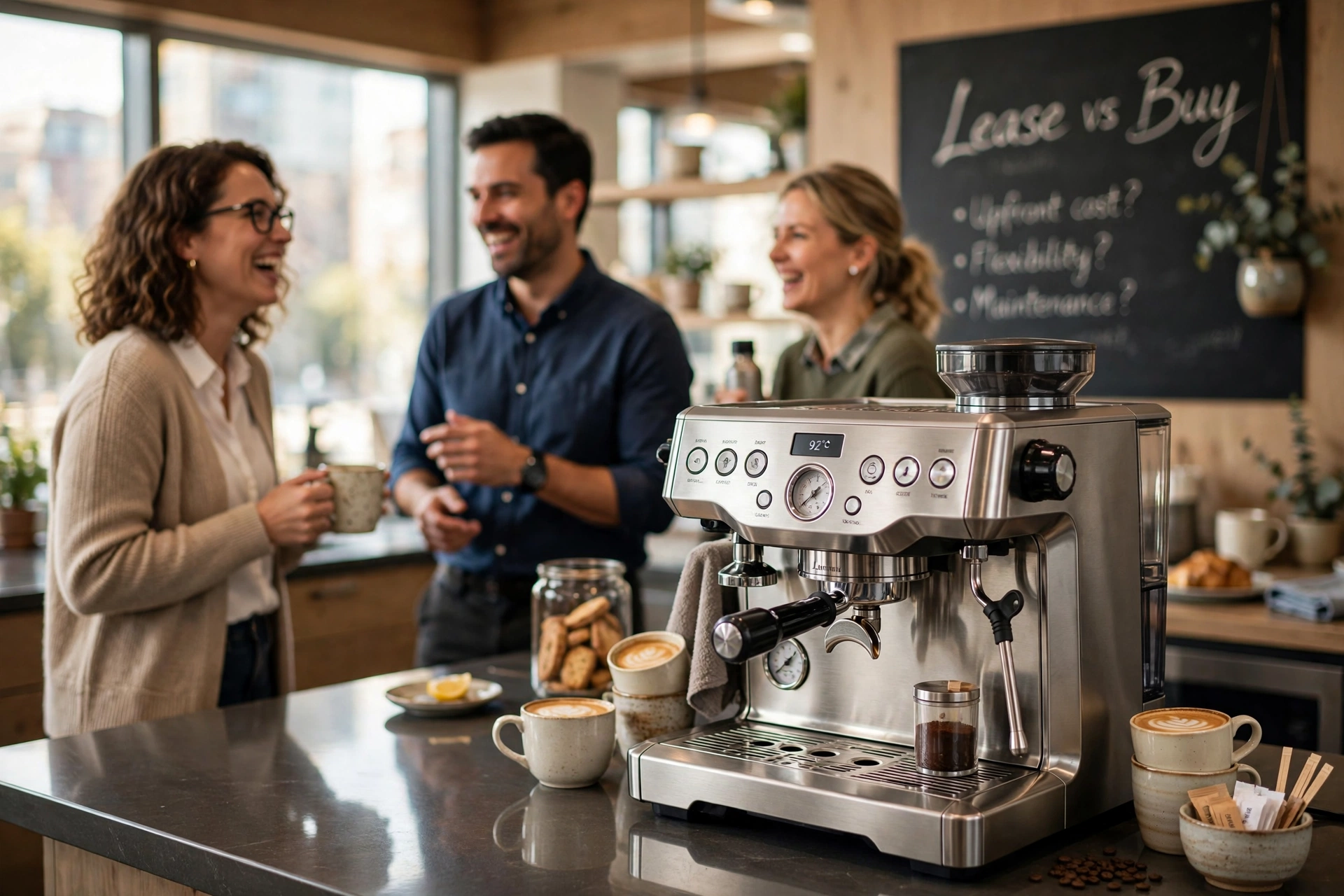
Deciding between an office coffee machine lease and an outright purchase directly impacts your balance sheet, your operational risk, and the quality of the coffee your team drinks. The primary reason this matters is the Total Cost of Ownership (TCO). A purchase price is a one-time event, but a lease is a managed expense that incorporates depreciation and maintenance.
According to the National Coffee Association USA (NCA), coffee consumption patterns in the workplace are shifting toward specialty-grade beverages, meaning the equipment required is more complex and prone to failure if not calibrated. If you buy a machine and the pump fails in month 14, you are responsible for the parts and the technician's hourly rate. In a lease, that risk is shifted to the provider.
From a tax perspective, leases are often treated as operational expenses (OPEX), which can be deducted more flexibly than the depreciating asset of a purchased machine (CAPEX). For businesses utilizing Sensa Coffee Service in Raleigh NC, this financial agility allows for better cash flow management, freeing up capital for core business growth rather than tying it up in stainless steel and copper piping.
Furthermore, the quality of the bean is inextricably linked to the machine's calibration. A purchased machine that isn't regularly serviced will produce sour or bitter coffee, regardless of how expensive the beans are. A managed lease ensures a professional barista or technician regularly tunes the equipment, maintaining the integrity of the specialty coffee experience.
How to Choose the Right Acquisition Model for Your Office
Choosing the right path requires a cold analysis of your daily volume and your internal technical capabilities. If you are a small office of 10 people, a low-cost purchase might suffice. However, for any business with more than 30 employees or a high volume of guest traffic, the complexity of maintaining a commercial-grade espresso machine becomes a liability.
Step 1: Calculate your projected daily cup volume. If you are serving 50+ cups a day, you need a machine with a high-capacity boiler and professional-grade grinders. At this scale, the wear and tear on the group heads and seals is significant, making a lease with included maintenance far more attractive.
Step 2: Assess your "Technical Debt." Who is responsible for descaling the machine? Who handles the water filtration changes? According to NSF International, adherence to sanitary standards for food equipment (like NSF/ANSI 4) requires rigorous cleaning schedules. If you don't have a dedicated staff member for this, a managed lease is the only way to ensure compliance and machine longevity.
Step 3: Evaluate the upgrade cycle. Technology in the coffee world moves fast. From automatic milk frothing to precision temperature control, the hardware you buy today will be outdated in three to five years. A lease allows you to cycle into new equipment without the hassle of trying to sell a used, depreciated machine on the secondary market.
For those in high-growth regions, such as those seeking Sensa Coffee Service in Virginia Beach VA, the ability to scale the equipment as the office grows is a critical operational advantage. You can move from a single-group machine to a multi-group powerhouse without a massive capital injection.
Lease vs Buy: A Detailed Comparison
To truly understand the impact, we must look at the three most common ways businesses acquire their coffee setups in 2026.
| Feature | Outright Purchase (Buy) | Generic Cheap Lease | Busy Bean Managed Lease |
|---|---|---|---|
| Upfront Cost | Extremely High (CAPEX) | Low to Moderate | Zero/Low Monthly Fee |
| Maintenance | Owner's Responsibility | Basic/Reactive | Proactive & All-Inclusive |
| Equipment Quality | Variable (Risk of cheap gear) | Mid-tier/Generic | Premium SENSA Equipment |
| Tax Treatment | Depreciating Asset | Operating Expense | Operating Expense |
| Scalability | Fixed/Hard to Upgrade | Contractual Hurdles | Flexible Growth Path |
| Risk of Downtime | High (Wait for tech) | Moderate | Low (Guaranteed SLAs) |
As shown above, the "Generic Lease" often hides costs in the fine print, such as charging for "emergency" visits or limiting the number of service calls per year. The Busy Bean approach removes this friction by bundling the equipment, the product, and the maintenance into one predictable fee. This eliminates the "sticker shock" associated with a sudden $500 repair bill for a leaking gasket.

Common Mistakes to Avoid When Leasing Coffee Equipment
I have seen many companies sign leases that were essentially "equipment traps." The most common mistake is ignoring the "End of Term" clauses. Some leases require you to buy the machine at a fair market value at the end, while others simply take it back. If you've spent years customizing your workflow around a specific machine, you need to know if you'll actually own it eventually.
Another critical error is failing to account for water quality. In cities with hard water, a machine can be ruined in six months if the filtration system isn't correctly specified. When you buy a machine, you often buy a generic filter. When you use a professional service like Sensa Coffee Service in Richmond VA, the provider analyzes your local water chemistry to install the correct filtration, protecting the internal components from lime-scale buildup.
Thirdly, avoid the "Lowest Monthly Payment" trap. A lease that looks cheap often excludes the coffee beans or requires a minimum monthly spend on low-quality coffee to keep the equipment rate low. This results in a poor employee experience. Using a service that prioritizes specialty coffee ensures that the quality of the beverage matches the quality of the machine.
Finally, don't overlook the training component. A $20,000 machine is useless if the staff doesn't know how to purge the steam wand or dial in the grind for different roast profiles. Many purchase-only models leave you to figure this out via YouTube; a managed lease includes professional barista training to ensure the output is consistent.
Pro Tip: The Hybrid Approach
For businesses that are undecided, I often recommend a "Proof of Concept" period. Instead of committing to a 5-year lease or a $10k purchase, start with a managed membership. This allows you to test the volume and the preference of your staff without risking capital. If you find that your team prefers cold brew over lattes, you can pivot your equipment without the baggage of owning a machine that doesn't fit your needs. This flexibility is exactly why we've integrated our solutions for clients using Sensa Coffee Service in Savannah GA, where the hospitality culture demands a higher standard of beverage variety.
Deep Dive: The Impact of Technical Specifications on ROI
When evaluating an office coffee machine lease, you must look at the "Recovery Time" and "Thermal Stability." Professional machines use PID controllers to keep water at an exact temperature. In a purchase model, if the PID fails, you are offline for days. In a managed lease, the provider typically has redundant parts or a swap-out program to keep you running.
Furthermore, consider the energy consumption. Modern SENSA equipment is designed for 2026 energy standards, reducing the electricity overhead compared to older, inefficient boilers. This creates a secondary ROI through lower utility bills. When you factor in the cost of electricity, water, and the labor of cleaning, the "expensive" lease often ends up being cheaper per cup than the "cheap" purchase.
Frequently Asked Questions
Is it better to lease or buy a coffee machine for a small office?
For offices under 15 people, buying a high-quality semi-automatic machine can be cost-effective if you have a coffee enthusiast on staff to handle maintenance. However, for any business prioritizing consistency and zero downtime, a lease is superior. It removes the burden of technical upkeep and ensures that the equipment is always calibrated to the specific coffee beans being used, preventing the common "bitter cup" syndrome associated with neglected machines.
What happens at the end of an office coffee machine lease?
Depending on the contract, three things typically happen: you can enter a "buy-out" phase to own the machine, you can upgrade to the latest model (refresh), or you can extend the lease. At Busy Bean Coffee, we emphasize the refresh model. Because coffee technology evolves rapidly, owning a five-year-old machine is often a liability. Refreshing your equipment ensures you always have the most energy-efficient and highest-performing gear available.
Are lease payments tax-deductible for businesses?
Yes, in most jurisdictions, lease payments are categorized as operating expenses (OPEX). This means the entire monthly payment can often be deducted from your taxable income in the year it was paid. In contrast, a purchased machine is a capital expenditure (CAPEX) and must be depreciated over several years, which provides a slower tax benefit. You should always consult with your accountant to see which method maximizes your 2026 tax strategy.
Does a lease include coffee beans and supplies?
Standard equipment leases may only cover the hardware. However, a managed coffee service, like the one we provide at Busy Bean Coffee, bundles the equipment, the specialty coffee beans, and the maintenance into one monthly membership. This prevents the logistical headache of managing multiple vendors for beans, filters, and technicians, providing a single point of accountability for your entire beverage program.
How do I handle maintenance if I buy my own machine?
If you choose to buy, you must establish a relationship with a certified commercial technician. You will need to schedule quarterly preventative maintenance (PM) visits to check gaskets, calibrate grinders, and descale the boiler. Without a PM contract, you are relying on "reactive maintenance," which means you only fix the machine after it breaks, leading to days or weeks of no coffee for your staff and lost productivity.
Reference Sources
For deeper context on this topic, these sources provide additional authoritative perspectives:
- Wikipedia — general knowledge reference
- GitHub — development and technology documentation
- The New York Times — news and journalistic updates
These references help establish a complete view of the subject matter.
Conclusion
The choice between an office coffee machine lease and buying comes down to how you value your time and your cash flow. Buying gives you ownership, but it also gives you all the risk, the maintenance burden, and the inevitable obsolescence of the hardware. Leasing, specifically through a managed membership, transforms coffee from a technical headache into a seamless amenity that boosts employee morale and impresses clients.
If you are tired of managing unreliable equipment and inconsistent taste, it is time to move toward a professional, all-inclusive model. Whether you are scaling your footprint in the South or optimizing a single headquarters, the financial logic of 2026 favors flexibility over ownership.
For more detailed information on structuring your beverage program, check out our Ultimate Guide to Office Coffee Service Memberships and see how we can eliminate your CAPEX concerns. Visit www.busybeancoffee.com to start your journey toward a better breakroom.
Ready to Upgrade Your Business Coffee?
Café-quality coffee, zero maintenance headaches, and one predictable monthly price. Let's build your custom coffee program.
Free Coffee Pairing Guide & Specialty Roast Cheat Sheet
Unlock the secrets of perfect brewing ratios, water temperatures, and specialty roast profiles. Download the guide.