How to Master the Operation of Commercial Espresso Machines
Most new cafe owners make the mistake of treating their equipment like a home appliance, leading to inconsistent shots and expensive downtime. To properly use commercial espresso machines, you must master the "Golden Triangle" of espresso: precise grind calibration, consistent tamping pressure, and strict thermal stability. When these three elements align, you produce a balanced extraction with a rich crema and a consistent flavor profile across every single cup.
In my experience working with dozens of high-volume cafes in Mount Pleasant, South Carolina, the difference between a struggling shop and a profitable one often comes down to how the staff handles the machine. I've seen businesses lose thousands in wasted specialty coffee beans simply because they didn't understand how to "dial in" their equipment for the current humidity and temperature of the room.

What Exactly Is a Commercial Espresso Machine?
Before diving into the mechanics, we need to establish what separates these beasts from the machines you find in a kitchen. A commercial unit is engineered for thermal mass and recovery speed, allowing a barista to pull shot after shot without the water temperature dropping.
📚
Definition
A commercial espresso machine is a high-pressure brewing system designed for continuous use, typically featuring a large boiler (or multiple boilers) to maintain a constant temperature for both brewing water and steam.
The core of the machine is the group head, where the water is delivered to the coffee puck. In a professional setting, you will encounter either a heat-exchange system or a dual-boiler system. Heat-exchange machines use a secondary pipe to warm the brew water using the steam boiler, while dual-boilers have separate tanks for brewing and steaming. This distinction is vital because it affects how you manage your temperature.
According to the Specialty Coffee Association (SCA), precision in water temperature—typically between 195°F and 205°F—is fundamental to avoiding over-extraction (which tastes bitter) or under-extraction (which tastes sour). If your machine fluctuates by even two degrees, the chemical composition of the extraction changes, altering the perceived acidity of the Coffea arabica beans you are using.
The complexity of these machines is what allows for the incredible nuance of specialty coffee. By controlling the pressure (usually 9 bars) and the flow rate, you can highlight the floral notes of an Ethiopian bean or the chocolatey depth of a Brazilian roast. However, this power requires a disciplined approach to operation.
Why Proper Machine Operation Impacts Your Bottom Line
Using commercial espresso machines incorrectly isn't just a quality issue; it is a financial drain. When a technician arrives to fix a machine that has been neglected, the bill is often steep. But the hidden costs—waste and slow service—are where most businesses bleed money.
Research from the National Coffee Association USA (NCA) indicates that consumer expectations for "premium" coffee have risen sharply, with a growing segment of the population demanding specialty-grade beverages. If your staff cannot operate the machine consistently, you are not delivering a premium product, which directly impacts customer retention and your average ticket size.
Consider the cost of "dialing in." If a barista wastes 20 double-shots a day trying to find the right grind setting because they don't understand the relationship between dose and yield, that is nearly 300 grams of high-end coffee gone every day. Over a year, that is a significant hit to your margins.
Furthermore, there is the risk of equipment failure. Scaling is the number one killer of commercial boilers. If the operator is not following a strict back-flushing protocol, mineral deposits build up in the group head and solenoid valves. According to NSF International, maintaining food-grade equipment standards is not just about hygiene; it is about the mechanical integrity of the machine. A machine that isn't cleaned properly will eventually produce "burnt" tasting coffee as old oils oxidize inside the group head, regardless of how expensive your beans are.
Step-by-Step: How to Operate Your Machine Like a Pro
To get a perfect shot, you need a repeatable workflow. I always tell my clients at Busy Bean Coffee that the machine is a tool, but the process is the product. Here is the professional sequence for operating commercial espresso machines.
1. The Preparation (The Purge)
Before you even touch the coffee, purge the group head. Run the pump for two seconds to clear any remaining grounds from the previous shot and to stabilize the temperature of the group head. This ensures the water hitting your coffee puck is exactly the temperature the boiler is set to.
2. Dosing and Distribution
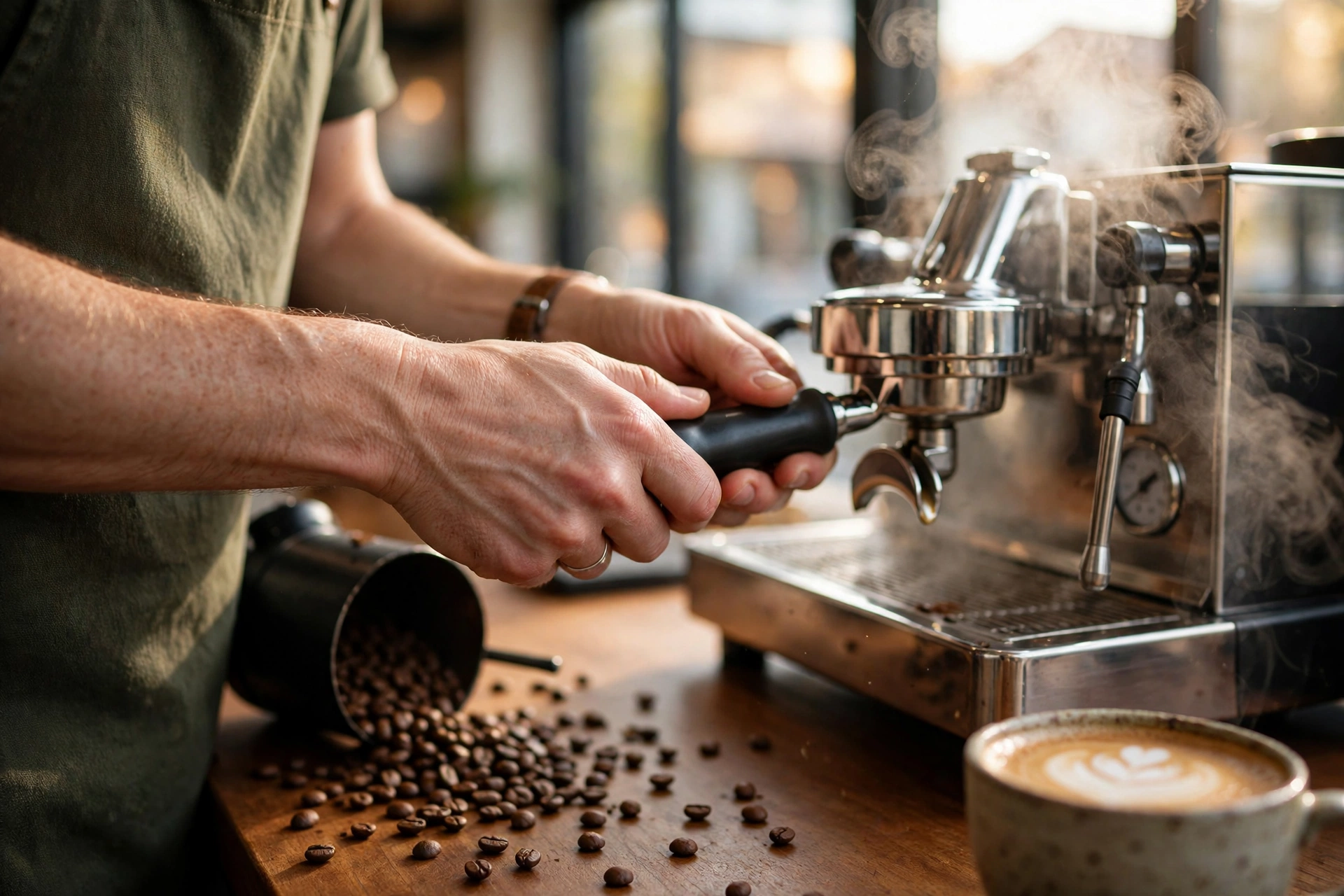
Grind your coffee bean selection into the portafilter. For a standard double shot, we usually target 18 to 20 grams. The mistake I see constantly is "mounding" the coffee. If the coffee is a mountain in the basket, it will channel. Use a distribution tool or your finger to level the bed so the water meets an even surface.
3. The Tamp
Apply firm, level pressure. You don't need to lean your entire body weight into it; you just need to remove the air pockets. The goal is a perfectly flat surface. If the tamp is slanted, the water will take the path of least resistance, leading to "channeling," where some coffee is over-extracted and some is barely touched.
4. The Extraction
Lock the portafilter and start the timer and the pump simultaneously. A standard extraction should yield roughly 36 to 40 grams of liquid in 25 to 30 seconds. If it flows too fast (e.g., 15 seconds), your grind is too coarse. If it drips slowly (e.g., 45 seconds), your grind is too fine.
5. Milk Texturing
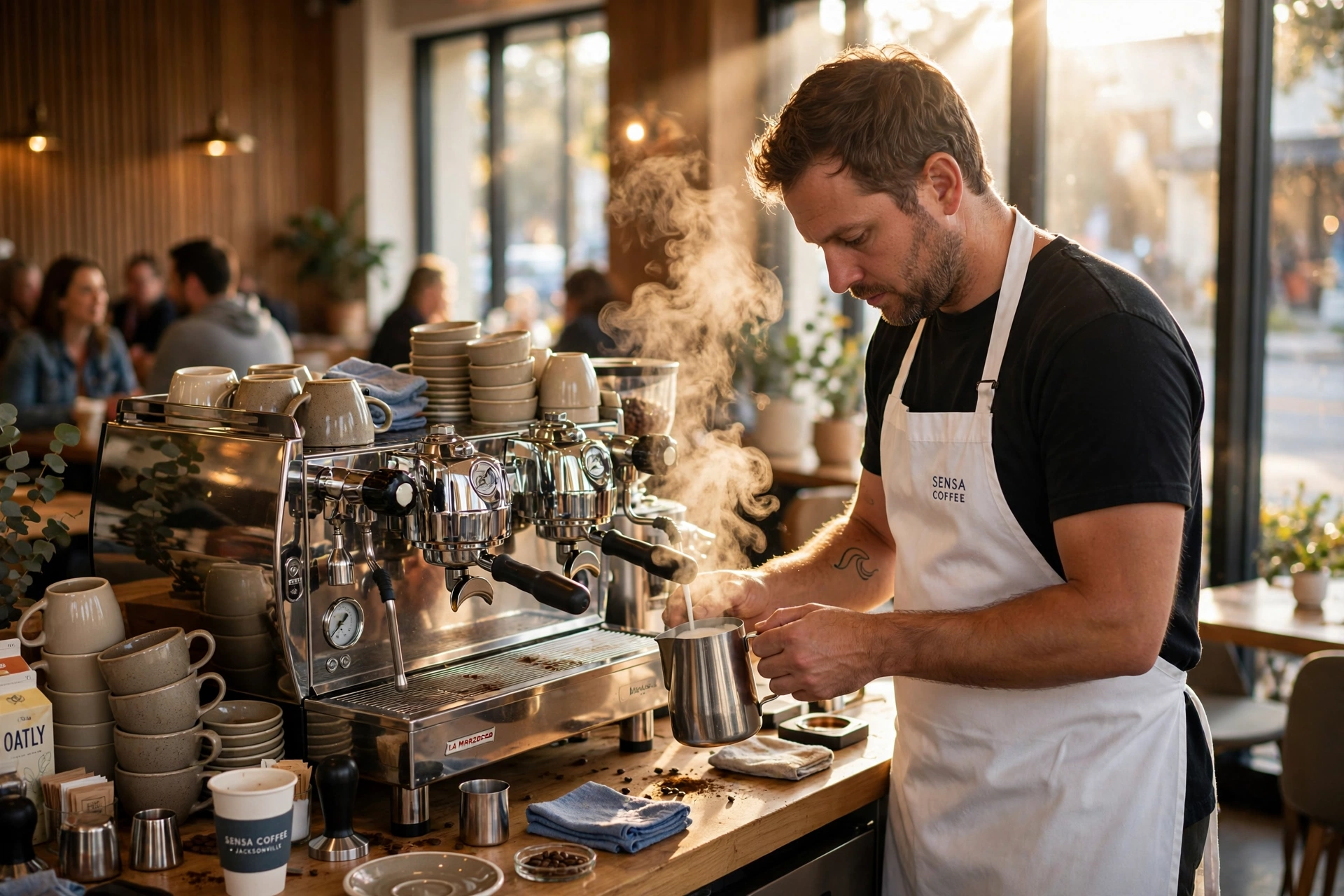
Purge the steam wand first to remove condensed water. Submerge the tip just below the surface of the milk to create a "whirlpool" (stretching), then lower it to create the microfoam. Once you hit the desired temperature (about 140°F to 150°F), shut it off and wipe the wand immediately.
💡
Key Takeaway
Consistency is born from repetition. Using a timer and a scale for every single shot is the only way to ensure that the customer who visits on Monday gets the same experience as the customer who visits on Saturday.
At Busy Bean Coffee, we provide the training and the equipment (like our SENSA systems) to ensure this workflow becomes second nature for your team, removing the guesswork from your morning rush.
Choosing the Right Setup: Comparing Machine Types
Not all commercial espresso machines are created equal. Depending on your volume, you might need a different architecture. Here is how the main options stack up.
| Feature | Heat Exchange (HX) | Dual Boiler | Super-Automatic |
|---|---|---|---|
| Temp Stability | Moderate (Requires cooling flush) | Excellent (Digital PID control) | Good (Automated) |
| Learning Curve | Medium (Requires barista skill) | Medium (Requires barista skill) | Low (Push-button) |
| Output Speed | High | Very High | Maximum |
| Flavor Control | High | Highest | Moderate |
| Best For | Small to Medium Cafes | High-End Specialty Shops | Hotels, Offices, Fast Food |
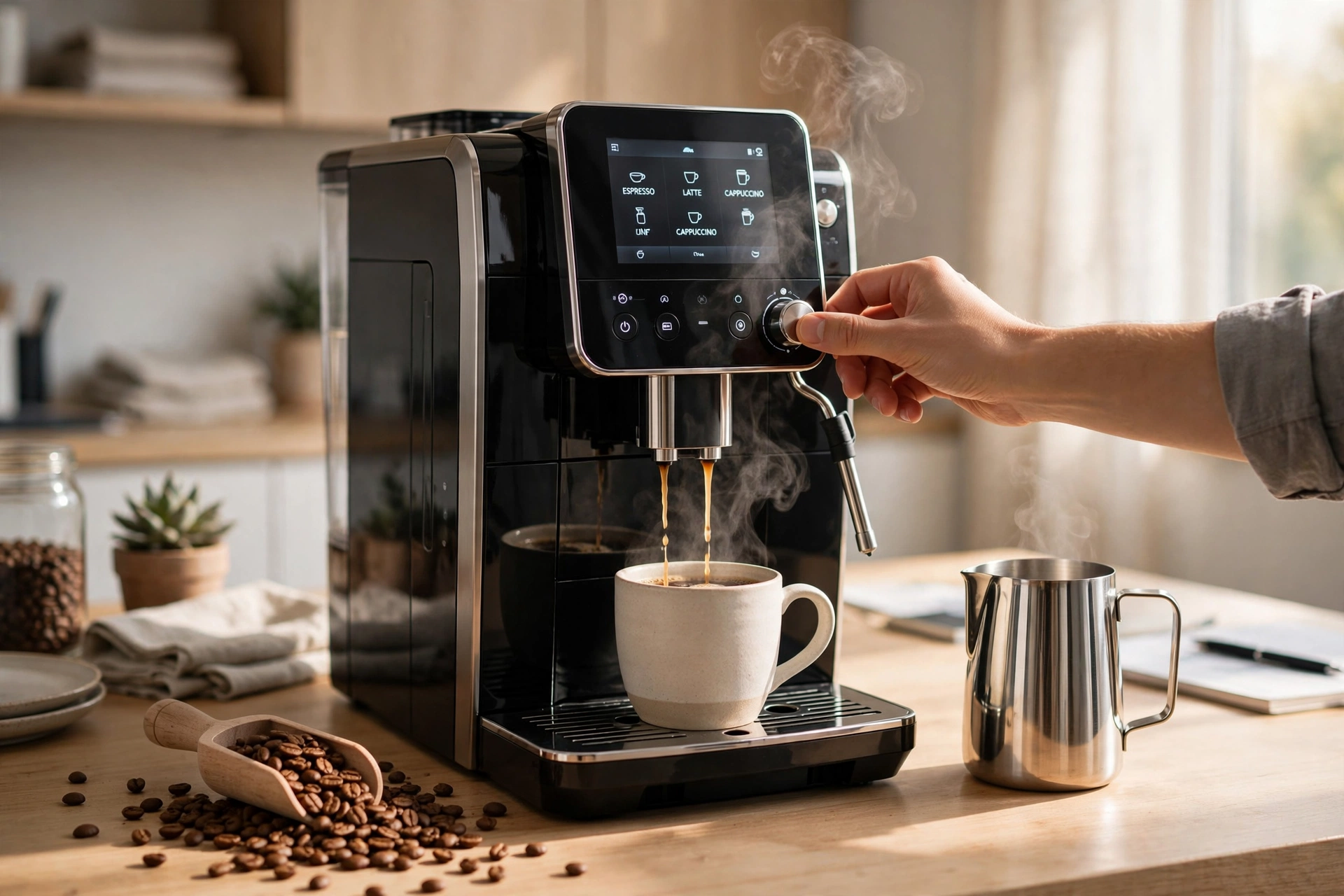
The "Best For" column is where most owners get confused. If you are positioning yourself as a specialty coffee destination, a dual-boiler machine is non-negotiable. The ability to set a precise temperature for the brew boiler ensures that you aren't burning the delicate notes of a light roast. Conversely, if you are running a high-volume breakfast spot where speed is king and the coffee is a secondary offering, a super-automatic machine reduces labor costs and training time.
However, the "Generic/Cheap AI" approach to coffee—relying solely on automation—often results in a flat, one-dimensional flavor. The professional approach integrates high-end hardware with skilled human oversight. This is why we emphasize the role of the barista; the machine provides the pressure, but the human provides the quality control.
Common Misconceptions About Commercial Brewing
Most guides get the "science" of espresso wrong by oversimplifying it. Let's clear up some common myths that I encounter when auditing cafe operations.
Myth 1: "More pressure equals stronger coffee."
Actually, too much pressure can lead to "choking" the machine or creating an over-extracted, bitter mess. The industry standard is 9 bars for a reason. Pushing beyond that doesn't make the coffee "stronger" in terms of flavor; it just forces the water through the puck in a way that often ruins the crema and introduces harsh notes.
Myth 2: "The darker the roast, the finer the grind."
It is often the opposite. Darker roasts are more porous and soluble, meaning the water flows through them more easily. To slow the flow and achieve the correct extraction time, you often need a finer grind for light roasts and a slightly coarser grind for dark roasts. If you treat every bean the same, you'll end up with sour light roasts and bitter dark roasts.
Myth 3: "A more expensive machine automatically makes better coffee."
A $20,000 machine operated by an untrained employee will produce worse coffee than a $5,000 machine operated by a pro. The hardware provides the capability for excellence, but the execution comes from the operator's understanding of ratios and temperature.
Frequently Asked Questions
Why does my espresso taste sour even though I'm following the recipe?
Sourness is a classic sign of under-extraction. This happens when the water hasn't had enough time or heat to pull the sugars and oils out of the coffee grounds. To fix this, you can either fine-tune your grind to be slightly finer (which slows the flow) or increase your water temperature by a degree or two. In my experience, checking the dose is the first step; if you are using too little coffee in the basket, the water will rush through too quickly, resulting in that sharp, vinegary taste.
How often should I actually back-flush my commercial espresso machine?
You should perform a basic back-flush with water every single day at the end of service. However, a chemical back-flush using a specialized detergent should be done weekly or even daily depending on your volume. If you are pulling more than 100 shots a day, daily chemical cleaning is essential. Failing to do this leads to oil buildup in the group head, which creates a rancid taste in your coffee and can eventually clog the three-way solenoid valve, leading to expensive repairs.
What is the "cooling flush" and do I really need to do it?
The cooling flush is primarily necessary for heat-exchange (HX) machines. Because the brew water sits in a pipe surrounded by boiling steam water, it can actually overheat (superheat) if the machine has been idling. By running a short burst of water before locking in the portafilter, you flush out that overheated water and bring the group head back to the target temperature. If you skip this on an HX machine, your first shot of the hour will likely be burnt.
How do I know if my milk is textured correctly for a latte?
Properly textured milk should look like wet paint—glossy, smooth, and without any visible bubbles. If you see "sea foam" or large bubbles on top, you've introduced too much air during the stretching phase. If the milk is thin and lacks body, you didn't stretch it enough. A professional tip: always tap the pitcher on the counter and swirl the milk vigorously before pouring to integrate the microfoam and remove any remaining surface bubbles.
Why is my crema disappearing so quickly?
Crema is an emulsion of CO2 and coffee oils. If it disappears instantly, it usually means your beans are not fresh. Coffee peaks in flavor and crema production between 7 and 21 days after roasting. If you are using beans that were roasted three months ago, the CO2 has escaped, and you won't get that thick, golden layer. Another factor can be the cleanliness of your cup; residual soap or oils in the cup can break the surface tension of the crema and make it collapse.
Final Thoughts on Operating Commercial Espresso Machines
Mastering commercial espresso machines is a journey of precision. It is not enough to simply "push a button"; you must understand the dialogue between the bean, the water, and the metal. By focusing on the Golden Triangle of grind, tamp, and temperature, you can ensure that every cup leaving your counter is a testament to quality.
Whether you are upgrading your current setup or starting a new venture, remember that the equipment is only half the battle. The other half is a rigorous commitment to maintenance and training. If you want to eliminate the stress of equipment failure and inconsistent quality, that is where a managed solution makes sense.
For those looking for a seamless experience, Busy Bean Coffee provides all-inclusive managed coffee solutions. We don't just drop off a machine; we provide the professional installation, full maintenance coverage, and the expertise needed to keep your business thriving. Stop worrying about boiler scales and grind drifts, and start focusing on your customers.
Visit www.busybeancoffee.com to see how we can streamline your coffee service.
Recommended Readings
To deepen your understanding of these topics, we recommend reading the following articles:
- The Complete Guide to White Glove Coffee Service
- Ultimate Guide to All-Inclusive Coffee Service for Businesses
- Ultimate Guide to Automated Coffee Machines for Business
- Ultimate Guide to Specialty Coffee Equipment for Business
Free Coffee Pairing Guide & Specialty Roast Cheat Sheet
Unlock the secrets of perfect brewing ratios, water temperatures, and specialty roast profiles. Download the guide.