What Are Coffee Measuring Scales?
📚
Definition
Coffee measuring scales are precision digital or analog devices used to weigh coffee beans, ground coffee, and water to within 0.1 grams, enabling baristas to replicate brew ratios with scientific accuracy.

In my decade of training foodservice teams across the U.S., the most common mistake I see is assuming that volume-based measuring—scoops, tablespoons, or the old “bean-to-eye” method—produces consistent coffee. It doesn’t. Bean density varies by origin (Arabica vs. Robusta), roast level, and even seasonal micro-lot changes. A tablespoon of dark roast weighs less than a tablespoon of light roast because darker beans are more porous. That variability can shift your coffee-to-water ratio by 20% or more, according to Scott Rao’s The Coffee Roaster’s Companion.
A dedicated coffee measuring scale eliminates this guesswork. The Specialty Coffee Association (SCA) recommends a 1:15 to 1:18 brew ratio for filter coffee (SCA, Brewing Handbook). Achieving that ratio without a scale is virtually impossible: you need to know both the weight of the coffee and the weight of the water. Modern scales like the Acaia Lunar or Hario V60 Drip Scale offer 0.1g resolution, auto‑tare, and built‑in timers that start automatically when water hits the grounds. For commercial settings, we at Busy Bean Coffee include scale training in every All-Inclusive Coffee Membership Models Explained to ensure every cup meets professional standards.
Scales come in three main categories: digital pocket scales (compact, affordable, travel‑friendly), brewing scales (larger platform, rechargeable, often waterproof), and analog scales (classic look but poor precision). For serious brewing, digital brewing scales are the standard.
Why Coffee Measuring Scales Make a Difference
Using a coffee measuring scale is not just about precision—it’s about profitability, consistency, and customer loyalty. A study by the Coffee Quality Institute found that inconsistent dosing leads to over‑extraction in 30% of shots and under‑extraction in 25%, wasting both coffee and labor. In a café that pulls 200 shots daily, that means up to 60 wasted shots per day. At $0.66 per shot (based on $15/lb coffee at a 20g dose), that’s nearly $40 a day—over $14,000 annually. A $40 scale pays for itself in a single day.
Beyond cost, consistency drives repeat business. According to a 2023 report from McKinsey & Company, businesses that deliver consistent product quality experience a 3x increase in customer retention rates. When every latte tastes the same, customers trust you. That’s why we integrate scale usage into our Quick Setup Guide for Office Espresso Machines and recommend scales for all Managed Coffee Service Offices.
Another benefit: scales enable true espresso diagnosing. Without weighing your yield, you can’t tell if your shot is over‑ or under‑extracted. A scale lets you track dose, yield, and time together—the three pillars of extraction science.
💡
Key Takeaway
A coffee measuring scale reduces waste by up to 30%, saves thousands of dollars annually in a busy café, and ensures every cup meets the same quality standard.
Step-by-Step Guide to Using Coffee Measuring Scales
Here’s how to use your coffee measuring scale like a professional barista—a method we teach in every Barista Equipment Training for Foodservice Teams session.
- Tare your equipment. Place your portafilter, brew basket, or empty carafe on the scale and press tare. This eliminates the weight of the vessel.
- Weigh your dose. Add coffee beans until you reach the target weight. For espresso, start at 18–20g. For pour‑over, 15–30g depending on serving size. Use a spouted dosing cup to avoid spills.
- Grind and distribute. Grind directly into the basket. Tap to level and tamp evenly. The scale ensures your dose is exact before tamping—critical for consistent puck resistance.
- Zero again. Place the full portafilter back on the scale, tare to zero, then start your shot. This is where most beginners go wrong: they skip this step and lose the ability to measure yield accurately.
- Measure yield and time. Stop the espresso when the scale reads your target yield. For a 1:2 ratio, if your dose was 18g, stop at 36g. The timer should read 25‑30 seconds. If it’s faster or slower, adjust your grind.
- Record and repeat. Write down your dose, yield, and brew time. This data is your recipe. Reproduce it every shot.
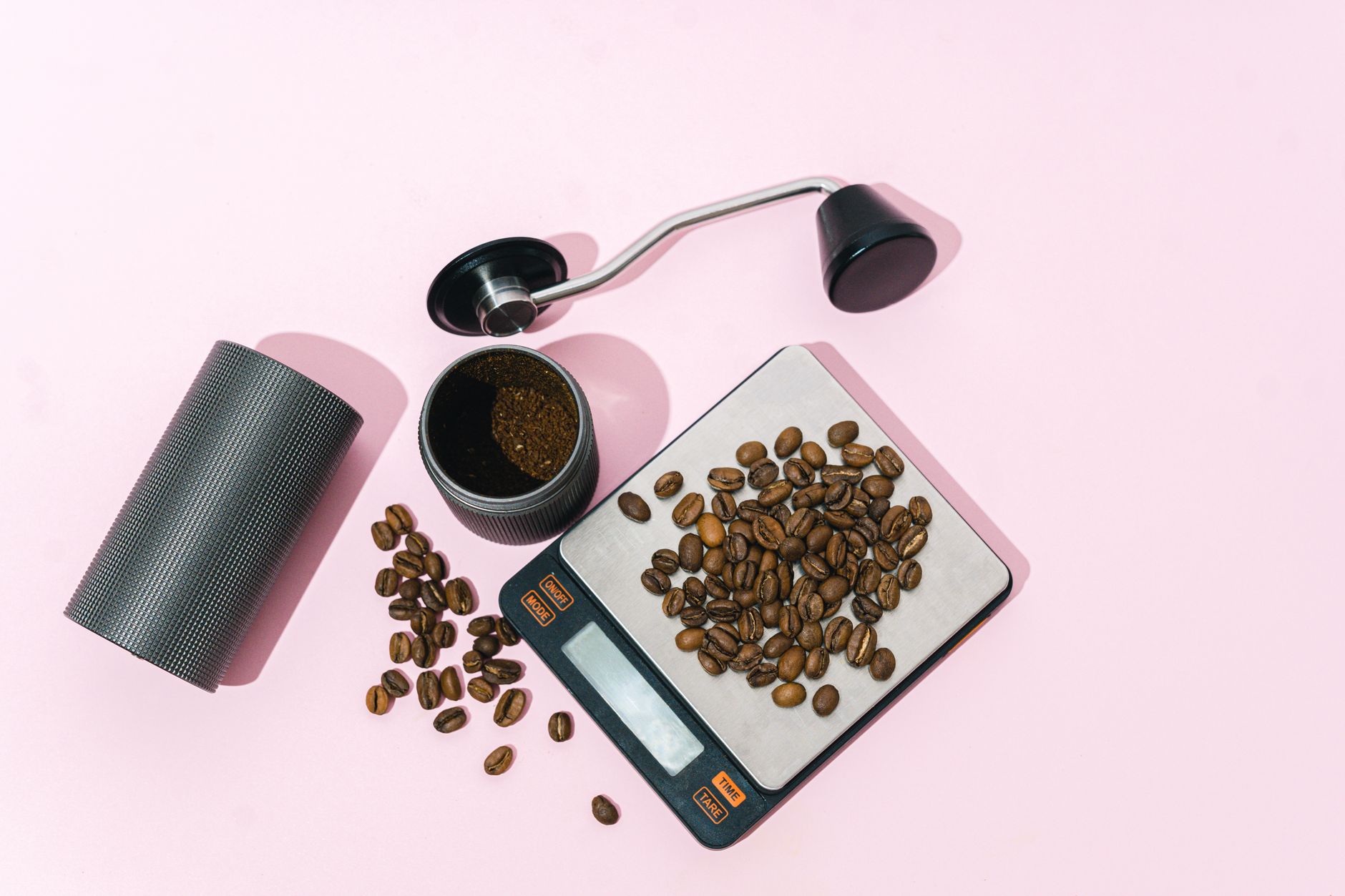
For pour‑over, the process is similar: place your dripper and server on the scale, tare, add coffee, tare, then pour water while watching the brew weight. The timer helps you manage the bloom phase (30‑45 seconds) and total pouring time.
💡
Pro Tip
If your scale has an auto‑start timer feature (like the Acaia Pearl or Brewista Smart Scale), use it. It activates when it detects the first drop of water, giving you more accurate extraction time.
Coffee Measuring Scales vs. Other Methods
Let’s compare the accuracy and practicality of common coffee measuring methods:
| Method | Precision | Consistency | Learning Curve | Cost |
|---|---|---|---|---|
| Coffee measuring scale (0.1g) | ★★★★★ | High (after setup) | Moderate | $15–$200 |
| Measuring spoon (volume) | ★☆☆☆☆ | Low (varies by grind) | Easy | $5 |
| Scoop (with coffee) | ★★☆☆☆ | Very low | Very easy | Free |
| Pre‑ground in bag | N/A | Low (by brand) | Very easy | $–$ |
| Flow‑profiling espresso machine | ★★★★☆ | High (automatic) | Depends on tech | $1,000+ |
The clear winner for precision is the scale. While a flow‑profiling machine can automate consistency, it still needs a scale to calibrate. For most businesses, a $50 brewing scale offers the best ROI. At Busy Bean Coffee, we recommend scales for every Commercial Coffee Repair in Atlanta GA service tier to ensure ongoing quality.
Common Mistakes to Avoid with Coffee Scales
Over the years, I’ve seen these mistakes ruin consistency even when using a scale:
- Using a scale with poor resolution. Kitchen scales with 1g increments hide variability. For espresso, 0.1g is non‑negotiable.
- Not taring between steps. If you don’t reset after adding coffee, your water measurement will be wrong.
- Ignoring scale drift. Cheap scales can fluctuate by 0.3g over a few minutes. Check with a calibration weight monthly.
- Placing the scale on an uneven surface. A tilted scale can throw readings by 0.5g or more. Always use a level countertop.
- Over‑relying on the scale without tasting. The scale is a tool, not a substitute for your palate. Use it to replicate good cups, not to override sensory feedback.
How to Choose the Right Coffee Measuring Scale
Not all scales are created equal. Here are the features I evaluate when recommending scales for foodservice clients:
- Precision: 0.1g resolution is mandatory for espresso. 0.5g may suffice for batch brew.
- Response time: Look for sub‑2 second response. Slow scales lag when you pour quickly.
- Water resistance: IPX4 rating or higher allows rinsing and protects against spills.
- Built‑in timer: Saves you from jugging a separate timer. Auto‑start is a bonus.
- Battery life: Rechargeable lithium‑ion (e.g., Acaia) lasts weeks. AA battery models are also reliable.
- Platform size: For pour‑over, you need a platform that fits your dripper and server (at least 6×6 inches).
Top brands include Acaia (Lunar for espresso, Pearl for pour‑over), Hario (V60 Drip Scale), Brewista (Smart Scale II), and Amazon Basics (budget option). For businesses, we often bundle scales with our All-Inclusive Coffee Membership programs.
Real-World Examples: The Impact of Scaling
At a 45‑seat café in Savannah, Georgia, we recently upgraded their workflow from volume scooping to digital weighing. Within two weeks, coffee waste dropped by 22%, and their customer satisfaction scores on “consistent taste” rose from 3.8 to 4.6 out of 5. The owner told me, “I never realized how much coffee I was throwing away. The scale paid for itself in three days.” This mirrors what we see with Espresso Machine Service in Savannah GA clients who adopt our scaling protocol.
In another example, a hotel breakfast bar in Detroit was using pre‑ground coffee in bulk urns. By switching to whole‑bean and a scale for batch brew (450g coffee to 7.2L water, 1:16 ratio), they reduced their per‑cup cost by 18% while guests rated the coffee significantly higher. We documented this in our Commercial Coffee Repair in Detroit MI case studies.
Frequently Asked Questions
How do I choose a coffee measuring scale?
Look for 0.1g resolution, sub‑2 second response, auto‑tare, built‑in timer, and water resistance. For espresso, a compact scale like the Acaia Lunar fits under dual‑spout portafilters. For pour‑over, a larger platform like the Hario V60 Drip Scale works better. If you run a high‑volume café, consider scales with USB‑C rechargeable batteries to avoid downtime. We recommend specific models in our Quick Setup Guide for Office Espresso Machines.
Can I use a coffee measuring scale for pour‑over?
Absolutely. In fact, pour‑over benefits even more than espresso because the brew ratio directly affects flavor clarity. For a single cup, use 15g coffee to 250g water (1:16.7). Place your dripper and server on the scale, tare, add coffee, tare again, then pour water while watching the weight. The timer helps manage the 30‑second bloom and total brew time of 2:30–3:00. This technique is standard in our Barista Training for Foodservice Teams.
How important is the timer on a coffee scale?
Extremely important. Extraction time is the third variable in the dose‑yield‑time equation. Without it, you can’t diagnose why a shot tastes sour (under‑extracted, too fast) or bitter (over‑extracted, too slow). Scales with auto‑start timers (like Acaia) activate when liquid first hits the portafilter, giving you the most accurate data. We always include timer‑equipped scales in our Managed Coffee Service Offices setups.
What's the best brew ratio for espresso?
The industry standard is 1:2 (coffee to water) for a balanced shot. For example, 18g dose yields 36g espresso. Adjust grind to hit that in 25–30 seconds. For milk‑based drinks, some baristas prefer a longer ratio (1:2.5) to balance with milk. Your scale is the only way to measure yield precisely. We teach ratio adjustment in every Espresso Machine Service in Atlanta GA training.
Do coffee measuring scales require calibration?
Yes, most digital scales drift over time due to temperature changes and use. Check calibration monthly using a certified 50g weight or a calibration mode. Many scales come with a nickel (5g) reference, but a proper weight is better. If you notice your shots running longer or shorter than usual, recalibrate. For high‑usage commercial environments, we include recalibration in our White Glove Coffee Installation maintenance programs.
Can I use a coffee scale for espresso and pour‑over?
Yes, but you may prefer dedicated scales. The Acaia Pearl is great for both—it has a large platform for pour‑over and a fast response for espresso. The Hario scale is pour‑over specialized but can work for espresso if you have a small cup. Some baristas carry a pocket scale (like the AWS 20g×0.01g) for travel and a brewing scale at their station. For offices using Bean to Cup Office Espresso Machines, you may not need a separate scale because those machines dose automatically.
How accurate do I really need to be?
For espresso, 0.1g accuracy is critical because small changes in dose (0.5g) alter the puck dynamics and extraction. For filter coffee, 0.5g accuracy is acceptable for the coffee, but you still need 1g accuracy on water because the ratio matters. Using a scale with 1g resolution for coffee will introduce 5–10% variance, which is detectable in the cup. That’s why professional scales resolve to 0.1g.
What’s the difference between a coffee scale and a regular kitchen scale?
Kitchen scales typically have 1g resolution and slower response times (3‑5 seconds). They also lack auto‑tare for sequential additions and rarely include a timer. Coffee scales are designed for the workflow: small increments, fast updates, and water‑resistant surfaces. Using a kitchen scale for espresso is possible but frustrating—you’ll lose the fine control needed to hit your target yield within 1‑2 seconds of stopping the shot.
Summary + Next Steps
Using coffee measuring scales transforms your brewing from guesswork to science. It reduces waste, saves money, and ensures every cup delivers the same excellent taste. Whether you’re a home enthusiast or run a busy café, investing in a quality scale and learning to use it consistently is the single highest‑impact change you can make.
At Busy Bean Coffee, we don’t just sell coffee equipment—we teach precision. Every All-Inclusive Coffee Membership includes scale training and equipment calibration as part of our onboarding. Ready to brew better? Visit us to schedule a consultation.
About the Author
Travis Estes is the founder of Busy Bean Coffee, a provider of premium coffee equipment and managed coffee services for businesses since 2014. He has trained hundreds of baristas and foodservice teams across the U.S. on precision brewing techniques, and personally consults on equipment selection for hotels, restaurants, and offices. When he’s not helping clients improve their coffee, Travis is testing new brewing methods at his lab in Atlanta.
Free Coffee Pairing Guide & Specialty Roast Cheat Sheet
Unlock the secrets of perfect brewing ratios, water temperatures, and specialty roast profiles. Download the guide.