How Does Specialty Coffee Equipment Actually Work?
Most business owners assume that a high-end espresso machine is just a fancy water heater, but the reality is far more clinical. To get a consistent, specialty-grade extraction, you need a synchronized system of thermal stability, precise pressure regulation, and micron-level grind consistency. When you invest in professional specialty coffee equipment, you aren't paying for the brand name; you are paying for the ability to control variables that would otherwise fluctuate and ruin your margins.
In my experience working with hospitality groups across Mount Pleasant, South Carolina, the biggest point of failure isn't the barista's skill—it's the equipment's inability to maintain a constant temperature. If your brew head drops by even two degrees during a morning rush, your acidity spikes, and your customers notice. To truly understand how this gear works, you have to look at the physics of extraction: how water moves through a compacted puck of Coffea arabica to pull out the specific oils and acids that define a premium cup.

The Engineering Behind Precision Extraction
At its core, specialty coffee equipment is designed to solve one problem: inconsistency. In a standard home machine, water is often heated in a single boiler that fluctuates wildly. Professional gear utilizes sophisticated thermal management to ensure that every single shot is identical.
📚
Definition
Thermal Stability is the ability of a brewing system to maintain a constant water temperature throughout the entire extraction process, preventing "temperature surfing" which leads to uneven flavor profiles.
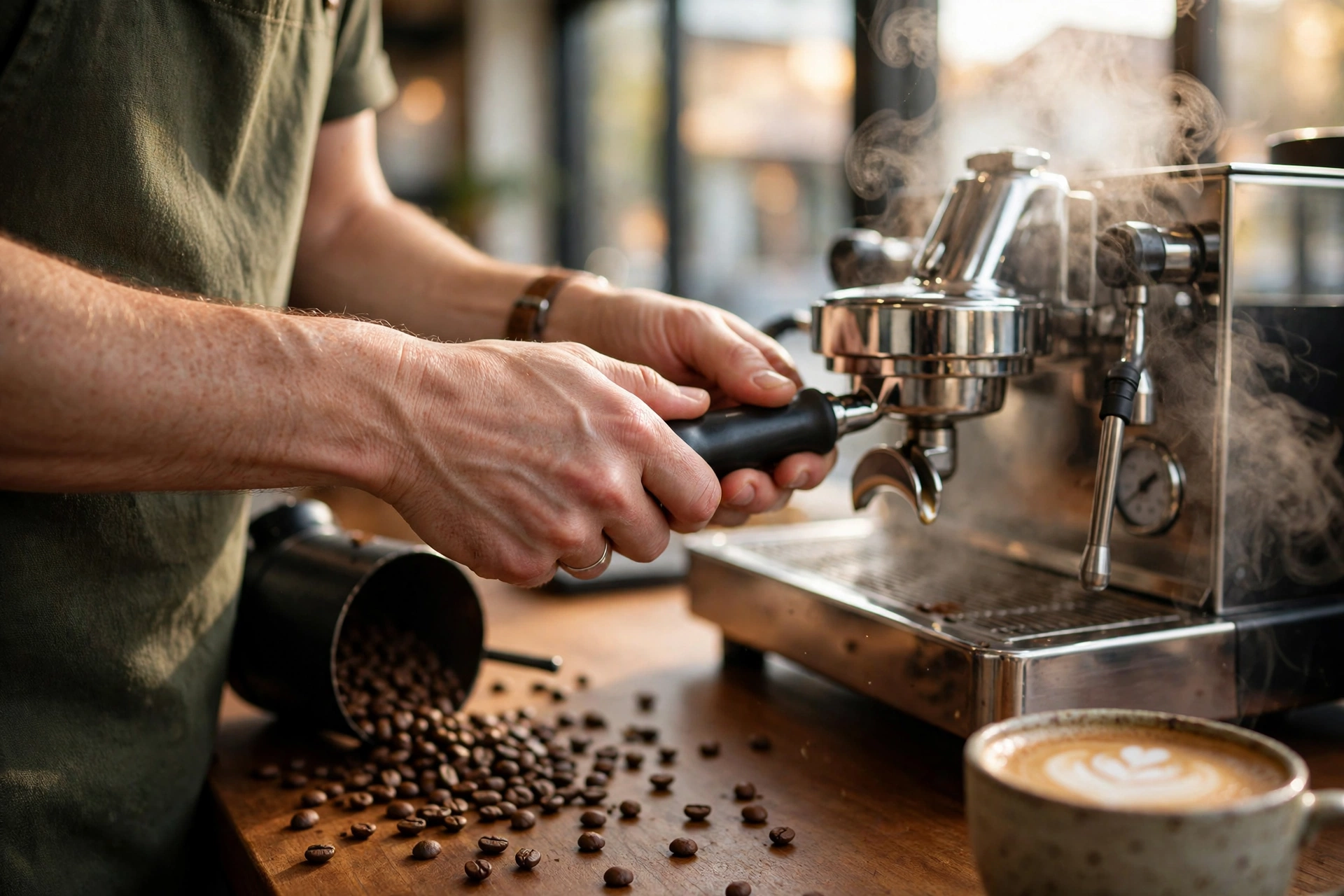
The process begins with the grinder. You cannot achieve a specialty result without a burr grinder capable of producing a uniform particle size. Unlike blade grinders that "chop" the coffee bean, burr grinders crush the bean between two calibrated surfaces. This ensures that the water flows through the coffee puck evenly. If you have "fines" (tiny dust-like particles) and "boulders" (large chunks) in the same dose, the water will take the path of least resistance, resulting in a cup that is simultaneously sour and bitter.
Once the grind is set, the espresso machine takes over. Most high-end systems use a PID (Proportional-Integral-Derivative) controller. This is a digital feedback loop that monitors the boiler temperature and makes micro-adjustments in real-time. According to the Specialty Coffee Association (SCA), the precision of water temperature and pressure is the primary differentiator between "commodity" coffee and "specialty" coffee. When the water hits the puck at exactly 200°F (93°C) under 9 bars of pressure, it emulsifies the coffee oils into the signature crema we expect from a professional barista.
Why Precision Equipment Impacts Your Bottom Line
Many cafe owners view expensive gear as a capital expense to be minimized, but I've found the opposite is true: cheap equipment is a hidden tax on your daily operations. When your equipment is inconsistent, your waste increases. I’ve seen shops throw away dozens of "dial-in" shots every morning because their machines take an hour to stabilize.
The business impact is measurable. High-quality specialty coffee equipment reduces the "error rate" per cup. If a barista has to dump 10% of their shots due to temperature swings or poor grind distribution, you are literally pouring your profit down the drain. Furthermore, the labor cost of training a staff member to "fight" a temperamental machine is significantly higher than training them to operate a stable, intuitive system.
From a health and safety perspective, the engineering also matters. Professional equipment must adhere to strict sanitary standards to prevent biofilm buildup in the boilers. NSF International provides the gold standard for these certifications, ensuring that the materials used in the boilers and piping are food-safe and corrosion-resistant. Investing in NSF-certified gear isn't just about quality; it's about mitigating the risk of health department violations and equipment failure.
According to data from the National Coffee Association USA (NCA), consumer demand for "premium" and "specialty" experiences is growing. Customers are no longer satisfied with "burnt" tasting coffee; they want the nuanced notes of a light-roast Arabica coffee. If your equipment cannot deliver those nuances, you are competing on price rather than quality, which is a race to the bottom in the 2026 market.
Practical Application: Setting Up Your Workflow for Success
Getting the gear is only half the battle; the "how" of the operation is where the magic happens. To maximize your specialty coffee equipment, you must implement a strict workflow. The mistake I made early on—and that I see constantly in new cafes—is neglecting the "water" part of the equation. You can have a $20,000 machine, but if your water is hard or chlorinated, the machine will scale up and the coffee will taste like chemicals.
Here is the step-by-step professional approach to operating a specialty setup:
- Water Filtration: Install a reverse osmosis or multi-stage filtration system. This protects the boiler from calcium buildup and ensures a neutral pH for the coffee.
- The Grind Calibration: Start with a medium-fine setting. Pull a shot and time it. If it flows in 15 seconds, it's too coarse (underextracted). If it takes 45 seconds, it's too fine (overextracted). Aim for the 25–30 second "sweet spot."
- Dose and Distribution: Weigh your dose to the tenth of a gram. Use a distribution tool or a "WDT" (Weiss Distribution Technique) to break up clumps. This prevents "channeling," where water carves a hole through the puck.
- The Tamp: Apply consistent, level pressure. The goal is to create a uniform resistance for the water to push against.
- The Pull: Engage the pump and monitor the flow. A steady, honey-like stream indicates a perfect extraction.
💡
Key Takeaway
Consistency is born from measurement. If you aren't weighing your beans and timing your shots, you aren't practicing specialty coffee; you're guessing.
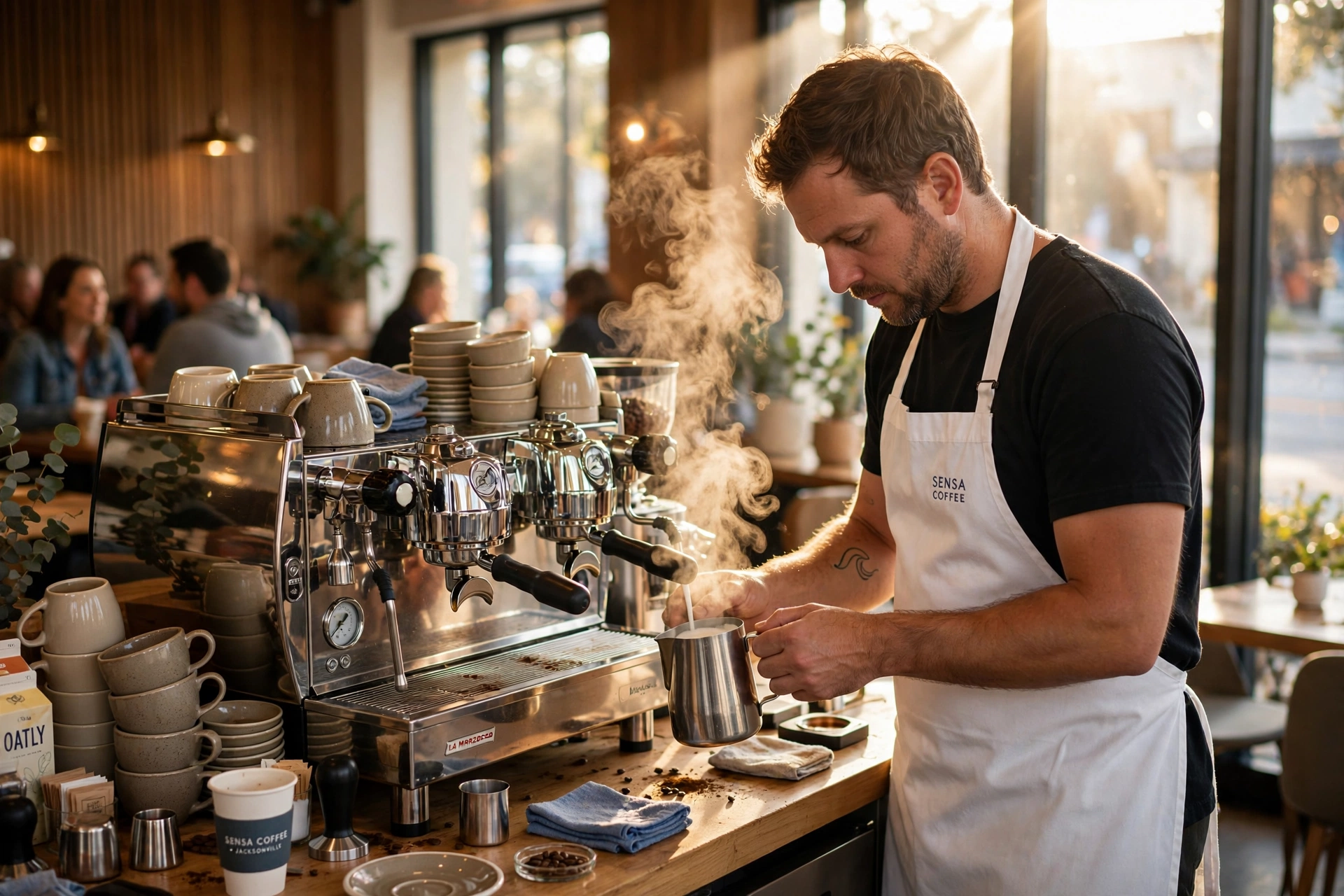
At Busy Bean Coffee, we eliminate the stress of this technical setup. Instead of leaving you to figure out the physics of pressure and temperature on your own, our managed coffee solutions provide the premium SENSA equipment and the professional installation needed to ensure these variables are locked in from day one. We handle the maintenance, so you don't have to worry about a boiler failure during your busiest Saturday of the year.

Comparing Equipment Approaches
When choosing how to kit out your business, you generally face three paths. Most owners lean toward the cheapest option initially, only to realize that the "cost per cup" actually increases due to waste and downtime.
| Feature | Traditional/Budget Gear | Generic "AI" or Cheap Auto | Professional Specialty Gear |
|---|---|---|---|
| Temp Control | Manual / Unstable | Basic Thermostat | PID Digital Control |
| Grind Quality | Inconsistent / Bladed | Basic Burr | Low-Retention Precision Burr |
| Consistency | Low (High Waste) | Medium (Flat Flavor) | High (Repeatable Results) |
| Maintenance | Frequent Breakdowns | Hard to Repair | Scheduled Professional Care |
| Best For | Low-volume home use | Basic office breakrooms | Cafes, Hotels, High-end F&B |
Now here's where it gets interesting: the "middle ground" is often the most dangerous place to be. Generic automatic machines often hide poor-quality beans behind a wall of automation. However, true specialty coffee is about transparency. Using professional-grade espresso machines allows the origin of the bean—whether it's a fruity Ethiopian or a chocolatey Brazilian—to actually shine through.
Common Questions and Misconceptions
There are a lot of myths in the coffee world, mostly perpetuated by companies trying to sell "convenience" over quality.
Myth 1: "The more expensive the machine, the better the coffee."
Most guides get this wrong. A machine is a tool, not a magician. If you use low-grade, over-roasted beans, a $30,000 machine will simply make a very expensive version of bad coffee. The equipment's job is to not get in the way of the bean's quality.
Myth 2: "Automatic machines are just as good as manual ones."
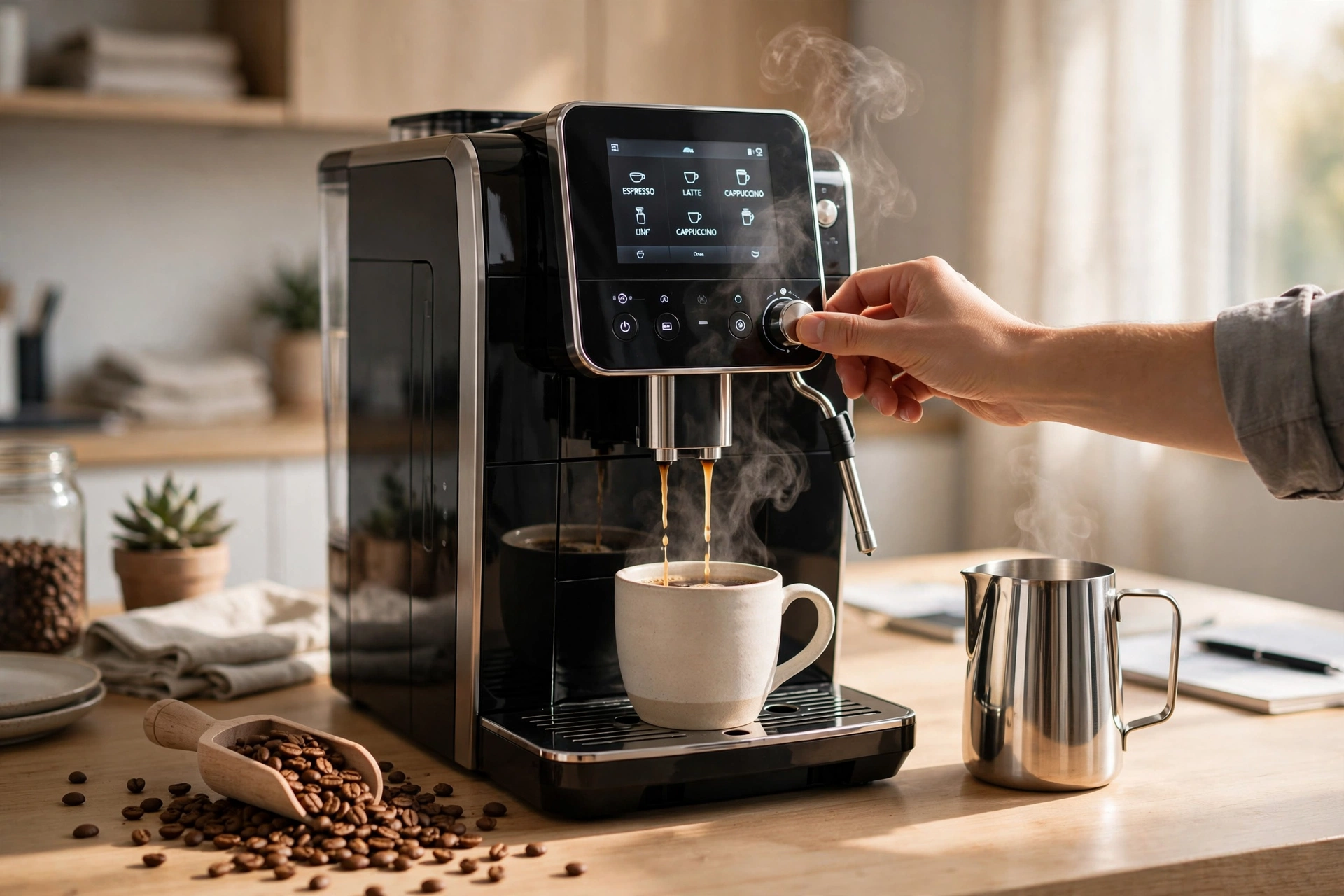
While super-automatics have improved, they cannot match the tactile control of a manual or semi-automatic setup. A barista can feel the resistance of the puck and adjust the grind in real-time. Automation removes the human element, and in specialty coffee, the human element is what creates the "premium" experience.
Myth 3: "You only need to calibrate your grinder once a week."
This is a recipe for disaster. Coffee beans are organic matter; they react to humidity and temperature changes in the air. In my experience, you should calibrate your grind at least twice a day—once in the morning and once after the lunch rush—to account for the changing environment in your shop.
Frequently Asked Questions
How does a PID controller improve the taste of the coffee?
A PID (Proportional-Integral-Derivative) controller acts as the "brain" of the heating element. In older machines, the heater would turn on until it hit a target temperature, then shut off, causing the water to cool down before the next shot. This "sawtooth" temperature pattern creates inconsistent flavor. A PID controller makes tiny, rapid adjustments to the power, keeping the water within a fraction of a degree of the target. This ensures that the delicate aromatic compounds in specialty coffee are extracted without being scorched or left behind.
What is the difference between a single boiler and a dual boiler system?
A single boiler machine must switch between "brew mode" and "steam mode." This means if you want to froth milk, you have to wait for the boiler to heat up to a higher temperature, and then wait for it to cool back down to brew another espresso. This is inefficient and causes thermal instability. A dual boiler system has one dedicated boiler for brewing and another for steaming. This allows you to pull shots and steam milk simultaneously without ever compromising the temperature of either, which is essential for high-volume coffee service.
Why is the "grind size" considered the most important variable?
Grind size determines the surface area of the coffee exposed to water. If the grind is too coarse, the water rushes through too quickly, failing to extract the sugars and oils, resulting in a sour, thin liquid. If it's too fine, the water struggles to pass through, over-extracting the bitter tannins and resulting in a burnt, harsh taste. Because the margin for error is so small—often a matter of microns—having professional specialty coffee equipment with a high-precision burr set is the only way to ensure every cup is balanced.
How does water filtration affect the longevity of the equipment?
Water contains minerals like calcium and magnesium. When this water is heated in a boiler, those minerals precipitate out and form "scale," which is essentially rock inside your machine. Scale acts as an insulator, making the machine work harder to heat the water, eventually burning out the heating element. Furthermore, scale can clog the narrow Gicleur (flow restrictor), leading to uneven pressure. Using a professional filtration system according to FDA food safety guidelines ensures both the health of your customers and the lifespan of your gear.
What is "channeling" and how does the equipment prevent it?
Channeling occurs when water finds a path of least resistance through the coffee puck, bypassing large sections of the coffee. This results in a shot that is both under-extracted (from the bypassed areas) and over-extracted (from the channel). High-end equipment helps prevent this through precision baskets and the use of professional distribution tools. When combined with a high-quality grinder that produces uniform particles, the puck is more cohesive, forcing the water to flow evenly through all the coffee, resulting in a full-bodied, balanced extraction.
Final Thoughts on Specialty Coffee Equipment
Understanding how specialty coffee equipment works is the difference between running a business that simply sells caffeine and running one that sells an experience. When you control the variables—temperature, pressure, and grind—you stop guessing and start producing. The engineering behind these machines is designed to remove the "luck" factor from the equation, allowing you to scale your quality as you scale your volume.
If you're tired of fighting with inconsistent gear or worrying about the next expensive repair bill, it's time to move toward a managed approach. At Busy Bean Coffee, we provide the tools, the installation, and the ongoing maintenance so you can focus on your guests instead of your boilers.
Ready to upgrade your beverage program? Visit www.busybeancoffee.com to explore our all-inclusive managed coffee solutions.
Free Coffee Pairing Guide & Specialty Roast Cheat Sheet
Unlock the secrets of perfect brewing ratios, water temperatures, and specialty roast profiles. Download the guide.