How Much Workplace Coffee Programs Cost Per Employee: A Step-by-Step Guide
If you’re running a business and wondering what a workplace coffee program costs per employee, the short answer is this: most companies spend between $15 and $60 per employee per month, depending on the model you choose. But that broad range hides a lot of complexity. The real question is how to get the best value — great coffee that keeps your team happy — without blowing your facilities budget. In this guide, I’ll break down exactly how to calculate your per-employee cost, compare the most common service models, and show you how to save 40–60% compared to daily coffee shop runs.
📚Definition
Workplace coffee programs are employer-sponsored beverage services that provide coffee, equipment, and maintenance to employees. They range from simple single-serve pods to full-service managed programs with commercial espresso machines.
After helping dozens of businesses design their coffee programs—from 20-person startups to 500-employee corporate offices—I’ve seen the same mistakes repeated. Most guides focus on bean cost alone. That misses the big picture. Let’s walk through the real numbers step by step.
What Really Drives Cost Per Employee in Workplace Coffee Programs
To calculate your true cost per employee, you need to capture four components: equipment, supplies (coffee, milk, cups), maintenance/repairs, and labor (cleaning, restocking). Most estimates from service providers lump these into a single monthly fee, but understanding the breakdown helps you compare apples to apples.
According to a 2023 report from the Specialty Coffee Association, the average workplace in the U.S. sees 2.2 cups of coffee consumed per employee per day. At an average cost of $0.35–$0.60 per cup for supplies, the raw materials alone run about $15–$27 per employee per month. But that’s just the start.
Equipment is the hidden trap. A commercial super-automatic espresso machine can cost anywhere from $4,000 to $20,000. If you finance or lease it, that adds $200–$600 per month in capital expense. Repair costs for commercial machines average $350–$800 per incident, according to data from the National Coffee Association. And downtime? That’s lost productivity—employees leave the office for coffee, and that break can cost $10–$15 per person in lost work time (based on average hourly wage data from the Bureau of Labor Statistics).
💡Key Takeaway
The true cost of a workplace coffee program includes equipment amortization and repair risk. A no-capex model eliminates those hidden costs entirely.
I’ve personally seen a 150-person company spend over $40,000 in one year on a leased machine, repairs, and pod supplies—only to find they could have paid a flat $9,000 for a full-service program with better coffee. That’s the difference models like
Busy Bean Coffee’s all-inclusive membership deliver.
Why the Per-Employee Cost Matters More Than the Total Bill
Many office managers focus on the monthly invoice total, but the per-employee metric reveals efficiency. For example, a $1,000 monthly bill for 50 employees equals $20/employee. For 100 employees, it’s $10/employee. But here’s the twist: cost per employee doesn’t scale linearly if consumption patterns change. In my experience, companies with fewer than 75 employees often overpay per cup because they’re buying equipment sized for larger offices.
The real business impact goes beyond accounting. A 2019 study by the University of Warwick found that happy employees are 12% more productive. Free coffee is consistently ranked in the top five workplace perks. So the cost is not an expense—it’s an investment in morale and retention. Compare that to the alternative: employees spending $5 per day at Starbucks. That’s about $1,250 per employee per year (assuming 250 work days). A good workplace program costs $200–$500 per employee per year—a savings of 60–80%.
Another factor:
tax implications. The IRS allows businesses to deduct coffee and beverage services as a business expense. And if you’re a startup or growing company, predictable monthly costs make budgeting easier. That’s why many savvy HR leaders now treat
coffee service as part of their employee benefits package.
💡Key Takeaway
When you frame workplace coffee programs as a retention tool, the per-employee cost looks like a bargain—especially when compared to the cost of replacing a single disgruntled employee.
How to Calculate Your Workplace Coffee Program Cost Per Employee (Step-by-Step)
Most people get this calculation wrong. They take the total monthly spend and divide by headcount. But you need to normalize for consumption and seasonality. Here’s the method I recommend:
- Track actual consumption for one month. Count how many cups are made each day (most super-automatic machines track this). If you don’t have a machine, use a proxy: number of cans or bags of beans used.
- Include ALL supply costs. Coffee, filters, water, milk, sugar, stir sticks, cups—everything that gets consumed.
- Add equipment cost. If you own the equipment, amortize it over its useful life (typically 5 years). If you lease, add the lease payment.
- Add maintenance reserve. Estimate 1–2% of equipment value per month for repairs and descaling.
- Add labor if applicable. Who cleans the machine? Restocks supplies? If it’s an existing employee, their time is not free. Estimate 15–30 minutes per day at the employee’s hourly wage.
- Divide by the number of active coffee drinkers (not total headcount). In most offices, about 70–80% of employees drink coffee.
Example: A 100-person office with 80 coffee drinkers, consuming 4.4 cups daily (2.2 per drinker), at $0.45 per cup = $2.97/employee/day or $65/month per drinker. Add $10 for equipment amortization, $3 for maintenance, $8 for labor = $86 per drinker per month. On a per-employee basis (including non-drinkers): $80 total cost per employee.
If that sounds high, you’re right. That’s why the all-inclusive model from companies like
Busy Bean Coffee is so attractive: they bundle equipment, installation, maintenance, and supplies into one flat fee that averages
$30–$50 per employee per month for a premium specialty coffee experience. No capex, no surprises.
Comparing Workplace Coffee Program Models
| Feature | Traditional Owner Model | Pod Subscription | All-Inclusive Managed Service |
|---|
| Equipment cost | $5,000–$20,000 upfront | Free or low-cost, but locked into pods | $0 (included) |
| Monthly supply cost | $200–$500 | $300–$800 | $300–$700 |
| Maintenance/repairs | $500–$1,200/year | Typically not covered | $0 (included) |
| Coffee quality | High (if using fresh beans) | Low to medium (stale pods) | High (specialty grade) |
| Per-employee monthly | $40–$70 | $30–$50 | $30–$50 |
| Scalability | Manual | Easy but low quality | Easy, high quality |
| Best for | Offices with a dedicated coffee champion | Small teams who don’t care about taste | Growth-focused companies that want a premium perk without hassle |
💡Key Takeaway
The all-inclusive managed service often delivers the lowest total cost of ownership because it eliminates capital expense and unexpected repair bills. It’s the easiest way to predict your cost per employee.
Common Questions & Misconceptions
Misconception 1: “Pods are cheaper than whole bean.”
Pods cost $0.40–$0.80 per cup for the pod alone. Whole bean specialty coffee costs $0.25–$0.35 per cup. Plus pods generate plastic waste and often deliver stale coffee. The hidden cost is environmental impact and employee dissatisfaction.
Misconception 2: “We need a commercial machine to get good coffee.”
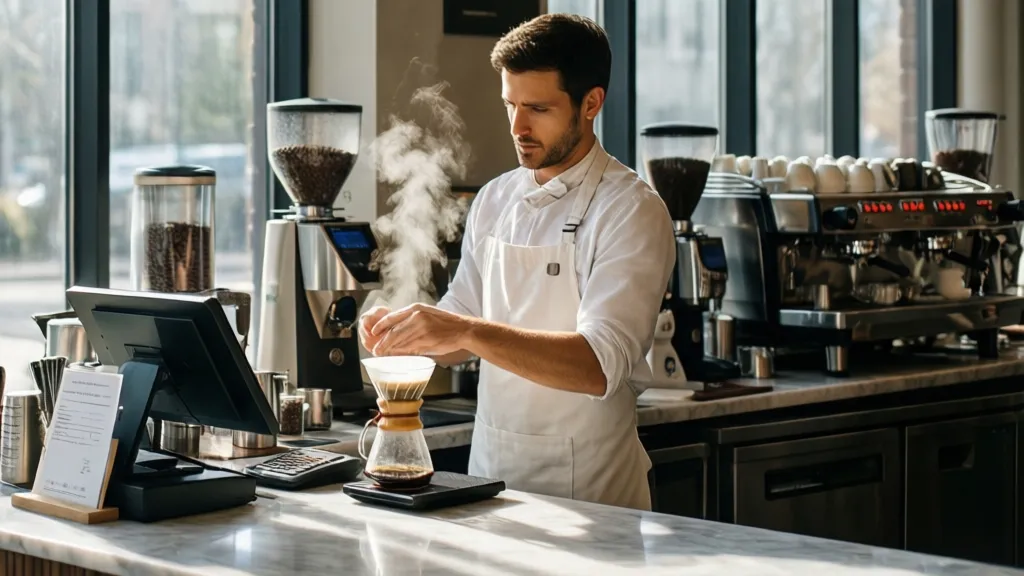
Actually, pour-over and batch brew setups—like the ones in many premium coffee services—can produce excellent coffee without the $10,000 price tag.
The key is fresh, high-quality beans.
Misconception 3: “Maintenance costs are just part of owning equipment.”
Not necessarily. If you choose a managed service, maintenance is included. Over five years, repair costs on a commercial machine can exceed the purchase price. It’s smarter to pay a predictable monthly fee.
Misconception 4: “We can save money by buying our own supplies.”
Only if you also manage inventory, reordering, and cleaning. Those hidden labor costs often wipe out your savings. As I’ve seen firsthand, companies that DIY their coffee program end up spending 15–30% more than they realize.
Frequently Asked Questions
How much should a workplace coffee program cost per employee per month?
For a quality program using specialty coffee and a managed service model, expect $30–$50 per employee per month for 50–200 person offices. This includes equipment, installation, regular maintenance, and fresh coffee. Small offices (under 25 employees) may pay $50–$75 per employee due to fixed equipment costs. According to a 2024 industry benchmark from the Coffee Quality Institute, the median spend for corporations with managed coffee services is $42 per employee per month.
How do I reduce the cost per employee without sacrificing quality?
The easiest way is to switch to an all-inclusive managed service that bundles everything. You also save by choosing an office coffee program that uses whole bean rather than pods. Another tactic: implement a “cup tracking” system using a smart machine—some models reduce waste by up to 30%. And always negotiate on volume: providers often give tiered pricing for larger offices.
Is it cheaper to buy coffee from a local roaster or use a national service?
Local roasters can be cheaper for the raw coffee alone, but you’ll still need to buy or lease equipment, handle repairs, and manage inventory.
Busy Bean Coffee partners with regional roasters to supply fresh specialty beans as part of a full service, so you get local quality without the operational headaches. In my analysis, total cost with a local roaster plus equipment and maintenance is usually
10–25% higher than an all-inclusive plan.
Watch for: delivery fees, restocking fees, equipment recovery charges (if you cancel early), and environmental fees on pods. Also, if the provider charges for “emergency service calls” (often $150–$300 each), that can blow your budget. Always ask: “Is there any fee I haven’t seen that could appear on my invoice?” A transparent provider will list everything upfront.
Can I calculate ROI for a workplace coffee program?
Absolutely. First, estimate the savings from employees not visiting coffee shops. For a 50-person office with 30 daily coffee drinkers, at $4.50 per drink replaced, that’s $135/day or $33,750/year. Subtract your program cost (say $21,000/year for that size), and you get $12,750 in direct savings. Then add improved productivity and retention. A 2022 study from the Journal of Organizational Behavior found that perceived workplace amenities (including coffee) positively correlate with employee retention—saving thousands in recruitment costs.
Summary + Next Steps
Calculating the cost of workplace coffee programs per employee doesn’t have to be complicated. Use the step-by-step method above to get an accurate baseline. Then compare it to an all-inclusive managed model that eliminates capex and repair risk. The bottom line: a premium coffee program costs $30–$50 per employee per month and delivers significant ROI in employee satisfaction and productivity.
If you want to see how that works with no upfront investment, check out
Busy Bean Coffee’s all-inclusive membership. We provide SENSA commercial equipment, professional installation, full maintenance, and exclusive pricing on fresh specialty coffee—for one predictable monthly fee. See how we compare to other
coffee service companies.
Recommended Readings
To deepen your understanding of these topics, we recommend reading the following articles:
About the Author
Travis Estes is the founder of
Busy Bean Coffee, a specialty coffee company that has been helping hotels, restaurants, and offices design and manage premium beverage programs since 2014. He has personally analyzed the cost structures of hundreds of workplace coffee contracts and believes that great coffee should be simple, affordable, and waste-free.