📖This article is part of the complete guide to Complete Guide to Coffee Membership Services for Business.
Spending $6.50 per latte for employees or relying on a scattered collection of retail gift cards is a silent drain on corporate operational budgets. In my experience working with dozens of firms in Mount Pleasant, SC, the 'Starbucks run' isn't just a productivity killer; it is a financial leak. Most office managers realize too late that the convenience of a retail chain comes with a massive premium that adds zero value to the actual quality of the beverage consumed in the breakroom.
For a comprehensive overview of how to structure your beverage program, explore our Complete Guide to Coffee Membership Services for Business.
What is the Difference Between a Managed Coffee Service and Retail Coffee Runs?
📚
Definition
A managed coffee service is an all-inclusive membership providing high-end espresso machines, professional installation, maintenance, and a consistent supply of specialty coffee beans for a fixed monthly fee.
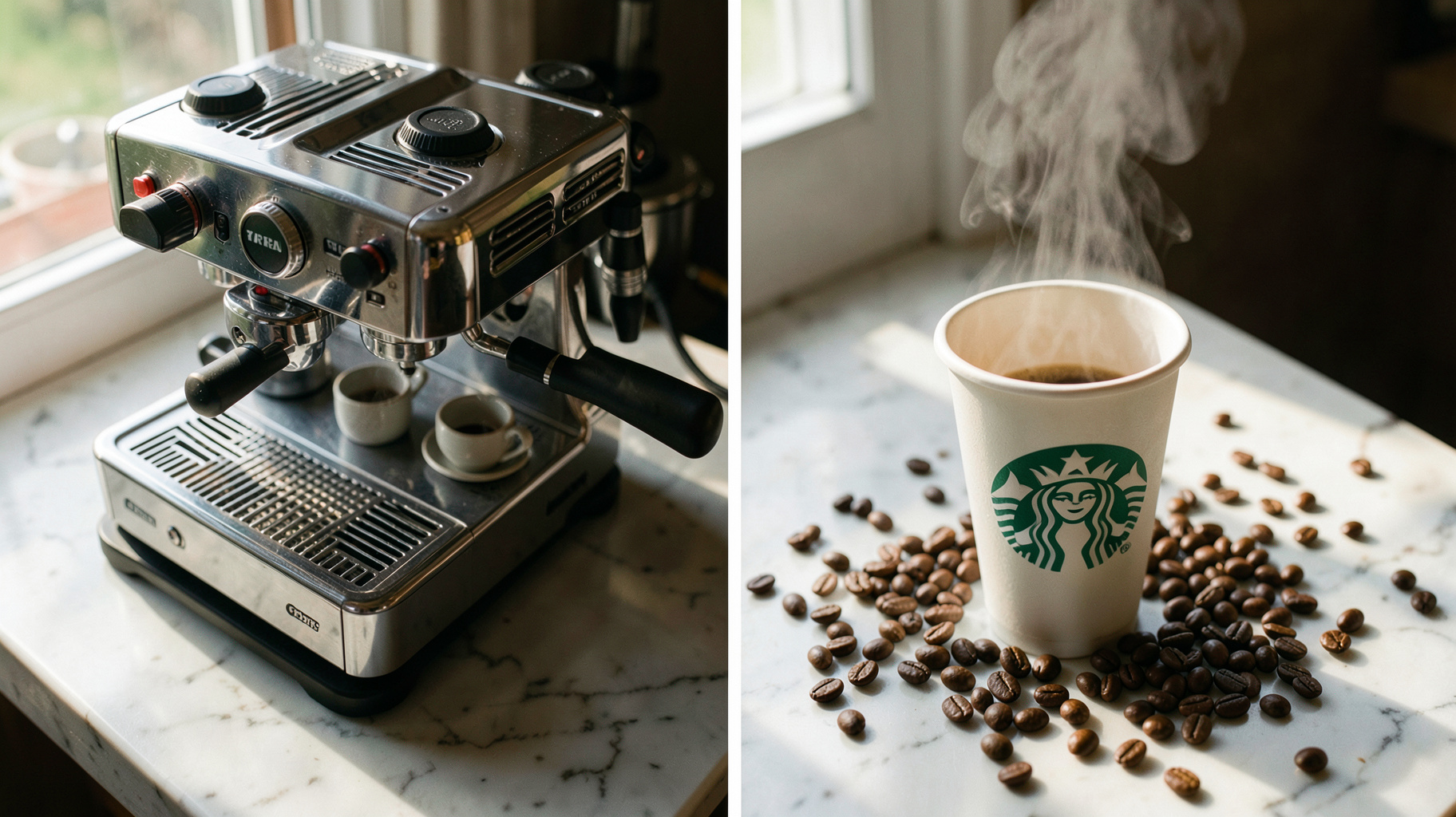
When we analyze the coffee service vs starbucks debate, we are comparing a scalable infrastructure against a transactional retail model. Retail coffee, like that from Starbucks, is designed for individual consumers paying for a brand experience and a physical storefront. In contrast, a business coffee membership, such as those provided by Busy Bean Coffee, is an operational utility designed to integrate specialty coffee into the workplace environment without the overhead of retail pricing.
In my years as a Q-Grader, I have found that the biggest misconception is that retail chains offer 'better' coffee. In reality, the high-volume roasting processes used by global chains often prioritize consistency over complexity. A managed service utilizing Coffea arabica from sustainable sources provides a vastly superior flavor profile because the beans are roasted in smaller batches and delivered fresh to your office. This shift from a transactional relationship to a membership model allows a business to control the quality of the bean and the precision of the brew.
Why Does This Choice Matter for Your Business Bottom Line?
Choosing a managed coffee service over retail options directly impacts three key areas: operational expenditure, employee productivity, and workplace culture. The financial delta between buying individual cups at retail prices and paying a fixed monthly fee for a membership is staggering. When a company subsidizes coffee runs or provides gift cards, they are paying for the retail markup, the real estate of the store, and the labor of the barista—costs that do not benefit the business.
According to the National Coffee Association USA, coffee consumption in the workplace remains a primary driver of employee engagement. By shifting to an in-house specialty coffee program, companies typically see a reduction in 'coffee run' durations. A 15-minute trip to a retail store, when multiplied by 20 employees three times a week, results in hundreds of lost productivity hours per year. An on-site Sensa machine reduces this friction to seconds.
Furthermore, the quality of the beverage influences the perceived value of the workplace. When a company provides specialty coffee on-site, it signals a commitment to quality. This is particularly evident when comparing the options for different sectors; for instance, those looking for a Coffee Membership for Offices: Cut Costs and Boost Morale often find that high-quality caffeine is the most cost-effective perk to implement. In Mount Pleasant, SC, where corporate competition for talent is high, the difference between a stale pot of drip coffee and a professional espresso machine can be a subtle but powerful retention tool.
How to Transition Your Office from Retail Runs to a Managed Membership
Transitioning your office to a professional coffee service requires a shift in how you view your beverage budget. Instead of treating coffee as a variable expense (buying cups as needed), you treat it as a fixed monthly utility. This transition ensures that you never run out of beans and that your equipment is always functioning at peak capacity without requiring your staff to act as technicians.
Step 1: Audit your current spend. Track every dollar spent on retail coffee gift cards, reimbursement requests, and the time employees spend leaving the building. You will likely find that the 'convenience' of retail is actually a significant financial burden.
Step 2: Define your volume needs. Determine if you need a high-volume solution for a large corporate headquarters or a more boutique setup for a small professional firm. This is where most businesses make a mistake by underestimating their daily cup count, leading to equipment strain.
Step 3: Select the right equipment. A professional espresso machine capable of handling peak morning rushes is essential. At Busy Bean Coffee, we provide SENSA equipment that handles the heavy lifting, ensuring that a barista-quality drink is available at the touch of a button. This removes the need for specialized training while maintaining the standards of specialty coffee.
Step 4: Implement a quality-first bean program. Move away from generic blends and embrace the nuance of Arabica coffee. By sourcing beans that are roasted specifically for the machine's pressure and temperature settings, you eliminate the bitterness and acidity often found in mass-market retail coffee.
For those in the medical sector, this transition is even more vital. A Clinic Coffee Membership: Differentiate Patient Experience Effortlessly can turn a sterile waiting room into a welcoming environment, moving the value proposition from a 'waiting area' to a 'hospitality experience.'
Coffee Membership vs Retail: The Operational Comparison
To truly understand the gap, we must look at the friction involved in each model. Retail coffee relies on the user leaving their post. A managed service brings the cafe to the user. This is not just about the liquid in the cup, but the systemic efficiency of the office.
| Feature | Retail Coffee Runs (Starbucks) | Cheap/Generic Office Coffee | Busy Bean Coffee Membership |
|---|---|---|---|
| Cost per Cup | High ($5.00 - $7.00) | Low but poor quality | Predictable monthly fee |
| Time Loss | High (Travel + Queue) | Minimal | Zero (On-site) |
| Quality | Consistent but mass-market | Stale / Burnt | Specialty Grade (Q-Graded) |
| Maintenance | N/A (External) | Internal (Manual cleaning) | Full managed coverage |
| Sourcing | Global Commodity | Generic Blends | Ethically sourced Arabica |
As noted by the Specialty Coffee Association, the standard for specialty coffee requires a score of 80 or above on a 100-point scale. Most retail chains cannot maintain this standard across thousands of stores due to the sheer volume of their supply chain. A managed membership allows a business to access these high scores consistently because the supply chain is shorter and the roasting is more precise.
Common Mistakes When Comparing Office Coffee Options
One of the most frequent errors I see in Mount Pleasant, SC, is the 'False Economy' trap. A business owner decides that since Starbucks is expensive, they will simply buy a consumer-grade Keurig or a cheap drip machine and bulk-buy beans from a warehouse club. This is a mistake for two reasons: equipment failure and taste degradation.
Consumer machines are not built for the duty cycle of an office. When five people try to make lattes in a row, the boiler cannot keep up, and the machine eventually burns out. This leads to unplanned downtime and a frustrated workforce. A professional-grade service ensures that the hardware is designed for volume, which is why it is essential for those managing Retirement Community Coffee Service: Reliable High-Volume Solutions.
Another mistake is ignoring the 'hidden' labor of maintenance. Who cleans the machine? Who descales the boiler? Who monitors the bean inventory? In a retail-run model, the employee does the work. In a cheap-office model, the office manager does the work. In a managed membership, Busy Bean Coffee handles the logistics. We discovered early on that the true value of a membership isn't just the coffee; it's the reclamation of the office manager's time.
Finally, businesses often overlook the impact of coffee on client perception. Offering a guest a mediocre cup of burnt coffee is a missed opportunity for a first impression. Whether you are running a Restaurant Coffee Membership: Profitable Programs Without Hassle or a high-end law firm, the quality of your coffee is a proxy for the quality of your attention to detail.
How to Maximize ROI Through a Managed Coffee Program
To get the highest return on investment, you must treat your coffee program as an asset rather than an expense. This means optimizing the placement of the machine to encourage 'water-cooler' moments—spontaneous collaborations that happen when employees bump into each other while brewing. Research indicates that these unplanned interactions can increase cross-departmental innovation.
To maintain hygiene and safety, ensure your equipment meets industry standards. The NSF International provides critical guidelines on food equipment safety; using NSF-certified machines in your office prevents health risks and ensures that your beverage service is compliant with workplace safety regulations.
Integrating a managed service also simplifies your accounting. Instead of tracking hundreds of small retail transactions, you have one predictable line item on your monthly P&L. This predictability is essential for scaling businesses that need to forecast their overhead accurately. For example, if you are expanding into different regions, implementing a standardized service like the Sensa Coffee Service in Charleston SC - Complete Guide ensures that every single office has the same high standard of quality, regardless of the local retail options available.
Frequently Asked Questions
Is a coffee membership actually cheaper than buying retail coffee?
Yes, when analyzed on a per-cup basis, a managed membership is significantly more affordable. Retail prices include immense markups for storefront rent, marketing, and labor. By bringing the production in-house via a membership, you eliminate these middlemen. For an average office of 20 people, the monthly cost of a membership is often lower than the cumulative cost of a few subsidized retail runs per week, while providing a higher volume of drinks.
Do I need to hire a barista to use professional espresso machines?
No. Modern professional equipment, specifically the SENSA line used by Busy Bean Coffee, is designed for 'one-touch' simplicity. The complexity of the brew—grind size, water temperature, and pressure—is pre-programmed into the machine. This allows any employee to produce a specialty-grade beverage without any formal training, removing the need for dedicated staff while maintaining an elite taste profile.
How does the quality of membership coffee compare to Starbucks?
Specialty coffee memberships typically offer a higher grade of bean. While retail chains focus on a 'dark roast' profile to mask inconsistencies in mass-produced beans, we focus on the nuances of Arabica coffee. As a Q-Grader, I can confirm that smaller-batch roasting preserves the volatile aromatic compounds that provide the complex flavors—citrus, berry, or chocolate—that are often lost in the industrial roasting processes used by global chains.
What happens if the machine breaks down?
This is the primary advantage of a managed service over a retail or owned-equipment model. With a membership, maintenance is inclusive. We provide full coverage, meaning that if a machine malfunctions, a technician is dispatched to fix it. You avoid the downtime associated with waiting for a repair shop or the frustration of having to replace a cheap consumer machine that finally gave out.
Can we change the coffee roast based on employee preference?
Absolutely. One of the limitations of retail runs is that you are stuck with whatever the store has on the menu. With a managed service, you can curate your bean selection. Whether your team prefers a bold, smoky roast or a bright, acidic light roast, we can adjust your supply to match the palate of your workforce, ensuring that the coffee is a perk employees actually enjoy.
Conclusion
The debate over coffee service vs starbucks isn't actually about the coffee; it's about how you value your time and your budget. Relying on retail runs is an expensive, inefficient way to keep a team caffeinated. By shifting to a managed membership, you replace a chaotic variable expense with a streamlined, high-quality utility that boosts morale and preserves your bottom line.
When you eliminate the travel time, the retail markups, and the inconsistency of mass-market beans, the financial logic becomes undeniable. Your office deserves more than a trip to the nearest drive-thru; it deserves a professional beverage experience that reflects the quality of your brand.
To discover the perfect setup for your specific business needs, visit our Complete Guide to Coffee Membership Services for Business and start reclaiming your operational efficiency today.
For more information on our all-inclusive solutions, visit www.busybeancoffee.com.
Free Coffee Pairing Guide & Specialty Roast Cheat Sheet
Unlock the secrets of perfect brewing ratios, water temperatures, and specialty roast profiles. Download the guide.